

Key Takeaways
- Fintech startup marketing should begin before launch to validate demand, positioning, customer expectations, and trust barriers.
- Customer acquisition depends on reducing uncertainty around financial products, sensitive data, security practices, and provider credibility.
- Fintech startups should select marketing channels based on customer intent, product maturity, and measurable contribution to activation.
- Educational content should explain complex fintech products, address customer concerns, and reduce friction between initial interest and adoption.
- Marketing should scale only when acquisition sources consistently produce qualified users who activate, retain, and support sustainable customer economics.
Fintech startup marketing creates demand while reducing trust barriers around a new financial product. Fintech companies must persuade customers to adopt unfamiliar services involving money, sensitive information, or financial decisions. Effective marketing therefore connects acquisition with credibility, product understanding, and evidence supporting the company’s promises.
This changes how fintech startups should approach growth. Traffic can amplify weak assumptions when audience, message, and customer journey remain unvalidated. Marketing should reveal why customers adopt, hesitate, activate, and remain with the product. Those insights provide a stronger foundation for scaling acquisition.
When Fintech Startups Should Start Marketing
Fintech startups should start marketing before they are ready to scale acquisition. Early marketing can validate demand, audiences, positioning, credibility, and customer expectations. The objective is not immediate reach. It is reducing uncertainty before larger acquisition investments begin.
At this stage, marketing for fintech startups becomes part of product learning. A fintech market entry strategy based only on internal assumptions can misread who experiences the problem most urgently. Interviews, landing-page tests, waitlists, educational content, and controlled campaigns can reveal which audiences respond and which value propositions create interest.
Early evidence should answer five questions:
- Demand: Does the problem generate enough interest to justify further acquisition?
- Audience: Which customer segment responds most strongly?
- Value: Which benefit makes the product worth considering?
- Trust: What prevents interested prospects from moving forward?
- Expectations: What information or reassurance do customers need before adoption?
This is why a fintech startup growth strategy should separate validation from scaling. During validation, marketing identifies repeatable signals across audience, message, channel, and activation. Scaling fintech customer acquisition becomes more defensible once those relationships are understood.
The growth stage also changes marketing’s job. Pre-launch teams need evidence that demand and positioning are credible. Newly launched products need activation and channel learning. Growing companies need predictable acquisition economics, retention, and expansion rather than awareness alone.
These stages give startup digital marketing a clear sequence. Test assumptions before launch, strengthen what customers respond to, then scale validated acquisition.

Fintech Marketing Traps New Startups Often Fall Into
Many fintech startup marketing mistakes come from applying conventional growth assumptions when promoting fintech products with higher trust barriers. The problem is rarely inactivity. More often, founders invest before establishing the conditions that make acquisition work.
| Assumption | Why It Fails | Better Approach |
| Marketing can wait until after launch. | The company reaches launch without validating demand, positioning, or customer objections. | Use pre-launch marketing to test audiences, messages, and adoption barriers. |
| Paid ads alone will drive growth. | Paid traffic cannot repair weak positioning, onboarding friction, or insufficient trust. | Validate conversion mechanics before increasing media investment. |
| A useful financial product sells itself. | Customers may not understand the product, differentiation, risks, or reasons to trust it. | Explain value and reduce uncertainty throughout the decision journey. |
| We need every channel. | Limited teams spread budget and learning across channels without establishing meaningful evidence. | Prioritize channels around audience behavior, intent, and current growth objectives. |
| Results should appear immediately. | Early signals may show interest before acquisition economics or retention become measurable. | Define expectations and KPIs according to the company’s growth stage. |
Waiting until launch means positioning, messaging, and acquisition assumptions meet real customers simultaneously. A stronger fintech marketing strategy for early-stage companies tests those assumptions before launch.
A better marketing strategy for fintech startups concentrates resources where audience intent and current growth objectives intersect. Channel expectations should reflect the growth stage, but every stage also depends on customer trust.
Why Security Matters in Fintech Marketing
Security matters in fintech marketing because customers often share sensitive information before receiving full product value. Data requests, account connections, identity verification, and payment details can create acquisition friction. Marketing must explain legitimate security and privacy practices without promising protections the product cannot substantiate.
I’d look at conversion after the initial touchpoint — for example, from sign-up to KYC completion, account linking, or first deposit. If people are clicking and showing intent but dropping off at high-trust steps, the issue is often not acquisition itself, but a lack of confidence in the product.
Maya Miller, Strategist at NinjaPromo
This responsibility extends beyond messaging. Financial companies may face formal requirements for protecting customer information. FTC guidance shows why marketing claims should reflect the safeguards customers actually receive.
Four areas need alignment:
- Data collection: Explain why sensitive information is required.
- Privacy: Make important data-use practices understandable and accessible.
- Security: Use claims that product and security teams can substantiate.
- Personalization: Limit customer-data use to legitimate, understood purposes.
Privacy practices also affect trust. Permission and data use should remain understandable. The same transparency applies to security claims, which must reflect actual controls. Absolute promises can exceed what the product can substantiate.
That alignment also improves internal decisions. Marketing should not invent security language after campaigns are designed. Product, security, compliance, and marketing teams should verify claims before they enter landing pages, advertising, email, or PR.
How to Build an Effective Fintech Startup Marketing Strategy
An effective fintech startup marketing strategy connects positioning, trust, acquisition, activation, and retention rather than treating channels independently. Effective marketing for fintech startups should address a defined constraint in the fintech customer journey. Start with the growth problem, then choose the channel or capability that can influence it.
Establish a Clear Fintech Marketing Strategy Before Scaling
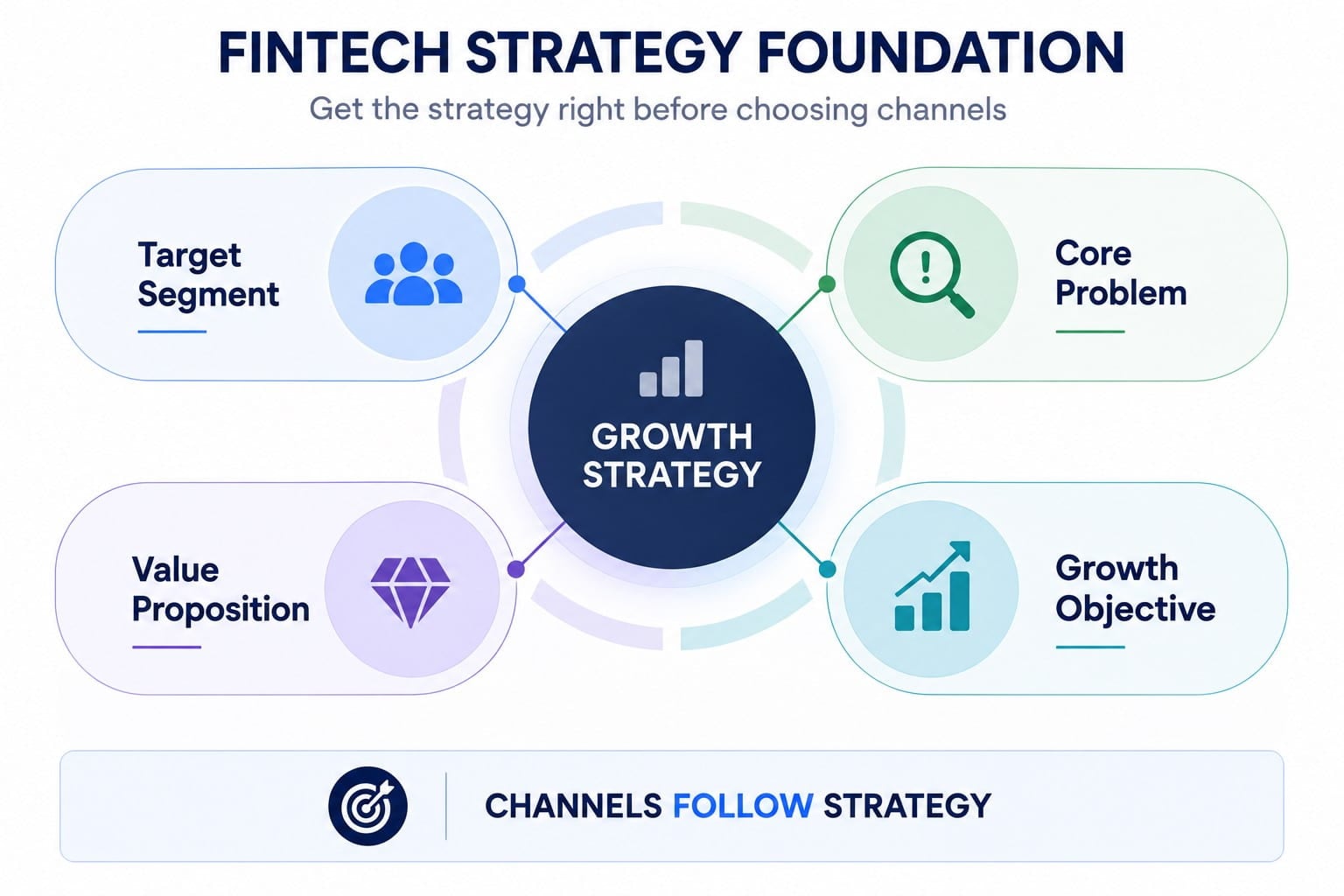
Define the market, audience, value proposition, growth objective, and acquisition assumptions before increasing investment. Otherwise, teams can generate activity without learning which customers create sustainable growth.
Start by mapping four strategic choices:
- Target segment: Who has the strongest need and ability to adopt?
- Core problem: Which financial problem creates urgency?
- Value proposition: Why should customers choose this product?
- Growth objective: Which behavior should marketing influence now?
Test these choices before increasing investment or pursuing fintech market expansion. A fintech go-to-market strategy becomes particularly important when market entry changes customer expectations, distribution, competition, or regulation. Strategic promotion for fintech companies should follow local market conditions, including the trust and compliance requirements shaping customer decisions.
Make Security and Data Protection Part of the Marketing Message
Security messaging should reduce uncertainty without creating unsupported promises. The strongest approach connects a customer concern with a verifiable product practice. That requires coordination between marketing, product, security, and compliance.
The riskiest claims are things like “guaranteed returns,” “risk-free,” or “better than a bank.” In fintech, overpromising can damage credibility very quickly and, at the same time, create unnecessary regulatory exposure.
Maya Miller, Strategist at NinjaPromo
A simple claim test can prevent credibility problems:
Customer concern → Actual safeguard → Verifiable evidence → Marketing claim
Marketing should know which protections are public, what supports them, and where explanation is necessary. Security information also needs appropriate placement. Customers may need reassurance during account creation, data connection, identity verification, or transactions. Addressing concerns near those decisions is more useful than isolating security messages on a corporate page.
Use Educational Content to Explain Complex Fintech Products
Educational content helps customers understand unfamiliar financial decisions or terminology. Its purpose is not simply generating search traffic. Good fintech content reduces knowledge gaps that prevent prospects from evaluating or using the product.
A useful content map connects questions with customer decisions:
| Customer Question | Content Role | Example Format |
| What does this product do? | Build basic understanding | Explainer |
| Is it relevant to me? | Establish use-case fit | Scenario guide |
| What will it cost? | Reduce commercial uncertainty | Fee comparison |
| How does it work? | Prepare for adoption | Step-by-step guide |
| Can I trust it? | Reduce perceived risk | Security or process explainer |
This makes fintech content marketing part of conversion support rather than a publishing quota. Content should move customers toward a clearer decision, even when that decision happens outside the article itself. Educational assets can support sales, onboarding, email, PR, and organic acquisition.
Strengthen Fintech SEO Across Content and Technical Foundations
Fintech SEO should capture relevant demand while making product information easy to discover. Rankings have limited value when visitors do not match intended customers or progress toward adoption.
Start with search intent rather than publishing volume. Product pages can target high-intent needs, while educational resources address earlier questions. This creates a path from discovery toward evaluation instead of disconnected traffic. Technical foundations should support indexability, performance, mobile usability, internal linking, and clear information architecture.
A practical fintech SEO program should therefore evaluate both:
- Demand fit: Are pages attracting searches relevant to the product and audience?
- Journey fit: Can those visitors find the information needed for their next decision?
Measure organic performance beyond rankings. Qualified visits, product-page progression, sign-ups, activation, and assisted conversions can reveal whether search demand contributes to customer growth.
Use PPC to Reach High-Intent Fintech Audiences
While SEO captures existing demand, PPC can test high-intent audiences faster and measure post-click behavior. It accelerates learning about audiences, messages, and acquisition economics, but cannot compensate for unresolved conversion problems.
Paid fintech campaigns face platform-specific restrictions alongside regulatory requirements. Google Ads, for example, requires financial-services verification in certain markets. Check eligibility before allocating the acquisition budget.
Campaign feasibility therefore belongs in planning. Before allocating budget, confirm that the product, market, claims, landing pages, and advertiser status meet requirements.
Evaluate fintech PPC through a simple progression:
Click → Qualified Visit → Sign-Up → Activation → Customer
Judge fintech PPC by downstream activation and customer economics, not click cost alone.

Develop Email Campaigns to Nurture Prospects and Customers
Acquisition does not end when SEO or PPC generates a lead. Email can nurture prospects who need more information before taking the next meaningful action. Rather than sending the same sequence to every contact, fintech email marketing should respond to customer stage and behavior.
Segment sequences around meaningful states:
- Interested: Explain the problem and product fit.
- Evaluating: Address objections, costs, security, and differentiation.
- Onboarding: Help users complete required setup.
- Activated: Encourage relevant product adoption.
- Inactive: Diagnose or address barriers to continued use.
This makes email part of lifecycle management. Opens can diagnose message performance, but stronger measures show whether communication advances intended customer behavior.
Introduce Referral Programs to Drive Fintech User Acquisition
Once customers experience clear product value, referrals can create another acquisition source. Customers also need confidence in associating their reputation with the product. Incentives cannot create advocacy for a product customers do not value or trust.
Then design the program around three variables:
| Variable | Question to Answer |
| Referral moment | When has the customer experienced demonstrable value? |
| Incentive | What motivates participation without attracting poor-fit users? |
| Referred-user quality | Do referred users activate and remain customers? |
The last measure matters most. Referral volume can look healthy while producing inactive users. Compare activation, acquisition cost, and retention between referred and non-referred cohorts before increasing incentives.

Partner With Fintech Influencers to Build Industry Credibility
Fintech influencer partnerships should prioritize audience relevance and credibility over follower count. The creator should influence people who could realistically evaluate or adopt the product. This makes fintech influencer marketing more useful for reaching specialized audiences than buying broad exposure.
Before selecting a partner, verify:
- Audience relevance.
- Subject expertise.
- Previous financial partnerships.
- Engagement quality.
- Disclosure practices.
- Brand and compliance risk.
The same selection logic applies to startup influencer marketing when credibility shapes customer decisions. Smaller specialist audiences can outperform broader reach when they closely match the target customer. Measure qualified traffic, sign-ups, and activation to determine whether that influence produces meaningful acquisition.
Explore how fintech social media marketing can support audience growth and customer acquisition.
Use PR to Establish Trust and Increase Fintech Brand Visibility
Influencer and social channels build credibility through relevant audiences, while PR adds independent third-party validation. This matters when customers, partners, investors, or industry stakeholders lack familiarity with the company. Strong fintech PR creates credible context around milestones that matter.
Effective PR for fintech should answer three questions before outreach:
- Why does this development matter outside the company?
- Which audience should care?
- What evidence makes the story credible?
Relevant coverage can support branded search, sales conversations, partnerships, and customer confidence without immediate direct-response conversions. For early companies, broader PR for startups principles also matter. Founders should distinguish between media visibility and business impact, then choose stories and publications according to the audience they need to influence.
Personalize Marketing Around Different Fintech Customer Segments
Personalization should reflect meaningful differences in customer needs rather than simply inserting personal details into communications. Fintech customers can differ by financial goal, product knowledge, risk concerns, use case, company size, or lifecycle stage.
Useful personalization can affect:
- Value proposition.
- Educational depth.
- Product use cases.
- Acquisition channel.
- Onboarding guidance.
- Lifecycle communication.
This is where AI-driven fintech marketing practices can support segmentation, content selection, propensity modeling, or next-best-action systems. Automation should still operate within clear rules for data access, consent, accuracy, and human oversight.
Personalization should ultimately reduce friction in the fintech customer journey. Measure whether differentiated experiences improve conversion, activation, product adoption, or retention rather than treating personalization itself as success.
How to Measure the Effectiveness of Fintech Startup Marketing
Fintech startups should measure marketing according to the growth decision each metric needs to support. Early-stage teams need evidence of qualified demand and activation before mature unit economics become dependable. As acquisition scales, CAC, conversion, LTV, and retention become increasingly important for deciding where additional investment can create sustainable growth.
A stage-based measurement framework prevents premature optimization:
| Growth Stage | Priority Metrics | Decision |
| Validation | Qualified leads, sign-ups, audience response | Is meaningful demand emerging? |
| Activation | Activation rate, onboarding completion, conversion | Are acquired users reaching value? |
| Acquisition | CAC, channel conversion, customer volume | Which sources acquire customers efficiently? |
| Retention | Retention, repeat usage, churn | Are customers continuing to receive value? |
| Scale | LTV, LTV:CAC, cohort performance | Where can acquisition investment expand sustainably? |
Qualified leads and sign-ups provide early evidence, but neither proves fintech startup marketing is driving sustainable acquisition. As acquisition grows, compare sources through activation and retention rather than cost per lead alone.
I’d focus on payback period or LTV-to-CAC, but only once retention has been validated. If the unit economics work and customers stay active long enough to justify acquisition costs, then the business is in a much stronger position to scale.
Maya Miller, Strategist at NinjaPromo
This distinction is essential for marketing for fintech startups because acquisition quality can change after registration. Marketing should therefore connect campaign data with product analytics wherever practical.
A simple investment decision framework is:
Source → CAC → Activation → Retention → Customer Value
Increase investment when a source repeatedly produces customers with acceptable economics and downstream quality. Reduce or redesign investment when traffic appears efficient but activation or retention remains weak.
Most often, it’s saturation. A channel usually captures the cheapest and most relevant users first; as you scale, CAC goes up and user quality starts to decline. Another common issue is scaling acquisition faster than the product can retain the users coming in.
Maya Miller, Strategist at NinjaPromo
This approach also connects acquisition with customer retention in fintech. Marketing efficiency does not end at conversion when customer churn erodes the value generated by acquisition.
The final measurement question is not “Which channel produced the most leads?” It is “Which source produced customers who reached value at economics the business can sustain?” That distinction turns reporting into an investment decision.

Final Thoughts
Effective fintech startup marketing builds acquisition and trust together. Start before scaling, validate demand and positioning, align security claims with product reality, and choose channels according to customer intent. Marketing becomes more efficient when each activity addresses a specific barrier in the customer journey.
Measurement should evolve with the business. Early signals establish whether demand and activation exist, while CAC, retention, and LTV become more useful as acquisition matures. Sustainable growth comes from increasing investment behind evidence rather than expanding activity by default.