
Key Takeaways
- FinTech growth requires customer acquisition and financial trust to work together.
- FinTech education reduces uncertainty around complex financial products before conversion.
- FinTech channel selection depends on product economics, customer intent, and financial regulations.
- FinTech KPIs should track qualified progression instead of traffic or engagement alone.
- FinTech compliance should influence campaign design before financial promotions reach customers.
FinTech marketing is difficult because customers are not simply choosing software. They are trusting a company with money, personal data, or consequential financial decisions. Complex products, regulatory requirements, and security concerns make credibility part of customer acquisition rather than a separate brand exercise.
This guide explains how financial brands can connect trust with measurable growth. It covers strategy, acquisition channels, SEO, content, advertising, PR, retention, compliance, and performance measurement. The goal is a practical system for turning attention into informed product adoption.
What Is FinTech Marketing?
FinTech marketing is the process of attracting, educating, converting, and retaining customers for financial technology products. It combines customer acquisition with trust building because users must understand both the product and its financial implications. Effective campaigns connect demand generation with evidence, education, and product adoption.
FinTech spans several distinct financial business models:
- Digital banking: includes digital banks, neobanks, online banking, and banking apps.
- Payments and lending: covers payment platforms, payment solutions, digital payments, mobile payments, and peer-to-peer lending.
- Investment and insurance: includes WealthTech, wealth management, investment products, and insurance technology.
- Financial infrastructure: includes B2B FinTech, embedded finance, and open banking capabilities.
- Digital assets: includes cryptocurrency and blockchain-based financial products.
Different financial services create different marketing problems. Banking apps may need to explain security and everyday utility, while investment platforms require stronger financial education. Payment solutions selling to enterprises may instead depend on lead generation, integrations, and a longer sales process.
How Is FinTech Marketing Different From Traditional Marketing?
FinTech campaigns operate where customer attention, financial risk, data privacy, and regulatory compliance intersect. A conventional SaaS company may optimize a signup flow primarily for conversion. Lending platforms must also consider disclosures, eligibility, sensitive financial information, and whether acquisition messaging accurately represents the product.
Consideration cycles also vary significantly. A consumer may test a simple app quickly, while wealth management or B2B financial technology can involve multiple decision makers. Customer education therefore becomes part of the customer journey rather than supporting content around it.
How to Build a FinTech Marketing Strategy
A FinTech marketing strategy connects business goals with a defined audience, product economics, acquisition channels, and regulatory requirements. Start by deciding which business outcome marketing must influence. Then build audience, positioning, channel, and measurement decisions around that outcome rather than around available tactics.
A useful strategy should also reflect the product’s maturity. Early-stage neobanks may prioritize trust and user acquisition, while established payment platforms may focus on expansion or customer retention. A clear fintech go-to-market strategy keeps those priorities connected to market entry and product readiness.
Define Your Marketing Goals
Start with an outcome that can be connected to business performance. Customer acquisition and lead generation matter when growth is the immediate constraint. Product adoption, customer retention, brand awareness, or revenue growth may matter more at another stage.
| Marketing Goal | Useful Business Signal |
| Customer acquisition | Approved or activated customers |
| Lead generation | Sales-qualified opportunities |
| Product adoption | Meaningful feature usage |
| Brand awareness | Branded demand from target audiences |
| Customer retention | Active or returning customers |
| Revenue growth | Revenue influenced by acquired customers |
Translate each goal into a measurable progression. Acquisition can connect qualified visits to approved accounts, while B2B lead generation can connect marketing-qualified leads to sales opportunities. Retention should ultimately relate to active usage and customer lifetime value rather than email opens alone.
Identify Your Target Audience
FinTech segmentation should reflect financial needs and intent, not demographics alone. Useful dimensions include location, business size, financial behavior, product eligibility, customer intent, and the problem being solved. A buyer persona becomes valuable when it changes channel, message, or product decisions.
A neobank can segment consumers by salary patterns, international payments, or savings needs, then adapt onboarding messages accordingly. B2B fintech marketing requires deeper segmentation. CFOs need financial impact, while operations teams need workflow evidence. Compliance buyers need controls, while technical buyers need integration details. Search and LinkedIn can capture finance leaders, while technical buyers may require documentation, product pages, and demos.
Develop Your Value Proposition
A value proposition should translate product mechanics into a credible customer outcome. Start with the problem, explain how the product changes it, and provide evidence for meaningful differentiation. Avoid positioning built entirely around vague claims such as faster, smarter, or easier.
A credible FinTech value proposition should make four things immediately clear:
- Problem: the specific financial or operational friction being addressed.
- Mechanism: what the product actually changes in the existing process.
- Outcome: the practical benefit customers can reasonably expect.
- Evidence: the product facts that make the differentiation believable.
Specificity matters for financial products. A payment platform can explain settlement workflow or integration coverage rather than promising frictionless payments. An investment product should distinguish functionality from investment outcomes it cannot guarantee.
Choose the Right Marketing Channels
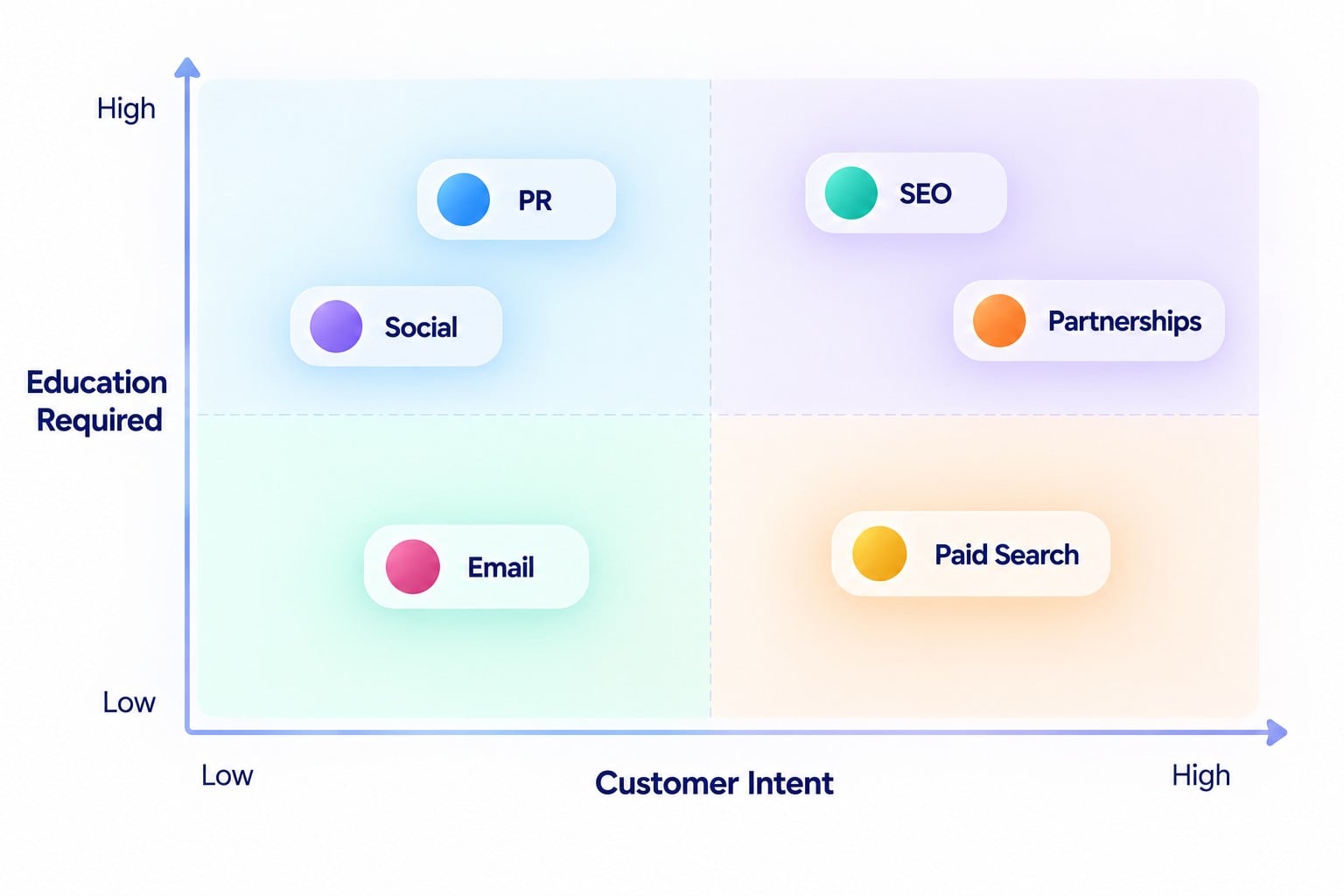
Choose channels according to audience behavior, product type, customer acquisition cost, journey stage, and regulatory restrictions. High-intent paid search may suit an established financial need. Educational search content may work better when prospects first need to understand a new category.
Channel economics should reflect the FinTech conversion event. A lender should compare paid-search cost with eligible applications, while embedded finance may measure partner-sourced integrations. WealthTech can value qualified consultations instead of cheap leads that never become funded customers.
The FinTech Marketing Funnel
The FinTech marketing funnel describes how prospects move from discovering a financial brand to becoming customers and advocates. Each stage should resolve a different barrier. Measuring movement between stages reveals more than treating every campaign as an isolated source of conversions.
| Funnel Stage | Goal | Marketing Activities |
| Awareness | Build visibility | SEO, PR, social media, advertising |
| Interest | Educate prospects | Content, guides, webinars |
| Consideration | Build trust | Reviews, case studies, comparisons |
| Conversion | Acquire customers | Landing pages, demos, offers |
| Retention | Increase customer value | Email, CRM, personalization |
| Advocacy | Generate referrals | Reviews, referral programs |
The important metric is qualified progression. A lending guide that attracts traffic but produces few eligible applications may create awareness without acquisition value. Marketing funnel reporting should therefore connect channel activity with downstream product behavior.
10 FinTech Marketing Strategies That Drive Growth
The strongest growth strategies combine acquisition with trust, education, and product experience. Each tactic should have a defined job, a reason for using it, and a metric connected to business outcomes. The right mix changes across business models.
1. Build a Trust-Focused FinTech Brand
Build credibility into positioning, messaging, security communication, and customer touchpoints. A neobank might emphasize safeguarding and transparent fees, while an InsurTech platform may need clearer explanations of coverage and claims. Consistency matters because contradictions between ads, product pages, and terms create avoidable uncertainty.
Measure more than brand awareness. Track branded search, direct traffic, review sentiment, trust-page engagement, and conversion progression after users view evidence. These signals show whether brand positioning helps people evaluate the product.
2. Invest in FinTech SEO and Content Marketing
Search engine optimization captures demand when prospects actively investigate financial problems, products, or providers. Map informational queries to guides, commercial searches to comparison pages, and high-intent terms to product or application pages. A structured fintech SEO program should ultimately move organic visitors toward meaningful product evaluation.
A lending platform might target questions about borrowing requirements before commercial loan queries. WealthTech can build topical authority around investment concepts before introducing relevant services. Effective fintech content marketing measures qualified organic visits, assisted conversions, commercial-page progression, and organic customer acquisition.
3. Use Paid Search and Performance Advertising
Match paid campaigns to a specific financial decision. A lender can connect high-intent borrowing searches with an eligibility-focused landing page, while a B2B payment platform can target finance leaders with integration-focused campaigns. Effective fintech PPC advertising measures eligible applications, qualified demos, and acquisition cost rather than clicks.
Before allocating paid media budget, verify four conditions:
- Audience fit: Targeting can reach people who are relevant and potentially eligible.
- Message fit: The ad accurately represents the financial product and its conditions.
- Landing-page fit: The destination continues the promise made in the advertisement.
- Economics: Qualified conversion value can justify the expected customer acquisition cost.
Financial advertising also requires policy review before launch. Google requires financial advertisers to comply with applicable local regulations and applies product-specific restrictions and verification requirements. Teams using Google ads for fintech should verify eligibility before allocating budget. Restricted products may require SEO, PR, partnerships, or compliant specialist channels instead.
4. Create Educational Financial Content
Educational content reduces the knowledge gap between product discovery and informed action. Use formats that resolve product-specific uncertainty: InsurTech coverage explainers, lending calculators, or embedded-finance integration guides. The objective is clarity without simplifying financial concepts until they become inaccurate.
Match format to decision friction. A payments company might create a fee calculator, while an open banking provider may explain its integration model visually. Measure content-assisted conversions, calculator completion, qualified return visits, and progression to relevant product pages.
5. Use FinTech PR and Thought Leadership
Build FinTech PR around evidence: payment data, lending research, regulatory expertise, product milestones, or proprietary market findings. PR for fintech can combine earned media, expert commentary, and original research. Founder content, press releases, podcasts, and interviews support different story types. The story should provide information beyond the existence of the company.
| Available Evidence | Suitable PR Angle |
| Proprietary market data | Research report or data story |
| Executive expertise | Expert commentary or interview |
| Meaningful company development | News announcement or press release |
| Distinct industry perspective | Founder thought leadership |
| Complex subject expertise | Podcast or educational media contribution |
Measure earned referral traffic, branded search, relevant media mentions, and qualified actions following coverage. For B2B brands, track whether coverage influences target accounts or sales conversations. Placement count alone cannot show whether PR reached the right market.

6. Leverage Social Media Marketing
Use social platforms according to audience and communication purpose. LinkedIn can support B2B expertise, YouTube can explain complex products, while X and Instagram may distribute timely educational content. A fintech social media marketing plan should define what each platform contributes.
| Channel | Primary Role | Useful Signal |
| B2B expertise and demand | Qualified profile or site visits | |
| YouTube | Product and financial education | Meaningful viewing and next-step actions |
| X | Timely industry communication | Relevant audience engagement |
| Accessible brand education | Qualified content interactions | |
| Creators | Trusted audience distribution | Referred qualified actions |
Financial promotions require additional care. The UK FCA, for example, states that financial promotions on social media should be fair, clear, and not misleading. Its guidance also addresses firms working with influencers and affiliate marketers. Where creators are appropriate, fintech influencer marketing should evaluate audience relevance, geography, engagement quality, regulatory suitability, and downstream actions.
7. Use Email Marketing and CRM
Email can support acquisition, onboarding, retention, cross-selling, and re-engagement when messages reflect customer context. A structured fintech email marketing program can move from welcome sequences into product education, updates, personalized campaigns, and retention communication.
Strong customer retention in fintech connects email campaigns with customer relationship management and marketing automation rather than identical messages. Segment by lifecycle stage, relevant product behavior, and consent status. Measure activation, click-through rate, product adoption, re-engagement, and retained customer value by segment.
Build lifecycle email around customer behavior:
- New prospects: resolve questions preventing product evaluation.
- New customers: guide users toward activation and first value.
- Active customers: introduce relevant features based on product behavior.
- Inactive or at-risk customers: address barriers through appropriate re-engagement.
8. Build Partnerships and Referral Programs
Partnerships can reduce acquisition friction when another business already serves the required audience. Models include referrals, integrations, and co-marketing activated through shared content, offers, events, or product journeys. Embedded finance providers may partner with software platforms, while payment companies can activate distribution through commerce ecosystems.
Evaluate partnerships by audience fit and a clear value exchange. Track qualified referrals, activation, acquisition cost, and retained value. Strong partnerships improve distribution or product utility rather than merely combining two brands.
9. Optimize the FinTech Customer Experience
User experience and CRO turn acquisition into completed customer actions. Review landing pages, sign-up flows, application forms, onboarding, mobile UX, calls to action, and conversion friction as one connected journey. Fintech app marketing should therefore account for what happens after the app-install click.
| Journey Point | Friction to Investigate | Business Signal |
| Landing page | Unclear product or eligibility | Qualified CTA progression |
| Sign-up | Excessive steps or uncertainty | Sign-up completion |
| Application | Form complexity or unclear requirements | Application completion |
| Verification | Confusing instructions or delays | Verification completion |
| Onboarding | Weak guidance toward first value | Activation |
| Mobile journey | Device-specific usability barriers | Mobile completion rate |
Analyze abandonment at each meaningful step. A lending platform should distinguish application abandonment from eligibility failure, while digital banking teams can track onboarding completion and first useful action. Measure conversion rate, completion time, abandonment, activation, and verified customer acquisition.
10. Use Data and Personalization to Improve Acquisition
Data-driven marketing should help teams distinguish valuable customer behavior from surface-level engagement. Combine segmentation, behavioral data, customer journeys, attribution, experimentation, and responsible personalization. Privacy rules and user expectations should define what data can appropriately support those decisions.
Personalization should improve relevance rather than exploit sensitive information. The FTC notes that nonpublic personal information can include application, transaction, and account-related information for covered financial institutions. Measure incremental conversion, acquisition efficiency, product adoption, and retention against an appropriate control instead of assuming personalization creates value.
The Best FinTech Marketing Channels
No single channel is best for every financial brand. Product maturity, audience intent, sales cycle, acquisition economics, and compliance determine the useful mix. The comparison below is a decision shortcut rather than a universal ranking.
| Channel | Best For | Time to Results | Key KPI |
| SEO | Organic acquisition | Medium/Long | Qualified organic traffic |
| Content Marketing | Education & trust | Medium | Assisted conversion |
| Paid Search | High-intent acquisition | Short | CPA |
| Paid Social | Awareness & demand | Short/Medium | Qualified CPL |
| PR | Credibility & awareness | Medium | Relevant earned coverage |
| Email Marketing | Nurturing & retention | Short/Medium | Conversion rate |
| Social Media | Brand building | Medium | Qualified engagement |
| Partnerships | Customer acquisition | Medium | Referral conversions |
Judge channel performance downstream. Cheap leads have limited value when eligibility is poor, while organic traffic matters when users reach qualified financial actions. Compare channels by business outcomes rather than traffic volume.
FinTech SEO and Content Marketing
FinTech search strategy should connect informational demand with product evaluation while maintaining factual accuracy. The goal is not simply ranking for financial terminology. Search content should demonstrate expertise and move appropriate users toward the next relevant decision.
FinTech Keyword Research
Separate keywords by intent before assigning them to pages. Informational queries ask how financial concepts work, commercial queries compare possible solutions, and transactional queries indicate stronger product intent. Mapping these categories prevents one page from trying to satisfy incompatible needs.
| Search Intent | Searcher Needs | Appropriate Page | Conversion Expectation |
| Informational | Understand a financial concept | Guide or explainer | Low |
| Commercial | Compare possible solutions | Comparison or use-case page | Medium |
| Product research | Evaluate a specific capability | Product or feature page | Medium/High |
| Transactional | Complete a defined action | Focused landing page | High |
Include product-specific language alongside broader financial terms. A neobank marketing plan may target digital banking and online banking needs, while payment platforms can focus on digital payments or mobile payments. Track rankings alongside qualified organic sessions and downstream conversions.
Create Content for Different Search Intents
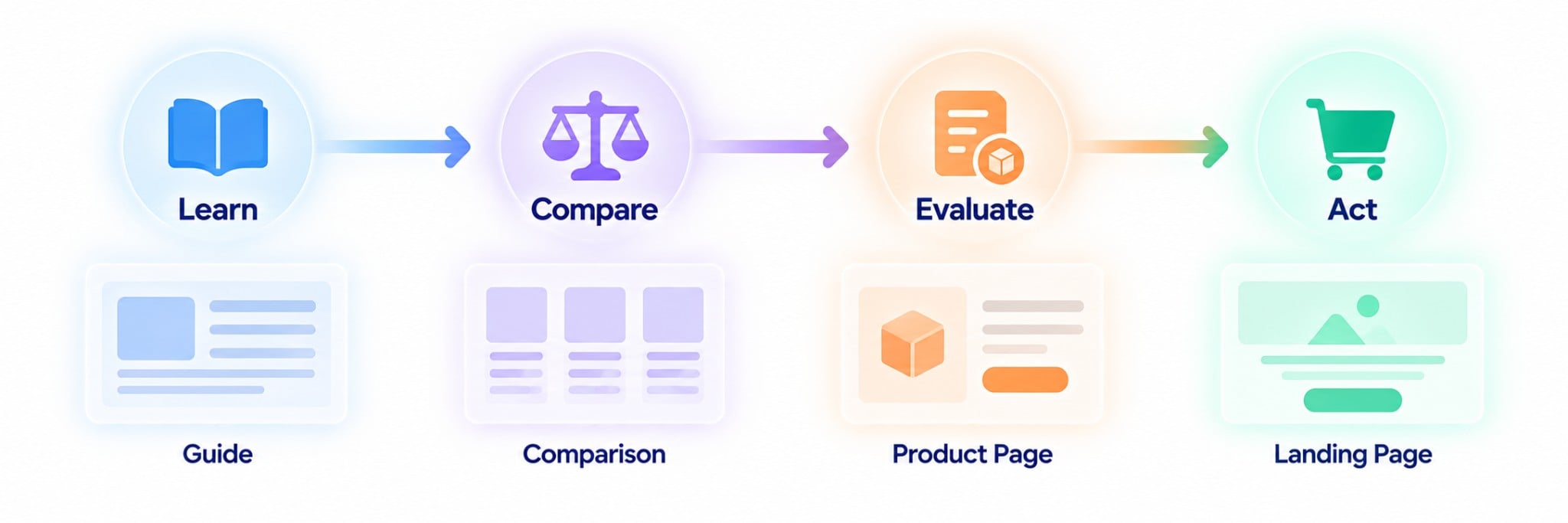
Build SEO around progression, not isolated rankings. A lending journey can move from an informational borrowing query to an educational guide, comparison page, loan product page, and eligible application. Measure progression between those steps alongside qualified organic acquisition.
This structure also supports fintech inbound marketing by giving prospects useful next steps at different stages. Internal links should connect related intent rather than merely distribute authority. Measure progression between content types to identify where organic journeys break.
Build Topical Authority
Build topic clusters around subjects where the company has genuine product expertise. A WealthTech platform might connect wealth management concepts with portfolio functionality and expert content. A lender could organize content around eligibility, borrowing decisions, repayment, and relevant product choices.
A useful FinTech topic cluster combines:
- Core resources: establish the main subject and its product relevance.
- Decision content: addresses comparisons, eligibility, risks, and customer choices.
- Supporting content: answers narrower questions requiring deeper explanation.
- Expert evidence: contributes research or credible specialist interpretation.
Supporting pages should answer narrower questions while linking to authoritative core resources. This architecture makes expertise easier for readers and search systems to interpret. It also prevents a content strategy from becoming an unrelated collection of financial articles.
Optimize for AI Search
AI-powered search favors content that makes useful answers easy to identify and substantiate. Use direct definitions, descriptive headings, structured comparisons, clear entities, and factual supporting evidence. Avoid burying the answer beneath generic introductions.
Structure alone cannot compensate for weak expertise. Financial brands should maintain consistent product facts, clear authorship, and verifiable supporting sources across important topics. Monitor qualified search visibility and referral behavior rather than assuming conventional rankings capture every discovery path.
Audit AI-search readiness at the answer level:
- Directness: Can an important question be answered from a self-contained passage?
- Entity clarity: Are products, concepts, and relationships unambiguous?
- Evidence: Can important financial claims be verified?
- Consistency: Do product facts remain consistent across relevant pages?

Building Trust in FinTech Marketing
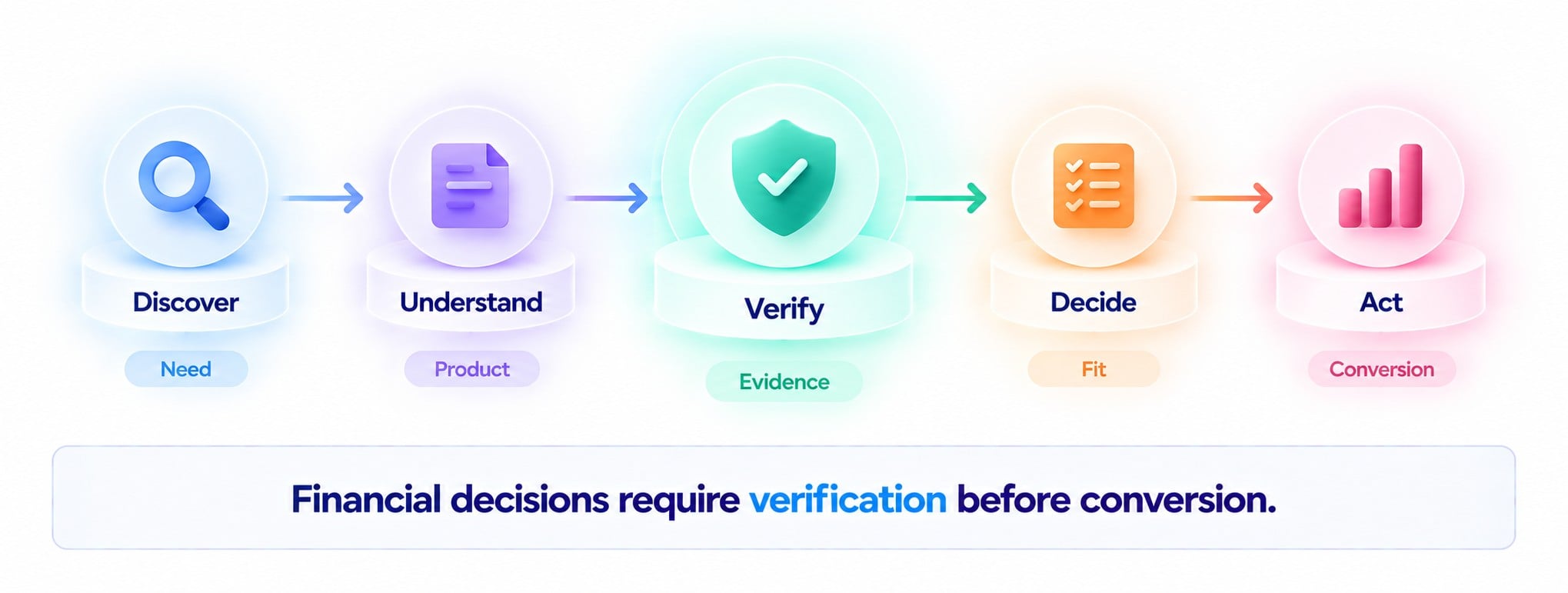
Trust in financial technology depends on making important product claims understandable and verifiable. Financial brands should connect transparent pricing, product explanations, security information, privacy practices, and terms with evidence. Trust signals support evidence; they should never substitute for it.
Different financial products require different proof:
- Neobanks and payment platforms: clarify fees, protection, transaction capabilities, and important limitations.
- Lending and investment products: explain eligibility, obligations, functionality, and relevant financial risks.
- B2B FinTech platforms: support reliability and security claims with documented practices and relevant credentials.
- Insurance technology products: make coverage, exclusions, eligibility, and claims processes understandable.
Customer reviews, credentials, expert content, and media coverage can reinforce credibility when represented accurately. Certifications should only be displayed where applicable and current. Responsible claims matter because financial decisions can carry material consequences for customers.
FinTech Marketing Compliance
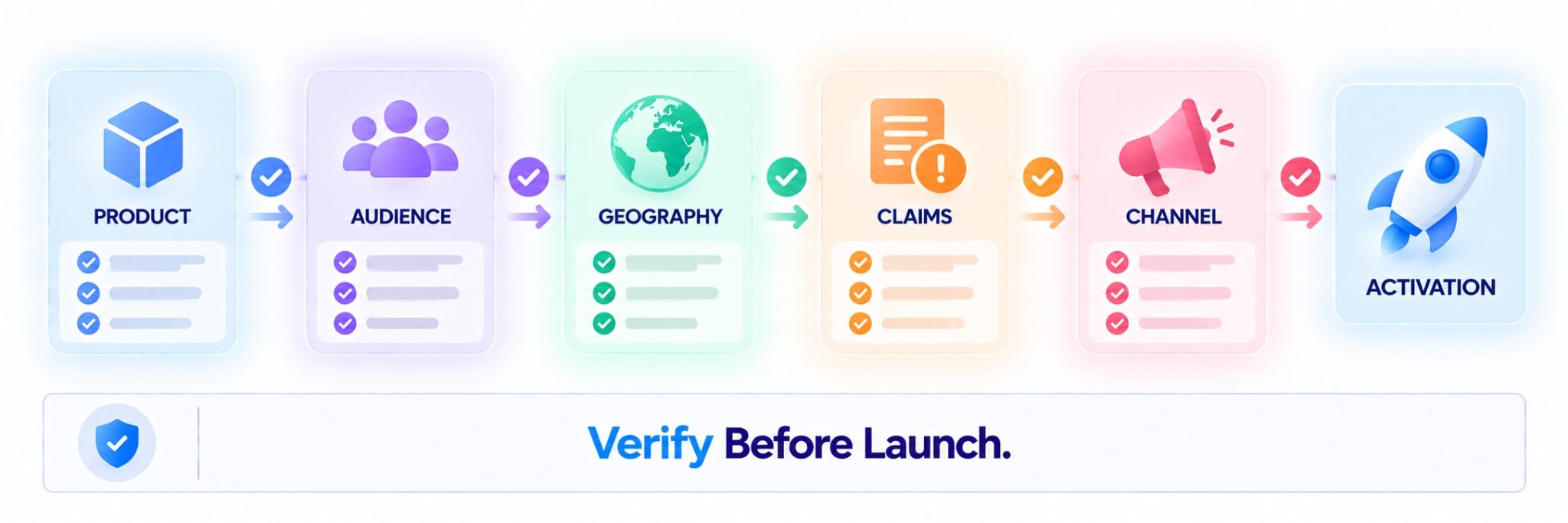
Marketing compliance requires designing financial promotions around the rules applying to the product, audience, jurisdiction, data, and channel. Teams should review compliance before campaign production rather than treating it as final copy approval. This section is informational and is not legal advice.
Before production, identify the requirements governing:
- Promotion: required disclosures and restrictions on financial claims or guarantees.
- Audience and geography: where and to whom the product may be promoted.
- Data: applicable privacy, data protection, and email consent requirements.
- Platforms: additional advertiser, product, or campaign approval requirements.
Platform rules add another layer. Google requires certain financial-services advertisers in applicable locations to complete verification and applies restrictions by product and geography. Regulatory requirements remain separate from platform approval, so passing an advertising review does not establish legal compliance.
Privacy also changes marketing operations. Financial information may require stricter handling than ordinary behavioral data, depending on jurisdiction and activity. Teams should document consent, data access, campaign claims, approval workflows, and geographic eligibility before activation.
How Much Does FinTech Marketing Cost?
Marketing costs vary by FinTech product, market, acquisition model, competition, and regulatory environment. Budgeting should start with required capabilities and acquisition economics rather than a universal industry benchmark. Separate foundation investments from recurring distribution when planning spend.
Budget allocation should reflect the product and acquisition model rather than a fixed industry percentage. A neobank may weight paid acquisition and lifecycle marketing more heavily, while B2B FinTech may invest more in content, sales-supporting demand, and analytics. Use the structure below to decide where spending performs a distinct job.
| Budget Area | Role in FinTech Marketing |
| SEO & Content | Capture research and product demand |
| Paid Acquisition | Generate qualified applications or leads |
| PR | Build financial credibility and visibility |
| CRM & Email | Support activation and retention |
| Creative | Explain products across campaigns |
| Analytics | Connect channels with customer outcomes |
| Compliance | Review claims, targeting, data, and promotions |
Common FinTech Marketing Mistakes
Most mistakes in this area disconnect acquisition from customer decision requirements. Some weaken trust or targeting, while others distort measurement. Use the following list as a diagnostic audit.
- Making the product too difficult to understand. Translate mechanics into customer decisions without removing important qualifications.
- Focusing on acquisition while ignoring trust. Give prospects evidence before increasing traffic.
- Making unsupported financial claims. Connect promotional statements to verifiable product facts.
- Ignoring compliance requirements. Review product, jurisdiction, channel, and audience before launch.
- Targeting everyone instead of a defined audience. Segment around financial needs and meaningful intent.
- Relying too heavily on paid advertising. Build organic and owned demand alongside paid acquisition.
- Ignoring SEO and educational content. Capture research demand before competitors control the learning journey.
- Using generic financial content. Publish material connected to real product expertise and customer questions.
- Creating unnecessary conversion friction. Measure abandonment across forms, onboarding, and activation.
- Measuring vanity metrics instead of business outcomes. Connect channels with qualified acquisition and product usage.
- Ignoring customer retention. Track ongoing value after initial conversion.
- Failing to personalize the customer journey. Use appropriate customer signals to improve relevance responsibly.
FinTech Marketing by Business Type
Marketing priorities should change with the product and target customer. The same channel can perform different jobs across consumer banking, payments, investment products, and B2B platforms.
| FinTech Business | Main Marketing Priorities |
| Neobank | Customer acquisition, trust, app adoption |
| Payment Platform | B2B/B2C acquisition, partnerships |
| Lending Platform | Lead generation, trust, conversion |
| Investment App | Education, acquisition, retention |
| WealthTech | Thought leadership, lead generation |
| InsurTech | Education, trust, lead generation |
| B2B FinTech | SEO, content, LinkedIn, ABM |
| FinTech SaaS | Demand generation, SEO, paid acquisition |
For example, neobank marketing often connects app acquisition with trust and activation. Enterprise platforms may prioritize sales-qualified demand and integrations instead. Business type should therefore change both channel allocation and KPI selection.
Conclusion
Effective FinTech growth connects acquisition with trust, education, and credible financial communication. Channels should work across one customer journey rather than as isolated campaigns. Compliance should influence decisions from planning through measurement.
Strong systems connect channel metrics with customer and revenue outcomes. Teams should test acquisition while protecting clarity, privacy, and product credibility. Monitor fintech marketing trends when changing customer behavior or channels affect that balance.