
Fintech email marketing is the use of personalized, trust-focused email communication to guide users through financial products, onboard them faster, reduce hesitation, and drive long-term engagement. Unlike traditional email marketing, fintech email campaigns operate in a high-trust environment where security, compliance, timing, and clarity directly influence whether users convert or disengage.
That’s what makes fintech email campaigns uniquely difficult to execute well. A generic abandoned-cart email might work for eCommerce, but it doesn’t work when users are being asked to trust a platform with their hard-earned savings, investments, credit history, or business finances.
This article breaks down the fintech email marketing practices that actually move users forward.
Why Generic Email Marketing Strategies Don’t Work for Fintech
Fintech marketing strategies operate under completely different conditions than those used for retail, SaaS, or lifestyle brands. Financial decisions involve higher perceived risk, stricter regulations, and longer trust-building cycles.
| Element of fintech email communication | Why it matters in fintech | A non-fintech approach |
| Security-first messaging | Users need reassurance around data protection, compliance, and fraud prevention communication. | Security is only lightly, if at all, mentioned |
| Behavioral email targeting | An email marketing strategy for fintech must reflect the onboarding progress, account activity, or financial milestones. | Broader lifecycle campaigns with simpler triggers |
| Educational content | Products from the fintech sector are often complex and require explanation before conversion. | Simpler product promotion and sales messaging |
| Regulatory-friendly messaging | Fintech products and platforms operate under stricter fintech regulations, with more careful wording and transparent disclosures. | Promotional language is more flexible |
| Email segmentation | Financial behavior and risk tolerance vary significantly between users. | Wider audience grouping with fewer behavioral layers |
Strong fintech brands also rely heavily on:
- Custom emails triggered by user behavior
- Conversion-focused email design with minimal friction
- Lifecycle email campaigns tied to onboarding stages
- AI-driven email personalization
- Educational sequences explaining financial concepts clearly
This matters because trust directly affects performance in the fintech industry. According to research published in the Management Dynamics journal, transparency and reliable financial services strongly influence customer trust and long-term retention.
When it’s done right, email marketing can contribute to revenue growth. Tidio reports that email marketing will bring in $17.9 billion by 2027, highlighting how big an impact it can have on businesses.
Fintech email works differently from retail marketing. Users are more cautious and are thinking about risk, security, and real financial consequences when they sign up for investment platforms, payment systems, or lending products. That kind of context means fintech brands can’t rely on typical onboarding tactics. They have to build trust and clarity into every step. That’s why many fintech companies work with a specialized fintech marketing agency that understands compliance, lifecycle communication, and trust-building strategies unique to financial products.
9 Proven Fintech Email Marketing Practices That Drive Results
For fintech businesses planning to engage fintech audiences through emails, four things do most of the heavy lifting: timing, trust, personalization, and relevance. The brands that get it right don’t treat email as one thing. They use it as onboarding support, an education tool, and a way to keep users engaged, guiding users and reducing hesitation along the way.
The most effective email marketing services for fintech brands combine personalization, trust-building, onboarding, and lifecycle automation into one cohesive strategy.
Use Real-Time Behavioral Triggers
Behavioral email targeting allows fintech businesses to send messages based on what users actually do instead of relying on generic schedules or batch campaigns. This matters because fintech users often hesitate during onboarding or abandon processes midway through verification, funding, or feature exploration. Real-time triggers help brands respond immediately while intent is still high and customers are more likely to buy.
The most common fintech email triggers include:
| User Behavior | Example Trigger Email | Goal |
| Account sign-up | Welcome email with onboarding checklist | Push first action |
| Incomplete KYC verification | Reminder with security reassurance | Reduce onboarding drop-off |
| Card added but unused | “Start your first transfer” or “continue your purchase” walkthrough | Increase activation |
| Inactive investment account | Market update tied to owned assets | Re-engagement |
| Feature exploration | Educational email about advanced tools | Improve product adoption |
Revolut, for example, has a quick, five-step onboarding guide that walks users through getting started with the platform. Revolut’s onboarding and lifecycle communication strategy emphasizes contextual guidance, feature education, security messaging, and personalized engagement throughout the user journey.
When applied to effective behavioral email targeting, this can look like:
- Accurate event tracking
- Email segmentation
- Timing optimization
- Context-aware messaging
- Minimal friction in the CTA flow
Build Trust Through Security-First Messaging
Customer trust in fintech directly affects whether users complete onboarding, connect bank accounts, or move money through a platform. That’s why an effective fintech email marketing strategy prioritizes security-first messaging throughout the customer journey. Instead of treating security as a footer disclaimer, successful fintech brands actively communicate:
- Encryption standards
- Fraud prevention communication
- Compliance practices
- Account protection features
- Secure communication channels
- Login verification processes
Fintech email campaigns also require stricter operational safeguards than standard marketing emails. Many companies implement SPF, DKIM, and DMARC authentication alongside GDPR- and CAN-SPAM-compliant messaging to reduce phishing risks and reinforce sender legitimacy.
“In my opinion, one of the biggest mistakes fintech companies make is trying to ‘hide’ compliance as if it automatically hurts conversions. In reality, the strongest fintech brands turn compliance into part of the product experience. Sometimes a simple line such as: ‘Verification usually takes less than 3 minutes’ or ‘You can withdraw your funds at any time’ has a stronger impact on conversion rates than a traditional promotional CTA. Strong fintech email campaigns are designed to reduce uncertainty.”
Ula Z., Senior Email Marketing & CRM Strategist at NinjaPromo
Use Educational Content to Explain Complex Fintech Solutions
Many fintech products fail because users don’t fully understand them. Investment tools, crypto products, lending systems, tax automation, and embedded finance solutions are already quite complex for the average person to understand. When you involve more unfamiliar financial concepts, this can overwhelm users. Educational email content helps simplify those ideas.
Well-optimized educational fintech email marketing includes:
- Short explainers
- Product walkthroughs
- Financial concept breakdowns
- Interactive guides
- FAQ sequences
- Market updates with context
Clear educational messaging strengthens fintech product positioning and improves user confidence and trust because it shows users that the people behind the platform know what they’re doing. It also helps with feature adoption because users get to know how to best use a fintech product for their needs. The key is clarity over jargon.
❌ Avoid:
“Optimize your DeFi liquidity provisioning strategy.”
✅ Instead:
“Learn how staking rewards work and how to manage risk.”
“Fintech users make decisions under conditions of uncertainty, perceived financial risk, and emotional pressure. This means user behaviour is often driven not only by rational product evaluation, but also by cognitive biases and psychological shortcuts. Effective fintech campaigns take these behavioural patterns into account.”
Ula Z., Senior Email Marketing & CRM Strategist at NinjaPromo
Boost Engagement with AI-Driven Email Personalization
AI-driven email personalization allows fintech brands to move beyond static campaigns and adapt messaging dynamically based on user behavior. Machine learning systems can analyze transaction history, product usage, feature engagement, time-of-day behavior, risk profiles, spending patterns, and investment interests.
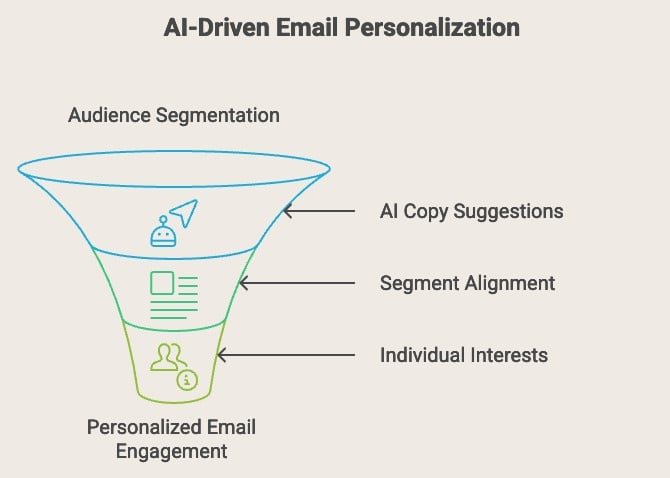
This helps fintech companies send custom emails with significantly higher relevance. Examples include:
- Personalized investment summaries
- Smart budgeting alerts
- Dynamic product recommendations
- Personalized savings milestones
- AI-driven re-engagement sequences
According to McKinsey, personalization can reduce acquisition costs while improving revenue and marketing ROI.
Effective AI-driven fintech email marketing (provided by strong fintech digital marketing services) should optimize timing, subject lines, CTA selection, product recommendations, and lifecycle sequencing without making personalization feel invasive.
“More fintech companies are adopting AI-driven systems that do not just suggest segments or content variations, but actively manage execution, optimization, and multichannel communication in real time. This allows fintech teams to scale campaign velocity much faster while maintaining regulatory consistency.”
Ula Z., Senior Email Marketing & CRM Strategist at NinjaPromo
Use Product-Led Emails Instead of Pure Promotions
Fintech users rarely convert because of aggressive promotional messaging alone. They convert when they understand how the product improves a financial task or solves real problems.
Product-led emails focus on functionality and outcomes instead of discounts or hype.
Good product-led fintech emails show workflows, highlight useful features, demonstrate product value, explain use cases, and reinforce practical benefits.
Stripe does this effectively through product-focused communications that introduce new tools with clear demonstrations of how businesses can use them operationally.
Impactful product-led emails often include:
- Product screenshots
- Short tutorials
- Interactive demos
- Feature-based use cases
- Real workflow examples
This approach improves product adoption, long-term retention, feature discovery, customer trust in fintech, and engagement quality.
| Promotional Email | Product-Led Email |
| “Limited-time offer” | “See how to automate payouts” |
| Discount-focused | Workflow-focused |
| Broad audience targeting | Behavior-based targeting |
| Focus is on the short-term conversion push | Focus is on long-term product adoption and relationship-building |

Reinforce Credibility with Proof Points
Fintech users look for reassurance before taking financial action.
That’s why strong fintech email marketing campaigns regularly include proof points that reduce hesitation and reinforce legitimacy.
Effective proof signals include:
- Customer testimonials
- Case studies
- Compliance certifications
- User growth milestones
- Industry awards
- Partner logos
- Security credentials
- Real usage statistics
Plaid frequently reinforces credibility through partnerships with major financial institutions and recognizable fintech brands.
Good proof points work because they shift messaging from: “Trust us” to “Here’s why other people already do.”
Re-Engage Users with Contextual Messaging
Most re-engagement emails fail because they provide no meaningful reason to return. Messages like “We miss you” might work for clothing brands, but they rarely work in fintech. High-performing contextual re-engagement emails reconnect users through feature updates, portfolio changes, market movement, savings milestones, financial insights, account activity summaries, and personalized recommendations.
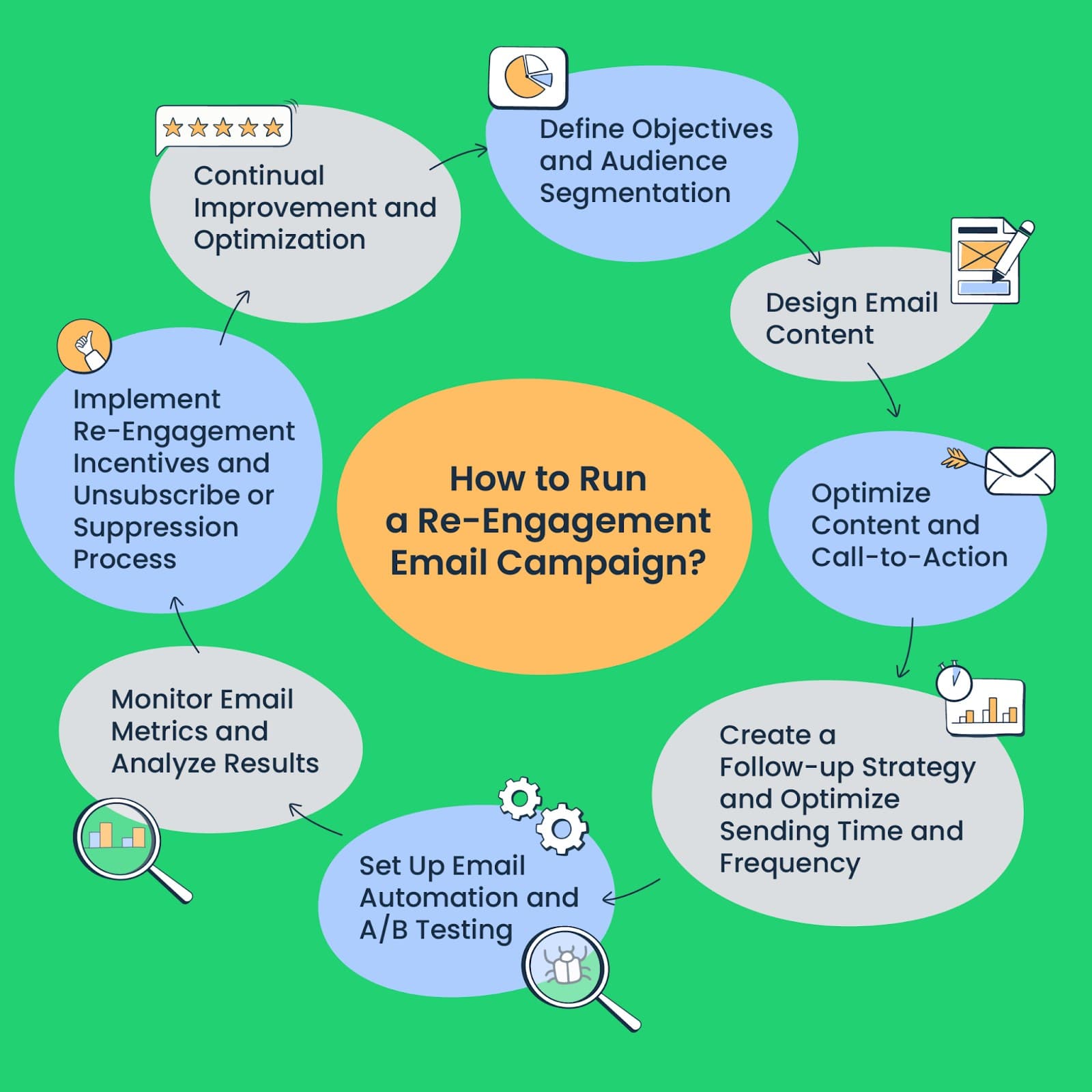
For example, investment apps often re-engage inactive users with portfolio-specific alerts tied to owned assets instead of generic reminders. Effective contextual messaging should:
- Reference real user behavior
- Provide clear value
- Avoid artificial urgency
- Feel timely and useful
Optimize Email Segmentation for Different Financial Behaviors
One of the biggest email marketing for fintech mistakes is treating all users the same. Financial behavior varies dramatically depending on spending habits, investment goals, income levels, and risk tolerance. That’s why strong email segmentation is critical for fintech businesses.
Good segmentation allows fintech brands to tailor the messaging tone, product recommendations, educational content, risk communication, investment insights, feature promotion, and lifecycle timing.
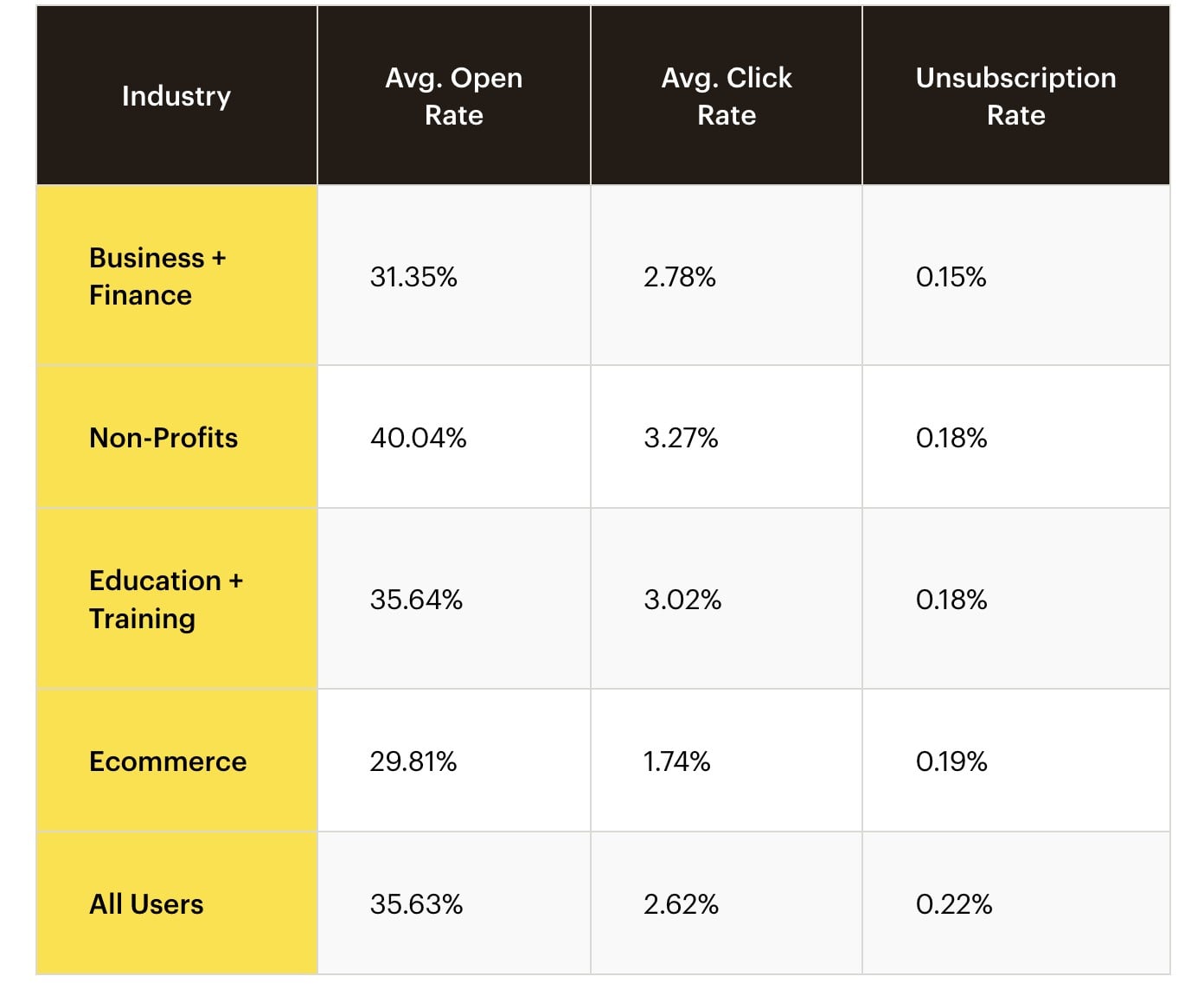
For example, Coinbase segments users differently depending on trading activity, asset interest, and engagement level. Beginner crypto users receive educational onboarding content, while active traders receive market updates and advanced product communication. According to Mailchimp’s email marketing benchmarks, segmented campaigns consistently outperform broad campaigns in engagement and click-through rates.
Here’s a visual representation of industry benchmarks to see how your brand compares:
For fintech brands specifically, segmentation also supports:
- Better compliance messaging
- More accurate product education
- Higher conversion quality
- Stronger user confidence
Use Transactional Emails as Engagement Opportunities
Transactional emails are often seen as purely functional: just confirmations, alerts, and receipts. But in reality, they’re some of the most valuable emails you can send. Users pay attention to transfer confirmations, deposit alerts, payment receipts, security verifications, and account activity updates because they involve real financial activity. Effective fintech email communication strategies use these moments to strengthen engagement in a natural, non-promotional way.
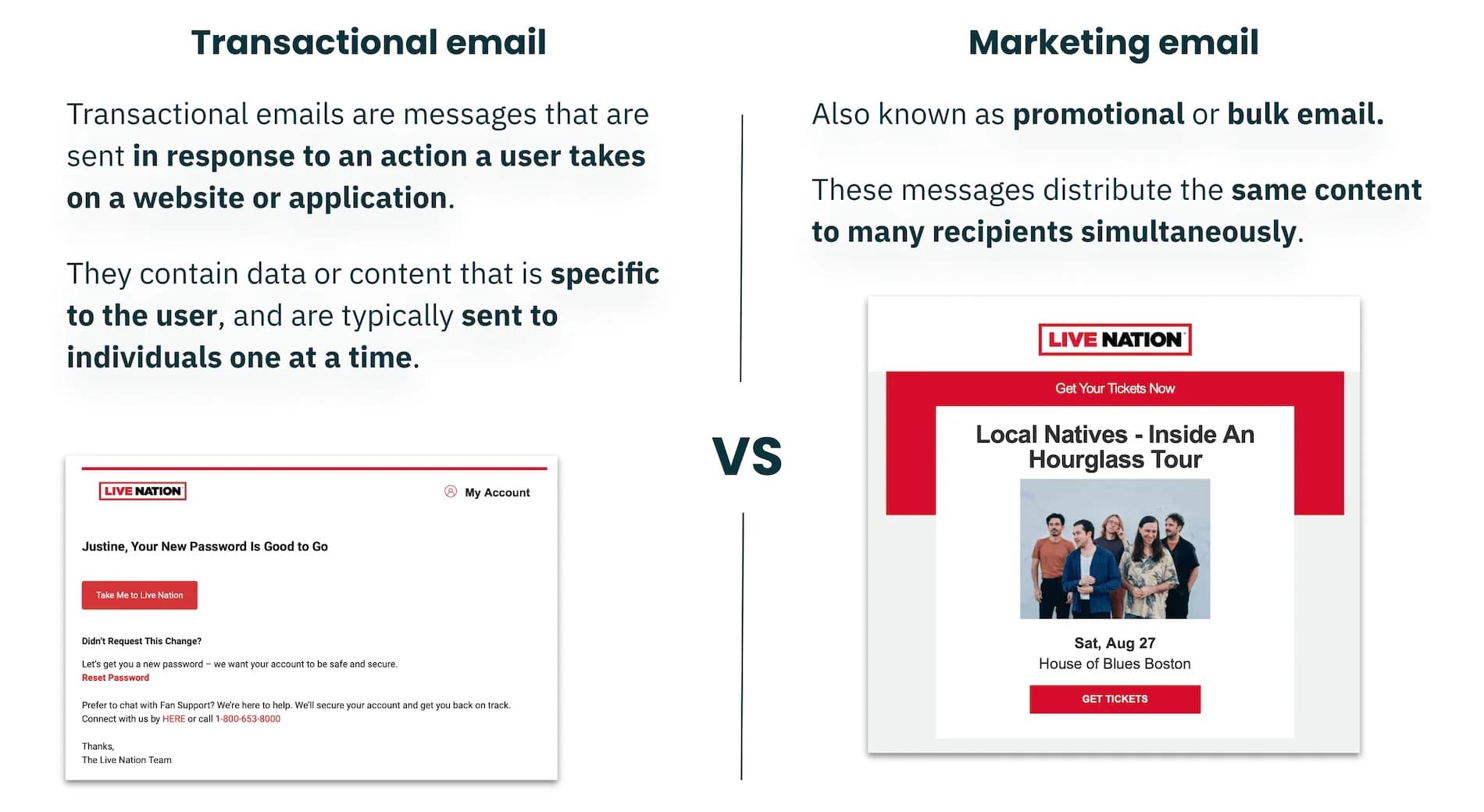
Good fintech transactional emails often include real-time account summaries, security reminders, spending insights, personalized recommendations, or contextual feature suggestions tied to user behavior. Say someone completes a transfer. A fintech platform might then offer options for recurring payments, budgeting tools, or spending analytics relevant to that action. Because users already expect these emails and open them regularly, they’re a steady way to strengthen customer trust in fintech products and encourage ongoing engagement.
From Practices to Strategy: How to Create a Complete Fintech Email Marketing Plan
Many fintech companies already use onboarding emails, segmentation tools, or behavioral triggers. The problem is that these tactics often operate independently. A strong email marketing strategy for fintech ties every email into a larger customer journey where trust-building, product education, personalization, and conversion flows work together instead of competing for attention.
The first step is mapping the full user lifecycle from sign-up to long-term retention. Instead of thinking in terms of isolated campaigns, fintech businesses should identify the critical stages where users hesitate, disengage, or need additional guidance. These usually include account creation, identity verification, first transaction, feature adoption, inactivity periods, and account expansion. Each stage should have its own email logic tied to user behavior and financial intent.
The most effective fintech brands also connect personalization with educational content instead of treating them separately. For example, a user exploring investment features might receive beginner-friendly explainers, while an experienced trader receives market insights and advanced product workflows. This combination of email segmentation and educational messaging makes communication feel significantly more relevant and trustworthy.
“I think one of the most important behavioural shifts is the growing preference for education-first communication. Especially among younger fintech users, aggressive sales messaging is becoming less effective compared to content that explains financial decisions, product mechanics, risks, or long-term value. Users increasingly expect fintech brands not just to sell products, but to help them make smarter financial decisions.”
Ula Z., Senior Email Marketing & CRM Strategist at NinjaPromo
Timing also matters. Well-optimized fintech lifecycle email campaigns react to behavior while intent is still high. Sending a verification reminder two minutes after drop-off is more effective than sending a generic reminder three days later. Similarly, contextual product recommendations tied to recent account activity consistently outperform broad promotional blasts.
To keep the strategy scalable, fintech companies should focus on:
- Clear segmentation rules
- Consistent security-first messaging
- Product-led email design
- AI-driven personalization
- Unified branding across all email flows
- Conversion-focused onboarding journeys
- Continuous testing and optimization
At the end of it all, the goal is to create a connected communication system where every email moves users toward stronger trust, deeper product adoption, and long-term engagement with the platform.
Final Thoughts
Fintech email communication works differently from traditional email marketing because products require higher levels of trust, clarity, and user confidence. The top brands understand that email isn’t just a tool used to promote financial technology products. It’s part onboarding system, part education channel, and part customer retention strategy. Effective email marketing for fintech combines behavioral triggers, personalization, educational content, trust-building messaging, and product-led communication into one cohesive customer journey. For effective email campaigns, many fintech brands rely on advanced email newsletter platforms that support behavioral triggers, segmentation, AI personalization, and compliance-friendly automation.