


Key Findings
- Higher fintech signup rates cannot guarantee growth in verified and funded accounts.
- KYC friction should be reduced without compromising mandatory identity verification.
- Transparent financial fees help prevent abandonment during applications and initial funding.
- Fintech A/B tests must measure funded-account activation alongside registration improvements.
- Funding completion and first-transaction rates reveal conversion barriers beyond onboarding.
Fintech conversion optimization improves how effectively potential customers progress from initial interest to meaningful financial activity. It addresses barriers across registration and verification before users reach funding or transactions. Success depends on increasing qualified customer activation rather than collecting more incomplete applications.
Financial products introduce challenges that conventional website optimization rarely addresses. Customers must understand eligibility requirements and financial consequences before sharing sensitive information. Effective improvements therefore combine behavioral research with transparent communication and compliant onboarding.
Why Conversion Optimization Matters for Fintech Companies
Conversion rate optimization improves the proportion of eligible prospects completing valuable actions across financial customer journeys. These actions include approved applications and funded accounts. A registration alone rarely represents the full commercial outcome.
Financial acquisition often involves several expensive interactions before customers generate revenue. Paid traffic can produce substantial signup volumes while verification failures prevent meaningful activation. Improving later stages may therefore create more value than increasing initial registrations.
Use this checklist to assess the business impact of conversion improvements:
- Qualified traffic: Measure how many relevant visitors enter the funnel.
- Signup completion: Track registrations without treating them as acquired customers.
- Verification success: Identify eligible applicants lost during identity checks.
- Funded accounts: Track approved customers completing their first required deposit.
- Conversion gains: Compare funded-account growth against the original visitor volume.
- Acquisition efficiency: Check whether improvements generate more customers without additional spending.
A useful fintech CRO strategy connects improvements with measurable business outcomes:
| Conversion stage | Primary outcome | Commercial significance |
| Registration | Qualified signup | Establishes initial intent |
| Verification | Approved identity | Enables eligible participation |
| Application | Completed submission | Creates an assessable financial request |
| Funding | Successful deposit | Indicates financial commitment |
| First transaction | Completed financial action | Demonstrates initial product use |
Fintech conversion rate optimization provides structured methods for investigating customer friction. Experiment design must account for verification requirements and delayed financial outcomes. Reliable conclusions depend on measuring those outcomes across comparable customer groups.
How the Fintech Conversion Funnel Works
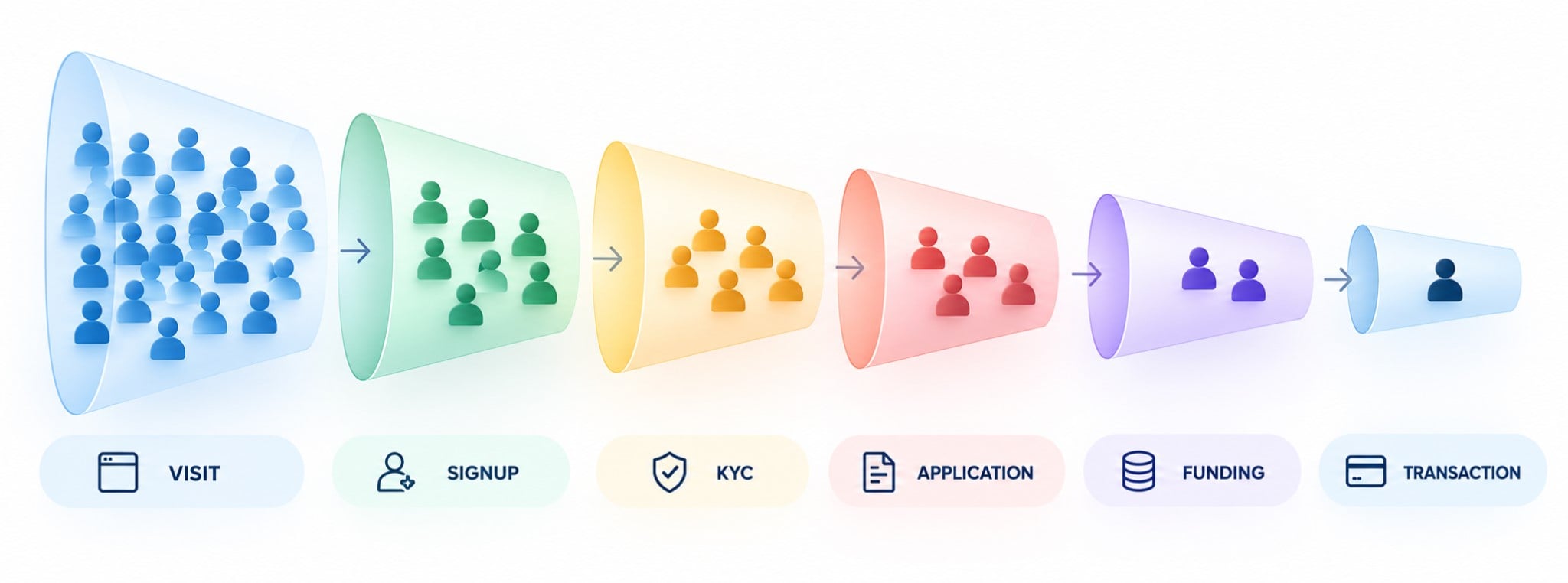
A fintech conversion funnel describes how prospective customers progress from discovery to their first meaningful financial action. Each transition introduces different information needs and potential abandonment points. The precise sequence depends on the financial product.
A lending application may require eligibility assessment before approval. Investment platforms typically emphasize account verification and initial funding. Payment products might prioritize merchant setup before the first successful transaction.
| Stage | Customer needs | Common friction | Useful measurement |
| Landing page | Product relevance | Unclear eligibility | Qualified visit rate |
| Signup | Simple registration | Excessive fields | Signup completion |
| Verification | Clear requirements | Rejected documents | KYC approval rate |
| Application | Understandable conditions | Repeated information | Application completion |
| Funding | Payment confidence | Failed transfers | Funding success rate |
| Transaction | Reliable execution | Unexpected restrictions | First-transaction rate |
Fintech conversion rate optimization must account for journeys spanning multiple sessions. Some customers return later to submit verification documents. Others delay funding until available payment methods become clear.
The fintech onboarding conversion rate should use a clearly defined starting population. Measuring approved users against registration attempts answers a different question from visitor-to-activation conversion. Teams need both views to distinguish acquisition problems from onboarding friction.
What Affects Conversion Rates in Fintech
Financial decisions involve greater perceived risk than many ordinary digital purchases. Users may hesitate because of uncertainty about fees or account security. Product complexity can intensify those concerns when essential conditions appear late.
Trust also depends on the relationship between marketing promises and operational reality. A polished interface cannot compensate for unclear withdrawal restrictions. Similarly, recognizable security symbols cannot replace understandable explanations of customer protections.
The following factors deserve separate investigation:
| Factor | Conversion risk | Recommended response |
| Trust | Uncertainty about legitimacy | Explain applicable protections and authorization |
| Product complexity | Misunderstood financial terms | Clarify conditions before commitment |
| KYC requirements | Verification abandonment | Explain documents and expected steps |
| Form length | Unnecessary effort | Remove redundant nonmandatory fields |
| Fee transparency | Late-stage hesitation | Disclose relevant costs early |
| Mobile UX | Difficult document capture | Test device-specific verification |
| Security signals | Fear of data exposure | Explain sensitive-data handling |
| Social proof | Unverified expectations | Use authentic and relevant evidence |
| Traffic intent | Unqualified applications | Align acquisition messaging with eligibility |
Effective fintech marketing should distinguish research-oriented visitors from customers ready to apply. Otherwise, identical interfaces may produce misleading conversion comparisons across acquisition segments. Teams should evaluate approval performance alongside signup rates.
Security messaging should remain factual rather than reassuring through unsupported claims. Explain applicable safeguards without suggesting that financial products are risk-free. Relevant user trust signals include clear policies and accessible support information.
Fintech Conversion Rate Optimization Best Practices
Successful fintech conversion rate optimization starts with measurable barriers rather than cosmetic redesigns. Each improvement should address a specific customer decision or operational obstacle. The following practices connect those problems with practical interventions.
Reduce Drop-Offs Across KYC and Verification
Confusing instructions can contribute to KYC abandonment even among customers willing to verify their identity. Customers may upload unsuitable documents or misunderstand acceptable identification requirements. Teams should separate preventable errors from legitimate compliance rejections.
Start by analyzing failure reasons across device types and verification steps. Distinguish camera problems from unreadable documents and unsupported identification. Then improve guidance without changing mandatory identity checks.
Practical improvements include:
- Explain document requirements before verification begins.
- Display camera guidance during capture.
- Preserve progress after recoverable errors.
- Offer compliant recovery options for rejected submissions.
- Clarify pending review status and next steps.
Official identity proofing guidelines help distinguish assurance requirements from optional interface decisions. Fintech teams can simplify instructions without reducing required checks. Specific obligations still depend on jurisdiction and product type.
Measure completion alongside approval quality and fraud indicators. Faster submissions offer limited value when invalid documents increase. The objective is compliant financial onboarding with fewer avoidable interruptions.
The goal is to eliminate unnecessary friction, not reduce verification standards. Removing duplicate data entry, improving document upload instructions, and allowing users to resume interrupted verification can reduce abandonment while preserving required compliance checks.
Dennis F., PPC Team Lead at NinjaPromo
Shorten the Path From Signup to Activation
Registration should lead customers toward their first useful product outcome. Unnecessary setup tasks can delay that moment without improving eligibility or security. Account signup optimization should therefore distinguish mandatory information from optional preferences.
Identify the minimum actions required before meaningful product use. A payment application might prioritize recipient setup after verification. Investment services may need funding instructions before portfolio customization.
Consider these activation improvements:
- Defer optional profile customization.
- Preserve previously supplied information.
- Show the next required action.
- Explain pending approval states.
- Resume interrupted onboarding sessions.
Track median time to activation alongside the percentage reaching that milestone. Shorter journeys should not produce weaker customer understanding. Product teams must preserve necessary disclosures and informed consent.
The clearest warning sign is when signup conversion increases, but fewer users complete KYC, link a bank account, or make their first transaction. A successful CRO experiment should improve activated users, not just registrations.
Dennis F., PPC Team Lead at NinjaPromo
Match Landing Pages to Financial Intent
Fintech landing page optimization begins with matching visitor intent to a specific financial proposition. Someone comparing business payment fees needs different information from a prospective borrower. Generic pages often conceal the details that determine eligibility.
A focused fintech CRO approach compares landing-page performance by audience segment. Evaluate qualified application starts rather than headline clicks alone. Traffic-source differences should remain visible throughout the analysis.
For fintech website conversion optimization, prioritize message consistency between advertisements and destinations. Promises about pricing must match disclosed conditions. Avoid introducing unexpected eligibility requirements after visitors begin applying.

Use Educational Content at Key Decision Points
Educational content reduces uncertainty when customers encounter unfamiliar financial concepts. The most useful explanation appears immediately before a consequential decision. Long resource libraries cannot replace timely guidance inside the journey.
A credit application might explain variable interest before commitment. Investment onboarding may require accessible explanations of risk exposure. Payment products should clarify settlement periods before merchants configure withdrawals.
Effective fintech content marketing connects educational materials with genuine customer questions. Support articles should answer recurring objections rather than redirect visitors toward unrelated promotional content. Contextual explanations can improve understanding without interrupting progression.
Useful educational placements include:
- Eligibility explanations beside application entry points.
- Fee definitions near pricing comparisons.
- Verification guidance before document submission.
- Risk disclosures before financial commitment.
Measure whether informed customers progress successfully after consuming relevant guidance. Avoid interpreting every additional pageview as positive engagement. Repeated visits may indicate unresolved confusion.
Make Financial Costs and Conditions Easy to Compare
Financial website conversion optimization requires transparent presentation of material costs and contractual conditions. Financial consumer understanding guidance emphasizes clear information before customers make consequential decisions. Hidden restrictions can create abandonment after substantial onboarding effort.
Present costs using comparable units and clearly defined assumptions. Separate fixed fees from variable charges. Explain when rates depend on transaction size or customer eligibility.
| Product | Information requiring clarity | Potential misunderstanding |
| Lending | APR and repayment conditions | Confusing rates with total borrowing cost |
| Payments | Transfer and exchange charges | Overlooking recipient deductions |
| Investing | Trading and custody fees | Underestimating cumulative costs |
| Business banking | Account and transaction charges | Missing usage-based pricing |
Fee comparisons should distinguish estimates from guaranteed amounts. Exchange-rate illustrations require clear assumptions and timing. Product disclosures must remain consistent across marketing and application interfaces.
Test comprehension before testing more persuasive layouts. A clearer comparison may reduce unsuitable applications while improving qualified completion. That outcome can be commercially preferable to higher raw signup volume.
Improve the Funding and First-Transaction Experience
Where funding is required, it represents a distinct step beyond account creation. Verified customers may hesitate when payment instructions appear unfamiliar. Technical transfer failures introduce additional barriers unrelated to initial interest.
Map funding attempts separately from successful deposits. Distinguish payment declines from user cancellations and pending transfers. This prevents operational failures from being mistaken for messaging problems.
Prioritize failures that prevent motivated users from completing their first transaction, especially unsuccessful bank connections, payment verification errors, and rejected deposits. Completed transactions are a much stronger indicator of activation than funding attempts.
Dennis F., PPC Team Lead at NinjaPromo
A funding-focused checklist should include:
- Display supported payment methods before selection.
- Explain minimum deposit requirements.
- Identify expected processing times.
- Show recoverable error instructions.
- Confirm successful funding clearly.
The transaction conversion rate should measure eligible users completing the defined financial action. Compare first attempts with eventual success after retries. Monitoring both reveals whether recovery mechanisms actually work.
Avoid encouraging unnecessary deposits through artificial urgency. Clear funding instructions should support informed decisions. Evaluate resulting activity against applicable compliance requirements.

Optimize UX Across Fintech Customer Decision Stages
Fintech user experience should adapt as customers move from exploration toward financial commitment. Early visitors need relevance and credible information. Verified users require efficient access to practical actions.
A single interface hierarchy cannot serve every decision equally well. Product comparison pages should prioritize eligibility and costs. Transaction screens should emphasize confirmation details and error prevention.
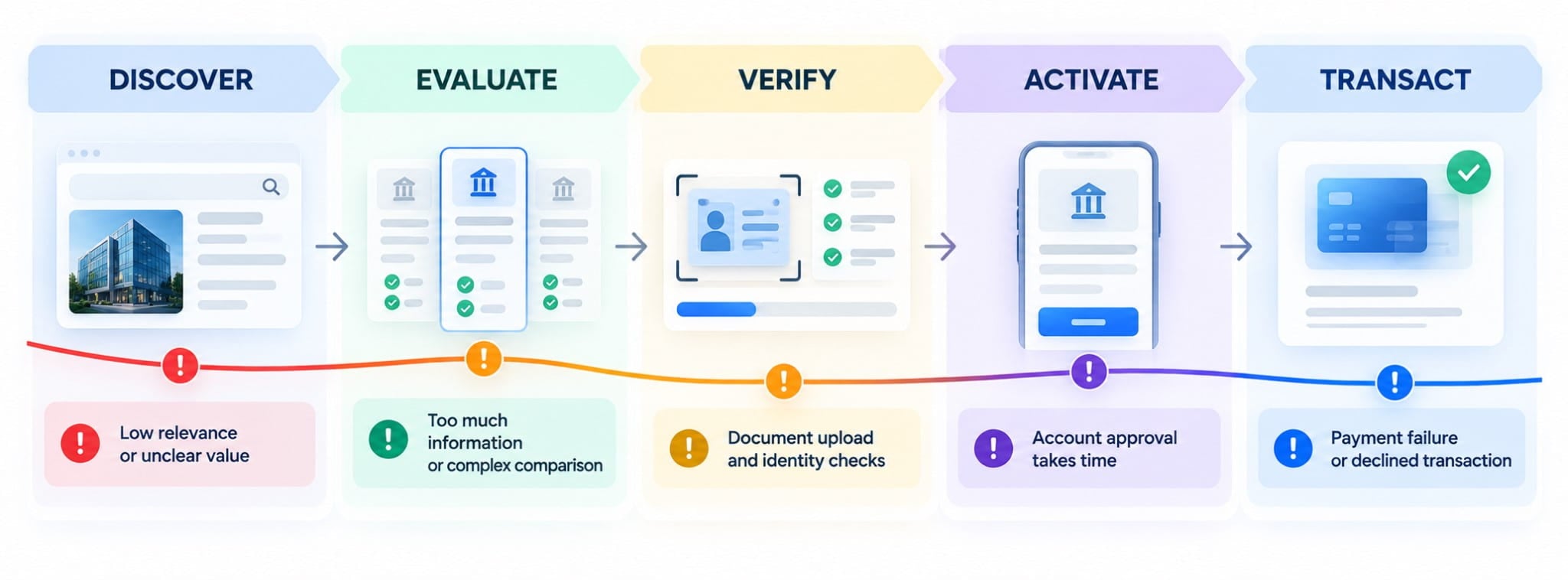
For teams optimizing fintech customer journeys, usability reviews should examine:
- Discovery: Can visitors identify the intended product?
- Evaluation: Are conditions understandable before signup?
- Verification: Can customers recover from document errors?
- Activation: Is the next meaningful action obvious?
- Transaction: Are amounts and destinations confirmed clearly?
Understanding how UX affects SEO helps teams evaluate the broader impact of financial website improvements. However, search visibility cannot replace qualified activation metrics. Both outcomes require separate measurement.
Test Conversion Changes Across the Fintech Customer Journey
Fintech conversion optimization requires experiments that connect interface changes with downstream behavior. A stronger signup result does not automatically imply improved financial product conversion. Testing should therefore include meaningful quality safeguards.
Different changes require different evaluation periods. Button wording may influence immediate behavior. Activation improvements can require additional observation before their business impact becomes visible.
Use this checklist to evaluate fintech conversion experiments:
- Test hypothesis: Reduce optional registration fields to address signup friction.
- Primary metric: Measure completed registrations against eligible signup starts.
- Quality safeguards: Monitor verification approval and funded-account conversion.
- Evaluation period: Allow sufficient time to observe downstream activation.
- Supporting evidence: Record the friction data and expected improvement mechanism.
- Negative results: Document unsuccessful experiments and update future testing priorities.
Which Fintech User Flows Should You Optimize First?
Prioritize fintech conversion rate optimization opportunities by combining measurable abandonment with commercial value and implementation feasibility. The largest drop-off is not automatically the best starting point. Some users abandon because they never met eligibility requirements.
Compare eligible customer volumes across individual funnel stages. Estimate potential gains using observed abandonment and realistic recovery assumptions. Regulatory constraints may limit which interventions teams can implement.
| Flow | Priority increases when | Critical safeguard |
| Signup | Qualified traffic abandons simple forms | Lead eligibility |
| KYC | Valid applicants encounter repeated failures | Verification integrity |
| Application | Eligible users stop before submission | Disclosure comprehension |
| Funding | Approved accounts remain unfunded | Payment risk |
| First transaction | Funded customers cannot complete intended actions | Transaction accuracy |
Use this prioritization checklist before selecting a project:
- Sufficient qualified traffic reaches the flow.
- Abandonment is materially above its established baseline.
- The target action has clear commercial value.
- Evidence identifies a plausible friction point.
- Required changes are technically feasible.
- Available data supports credible evaluation.
When internal capacity is limited, specialized CRO services can support audits and experiment execution. Prioritization should nevertheless remain tied to product economics. External support cannot substitute for accurate internal outcome data.
A practical fintech CRO strategy also considers expected impact per implementation effort. Fixing a broken funding confirmation may outrank redesigning a high-traffic homepage. Prioritize changes that recover qualified financial activity rather than improve superficial engagement metrics.
Fintech A/B Testing Checklist for Conversion Optimization
A fintech A/B testing checklist should connect each experiment with a defined customer problem and measurable business outcome. Tests must preserve compliance requirements across all variants. Changes affecting regulated disclosures require appropriate review before launch.
The following checklist provides an operational sequence rather than another theoretical testing framework.
- Define the problem. Identify the precise abandonment stage and affected customer segment.
- Form a hypothesis. Explain how one proposed change could remove observed friction.
- Select the flow. Choose a page or interaction with sufficient relevant traffic.
- Define the primary metric. Measure the action directly affected by the experiment.
- Establish safeguards. Monitor verification quality and downstream activation.
- Fix test conditions. Set eligibility rules and allocation before launch.
- Estimate sample requirements. Consider baseline rates and the minimum meaningful effect.
- Validate instrumentation. Confirm events and assignment logic across variants.
- Evaluate reliability. Apply the planned statistical method and stopping rules.
- Document the decision. Record implementation outcomes and unresolved questions.
For example, a lending team might test simplified application instructions. The primary measure could be eligible application completion. Approval quality should remain a guardrail.
Alongside signup and activation rates, monitor KYC failures, fraud indicators, payment failures, and transaction disputes. A variation that generates more signups but increases fraud exposure or reduces successful transactions should not automatically be considered a winning experiment.
Dennis F., PPC Team Lead at NinjaPromo
Avoid changing traffic allocation after observing early favorable results. Repeatedly checking significance can distort conclusions without appropriate sequential methods. Low-volume flows may require usability research before controlled experimentation becomes practical.
How to Measure Fintech Conversion Performance
Fintech conversion rate optimization should measure progression from qualified acquisition to completed financial activity. Intermediate events help identify friction but cannot establish commercial success alone. Reporting must connect each stage with a defined eligible population.
Different products require different final outcomes. Lending teams may prioritize approved and funded applications. Payment businesses often focus on successful transaction activity.
| Metric | Calculation | What it reveals |
| Signup rate | Completed signups ÷ eligible visitors | Registration effectiveness |
| KYC completion | Completed checks ÷ started checks | Verification progression |
| KYC approval | Approved verification cases ÷ decided verification cases | Verification quality |
| Application completion | Submitted applications ÷ started applications | Application friction |
| Funding rate | Funded accounts ÷ approved accounts requiring funding | Initial funding completion |
| First-transaction rate | Transacting users ÷ eligible activated users | Initial product use |
| Revenue per acquired customer | Attributed revenue ÷ acquired customers | Commercial contribution |
Keep denominators consistent when comparing periods. Changes in eligibility rules can alter rates without any interface improvement. Segment reporting should therefore identify material policy changes.
Use this checklist to validate fintech conversion performance:
- Traffic quality: Compare registrations with funded-account conversion across acquisition segments.
- Customer intent: Identify whether increased signups attract less qualified applicants.
- Data privacy: Exclude sensitive financial information from unrestricted session recordings.
- Consent management: Verify appropriate consent handling before collecting behavioral data.
- Access controls: Restrict analytics permissions according to data sensitivity.
Fintech CRO measurement should also track acquisition costs and customer value. Revenue growth can remain weak despite higher activation when average transaction values decline. Retention reveals sustained product use, while risk-adjusted contribution shows whether acquired customers generate economically valuable activity.
Final Thoughts
Effective fintech conversion optimization connects customer understanding with reliable financial outcomes. The strongest improvements remove unnecessary friction while preserving required safeguards. Registration gains matter when eligible customers progress toward meaningful product use.
Prioritize journeys using evidence and commercial value. Test changes against downstream performance rather than isolated interface activity. Consistent measurement turns individual experiments into a sustainable optimization program.