

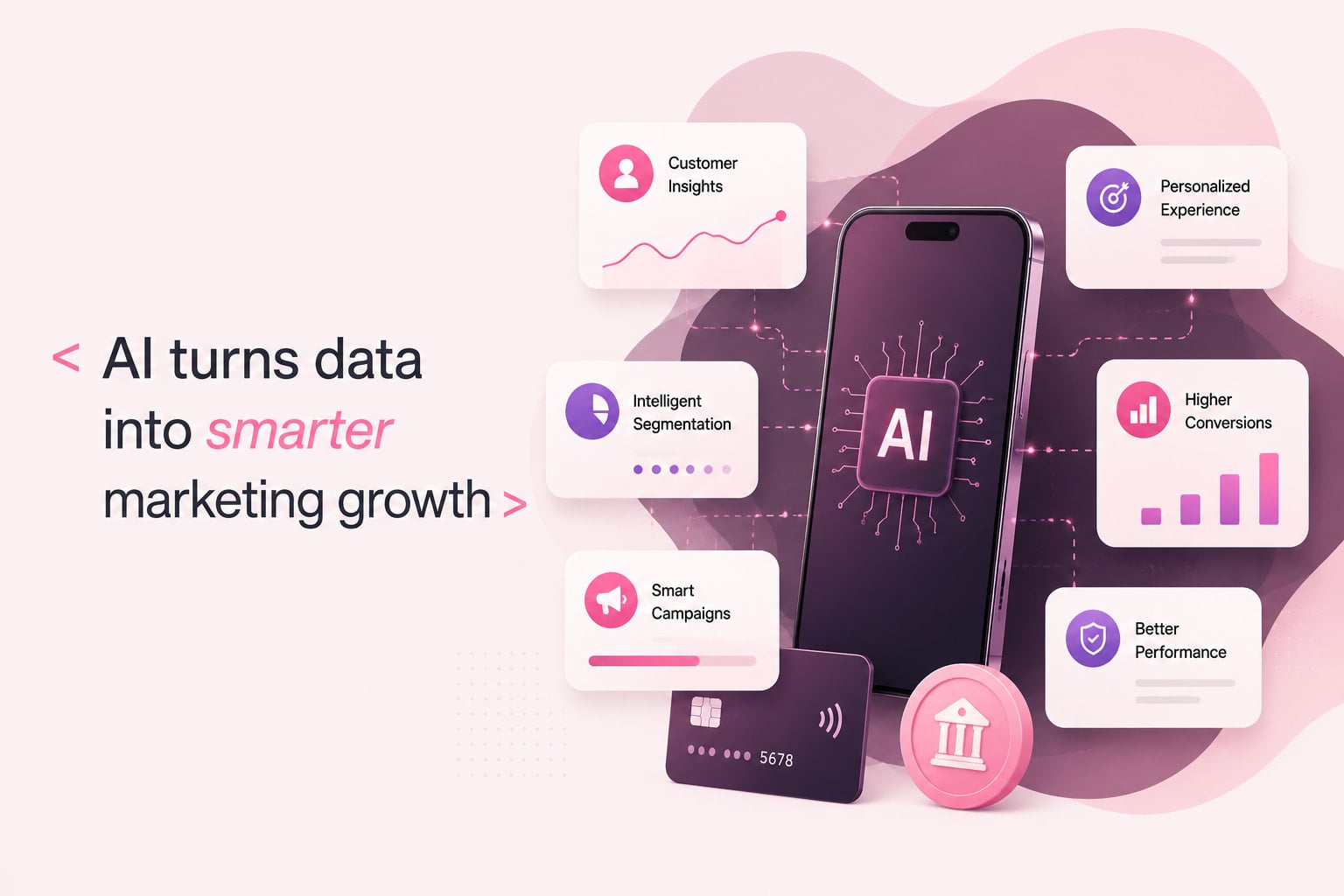
Artificial intelligence is transforming fintech marketing by helping companies make faster decisions, personalize customer experiences, automate repetitive work, and improve campaign performance using real customer data. The most successful implementations combine AI with clear business objectives, high-quality data, and human oversight rather than relying on automation alone.
Essential AI Marketing Practices for Fintech Growth
AI digital marketing for fintech delivers measurable value when it solves practical marketing challenges rather than replacing existing workflows. Instead of automating everything, successful fintech companies introduce AI where it improves decision-making, increases efficiency, or uncovers insights that marketers would struggle to identify manually.
The table below summarizes the primary marketing objective behind each AI practice discussed throughout this guide.
| AI Marketing Practice | Primary Goal | Typical AI Tools |
| Brand monitoring | Reputation management | Brand24, Meltwater, Talkwalker |
| Go-to-market planning | Market validation | Similarweb AI, Crayon, Semrush AI |
| Personalization | Customer engagement | Dynamic Yield, Adobe Journey Optimizer |
| Content creation | Marketing efficiency | ChatGPT, Jasper, Writer |
| Predictive lead scoring | Better lead quality | Salesforce Einstein, HubSpot AI |
| Conversational AI | Customer support and acquisition | Intercom Fin, Ada, Drift |
| Marketing analysis | Campaign optimization | GA4, Looker Studio, Mixpanel |
Teams comparing automation platforms can also review modern AI marketing tools before choosing technology for content, personalization, or customer engagement.
Use AI to Monitor Brand Reputation and Market Trends
AI-powered reputation monitoring continuously analyzes brand mentions, customer sentiment, competitor activity, and emerging industry discussions, helping fintech marketers react before small issues become larger business problems.
Traditional monitoring often depends on manual searches or delayed reporting. AI systems instead process thousands of conversations across news websites, review platforms, Reddit discussions, LinkedIn posts, financial media, and social networks in near real time. Rather than simply counting mentions, modern platforms identify sentiment shifts, recurring complaints, competitor campaigns, and topics that deserve immediate attention.
For example, imagine a digital payments provider launching a new international transfer feature. Within days, AI monitoring detects that users repeatedly question transfer speed rather than pricing. Marketing teams can immediately update landing pages, FAQs, paid advertising, and educational content to address this concern before it negatively affects conversion rates.
Platforms such as Brand24, Meltwater, and Talkwalker combine natural language processing with sentiment analysis to identify trends that would otherwise require extensive manual research. Instead of waiting for monthly reports, marketers receive alerts when customer perception changes or competitors introduce new messaging strategies.
AI monitoring helps marketers identify:
- Rapid sentiment changes
- Emerging customer concerns
- Competitor messaging shifts
- Trending financial topics
- Potential reputation risks
Companies developing broader fintech marketing strategies often combine AI monitoring with SEO, paid media, and content planning to respond more quickly to market developments.
Apply AI Insights to Strengthen Go-to-Market Planning
AI strengthens go-to-market planning by reducing uncertainty during audience research, positioning, competitive analysis, and product launch preparation. AI models reduce this risk by analyzing search demand, customer conversations, competitor positioning, pricing patterns, and behavioral data simultaneously.
Suppose a fintech company plans to launch a subscription-based expense management platform for freelancers. Instead of relying exclusively on surveys, marketers combine AI-powered competitive intelligence with search trend analysis and customer feedback collected from professional communities. The resulting insights reveal that tax reporting, rather than budgeting, represents the strongest purchase driver. Marketing messages, website copy, and launch campaigns are then built around this finding.
AI also accelerates segmentation, making fintech marketing automation more useful for launch planning and customer targeting.
| Go-to-Market Challenge | How AI Helps | Business Benefit |
| Audience segmentation | Groups users by behavior and intent | More relevant targeting |
| Competitive positioning | Compares messaging across competitors | Stronger differentiation |
| Market validation | Analyzes search demand and conversations | Lower launch risk |
| Product prioritization | Identifies emerging customer needs | Better resource allocation |
Teams developing a comprehensive fintech go-to-market strategy often combine AI research with interviews, customer validation, and commercial testing before committing significant marketing budgets.
Drive Customer Engagement Through Intelligent AI Personalization
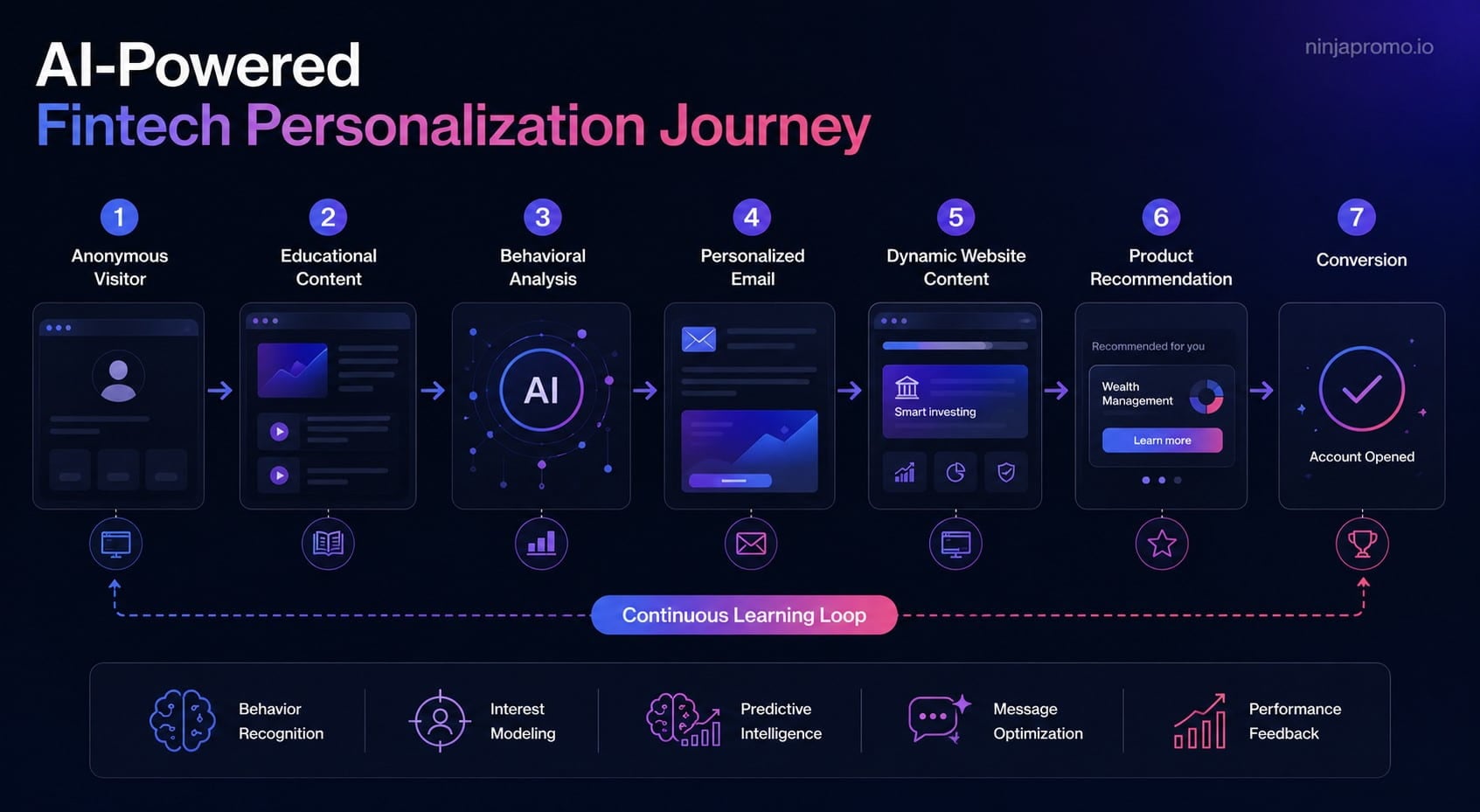
AI personalization adapts marketing messages, website experiences, email campaigns, advertising, and product recommendations according to each customer’s behavior instead of delivering identical content to every visitor.
Consider a consumer researching investment products over several weeks. Initially, AI identifies informational intent and recommends educational articles about portfolio diversification. As browsing behavior shifts toward fee comparisons and account opening requirements, the website automatically highlights investment calculators, onboarding guidance, and product-specific offers. Email campaigns, paid advertisements, and remarketing messages adapt simultaneously, creating a consistent experience across every channel.
Adobe Journey Optimizer, Dynamic Yield, Salesforce Marketing Cloud, and similar platforms allow marketers to automate these personalized experiences while maintaining centralized control over compliance requirements and brand messaging.
According to McKinsey’s analysis of personalized marketing, AI and generative AI help companies scale personalized customer experiences by adapting interactions to changing customer needs.
Personalization commonly improves:
- Customer engagement
- Product adoption
- Email performance
- Customer retention
- Conversion rates
Organizations tracking fintech marketing trends increasingly prioritize personalization because it allows marketing teams to scale relevance without proportionally increasing campaign complexity.
“The first thing I’d check is what the AI is actually optimizing for. Higher engagement does not prove much by itself. Users may click more, read more, or open more emails, but that does not necessarily move them closer to meaningful financial actions such as registration, KYC verification, or a first deposit. I look at three factors: segmentation quality, whether the offer matches genuine user intent, and where trust breaks down along the conversion path. In many cases, personalization fails because it does not address the real barrier, whether that’s unclear terms, concerns about security, or uncertainty that the product is the right fit.”
Maya Miller, Strategist at NinjaPromo
Automate Content Creation for Fintech Audiences
AI accelerates content production by helping marketers research topics, generate first drafts, repurpose existing materials, and personalize messaging without sacrificing editorial quality. For fintech companies, the biggest advantage is not replacing writers but enabling experts to publish more consistently while maintaining accuracy and compliance.
A practical workflow illustrates this well. Imagine a fintech company preparing educational content around cross-border payments. AI first analyzes trending customer questions using search data and discussion forums. It then creates a structured outline, suggests related entities, generates multiple headline variations, and proposes meta descriptions. A fintech marketing specialist reviews every claim, adds proprietary expertise, verifies compliance requirements, and publishes the final article. Instead of replacing human knowledge, AI removes repetitive work while preserving editorial oversight.
Modern AI-powered fintech marketing workflows often combine multiple AI platforms. ChatGPT supports ideation and drafting, Jasper assists with campaign copy, Writer enforces brand consistency, while Grammarly performs final language review before publication.
AI-generated content performs best when combined with human expertise.
| Content Stage | AI Contribution | Human Responsibility |
| Topic research | Analyze search trends and customer questions | Select strategic priorities |
| Content outline | Build article structure | Refine narrative and expertise |
| First draft | Generate initial copy | Fact-check and improve accuracy |
| SEO optimization | Suggest entities and metadata | Validate keyword strategy |
| Compliance review | Flag inconsistent wording | Approve regulatory accuracy |
Companies expanding their fintech content marketing programs increasingly use AI to scale educational resources without compromising quality or trust.
“AI saves the most time during preparation. It can analyze large datasets, identify patterns, repurpose long reports, build initial content structures, research topics, and adapt one asset for multiple channels. However, content quality remains high only when industry expertise, strategic thinking, and final editorial review stay in human hands.”
Maya Miller, Strategist at NinjaPromo
Leverage Predictive Analytics to Identify High-Value Fintech Leads
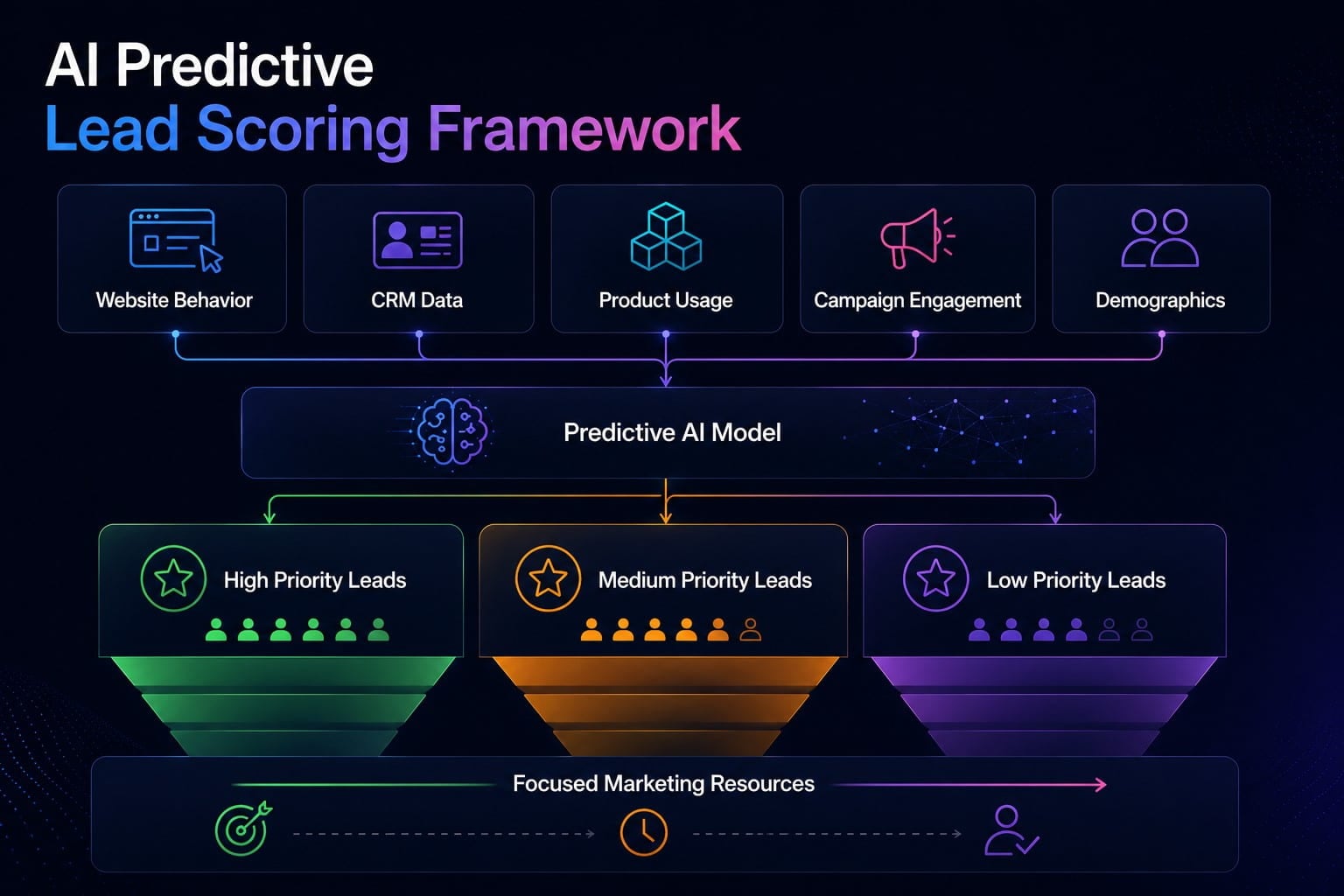
Predictive analytics helps marketers identify prospects most likely to convert before significant advertising budgets are spent on low-value audiences.
Instead of evaluating customers only after they complete a purchase, predictive models analyze behavioral patterns throughout the buying journey. Website activity, CRM records, previous product interactions, transaction history, campaign engagement, and demographic signals are combined to estimate future purchase probability.
Consider a lending platform attracting thousands of monthly visitors. Traditional lead scoring might prioritize everyone who downloads a loan guide. Predictive AI, however, recognizes that visitors comparing interest rates, returning multiple times within one week, and completing affordability calculators historically convert far more often than users who simply consume educational content. Marketing teams can therefore prioritize these prospects for remarketing, personalized outreach, or sales follow-up.
Platforms such as Salesforce Einstein, HubSpot AI, Snowflake Cortex, and Microsoft Dynamics Customer Insights help marketers automate predictive scoring while continuously refining models using newly collected customer data.
Machine learning in fintech marketing becomes even more valuable as marketing channels expand because it helps allocate advertising budgets toward audiences with the greatest commercial potential.
Predictive lead scoring typically improves:
- Lead prioritization
- Sales efficiency
- Advertising ROI
- Customer acquisition costs
- Campaign targeting
AI for fintech marketing helps predictive analytics shift investment toward qualified demand instead of awareness.
Enhance Customer Engagement with Conversational AI
Conversational AI improves customer acquisition, onboarding, and retention by providing immediate, context-aware assistance across websites, mobile apps, and messaging platforms.
Unlike traditional chatbots that rely on predefined decision trees, modern conversational AI understands intent, remembers previous interactions, and adapts responses according to customer history. This creates faster support experiences while reducing pressure on customer service teams.
Conversational AI is especially useful for:
- Explaining product eligibility
- Collecting onboarding details
- Routing complex cases
- Reducing repeated support questions
- Re-engaging returning visitors
A fintech customer researching mortgage products provides a useful example. During the first website visit, an AI assistant answers eligibility questions and recommends educational resources. When the customer returns several days later, the assistant recognizes previous interactions, explains required documentation, estimates application timelines, and schedules a consultation with a human advisor if needed. Every conversation builds on earlier interactions instead of restarting from the beginning.
Platforms such as Intercom Fin, Ada, Zendesk AI, and Drift combine conversational interfaces with CRM integration, allowing AI assistants to personalize recommendations using customer profiles and previous engagement.
Tasks well suited for conversational AI include:
- Product recommendations
- FAQ support
- Customer onboarding
- Appointment scheduling
- Lead qualification
Financial organizations implementing AI-powered marketing for fintech businesses often combine conversational AI with human advisors for complex financial decisions where trust and regulatory accuracy remain essential.

Strengthen Marketing Strategies with AI-Driven Analysis
AI-powered marketing analysis identifies performance gaps, inefficient spending, audience opportunities, and customer journey friction faster than traditional reporting methods.
Conventional dashboards explain what happened. AI increasingly explains why it happened and recommends actions that improve future performance. By analyzing campaign results, attribution data, customer behavior, conversion paths, and budget allocation simultaneously, AI highlights relationships that marketers frequently overlook.
Imagine a fintech subscription platform experiencing declining paid search performance despite increasing advertising budgets. AI analysis discovers that conversion rates remain strong among returning visitors but decline sharply for first-time users arriving from generic keywords. Rather than increasing bids, marketers redirect budget toward higher-intent search themes, simplify landing pages, and strengthen educational content for early-stage prospects. Performance improves because optimization targets the underlying cause rather than the visible symptom.
Google Analytics 4, Mixpanel, Looker Studio, and modern AI analytics platforms increasingly combine predictive insights with anomaly detection, helping marketers recognize problems before they significantly affect revenue.
Marketing analysis frequently uncovers:
- Inefficient budget allocation
- Weak audience segments
- Underperforming campaigns
- Customer journey friction
- Messaging inconsistencies
Many organizations using AI for fintech marketing combine automated analysis with quarterly strategic reviews to ensure AI recommendations align with broader commercial objectives.
The fintech companies seeing the strongest marketing results are not those using the most AI tools. They are the ones applying AI to improve specific business decisions, such as identifying high-intent customers, personalizing communication, optimizing acquisition costs, and uncovering opportunities that traditional analysis often misses.
What Separates Successful AI Adoption from Expensive Experimentation?
Successful AI adoption begins with solving clearly defined business problems rather than implementing technology for its own sake. Fintech companies achieve the strongest results when every AI initiative supports measurable objectives such as lowering customer acquisition costs, improving retention, increasing qualified leads, or reducing campaign execution time.
A useful way to evaluate AI readiness is through five practical questions.
| Question | Why It Matters | Risk if Ignored |
| Is the business objective clearly defined? | AI should optimize measurable outcomes. | AI automates the wrong activities. |
| Is customer data reliable? | AI models depend on accurate inputs. | Poor recommendations and inaccurate predictions. |
| Can AI integrate with existing systems? | Connected data improves decision-making. | Fragmented customer experiences. |
| Does the team understand how to use AI? | Human oversight improves performance. | Low adoption and inconsistent execution. |
| Are success metrics established before launch? | Progress becomes measurable. | ROI becomes difficult to evaluate. |
A practical example illustrates this difference. Imagine two digital banks introducing AI-powered personalization. One immediately automates email campaigns without improving customer segmentation, resulting in higher email volume but unchanged conversion rates. The second first cleans CRM data, defines customer lifecycle stages, and establishes clear success metrics before introducing AI. Although both organizations use similar technology, only the second achieves measurable improvements because AI enhances an already well-structured process.
Successful implementation also requires realistic expectations. AI rarely delivers dramatic improvements immediately after deployment. Instead, performance typically increases through continuous refinement, better training data, regular model evaluation, and close collaboration between marketing, analytics, and compliance teams.
Organizations implementing AI for fintech marketing should therefore treat AI as an optimization framework rather than a replacement for strategic marketing expertise.
“AI is a strong assistant, but it is only as good as the thinking and instructions behind it. When a decision cannot be made from clean data alone and instead requires market understanding, commercial judgment, and experience, it should never rely on AI alone. This is especially true for strategy, positioning, go-to-market planning, and business development.”
Maya Miller, Strategist at NinjaPromo
How Can Fintech Teams Balance AI Automation with Human Expertise?
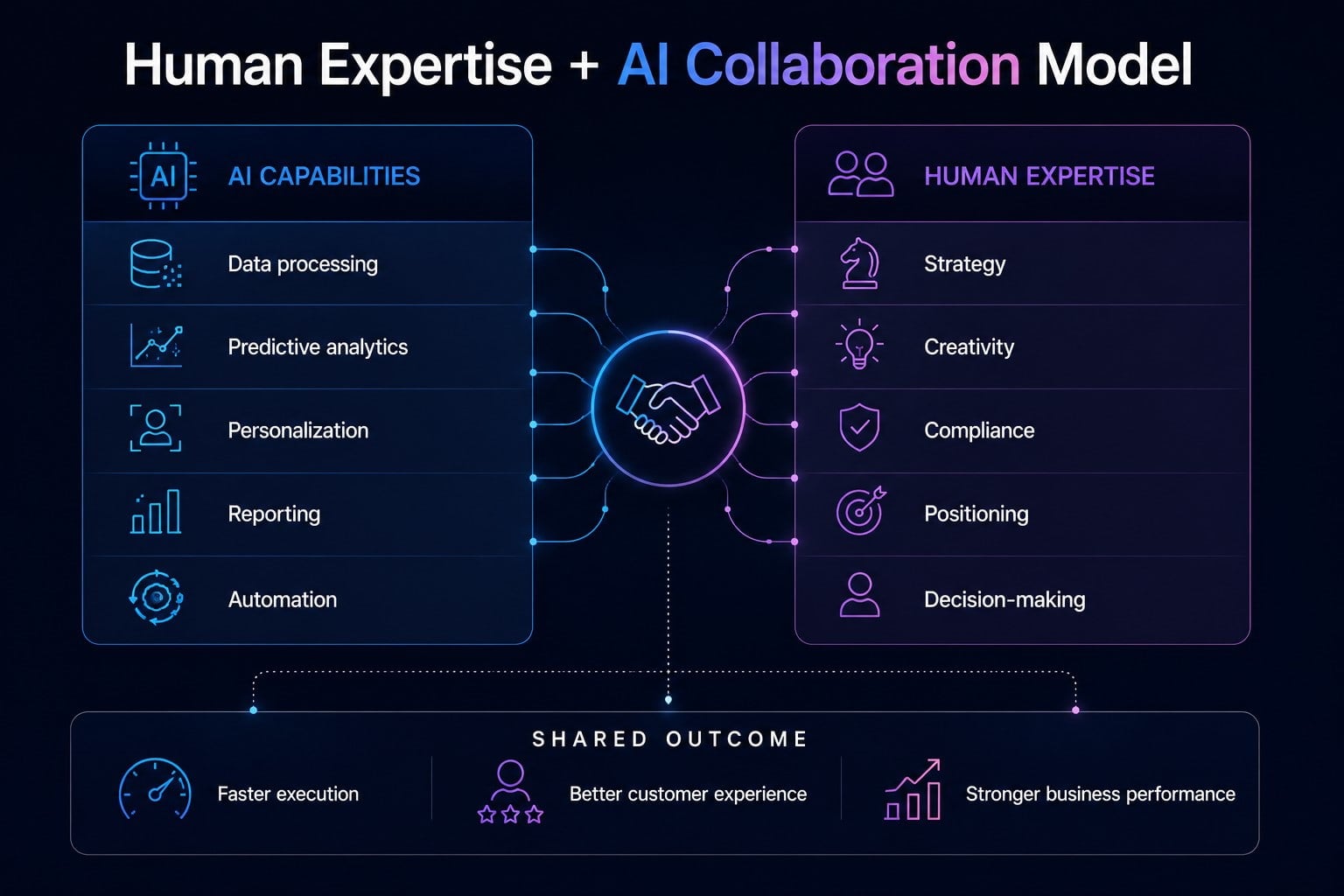
Fintech marketing performs best when AI handles speed, scale, and data analysis while people remain responsible for judgment, creativity, compliance, and strategic decision-making.
The most successful AI-powered marketing for financial technology firms assigns responsibilities according to each participant’s strengths.
| Marketing Activity | AI Contribution | Human Expertise |
| Audience analysis | Pattern recognition | Strategic interpretation |
| Content drafting | Initial content generation | Expertise, editing, compliance |
| Campaign optimization | Budget and bidding recommendations | Business priorities and approval |
| Customer personalization | Dynamic recommendations | Brand voice and customer trust |
| Marketing reporting | Automated insights | Commercial decision-making |
Consider content marketing as an example. AI may analyze search demand, generate article structures, recommend semantic entities, and draft the first version of educational content. Human specialists then validate financial accuracy, strengthen explanations using industry expertise, review compliance requirements, and ensure every recommendation reflects the organization’s positioning. The result is significantly faster production without sacrificing credibility.
The same principle applies to paid advertising. AI can optimize bidding strategies, forecast campaign performance, and identify underperforming audiences far more quickly than manual analysis. Human marketers remain responsible for defining customer acquisition goals, evaluating commercial priorities, approving creative direction, and ensuring every campaign complies with financial regulations.
Human marketers should still control:
- Risk tolerance for acquisition costs
- Exclusions for sensitive audience groups
- Messaging around financial promises
- Approval rules for regulated claims
- Escalation criteria for unusual results
As artificial intelligence in fintech continues to evolve, organizations should avoid viewing automation as a substitute for experienced professionals. Instead, AI becomes most valuable when it expands the capabilities of marketing teams, allowing specialists to spend less time on repetitive execution and more time on strategic planning, experimentation, and customer experience.
Businesses investing in B2B fintech marketing frequently combine AI automation with experienced strategists because enterprise sales cycles require relationship-building, trust, and commercial judgment that extend well beyond algorithmic optimization.
Final Thoughts
Artificial intelligence is reshaping fintech marketing by making customer insights, personalization, content creation, and campaign optimization significantly more effective. The organizations achieving the strongest results are those that use AI to improve existing marketing decisions rather than replacing strategic thinking with automation.
As the future of AI in fintech marketing continues to develop, success will depend on balancing technological efficiency with human expertise. Companies that combine reliable data, responsible AI adoption, and experienced marketing leadership will be best positioned to deliver data-driven customer experiences, strengthen customer trust, and build sustainable competitive advantages.