


Key Findings
- SEO marketing delivers the strongest results when technical optimization, content strategy, and business objectives support one another.
- Search intent has become a stronger competitive advantage than keyword volume alone.
- AI-powered search increasingly rewards comprehensive, experience-driven content over pages created primarily for ranking.
- Organic visibility should be evaluated through business outcomes such as qualified leads and revenue, not rankings alone.
- Long-term success depends on continuous optimization rather than one-time implementation.
Search has changed rapidly in recent years. Traditional rankings now compete with AI-generated answers and rich search features, which means visibility is no longer limited to standard results pages. Search algorithms also evaluate expertise, topical authority, and user experience together. As a result, businesses that still treat SEO as a checklist of keywords and backlinks risk losing visibility, even when their websites appear technically sound.
Modern SEO marketing therefore focuses on more than ranking individual pages. Its purpose is to make a business the most reliable answer to a user’s problem across traditional search, AI Overviews, and emerging answer engines. This requires organizations to connect technical quality with genuine business expertise instead of optimizing isolated elements.
Successful organizations treat search as a long-term business asset. They align content with customer intent, strengthen technical foundations, and measure commercial outcomes. This guide explains how these elements work together to support sustainable growth.
What Is SEO Marketing?
SEO marketing increases a company’s visibility across organic search. It also supports measurable business objectives. These objectives extend beyond keyword rankings. They include attracting qualified prospects, strengthening brand authority, and supporting sustainable customer acquisition. Effective search engine optimization marketing connects organic visibility with measurable commercial outcomes.
This broader definition reflects how search engines have evolved. Modern ranking systems evaluate relationships between topics, expertise, and user satisfaction. They no longer rely on keyword matching alone. Successful optimization depends on consistent expertise across a subject. Publishing isolated optimized pages is no longer enough.
Modern SEO marketing focuses on:
- Aligning search visibility with measurable business objectives.
- Building topical authority instead of optimizing isolated pages.
- Delivering content that satisfies user intent across the customer journey.
- Maintaining a technically accessible website for search engines.
- Strengthening credibility through expertise and trust signals.
Search visibility also extends beyond the familiar list of blue links. AI summaries and featured snippets now influence how users discover information. Local results, video results, and answer engines also shape visibility. Organizations that adapt to these experiences improve discoverability. They also remain more resilient as search technology evolves.

Why SEO Is Important for Business Growth
Many organizations judge search performance almost exclusively by keyword positions. Rankings remain important, but they provide only one performance indicator. This explains why SEO is important for sustainable customer acquisition. A broader system determines whether search creates meaningful business value. Effective organic search marketing attracts demand while strengthening long-term brand visibility.
A page ranking first for an informational keyword may generate thousands of monthly visits without producing qualified leads. A lower-ranking page can generate more revenue. It reaches users who are closer to making a purchase. Effective lead generation prioritizes commercial intent over raw traffic volume. This distinction is important when evaluating SEO in marketing. Commercial impact should outweigh vanity metrics.
Business value from SEO often comes from:
- Attracting visitors with stronger purchase intent.
- Building brand familiarity through repeated search visibility.
- Supporting customer decisions throughout the buying journey.
- Contributing to long-term revenue instead of rankings alone.
Search visibility also influences customer decisions before users click a result. Repeated exposure to authoritative content increases brand familiarity. Strategic SEO for brand awareness strengthens recognition before prospects are ready to buy.
Branded search demand has become a much stronger SEO signal over the past two years. As AI-powered search engines increasingly rely on trusted, recognizable sources, brands with stronger recognition tend to gain better visibility in traditional search and AI-generated results.
Olivia G., SEO Specialist at NinjaPromo
Consistent visibility also reinforces credibility throughout the buying journey. As a result, organizations that invest strategically in search often generate value beyond direct organic traffic.
Another important consideration is how search supports the wider marketing ecosystem. The role of SEO in marketing expands when search supports multiple acquisition channels. Visitors may first discover a company through organic search. They often return later through branded searches, email, or direct visits. SEO integration with other marketing channels creates a more connected acquisition journey. Evaluating performance in isolation therefore underestimates the role search plays in shaping customer acquisition across multiple channels. Effective SEO and marketing alignment strengthens attribution throughout the customer journey.
SEO contributes to business growth by:
- Attracting visitors with strong purchase intent.
- Supporting brand recognition throughout the buying journey.
- Increasing trust before prospects become customers.
- Assisting conversions across multiple marketing channels.
Sustainable SEO requires continuous improvement rather than one-time implementation. As search behavior and algorithms evolve, organizations must refine their strategies to maintain long-term visibility.
How Modern Search Engines Evaluate Quality
Search engines no longer rely on a single ranking formula. This approach aligns with Google’s SEO Starter Guide. They evaluate multiple signals that work together to estimate relevance and quality.
| Evaluation Area | What Search Engines Assess | Business Value |
| Relevance | How effectively the content satisfies user intent | Higher engagement from qualified visitors |
| Technical Quality | Crawlability, indexability, performance, and structured implementation | Improved accessibility for search systems |
| Authority | Demonstrated expertise and trusted references | Greater confidence in published information |
| User Experience | Navigation, readability, and page usability | Increased satisfaction and stronger conversions |
| Freshness | Ongoing maintenance and content accuracy | Continued relevance as search behavior changes |
Key Types of Search Engine Optimization
No single optimization technique can deliver sustainable results on its own. Different types of SEO address distinct visibility and performance challenges.
- Technical SEO provides the foundation that allows search engines to crawl, understand, and index a website efficiently.
- On-page SEO improves page relevance.
- Off-page SEO strengthens authority through trustworthy external signals.
Each discipline supports a different aspect of performance. Balanced investment produces stronger long-term results. Modern SEO techniques work best when technical quality supports user relevance.
Local and international optimization extend this framework by adapting visibility to specific markets. A neighborhood business may prioritize geographic relevance. A global organization must also manage multilingual content and localization. Effective SEO digital marketing strategies combine these disciplines around business goals. They avoid using the same approach for every website.
Effective SEO digital marketing also requires consistent measurement throughout every stage of growth.
| SEO Type | Primary Focus | Typical Business Outcome |
| Technical SEO | Crawlability, indexing, website performance | Better search accessibility |
| On-Page SEO | Content relevance and page optimization | Improved rankings for target topics |
| Off-Page SEO | Authority and reputation | Greater trust and stronger visibility |
| Local SEO | Geographic search intent | Increased local inquiries and visits |
| International SEO | Multi-country and multilingual optimization | Consistent global visibility |
The Core Practices Behind High-Performing SEO Marketing
High-performing SEO marketing is built on repeatable practices rather than isolated tactics. Successful organizations establish consistent processes instead of chasing algorithm updates. These processes improve technical quality, authority, and user experience.
Before examining each practice in detail, the following framework illustrates how they contribute to sustainable search performance.
| Core Practice | Primary Objective | Business Benefit |
| Align business goals | Define measurable outcomes | Better investment decisions |
| Sustainable optimization | Build long-term resilience | Lower ranking volatility |
| Search intent research | Match customer needs | Higher-quality traffic |
| Content authority | Demonstrate expertise | Increased trust |
| AI-ready optimization | Improve discoverability | Visibility across new search experiences |
| Technical excellence | Remove performance barriers | Better indexing |
| Website architecture | Strengthen topical relationships | Easier navigation |
| Strategic authority building | Earn trusted references | Greater competitive strength |
| Local and global optimization | Reach relevant audiences | Expanded market coverage |
Align SEO With Your Business Objectives
Optimization should begin with business outcomes rather than keyword targets. An enterprise company measures success through qualified leads. An Ecommerce retailer may instead prioritize product visibility.
Clear objectives determine which metrics deserve attention and which opportunities should receive priority. Every SEO campaign needs defined outcomes before teams choose specific tactics. Organizations should establish priorities before creating optimization roadmaps. Every search engine optimization strategy should begin with measurable commercial objectives. This prevents unnecessary work.
Business-aligned SEO planning should include:
- Clear commercial objectives
- Success metrics tied to revenue or leads
- Prioritized optimization initiatives
- Regular performance reviews
Businesses with specialized requirements often need a custom SEO approach. It should reflect their industry and sales cycle. Aligning optimization with commercial priorities creates a stronger framework. Every improvement then supports broader business growth.
External SEO services can close capability gaps when internal resources remain limited. Specialist support may also accelerate implementation across complex websites.
Choose Sustainable SEO Tactics Over Risky Practices
Search engines increasingly reward consistent quality while becoming more effective at identifying manipulative behavior. Short-term tactics may deliver temporary gains, but they frequently introduce long-term risk through ranking volatility or manual penalties. Understanding white hat vs black hat SEO helps teams evaluate those risks.
Sustainable optimization emphasizes genuine expertise, technically sound implementation, and content that answers real customer questions. This approach requires more patience, yet it builds assets that remain valuable even as search algorithms evolve.
Sustainable SEO avoids practices such as:
- Manipulative link schemes.
- Thin or duplicated content.
- Keyword stuffing.
- Short-term ranking tactics.
Organizations should evaluate every optimization decision by asking whether it improves the user experience as well as search visibility. When both objectives are supported simultaneously, long-term performance becomes significantly more stable.
Conduct Keyword Research and Understand Search Intent
Effective keyword research begins with understanding why someone performs a search rather than compiling the largest possible list of phrases. Two users may enter similar queries but expect different outcomes. Search intent often matters more than search volume.
Most searches fall into informational, navigational, commercial, or transactional intent. Recognizing these patterns helps businesses satisfy user expectations. One page should not cover multiple unrelated goals. This customer-first approach strengthens SEO marketing by improving relevance throughout the buying journey.
Search intent usually falls into four categories:

Modern research also considers topical relationships instead of individual keywords in isolation. Building content around related questions improves topical understanding. Logical topic clusters also help readers find complete answers. Organizations with a long-term SEO content strategy often outperform competitors. They build topical authority instead of targeting isolated keywords.
Create a Content Strategy That Builds Authority
Publishing more articles does not automatically improve organic visibility. Search engines increasingly reward websites with consistent topical expertise. Disconnected keyword-focused content is less effective.
Authority develops when content answers progressively deeper questions as readers move through the decision-making process. Introductory resources build awareness. Detailed guides and practical examples reinforce credibility for informed readers.
Authority grows when content:
- Covers related topics in depth
- Answers real customer questions
- Stays accurate through regular updates
- Supports logical internal linking
Content should also remain a living business asset rather than a one-time publication. Regular updates help maintain relevance over time. Performance reviews should guide future improvements. Organizations often discover new opportunities by improving existing content first. Creating additional pages should come later.
Creating truly valuable, experience-driven content remains one of the most underestimated SEO practices. Businesses achieve stronger long-term results by demonstrating genuine expertise instead of publishing large volumes of generic AI-generated content.
Olivia G., SEO Specialist at NinjaPromo
Adapt SEO for AI-Powered Search
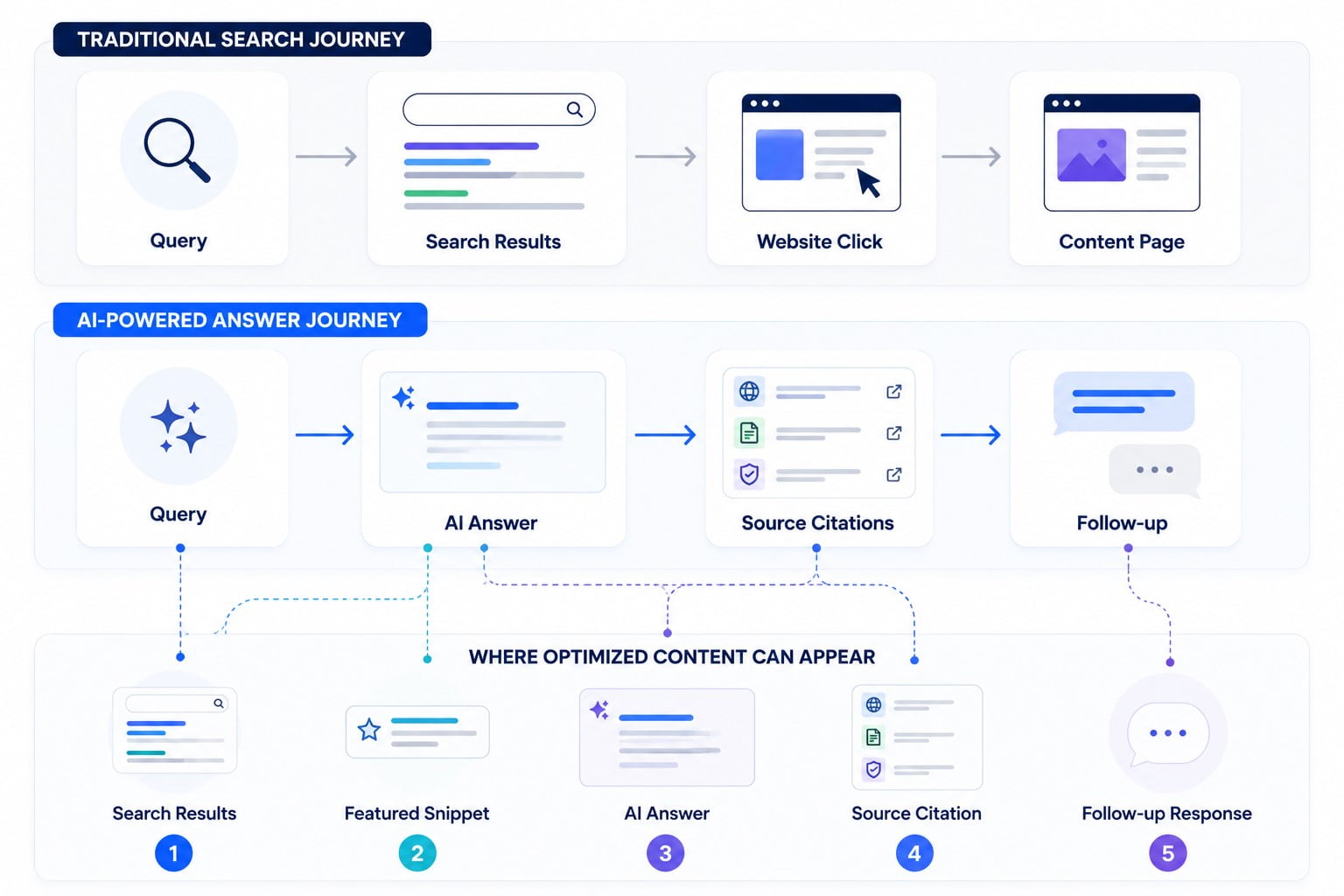
AI-powered search is changing how users discover information. Search platforms increasingly generate direct answers instead of listing ranked links. Visibility now depends on content quality and traditional rankings.
This shift rewards well-structured, experience-driven resources. Clear explanations and logical organization improve visibility. Pages that answer related questions comprehensively are more likely to support AI-generated responses. Repetitive keyword content is less effective.
AI search has changed how content should be evaluated before publication. Concise answers, clear structure, tables, bullet-point lists, and direct explanations make content easier for both users and AI systems to understand while preserving depth and value.
Olivia G., SEO Specialist at NinjaPromo
Understanding LLM SEO helps brands stay visible as search evolves beyond traditional rankings.
AI-friendly content is more likely to:
- Address complete user questions
- Present information in a logical structure
- Demonstrate first-hand expertise
- Support answer generation across search experiences
Businesses should create accurate and original information. It must also remain easy for users and search systems to interpret. Companies should use AI for SEO as a research and workflow tool. It cannot replace strategic expertise.
Improve Technical SEO Performance
Technical optimization ensures that valuable content can be discovered, interpreted, and indexed efficiently. Even the strongest editorial strategy has limits. Search engines must crawl and understand the website without obstacles. Effective SEO optimization removes technical barriers before content production expands.
Several technical elements deserve continuous monitoring because they directly influence discoverability:
- Website crawlability and indexation.
- Core Web Vitals and loading performance.
- XML sitemaps and robots directives.
- Canonical implementation and duplicate content management.
- Structured data where appropriate.
Regular reviews identify issues before they affect organic visibility. Routine SEO audit helps businesses detect indexing errors early. They also reveal broken references before traffic declines.
The first thing I check is which pages are driving organic traffic. A website can maintain stable traffic while losing visibility on the pages that matter most for conversions and business goals.
Olivia G., SEO Specialist at NinjaPromo
Maintaining awareness of common technical SEO issues also supports faster troubleshooting as websites grow and become more complex. A documented SEO process makes recurring technical reviews more consistent.
Optimize Website Structure and Internal Linking
Website structure determines how efficiently both users and search engines navigate information. A logical hierarchy groups related topics together. It also distributes authority more effectively across the website.
Internal links should support the user’s next step instead of existing solely for SEO purposes. Connecting related resources encourages deeper exploration. It also reduces navigation friction and strengthens topical clusters. Well-planned site architecture becomes more valuable as websites expand. It prevents important pages from becoming isolated.
A scalable website structure should provide:
- Clear navigation paths
- Logical topic relationships
- Consistent internal linking
- Room for future content growth
Navigation should also remain scalable. Businesses should organize categories and URLs before major expansion. Early planning reduces disruptive structural changes later. A consistent SEO taxonomy supports this process. It establishes clear relationships between categories and supporting content from the beginning.
Build Authority With a Strategic Link Building Approach
Authority remains a strong trust signal. Search engines now value backlink quality and relevance more than quantity. Sustainable link building strategies prioritize editorial relevance over backlink volume. A few references from respected publications often provide greater value. Hundreds of low-quality links rarely help.
Effective authority building begins with publishing resources that deserve to be cited. Original research and practical frameworks naturally attract references. They provide information unavailable elsewhere. Outreach then becomes an opportunity to introduce valuable resources rather than request links to ordinary content.
Editorial links are more likely to come from:
- Original research
- Practical guides
- Proprietary data
- Expert commentary
Businesses should also diversify how they earn recognition. Digital PR and expert commentary strengthen authority. Strategic partnerships also increase brand visibility. Organizations achieve stronger long-term results when every backlink reflects genuine editorial value. Artificial placement delivers less sustainable outcomes.
Optimize for Local and International Search
Search behavior changes significantly across locations, making geographic relevance an essential part of long-term optimization. Local businesses compete within specific service areas. International organizations must also consider language, culture, and regional search preferences.
Successful localization extends beyond translation. Effective SEO localization aligns content with regional language and customer expectations. Content should reflect regional terminology and local search intent.
Proper technical implementation helps search engines deliver the correct page version. Language targeting and regional URLs support this process.
Successful international SEO typically includes:
- Localized content that reflects regional search intent.
- Consistent technical standards across markets.
- Language and regional targeting.
- A structured expansion plan that supports long-term growth.

How Website Type and Industry Shape Your SEO Strategy
There is no universal SEO framework that produces identical results for every business. Website structure influences SEO priorities. Product complexity and market competition also affect resource allocation.
Different businesses may follow the same optimization principles. However, each prioritizes different activities. One business may focus on geographic relevance. Another may prioritize scalable architecture or topical authority. Understanding these differences improves investment decisions. Organizations can focus on activities with the highest commercial return.

🚀 New Websites Require Strong Foundations
Launching a new website creates an opportunity to build a strong SEO foundation. Early planning prevents expensive structural changes later. Decisions about information architecture, URL structure, and content hierarchy become harder to change as the site expands. Early planning therefore reduces future technical work and supports scalable growth.
Early-stage businesses should avoid publishing large volumes of low-value content simply to increase page count. A focused collection of authoritative pages usually establishes stronger topical relevance and creates a better foundation for expansion. This approach also makes it easier to maintain consistent quality as new sections are added.
Priorities for SEO for a new website include:
- Building a clear and scalable site structure.
- Publishing high-value pages around core topics.
- Setting realistic expectations for visibility growth.
- Earning trusted references over time.
- Developing authority through sustained optimization.
📄 One-Page Websites Have Unique Limitations
Single-page websites communicate a simple value proposition effectively. However, they offer limited opportunities to target multiple search intents. Every topic competes for space within a single URL. That makes it difficult to build topical authority or optimize for different stages of the customer journey.
This limitation does not mean one-page websites cannot perform well in search. Businesses with narrow service offerings can still achieve strong visibility. They need highly relevant content, solid technical performance, and clear navigation.
Before choosing SEO for one page website projects, consider whether you need to:
- Expand into additional services or product categories.
- Target multiple search intents with dedicated pages.
- Enter new geographic markets.
- Scale the website without major structural changes.
🎯 Industry Influences Search Strategy
Industry characteristics affect how users search, how competitors publish content, and how search engines evaluate credibility. Highly regulated industries require stronger signals of accuracy and trust. Competitive technology markets often need deeper educational content.
The length of the buying cycle also shapes optimization priorities. Businesses selling complex solutions benefit from detailed educational content. It supports prospects before they make purchasing decisions. Organizations with shorter buying journeys may instead prioritize commercial pages that reduce friction between discovery and conversion.
When adapting SEO to a specific industry, focus on:
- Matching content to customer decision-making behavior.
- Addressing the level of trust users expect.
- Aligning content depth with the buying cycle.
- Prioritizing user needs instead of copying competitor strategies.
🌍 International Expansion Requires More Than Translation
Expanding into additional markets introduces technical and editorial challenges that extend beyond language differences. Search behavior varies by region. Customer expectations also differ across cultures. Even identical products may require different messaging.
Successful international growth depends on localization rather than direct translation. Regional terminology and local search intent improve engagement. They also help search engines deliver the correct page version.
Before launching an international SEO migration, make sure to:
- Preserve redirects from existing URLs.
- Maintain internal linking between related pages.
- Protect existing search signals during the transition.
- Validate localization before publishing new regional content.
The Best Ways to Measure SEO Performance
Effective measurement begins by defining what success means for the business rather than the search engine. Rankings provide useful feedback, but they rarely capture the complete commercial impact of an optimization strategy. Organizations should evaluate more than ranking changes. Lead quality and long-term revenue matter just as much.
Performance should therefore combine visibility metrics with business outcomes. Organic sessions indicate whether search traffic is growing. Conversion data shows whether visitors complete valuable actions. Evaluating both perspectives produces a more accurate picture of how SEO marketing contributes to organizational growth. A strong approach connects visibility metrics with revenue and pipeline performance.
The following metrics provide a balanced framework for ongoing evaluation.
| Metric | Why It Matters | Business Question Answered |
| Organic traffic | Measures search visibility growth | Are more qualified users discovering the website? |
| Keyword visibility | Tracks topical presence | Is authority expanding across important subjects? |
| Click-through rate | Evaluates search result appeal | Are searchers choosing our pages? |
| Conversions | Measures commercial impact | Does organic traffic generate business value? |
| Revenue or pipeline contribution | Connects SEO with business performance | Is optimization supporting growth objectives? |
Current SEO statistics can provide useful benchmarks for evaluating broader performance trends.
No single metric should determine strategic decisions. Temporary ranking declines may occur alongside stronger lead quality. Higher traffic has little value if visitors are not aligned with business goals. Reviewing performance through multiple indicators helps distinguish meaningful progress from short-term fluctuations.
Measurement also benefits from regular reporting cycles that identify trends instead of isolated events. Compare performance over months instead of days. This reduces the impact of temporary algorithm changes and reveals long-term growth patterns.
The Most Common SEO Pitfalls and How to Fix Them
Even well-planned optimization strategies lose momentum when recurring problems remain unresolved. Many SEO issues develop gradually instead of appearing after a single update. Reviewing common SEO mistakes helps teams identify recurring weaknesses before visibility declines.
Regular reviews and clear performance benchmarks reveal declining visibility earlier. Cross-functional collaboration also improves response times. Organizations recover faster when optimization remains an ongoing process. Their websites already follow sustainable best practices.
| Common Issue | Why It Hurts Performance | Recommended Solution |
| Publishing content without a clear purpose | Pages compete against each other and fail to satisfy user intent | Define a primary objective for every page before publication |
| Ignoring technical maintenance | Search engines may struggle to crawl or index valuable content | Perform regular technical reviews and resolve priority issues |
| Chasing search volume alone | High traffic may produce little commercial value | Balance keyword demand with user intent and business goals |
| Weak internal linking | Important pages receive less authority and visibility | Strengthen contextual navigation between related resources |
| Treating SEO as a one-time project | Rankings decline as competitors improve | Establish continuous monitoring and optimization workflows |
One of the most persistent challenges is creating content before understanding what users actually expect to find. Keyword-focused pages often attract impressions. However, they generate little engagement when they fail to match search intent. Reviewing customer journeys before producing new resources reduces this mismatch and improves long-term performance.
Technical neglect creates another common obstacle. As websites expand, broken links, duplicate pages, redirect chains, and indexing issues become harder to identify without structured monitoring. Businesses that perform regular technical reviews usually resolve problems before they significantly affect visibility.
Why is your SEO not working? This guide breaks down the common reasons behind poor rankings, low organic traffic, and missed growth opportunities.
Common SEO issues include:
- Content that does not match search intent.
- Unresolved technical errors that limit crawling.
- Overlapping pages targeting the same queries.
- Delayed identification of indexing problems.
Optimization efforts also become less effective when multiple pages target similar keywords without a clear topical distinction. This internal competition makes it difficult for search engines to determine which resource should rank for a given query. Establishing clear content ownership across related topics strengthens topical authority while reducing unnecessary overlap.
Many organizations expect immediate results after implementing improvements. Tactical SEO quick wins should support rather than replace sustained optimization. Sustainable optimization takes time. Search engines must crawl updated pages before evaluating new signals. Setting realistic expectations helps teams make better long-term decisions.
A practical way to prioritize SEO improvements is to:
- Audit business goals before tactics.
- Review technical health regularly.
- Evaluate content quality against search intent.
- Resolve high-impact issues
- before smaller optimizations.
Emerging SEO Trends to Watch
Search optimization continues to evolve alongside advances in artificial intelligence, user behavior, and search technology. Rather than replacing established SEO principles, current trends reshape how businesses demonstrate relevance, authority, and trust.
⭐ AI Search and the Rise of Answer Engines
Search platforms increasingly generate direct answers instead of presenting only ranked lists of webpages. AI Overviews and answer engines evaluate multiple trusted sources before generating responses. They reward comprehensive, well-structured content instead of pages built around isolated keywords.
This transition makes visibility more diversified. Businesses now compete for inclusion in AI-generated responses as well as traditional rankings. Organizations with strong topical expertise gain new opportunities.
⭐ The Growing Importance of First-Hand Experience
Search engines continue emphasizing content that reflects genuine expertise and practical experience. Original research and real implementation examples provide stronger trust signals. Generalized summaries offer less value.
Organizations should therefore prioritize publishing insights that competitors cannot easily reproduce. Unique perspectives strengthen credibility for readers while also helping search systems distinguish original resources from derivative content.
⭐ Search Intent Over Keyword Volume
Keyword demand remains useful for identifying opportunities. However, optimization decisions increasingly depend on user intent. A lower-volume query with strong commercial intent often delivers greater business value. Broad informational keywords do not always produce customers.
This shift encourages businesses to evaluate opportunities by relevance and buying intent. Traffic estimates alone are no longer enough.
⭐ User Experience as a Ranking Factor
User experience extends beyond website design. Navigation clarity and page performance improve user engagement. Readability and logical architecture also influence visitor behavior.
Improving UX and SEO together produces benefits that extend beyond rankings alone. Faster websites and intuitive navigation improve user actions. Accessible content also reinforces important quality signals.
⭐ The Shift From Rankings to Visibility and Brand Presence
Modern search performance can no longer be summarized by a handful of keyword positions. Businesses now appear across many search experiences. Overall visibility is therefore a better performance indicator than rankings alone.
Organizations that monitor broader search visibility build more resilient strategies. They identify opportunities beyond traditional organic listings.
Final Thoughts
Successful SEO marketing is not defined by a single ranking, algorithm update, or optimization tactic. Long-term organic growth depends on technical excellence and authoritative content. A successful SEO strategy should evolve with customer behavior and search technology. AI-powered search continues to reshape how information is discovered. Businesses that publish trustworthy, well-structured content will maintain stronger visibility across traditional search engines and answer platforms. Organizations that view search as a long-term business capability rather than a short-term campaign are more likely to build sustainable competitive advantages.