

Crypto token marketing is the work involved in getting people to notice, understand, and use a token. Some launches attract thousands of users in a matter of days. A few months later, many of those same projects are struggling to keep their communities active. The product is not always the problem. Plenty of well-funded projects with experienced teams have run into the same issue.
Launch periods can make almost any project look healthy. New members arrive, social engagement increases, and trading activity picks up. It is often a few months later that the harder question appears: how many of those people are still around?
A few years ago, strong trading activity could keep a project in the spotlight for quite some time. These days, people look beyond trading volume. Product usage and community activity tend to attract just as much attention (a16z State of Crypto).
Crypto token marketing does not begin on launch day. The work done before launch and after launch often has just as much influence on long-term adoption.
What Is Crypto Token Marketing?
Crypto token marketing is the work involved in getting people to notice, understand, and use a token. Most campaigns are trying to achieve a combination of the following:
- Increase market awareness
- Attract token holders
- Support token adoption
- Explain token utility
- Contribute to ecosystem growth
Those objectives often sound straightforward. In practice, one challenge appears repeatedly: people may understand the product but still be unclear about the token’s role.
Common questions include:
- Why does the token exist?
- What is it used for?
- Who benefits from holding it?
- Does it do anything beyond trading?
The answers are not always obvious to newcomers. That is one reason token adoption can be much harder to achieve than awareness.
This is one of the main differences between broader crypto marketing and token marketing. An exchange, wallet, or blockchain platform can usually focus on explaining the product. Token projects also need to explain why the token matters.
How Token Marketing Differs From Traditional Marketing
One thing that becomes obvious quite quickly in token marketing is that different people often arrive for different reasons. Some want to use the product. Some are interested in the token. Others are watching price movements and looking for trading opportunities. Getting all of those groups interested is one challenge. Keeping them interested for the same reasons is another.
| Factor | Traditional Product | Token Project |
| Audience | Usually customers | Users, investors, traders, developers, and token holders |
| Main focus | Product benefits | Product benefits plus token utility |
| Growth | Customer acquisition | Adoption, participation, and network effects |
| Outside influences | Competitors and pricing | Competitors, market volatility, and token sentiment |
| Evaluation criteria | Product quality, pricing, and support | Product quality, tokenomics, token utility, and community activity |
| What success looks like | Revenue, renewals, and customer retention | Token adoption, participation, and ongoing community engagement |
Questions about tokenomics often appear before people have spent much time looking at the product. Distribution, supply, vesting schedules, and incentives can become talking points almost immediately.
Even after someone understands what the product does, the conversation does not always stop there. In some communities, a governance token generates more discussion than the product itself. In others, the conversation keeps returning to the utility token and whether it adds anything meaningful.
Building a Crypto Token Marketing Strategy
Many token projects spend a lot of time discussing channels, campaigns, and tactics. The underlying strategy often receives less attention. Before deciding where to market a token, teams usually need to decide who they are trying to reach, how the token should be positioned, and what success actually looks like.
Define Your Target Audience
Early adopters, crypto investors, and first-time users often arrive with very different expectations.
| Group | Typical Questions |
| Product users | What can I do with this? |
| Crypto investors | Is there long-term potential here? |
| Traders | Is there enough liquidity and activity? |
| Builders | Is this worth building on or integrating with? |
| Community members | What is happening and how can I get involved? |
A few years ago, many token projects were speaking to a relatively narrow group of crypto users. That is becoming less true. The Chainalysis Global Crypto Adoption Index reflects how participation now spans a much wider range of countries and user groups (Chainalysis).
Develop Your Token Positioning
Many projects describe themselves as faster, cheaper, or more scalable than the alternatives. After a while, those claims start to sound very similar.
Questions about the token often appear surprisingly early:
- Why does it exist?
- What is it used for?
- What changes if I hold it?
- Why not use the product without it?
The answers shape positioning more than many teams expect.
A project built around token utility will often be judged differently from one built around governance. The same applies to projects focused on ecosystem participation. People are not only evaluating the technology. They are also trying to work out where the token fits and whether it serves a meaningful purpose.
When that connection is obvious, explanations tend to be shorter. When it is not, marketing often ends up spending a lot of time justifying the token itself.
Trust is often affected by the same thing. Clear positioning supports crypto branding because it helps people understand what they are looking at. Over time, that understanding can contribute to brand credibility.
Set Marketing Goals and KPIs
Follower counts receive a lot of attention during token launches. They are also one of the easiest numbers to misread.
A project can gain thousands of followers, generate large numbers of impressions, and attract significant traffic without creating meaningful token adoption. The difference is not always visible immediately.
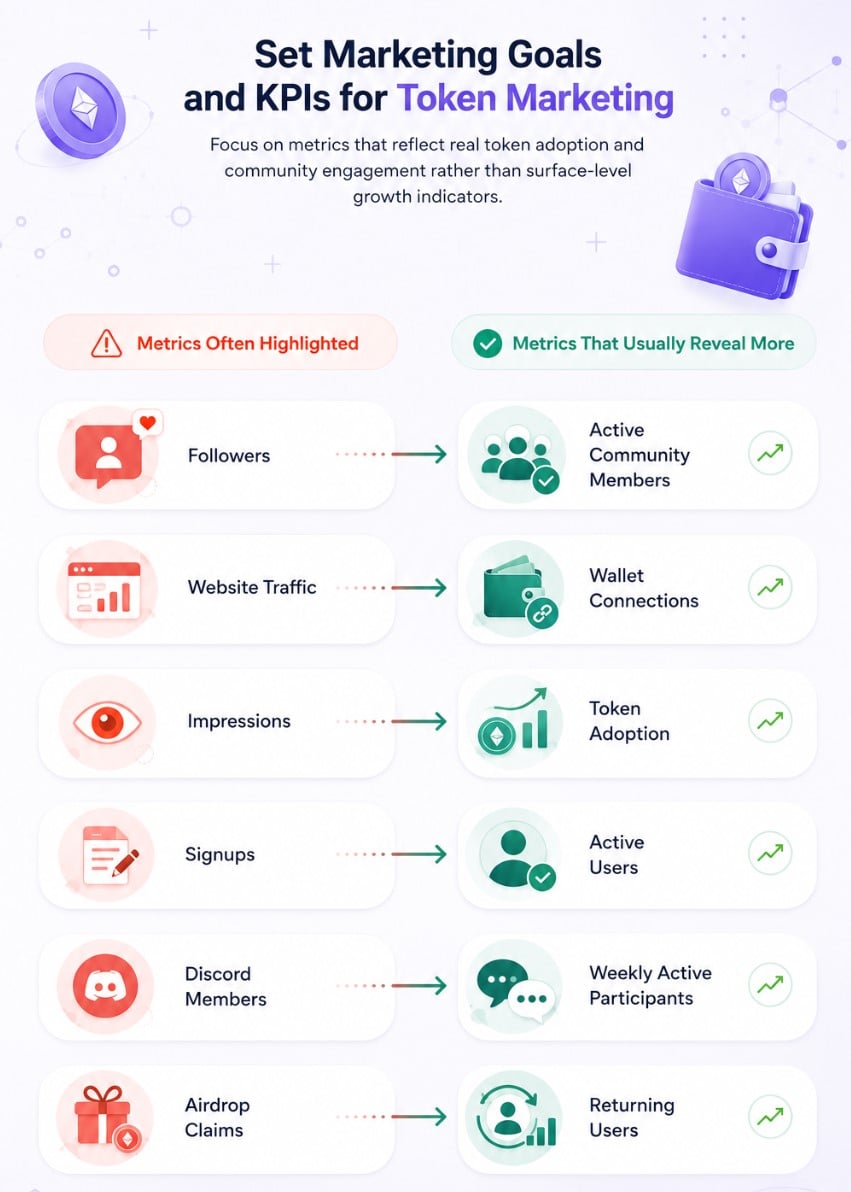
Community numbers often continue growing even when engagement is moving in the opposite direction. It is not unusual to see strong user acquisition figures alongside weak retention.
The same issue appears in many discussions around crypto go-to-market strategy.
“A growing holder count can be misleading if the average wallet size keeps shrinking, as it may indicate early holders are distributing rather than genuine adoption. Community metrics tell a similar story. If Discord or Telegram membership grows quickly but discussions stay quiet, much of that growth may come from bots or airdrop hunters rather than people likely to remain active.”
Vincent N, Lead Strategist at NinjaPromo
Best Marketing Channels for Crypto Tokens
No single channel consistently delivers awareness, trust, and participation at the same time. Most token projects rely on a mix of channels, with each contributing something different to the user journey.
Social Media Marketing
Not every social platform contributes in the same way.
Some channels are good at generating market awareness. Others are better at keeping people engaged once they arrive.
Common roles include:
- X — launch announcements, industry discussions, and visibility
- Discord — community discussions, support, and contributor programs
- Telegram — announcements, updates, and direct communication
- LinkedIn — partnerships, hiring, and B2B Web3 relationships
Platform strategy deserves its own discussion. We cover that in our guide to crypto social media marketing.
Influencer Marketing
Large audiences attract attention, but reach alone rarely determines whether a campaign succeeds.
Many projects now place greater emphasis on audience fit than follower counts. A creator with a smaller but highly relevant audience can outperform a larger account whose followers have little interest in the project.
Warning signs usually appear quickly:
- High impressions with little engagement
- Traffic spikes that disappear within days
- Large audiences but few conversions
- Interest in the creator rather than the project
The strongest crypto influencer marketing campaigns tend to feel natural. The audience already trusts the creator, making it easier to build brand credibility around a new project.
PR and Crypto Media Coverage
Media coverage often becomes part of the research process.
Someone considering a token might read the website, check social channels, and then look for independent coverage.
A single article rarely changes much on its own. Seeing the same project appear across several publications is a different experience. It gives people more material to evaluate and can make investor relations conversations easier because information is no longer coming from a single source.
Community Marketing
Large communities attract attention. Active communities are usually more valuable.
The difference becomes obvious when a project is not running a launch, giveaway, or promotional campaign. Some communities continue discussing updates and helping new members. Others become quiet almost immediately.
Metrics that often reveal community quality include:
- Weekly active participants
- Governance participation
- Community-created content
- Referral activity
- Returning members
Growth is easy to spot because the numbers are visible. Participation is harder to measure. A community with fewer members but regular discussions often looks healthier than a much larger community that rarely interacts.
For more on retention and participation, see our guide to crypto community building.
Paid Advertising
Paid media can create visibility quickly, but different channels tend to produce different outcomes.
| Channel | Common Use Case |
| Google Ads | High-intent searches |
| X Ads | Awareness and launch campaigns |
| Reddit Ads | Niche crypto communities |
| Crypto ad networks | Industry-specific reach |
Not every campaign makes it through the approval process on the first attempt. A promotion that runs on one platform may be rejected on another, even when the messaging is identical.
That uncertainty is one reason many token projects avoid relying entirely on paid traffic. If campaigns stop running, community channels, content, and existing users are often what keep momentum going.
Channel selection often has a bigger impact than people expect. We explore that further in our guide to crypto advertising strategy.
Pre-Launch Token Marketing
By the time a token launches, many potential users have already formed an opinion about the project. Community growth, educational content, and awareness campaigns often begin long before a token becomes available.
Build and Grow Your Community
Many token communities begin forming long before a token exists.
By launch day, people may already be following development updates, discussing the project, and sharing information with others. That early activity often becomes one of the first indicators of demand.
Telegram and Discord Growth
A large member count does not automatically mean people are paying attention. In some communities, discussions continue regardless of whether the team is posting updates. In others, activity drops away surprisingly quickly.
Community quality often depends on:
- Active discussions
- Responsive moderation
- Returning members
- Member-to-member interaction
Content Marketing
Content often answers questions that marketing campaigns cannot.
Potential users may understand the project but still be unsure about token utility, governance, or how the ecosystem works. Educational content helps reduce that uncertainty before launch.
Common examples include:
- Token utility explanations
- Product walkthroughs
- Ecosystem guides
- Development updates
Projects that rely heavily on education often take a different content approach. Our guide to crypto content marketing covers some common examples.
Airdrops and Whitelist Campaigns
Airdrop marketing campaigns and whitelist campaigns can attract attention quickly, but attention and commitment are not always the same thing.
| Potential Benefit | Potential Risk |
| Fast community growth | Incentive hunters |
| Increased awareness | Low retention |
| Community expansion | Speculative participation |
Some participants become long-term community members. Others leave once the campaign ends.
Generate Awareness Before Launch
Launch day is rarely the first time people encounter a project. For many users, the decision to pay attention happens much earlier through community discussions, creator content, media coverage, or word of mouth.
Token Launch Marketing
Token launches bring together work that has often been happening for months. Communities, creators, partners, exchanges, and media coverage tend to become most visible during the launch itself.
Execute a Successful Launch Campaign
People rarely discover a token through a single source.
A community member may see an announcement, encounter influencer content later that day, and then come across media coverage or exchange activity. Those interactions often overlap during a launch period.
The launches that feel organized usually have the same story appearing across multiple channels at roughly the same time.
“Even the best preparation cannot remove every risk. Exchange delays, network issues, or partner mistakes can still affect a launch. The teams that recover most effectively are usually the ones that have already planned how they will respond, rather than trying to solve everything once the problem appears.”
Vincent N, Lead Strategist at NinjaPromo
Launchpads
For many projects, launchpads provide a first introduction to potential investors and early users.
A listing on established crypto launchpads can increase visibility before a token launch and help projects reach communities already interested in new opportunities. The benefit is not limited to fundraising. Launchpads often function as discovery channels as well.
Exchange Listings
A listing often introduces a project to people outside its existing community.
Some discover the project through exchange announcements. Others notice unusual trading activity or see the token appear on trending pages. Either way, the audience usually becomes much larger overnight.
What happens afterwards varies considerably. Strong trading activity does not always translate into long-term interest in the product itself.
Community Activation
Community activity often changes noticeably during launch periods.
AMAs, launch events, competitions, and community challenges are commonly used to keep discussions active. The goal is not simply to generate excitement for a few days. It is to encourage participation while new users are arriving.
Drive Early Adoption and Trading Activity
Some projects try to bridge the gap through:
- Staking rewards
- Participation incentives
- Governance opportunities
- Product-based rewards
Not everyone who acquires a token becomes an active participant. These incentives can help create reasons to return once the initial launch activity begins to slow down.
Launch-day excitement is common. Sustained engagement is much less common (CoinGecko).
“Treat them as different audiences. Traders often respond to listings, liquidity events, and short-term incentives, while long-term community members are more likely to stay because of governance, participation, or rewards linked to continued involvement. Trying to satisfy both groups with the same campaign rarely works.”
Vincent N, Lead Strategist at NinjaPromo

Post-Launch Token Growth Strategies
Launches create visibility. Maintaining momentum afterwards is usually more difficult. Activity often starts to separate into two groups: projects that continue building participation and projects that gradually lose it.
Community Retention and Engagement
Many communities are at their most active during launch. The more interesting question is what happens afterwards.
| Community Behaviour | What It Can Reveal |
| Conversations continuing between announcements | People are still paying attention |
| Participation in governance votes or proposals | Ongoing involvement |
| Members returning regularly | Strong user retention |
| Questions answered by the community | Community maturity and engagement |
The drop-off is usually easy to spot.
A launch ends, activity slows down, and some communities keep talking while others do not. People discuss governance proposals, share feedback, answer questions, or debate future plans. In other communities, the conversation largely disappears.
“The strongest communities have a reason to return that goes beyond price movements. Governance votes, regular updates, events, or recurring content keep people involved between major announcements. Projects that rely only on market activity often see participation fall away once the initial excitement settles.”
Vincent N, Lead Strategist at NinjaPromo
That is why large numbers and active communities are not always the same thing.
Referral and Incentive Programs
Many projects discover that recommendations from existing users outperform paid promotion.
Common approaches include:
- Referral programs
- Contributor rewards
- Community incentives
- Ambassador programs
The quality of growth often depends on what is being rewarded. Incentives tied to meaningful participation tend to produce different outcomes from incentives tied only to signups or activity spikes.
Strategic Partnerships
Partnerships are often discussed as marketing opportunities, but many have a more practical impact.
Examples include:
| Partner Type | Why Projects Pursue Them |
| Wallets | To make onboarding and discovery easier |
| Protocols | To expand functionality and create new use cases |
| Infrastructure providers | To improve reliability and support growth |
Some strategic partnerships generate publicity. Others operate almost entirely behind the scenes while still contributing to adoption.
Common Crypto Token Marketing Mistakes
Most mistakes in token marketing are easy to recognise in hindsight. Communities become inactive, adoption stalls, or interest fades much faster than expected. The challenge is usually identifying those issues before they become difficult to reverse.
Prioritizing Hype Over Utility
Some projects generate enormous attention before launch and very little activity afterwards.
That gap often becomes visible once speculation slows down. If token utility is difficult to explain, people may struggle to find a reason to remain involved beyond price movements.
Neglecting Community Management
Community decline is usually gradual rather than sudden.
Questions receive fewer responses. Discussions become less frequent. Members remain in the server, but participation drops. Over time, trust can erode and inactive communities become harder to revive.
Targeting the Wrong Audience
Many token projects speak to everyone and end up connecting with nobody particularly well.
Some projects spend months explaining why the token might increase in value while saying very little about what people can do with it. Others make the opposite mistake and barely address the questions investors are asking.
| Common Mistake | Common Pattern Afterwards |
| Prioritizing hype over utility | Trading activity remains higher than product usage |
| Neglecting community management | Community participation gradually declines |
| Focusing only on investors | Product adoption remains limited |
| Treating all audiences the same | Messaging resonates with fewer people overall |
As discussed earlier, crypto participation now spans a much broader range of user groups than it once did. A message that resonates with investors may have little impact on product users, and vice versa.
Final Thoughts
A lot of token launches look successful in their first few weeks. The harder question is what the project looks like six months later. Some communities keep growing. Others gradually lose momentum. The same pattern often appears in product usage and participation.
The launch itself is only one point in a project’s timeline. Adoption, retention, and ecosystem growth continue to change afterwards, sometimes for years. Those are also recurring themes within crypto marketing services, where attention tends to focus on what happens after the initial excitement has faded.