

Key Takeaways
- Pre-launch crypto marketing programs often require monthly budgets ranging from $8,000 to $25,000.
- Focused token launch campaigns typically need between $40,000 and $150,000 to achieve meaningful reach and visibility.
- KOL partnerships and compliance requirements are among the most common sources of unexpected costs.
- Execution and management fees should be planned separately from media and advertising spend.
- Effective launch budgets account for post-launch retention and community engagement, not just initial acquisition.
In 2026, crypto marketing cost refers to the money a Web3 project spends to build user confidence and attract qualified demand. A lean pre-launch program can start around $8,000 to $25,000 per month, while a serious token launch can reach $40,000 to $150,000 or more. The number changes fast because crypto campaigns buy credibility, not only traffic.
You planned $50,000 for launch week. Then KOL rates moved and your ad copy needed compliance edits. The listing date shifted after moderators were already scheduled, so the original plan exposed how crypto launches really work.
Crypto feels bigger now, but not easier. According to the a16z State of Crypto 2025 report, market cap crossed $4 trillion for the first time, while mobile wallet users reached all-time highs. That growth creates more opportunity, but it also makes weak positioning more expensive.
Key Cost Factors in Crypto Marketing
In practice, crypto marketing costs rise when the budget only covers promotion, not the work needed to make promotion believable. A DeFi protocol and an NFT game may both buy visibility, but each one needs a different path to user confidence. The more complex the product, the more money goes into education before anyone clicks “connect wallet.”
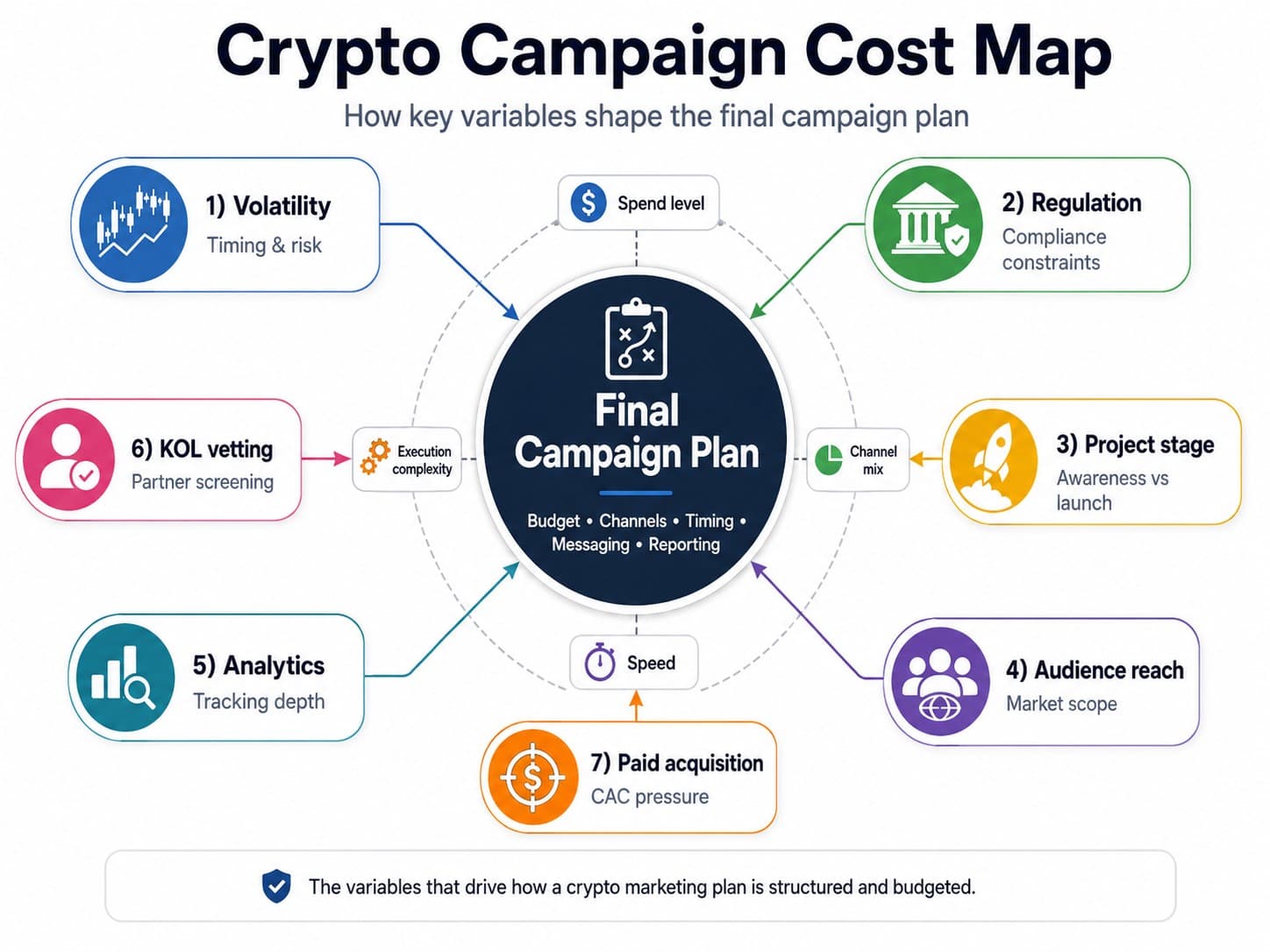
The main cost factors are:
- Market volatility: campaign timing may change fast.
- Regulatory constraints: claims often need extra review.
- Project stage: pre-launch education costs less than launch promotion.
- Campaign complexity: simple awareness costs less than multi-channel execution.
- Audience reach: retail users and institutions need different funnels.
- Analytics tools: tracking adds fixed monthly spend.
- Influencer networks: KOL vetting affects the final creator budget.
- Paid acquisition: ads need testing before they scale.
“An efficient crypto marketing budget turns attention into a durable market position. The best budget is not necessarily the cheapest one because cost alone is not a measure of effectiveness.”
Maya Miller, Strategist at NinjaPromo
Volatility and regulation are easy to budget for in theory. They get expensive when they arrive late. A project days from listing may have to rewrite its ad copy while the community team is already handling launch questions.
A realistic crypto marketing budget should treat these factors as connected costs, not separate line items. A bigger audience usually means more content, more moderation, and stronger tracking. That is why the cheapest channel plan can still become expensive when the operating work behind it is missing.
Overlooked Cost Drivers in Crypto Marketing Budgets
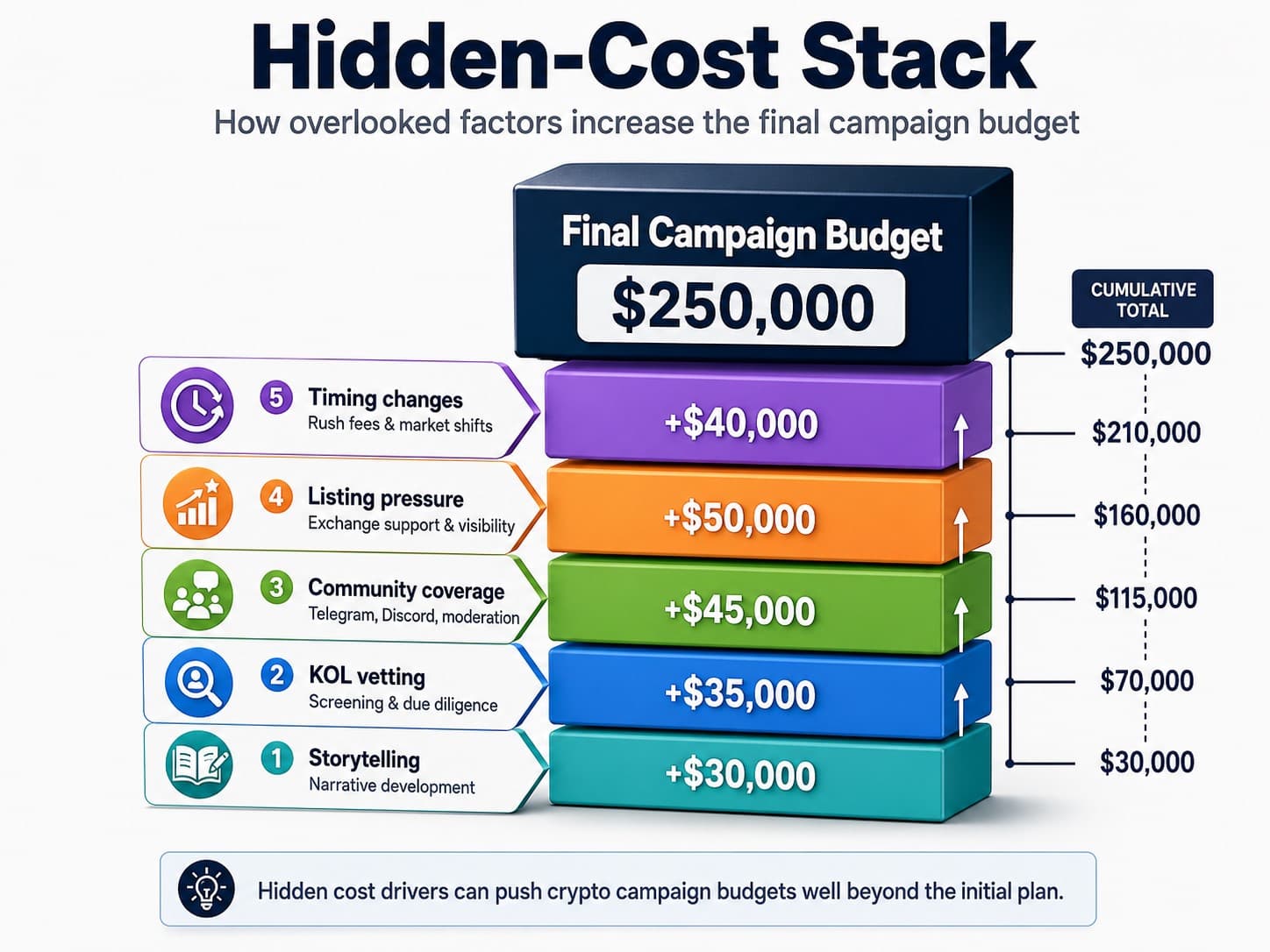
A lean crypto marketing budget breaks when the team treats storytelling as a one-time messaging task. Tokenomics and utility need plain-language framing before users can repeat the value. Roadmap and security also need messages that work without sending people back to the whitepaper.
Multi-chain execution is another quiet budget leak. A project active across Ethereum and Solana may need different ecosystem narratives. Translation is not enough when each chain has its own culture, vocabulary, and proof points.
Community coverage also gets underestimated. Telegram and Discord are not announcement boards. They are where users test whether the project feels alive, whether the team answers hard questions, and whether the roadmap sounds real.
Many teams underestimate crypto marketing costs because they price KOL posts but not KOL vetting. The cheap post can become expensive if the audience is full of airdrop hunters or bots. The real crypto promotion cost is not the creator fee, but the money lost when attention does not turn into qualified demand.
“The most underestimated cost is the infrastructure needed to turn attention into activated users. Teams budget for KOLs, PR, paid media, and community pushes, but often overlook onboarding, education, product guidance, and clear materials that reduce friction.”
Maya Miller, Strategist at NinjaPromo
Exchange-related promotion can also distort the plan. Listing windows create pressure, and pressure changes pricing. Add partner announcements and market-maker coordination, and the final spend can move far beyond the original launch number.
What Are the Average Crypto Marketing Costs?
Average crypto marketing costs vary because Web3 projects buy different types of credibility at different stages. A pre-launch project may need content and community setup, while a token launch needs concentrated attention. Most serious budgets sit higher than traditional marketing because volatility and compliance make every channel harder to run.
The ranges below are practical planning estimates based on common agency scopes and campaign components. They are not guaranteed market rates. Treat them as a capacity plan, not a shopping list.
| Activity | Typical Range | Best Use | Main Risk |
| Strategy audit | $2,500 to $10,000 | Pre-launch planning | Advice without execution |
| Community management | $3,000 to $15,000 monthly | Telegram and Discord confidence | Weak moderator quality |
| SEO and content | $4,000 to $20,000 monthly | Education and organic demand | Slow compounding |
| KOL campaigns | $5,000 to $100,000+ | Fast awareness | Low-quality audiences |
| Paid media | $5,000 to $75,000 monthly | Scalable testing | Policy delays |
| PR campaign | $3,000 to $30,000 | Credibility and announcements | Weak media relevance |
| Token launch campaign | $40,000 to $150,000 | Market exposure | Poor retention |
These ranges should be adjusted for audience quality and internal capacity. The average cost of launching a crypto project marketing campaign rises when creator promotion and paid media must work together. For broader strategy context, this guide to crypto marketing is a useful starting point before assigning channel budgets.
A small project can spend less if it already has a founder audience or ecosystem partners. A quiet project with no narrative pays more because every channel has to build credibility from zero. That is why two teams can spend the same media budget and get completely different outcomes.
Public service pages can help teams understand whether they are buying a task or an operating model. The cost of crypto marketing services is often a capacity question, not only a channel question. If the team needs strategy and execution at the same time, the budget should reflect the operating load.

Crypto Marketing Channels: Cost Comparison Across Key Acquisition Channels
Crypto marketing channels should be judged by the job they perform in the funnel, not by price alone. SEO helps users understand the product, while the community shows whether the project can handle doubt. Paid media and KOLs move faster, but they need a clearer story behind them to turn attention into demand.
| Channel | Cost Level | What It Does Best | Where It Breaks |
| SEO and content | Medium | Builds durable education | Takes time |
| Community management | Medium | Converts doubt into confidence | Needs daily labor |
| KOL partnerships | Medium to very high | Creates quick discovery | Audience quality varies |
| Crypto ad networks | Medium to high | Reaches Web3-native users | Can bring mixed traffic |
| Paid search and social | High | Scales tested messaging | Faces policy limits |
| PR and media relations | Medium to high | Adds credibility | Coverage can be shallow |
| Exchange promotion | High | Supports listing momentum | Spike can fade fast |
“Channel budgets should be decided at the strategy level, not by copying other projects. A strong strategy defines KPIs, the role of each channel, and how budget is split across awareness, trust, acquisition, and retention.”
Maya Miller, Strategist at NinjaPromo
The table shows why a single-channel plan usually breaks under pressure. Fast channels create attention, but they do not always explain the product well enough to convert cautious users. Slower channels build the proof that makes paid traffic and creator campaigns easier to justify.
The best mix usually combines one trust-building channel with one distribution channel. Content and community can prepare users before a paid or KOL push sends traffic into the funnel. This approach allocates budget more efficiently because each channel has a clear role in the acquisition strategy.
Crypto Marketing Pricing Models: A Clear Breakdown
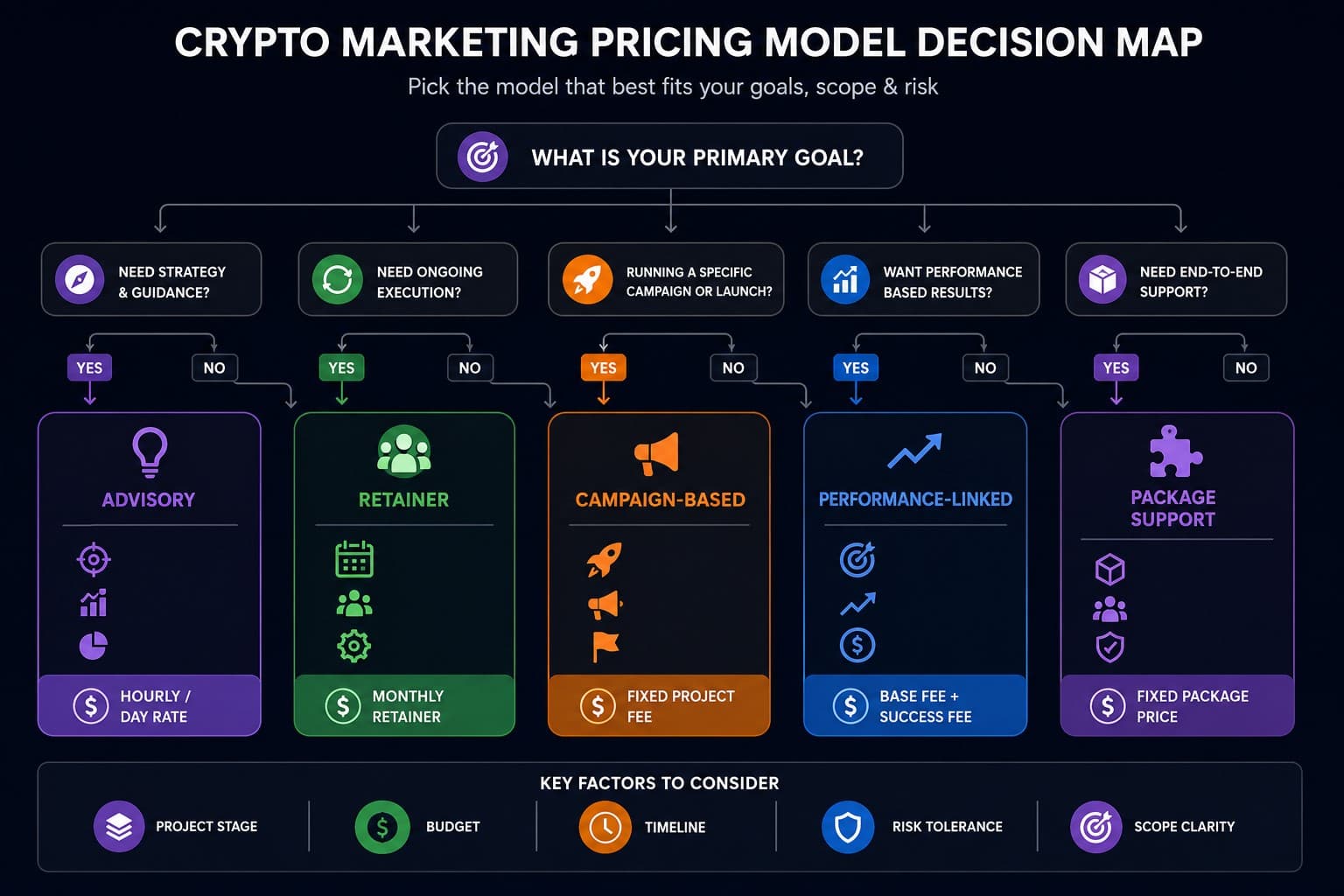
Crypto marketing pricing works best when the commercial model matches the job. Advisory fits expensive decisions, while retainers fit daily execution. Campaign-based work suits launch windows, and productized subscriptions suit teams that need a controlled starting point.
A useful cost model separates labor fees from pass-through spend. Labor pays for strategy and production, while pass-through spend covers media and creators. Crypto marketing tools should be budgeted separately when they support tracking or KOL checks.
| Pricing Model | Typical Use | Main Advantage | Main Limitation |
| Hourly advisory | Audits and launch planning | Flexible expert input | No execution capacity |
| Monthly retainers | Ongoing growth | Stable team support | Needs steady approvals |
| Campaign-based pricing | Token launches and listings | Clear scope | Momentum may fade |
| Performance incentives | Acquisition or engagement goals | Aligned upside | Attribution is difficult |
| Package subscriptions | Early-stage execution | Predictable entry point | Less customization |
Hourly Consulting & Advisory
Hourly consulting is for expensive decisions, not daily execution. It helps when a founder is unsure whether the token launch plan is realistic or the exchange listing story is ready. Rates depend on niche knowledge and reputation because bad advice can waste the entire next campaign.
This model is useful when founders need clarity but are not ready for a retainer. The cost of marketing for crypto token launch planning can stay controlled because the team buys expertise for specific decisions. The weak spot is execution, since a strategy deck does not answer Telegram at midnight.
Monthly Retainers
Monthly retainers are the default model for active crypto projects because the market keeps moving after the campaign goes live. They protect work that cannot pause, especially community response. Content production usually sits beside it because crypto narratives need constant reinforcement.
A retained team builds memory over time. It learns which narrative earns belief and which objections keep coming back. That memory prevents the retainer from turning into another disconnected vendor expense.
Campaign-Based Pricing
Campaign-based pricing fits a defined market moment. Token launches and exchange listings are the clearest examples because timing drives attention. NFT drops can use the same model when the goal is concentrated exposure.
The scope usually starts with messaging and creator coordination. Paid ads or PR can support the push once the narrative is clear. Community activation matters because attention fades quickly when nobody is ready to answer users.
A crypto campaign budget should not stop at listing day. The post-launch window is where users ask harder questions, liquidity expectations change, and the team needs to convert attention into retention. A campaign without follow-up is not efficient, but just loud.
“A hybrid model is often the most practical option for crypto. A base retainer covers continuity, while project fees cover campaign bursts. Performance bonuses should be tied only to metrics the agency can realistically influence.”
Maya Miller, Strategist at NinjaPromo
Performance-Linked Incentives
Performance-linked incentives tie part of the fee to measurable outcomes. In crypto, those outcomes may be wallet connections or qualified sign-ups. Later-stage programs may focus on liquidity growth, but only when attribution is credible.
External factors create crypto campaign risks that performance pricing cannot fully control. A delayed listing or sudden token price swing can distort results before the marketing work is fairly judged. That is why serious agreements usually include a base fee plus upside instead of pure commission.
Package & Subscription-Based Services
Package and subscription-based services give early-stage Web3 teams a more predictable way to start. A package may cover content and basic community support. It is easier to approve than a custom retainer and faster to activate than hiring internally.
The trade-off is customization. Standardized packages may not cover unusual tokenomics or regulated claims. They work best when the team needs structure now and deeper specialization later.
Crypto Marketing Cost Structures: In-House Teams vs Agencies vs Freelancers
The execution model often changes the final Web3 marketing spend more than the channel plan does. An in-house team gives control, but it also turns marketing into a payroll commitment. Agencies convert that commitment into scoped fees, while freelancers lower upfront spend and raise coordination pressure.
| Model | Typical Spend | Hidden Expense | Scalability | ROI Predictability |
| In-house team | $25,000 to $80,000+ monthly | Hiring and idle capacity | Slow to resize | Strong after playbook maturity |
| Agency | $8,000 to $75,000+ monthly | Scope creep | Fast to scale | Medium to high |
| Freelancers | $3,000 to $20,000 monthly | Founder management time | Fragile under pressure | Lower without tight systems |
In-house teams make sense when the company already has a repeatable acquisition motion. They are expensive when the project still needs to discover positioning and user segments. A blockchain marketing budget should include specialists and tools before leadership time is treated as free.
Agencies work best when the project needs several functions at once. Strategy and execution can sit under one operating rhythm instead of being split across disconnected vendors. Teams comparing Web3 spending with traditional digital marketing cost should remember that crypto adds confidence-building work that most mainstream campaigns do not carry.
Freelancers are useful for narrow tasks. A designer can solve a creative gap, and a media buyer can fix a specific acquisition problem. But when founders become the project manager and editor, the cheaper model starts to cost more.
This is where buying decisions need discipline. If the work requires coordination across several channels, teams should choose the right digital marketing agency instead of comparing proposals only by hourly rate. A cheap structure becomes expensive when nobody owns the full funnel.
Final Thoughts
The right budget depends first on stage and credibility gap. Channel mix changes the number once the core story is clear. A serious Web3 marketing budget should also protect money for timing changes.
The strongest plans admit crypto marketing limitations before spend begins. Paid media runs into platform rules, and KOL reach often hides weak audience quality. Attribution gets messy once users move across wallets and chains.
A useful budget is not the cheapest plan on paper. It is the plan that gives the team enough room to educate users, test demand, and respond when the market moves. That is what separates controlled spend from expensive improvisation.