

A crypto go-to-market strategy is a roadmap for attracting new users, building community trust, fuelling early adoption and on-chain engagement, and, ultimately, generating revenue. While it’s technically possible to launch without one, it’s risky.
This is because the crypto niche is rife with skepticism. As such, crypto market entry is as important as the building process. Here are the 10 steps that go into crafting a Web3 go-to-market strategy that builds trust from day one.
Understanding the Go-To-Market Approach in Crypto
A GTM strategy in crypto isn’t just about marketing, but a complete framework for bringing a product to market through positioning, distribution channels, and demand generation. Distribution channels, in particular, deserve special attention. Unlike a B2B go-to-market strategy that focuses heavily on traditional funnel-based marketing, crypto marketing relies on fast-paced growth, making community building and trust key.
The awareness, consideration, and decision stages are compressed, non-linear, and significantly influenced by sentiment, narrative, and networks. A token can go from unknown to viral overnight (and just as quickly collapse).
This means that your GTM strategy must be community-first, dynamic, and built on trust. The latter is especially important as your target audience is deciding whether to invest real capital and their reputation into your ecosystem.
Steps to Develop a High-Performing Crypto Go-To-Market Strategy
Whether you’re introducing a new token, protocol, or Web3 application, you need to pay attention to research, positioning, community, and distribution. Miss any of these or get them wrong and you’ll likely find yourself with a great crypto product, but an empathy Discord. By structuring your crypto GTM strategy around the following steps, you’ll ensure that the launch, along with the events leading up to it and activities to follow, earn lasting trust and credibility.
Define Your Crypto Market Positioning and Target Audience
Your value proposition should be benefit-focused and clearly separate it from competitors in the same category. You’ll need to go beyond generic differentiation and focus on what’s actually meaningful and defensible in your market. To do this, it should explain to your target audience:
- Which problem can you solve?
- Why should they use your crypto product?
- Which features do you include that others ignore?
As for your target audience, it’s best to keep it narrow initially. Key audience groups will likely include:
- Traders
- Investors
- Developers
- Institutions
- Creators
That said, it’s not as straightforward. When marketing a crypto product, you need to account for the fact that users often remain anonymous. In this case, you’ll have a hard time using titles like these.
One workaround is to use their actions. For example, are they more interested in minting or governance?
Then, using their motivations, priorities and level of understanding and trust, you need to adjust how you communicate your value proposition. If you treat them as a single audience, your messaging will resonate with few. For example, for crypto newcomers, messaging needs to be simpler, while messaging for developers can include technical terms.
“Stop thinking about demographics. In crypto, audiences are segmented less by age or location and more by behavior, motivation, and belief system. You have traders chasing yield, builders who care about infrastructure, ideological holders with strong ecosystem loyalty, and retail users entering through hype cycles. Your real audience is whoever complains loudest about the problem you fix.”
Vincent N, Lead Strategist at NinjaPromo
Related Content: Crypto Presale Marketing: How to Build Hype and Drive Token Sales
Plan and Execute a Structured Crypto Product Launch
Structure the launch as a sequence of connected phases that build on each other, rather than a single event. Aside from keeping you organised, accountable and on track, it also becomes a tool to grow market confidence and keep your target audience involved.
Early-stage efforts should focus on building anticipation and community interest. The goal is to create demand before supply is visible and available.
Key actions during the pre-launch phase include:
- Identifying the channels where your target audience is the most active
- Creating waitlists and early-access programs
- Constructing your narrative so that it ties your product to a real pain point
- Leveraging AI crypto marketing to optimize audience targeting before launch
“If you cannot describe what you are in one clear sentence that does not sound like every other project, you are not ready to launch. In crypto, narrative is not copywriting. It shapes whether people trust the product and whether they believe it belongs in the current market cycle. Teams treat messaging as a finishing layer, when it should be the foundation.”
Vincent N, Lead Strategist at NinjaPromo
The launch itself should be tightly coordinated across channels. All the announcements should be synchronized across channels and ideally shared the same hour, with your founders and core team visibly present online to respond in real time.
Post-launch activity is where the momentum you’ve built is either maintained or lost. Treating it as optional will definitely result in the latter.
Key actions during the post-launch phase include:
- Sharing a roadmap update within 48 to 72 hours after launch
- Recognizing and rewarding early adopters
- Following up on ecosystem integrations and partnerships
- Sharing regular updates about wallet growth, transaction volume, etc.
Scale User Acquisition With Paid Crypto Advertising
While paid ads should be part of your structured plan for launching a blockchain project, they should be used only to accelerate what’s already working. Using it as your primary growth channel is expensive and misleading.
As such, start with an experimentation phase where you allocate equal small amounts across channels testing various angles (including creatives, messaging, and targeting) simultaneously. This exercise is key to identify which combinations showed the strongest performance. Next, pick the two to three, best-performing channels and angles and concentrate your efforts and budget on these.
That said, platform limitations in crypto mean that you’ll be unable to run your campaigns as freely everywhere. Of the mainstream paid ad channels, X, YouTube, and Reddit typically have the fewest restrictions.
For example, If you’re targeting traders, paid ads on X work well as long as the creative feels native to the feed. For broader retail, YouTube pre-rolls, targeted Reddit, and short-form video can work, on condition that your product is simple enough to explain quickly.
Related Content: Lead Generation for Crypto: How to Turn Interest Into Quality Leads
Establish Authority Through Crypto Content Marketing
Content marketing is the most scalable way to build trust, the oxygen to any crypto go-to-market strategy. As such, it should be treated as a credibility engine, not just a means to improve SEO and drive traffic.
Here are a few ways how crypto content marketing should differ from the traditional approach a go-to-market company in a niche like fashion will use:
| Traditional Content Marketing | Crypto Content Marketing |
| Content is optimized for keywords and clicks. | Content is optimized for comprehension. |
| Publish cadence is frequent. | Consistency and accuracy are more important than frequency, yet fast and reactive enough to respond to regulatory news. |
| Content formats typically include blog posts and email newsletters. | Education-first content like white papers, guides, tutorials, glossaries, and onboarding content are prioritized. |
| Metrics used to track content’s success focus on impressions and conversions. | Metrics used to track content’s success include wallet activations, total valued unlocked (TVL), community growth, and on-chain activity, alongside traditional digital metrics. |
| Standard compliance reviews are sufficient. | Every content piece is a potential securities risk, making legal review non-negotiable. |
Using the above-mentioned as guidelines, your main focus will be on creating credible educational materials that focus on the:
- Product
- Category
- Broader ecosystem
Strengthen Visibility With Crypto SEO
Crypto SEO is best approached as a long-term strategy than a short-term traffic tactic. The goal should be to drive organic growth and AI-powered discovery over time through posting in-depth educational content consistently.
To do this, your crypto SEO strategy should focus on the following three pillars:
- Technical foundation to ensure traditional search and AI engines and crawl and index your website reliably
- Authority content that answers questions your target audience is already asking
- Backlinks from the ecosystem, e.g., developer communities and crypto media
Not all pillars will receive equal attention during the different phases of your project, though. For example, the pre-launch phase is primarily focused on building anticipation and technical aspects to capture early organic traffic.
Once you’ve launched, the goal is to convert attention. To do this, you’ll concentrate on link building and PR amplification.
Related Content: PR for Crypto: From Media Coverage to Community Trust
Then, when you enter post-launch, it’s a matter of widening your content efforts and becoming the category reference that owns topic authority. Now, the goal is retention and discoverability to ensure your product stays visible.
Here’s how you’ll space out your activities across market rollout:
| Pre-launch Phase | Launch Phase | Post-launch Phase |
| Create a semantic map | Publish launch explainers and exchange listing announcements for researchers and journalists to link to | Fix crawl issues, broken links, and improve site architecture |
| Identify keyword clusters your target audience uses | Write guests posts on established Web3 publications | Encourage community-generated content |
| Build landing pages, a docs hub, and glossary list that target the identified terms | Share press releases on crypto media sites like CoinDesk and Decrypt | Consistently publish a mix of tutorials, comparison queries (X vs Y), integration docs, and developer guides |
Leverage Social Media to Build Awareness and Engagement
Maintaining a consistent presence in discussions and staying active in conversations is more important than simply publishing posts. Transparency is foundational to crypto marketing and encouraging open dialogue through showing up reliably supports this.
Twitter, Discord and Reddit are the main platforms you’ll use as part of your crypto social media marketing strategy and should be treated as an ongoing communication channel, rather than merely a content distribution. For example, while Twitter is associated with thought leadership content, it’s not just a matter of posting your thought piece and disappearing. You’ll still need to take the time to connect with fellow users.
Then, on Discord and Reddit, your focus shifts towards offering support and gathering feedback through onboarding tutorials and user stories, for example. Not only is this the type of content that does well on these channels, but unlike other digital products, crypto has more technical aspects and jargon. As such, you’ll need to let education drive the conversation. Inform, then engage.

Use Influencer Marketing to Expand Reach and Trust
In a crypto go-to-market strategy, influencer marketing is essentially about distributing trust. Your goal is redirecting credibility from where it already exists to your project. Attention is secondary.
“Reputational risk compounds in crypto. If someone has repeatedly promoted failed or suspicious projects, that history transfers to you.”
Vincent N, Lead Strategist at NinjaPromo
Related Content: Top Crypto Marketing Tools for Web3 Growth
This means that in crypto influencer marketing, you’ll want to evaluate influencers closely on:
- Audience quality
- Track record
- Incentive alignment
To evaluate the quality of their audience, check their replies. Teams often go wrong by buying follower count instead of audience fit. Real engagement takes the form of questions, follow-up discussions, and a healthy dose of disagreement, not emoji reactions.
Ensure that you don’t just check the most recent interactions, though. You want to work with influencers who consistently engage and get cited or upvoted on platforms.
If they’ve been active in the space before the current hype cycle, it shows genuine conviction. Otherwise, it can be interpreted by your target audience as opportunism and an eagerness to promote anything to monetize their following.
That’s why incentive alignment should be a criteria too. When influencers’ personal motivations, values, and goals naturally overlap with your product, they’ll advocate more credibly than one who treats it as a paid, one-off post.
Then, once you find suitable influencers, define performance expectations upfront. Misalignment won’t just lead to underperformance, but it can actively damage your product positioning and credibility you’ve already created through your own content marketing and SEO efforts.
Grow a Strong and Active Web3 Community
Community building should be a system of active participation rather than passive audience growth. Equally important is that it should already start before your product is ready.
You can, for example, use the following strategies to build a strong crypto community:
- Invite users to test early versions and report bugs
- Add role tiers to your Discord channel (e.g., contributor, tester, etc.)
- Run a hackathon
- Publish regular behind-the-scenes progress updates
- Create a waitlist with a referral loop
- Let the community vote on some product decisions before launch (e.g., token design or features)
- Create a few memes
- Publish public leaderboards tracking community contributions or referrals
- Host ask-me-anything sessions (AMAs)
Track Performance and Continuously Optimize Your GTM Strategy
With crypto GTM marketing, you have Web2 and Web3 data to track. You can use on-chain data, like wallet holdings and DeFi interactions, to identify high-value user groups. Then, you can combine this data with other online actions like website visits to gain a more comprehensive view of your users’ behavior. This level of visibility also helps optimize your crypto marketing cost by revealing which channels, audiences, and campaigns generate the highest ROI.
Key metrics to track include:
- Cost per qualified wallet
- First transactions
- Swaps or stakes
- Return usage
- Transaction frequency
- Transaction volume
- Fees generated
- Total value locked (TVL)
“TVL is the metric most misused. It can signal traction, but it can also be inflated by incentives, mercenary capital, or short-term farming. Without retention, TVL doesn’t prove product-market fit.”
Vincent N, Lead Strategist at NinjaPromo
It’s also important to track retention at 7, 30, and 90 days. A campaign that drives one-time activity with no repeat behavior won’t drive sustained user retention in the crypto ecosystem.
What a Real Crypto Go-To-Market Campaign Looks Like in Practice
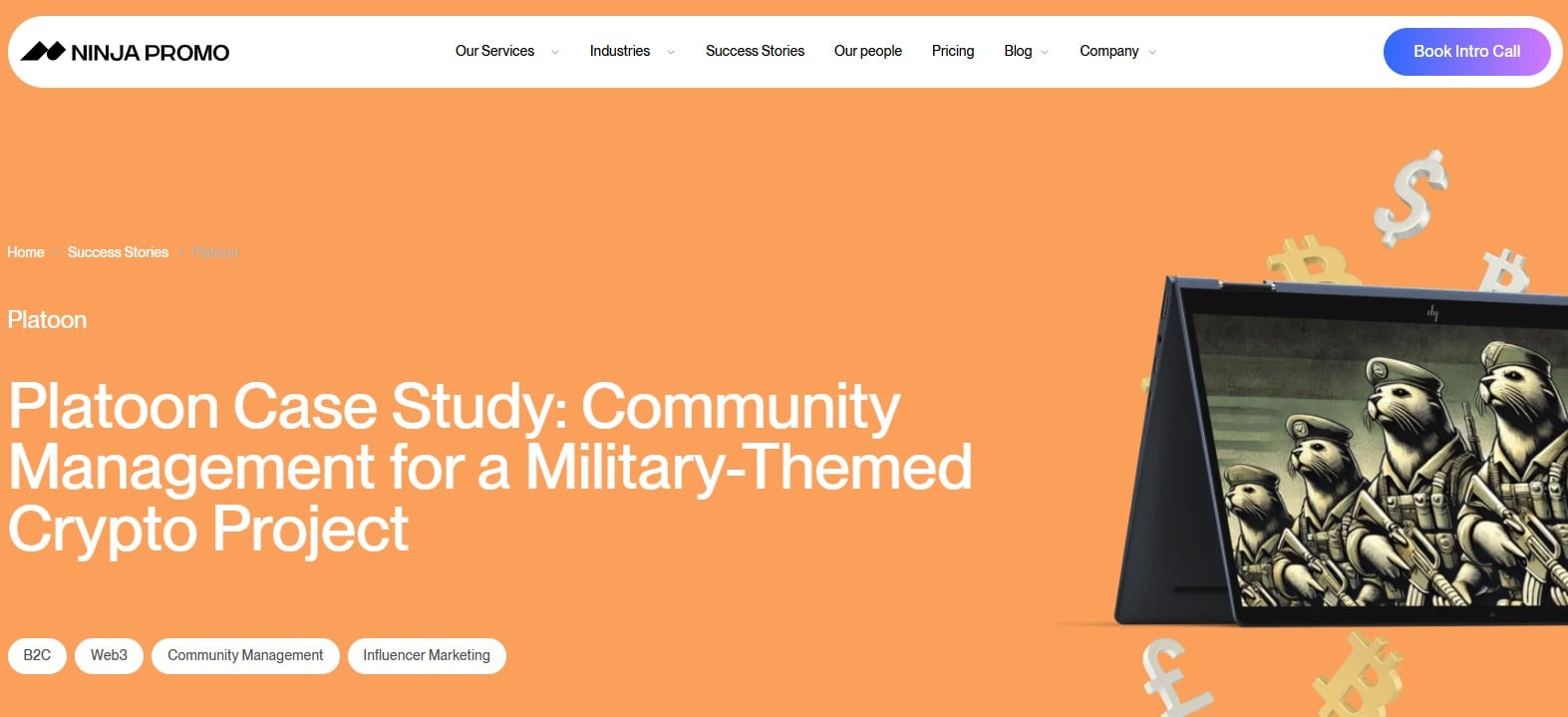
To see how it all comes together, you can refer to the work NinjaPromo completed for Project Platoon, a meme token created to honor those who’ve served in the armed forces. We were tasked with several responsibilities that we tackled with a two-phase strategy.
The first phase focused on preparing a crypto go-to-market strategy. It lacked a clear product positioning and consistent stream of content. When it did post, the content typically failed to communicate the essence of the project or in a way that addressed its target audience’s expectations.
As such, we redefined its positioning, tone of voice, and target audience. Influencer campaigns were launched, along with a content plan for Telegram and X.
Then, the second phase looked at:
- Moderating the Telegram group
- Posting to X
- Launching and promoting a Zealy campaign
Final Thoughts
Building a successful crypto go-to-market strategy requires more than a great white paper and token launch. It demands a deep understanding of your target audience, a clear value proposition, trust, and ongoing crypto network expansion. The teams that know how to create effective Web3 go-to-market strategy treat their community not as an audience to market to, but as co-owners who are invested.