


Crypto Google Ads means navigating paid search in one of the most regulated verticals on the internet. Google allows advertising for specific crypto products, such as exchanges, software wallets, hardware wallets, and coin trusts, but only after obtaining platform certification and only in approved countries.
Get the compliance layer right, and Google becomes one of the strongest customer acquisition channels available to crypto businesses. We’ll explain to you how to do it.
Is Cryptocurrency Advertising Allowed on Google?
Yes, but not across the board. Google categorizes crypto products into three tiers: freely allowed, restricted (requires certification), and prohibited entirely. Which tier your product falls into determines whether you can run ads at all.
“Cryptocurrency advertising is allowed on Google, but only under strict conditions. Google allows certain crypto products, including regulated exchanges and software wallets, but advertisers typically need Google certification, regulatory compliance, and, in most cases, a license in the target market. Because Google evaluates each crypto category differently, we first assess the product, target GEOs, and licensing requirements before launching campaigns.”
Dennis F., PPC Team Lead at NinjaPromo
Allowed without certification (per Google’s official crypto ads policy):
- Businesses that accept crypto as payment
- Mining hardware
- Tax, legal, and security services for crypto companies
- Educational content, provided it excludes investment advice and price predictions
- Blockchain-based NFT games, as long as there’s no wagering element
Requires Google certification:
- Cryptocurrency exchanges
- Software and hardware wallets
- Coin trusts, financial products that let investors trade shares in large crypto pools
Permanently prohibited, regardless of certification:
- ICOs, DeFi trading protocols, and token liquidity pools
- Unhosted wallets and unregulated dApps
- Trading signals, investment advice aggregators, and crypto affiliate sites
- NFT games where players can stake tokens for real-world value
Geographic restrictions add another layer. Even with a valid certification, you can only advertise in countries explicitly approved by Google. Targeting an unapproved market results in disapproved ads, not a warning.
“The biggest mistake crypto companies make when applying for Google certification is doing so before their business, website, ad account, and legal documentation are fully aligned. Google checks whether the product, target country, license, landing page, and advertiser identity are consistent. Common issues include targeting markets not covered by the license, promoting uncertified products, or making claims such as guaranteed profits or high returns.”
Dennis F., PPC Team Lead at NinjaPromo
Certification applications must be submitted through the Google Ads account directly (Admin > Account > Apply for Certification), not through the Help Center.
Why Google Ads Remain Important for Crypto Customer Acquisition
Intent-based targeting is what separates Google Ads from nearly every other paid channel.
When someone searches “best crypto exchange” or “how to set up a Bitcoin wallet,” they are already in decision mode. Google processes over 13.7 billion searches per day (SQ Magazine, 2025), and a meaningful share of those queries come from users actively evaluating crypto products. The ad just needs to answer their question better than the competition.
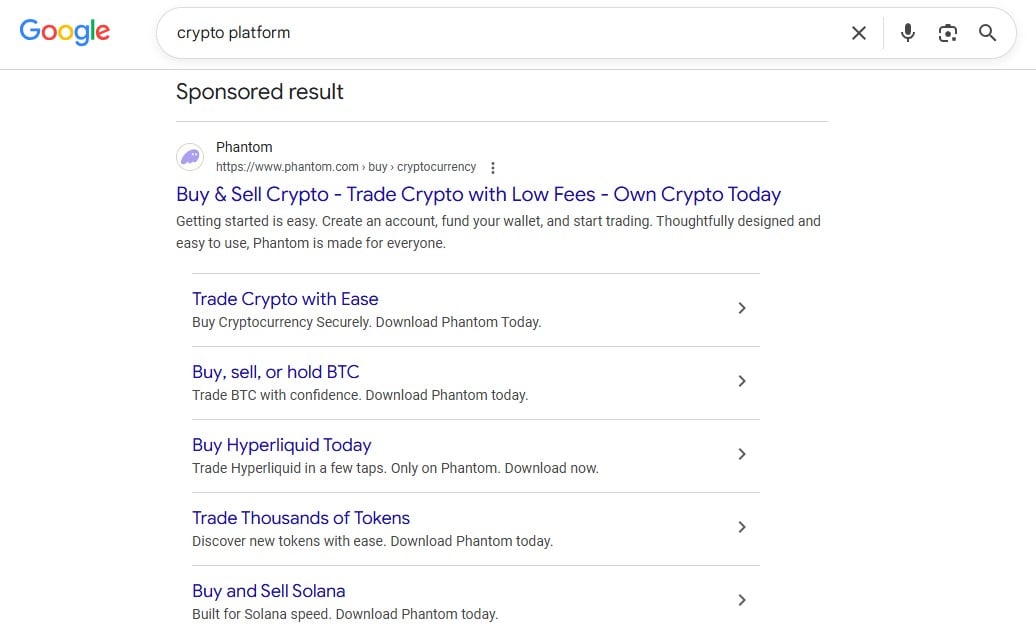
For exchanges and wallet providers, this translates directly to acquisition economics. A user who lands on a sign-up page after a transactional search query is far more likely to complete KYC than someone who clicked a display banner.
That difference is why crypto PPC through Google consistently outperforms awareness-only channels when the product and targeting are properly configured.
Related Content: Are Google Ads Worth It? Key Reasons Why They Still Work
Best Google Ads Types for Crypto Businesses
Not every campaign type serves the same purpose. Choosing the right format for each stage of the customer journey is one of the highest-leverage decisions in Google Ads optimization for crypto campaigns.
“Search campaigns consistently deliver the best results for most crypto projects, especially regulated exchanges, wallets, and B2B crypto services. The main advantage is user intent. Search queries reveal whether someone is looking to open an account, compare platforms, or research a topic, making it easier to optimize budget, relevance, and conversion quality while maintaining compliance.”
Dennis F., PPC Team Lead at NinjaPromo
Here’s how each fits the crypto context.
✅ Search Campaigns
Search ads target users typing specific queries into Google. For crypto businesses, this is the highest-intent format available. Someone searching “open crypto account” is at the bottom of the funnel and ready to act. Best suited for exchanges, wallet sign-ups, and any product with a clear transactional keyword.
✅ Display Campaigns
Display serves visual banner ads across Google’s partner network. In crypto, it’s most effective for retargeting — re-engaging users who visited your site but didn’t convert. Less effective for cold audiences because purchase intent is inherently lower than Search.
✅ Video Campaigns (YouTube)
YouTube gives crypto brands space to explain complex products: how staking works, why hardware wallets matter, and what differentiates one exchange from another. It’s effective during the research phase, when users are still forming opinions.
✅ Performance Max Campaigns
PMax runs across all Google surfaces simultaneously: Search, Display, YouTube, Gmail, and Discover. It uses machine learning to optimize delivery, but requires meaningful conversion data to perform well. The right sequence is to build baseline conversion volume through Search campaigns first, then layer in PMax.
✅ Demand Gen Campaigns
Demand Gen uses rich visual formats across YouTube, Gmail, and Discover to reach users before they know to search. For Web3 Google Ads and blockchain Google Ads in emerging product categories, this is how you generate demand rather than just capture it.
A full breakdown of Google Ads types:
| Campaign Type | Primary Goal | Best Crypto Use Case | Key Strength | Main Limitation |
|---|---|---|---|---|
| Search | Convert high-intent users | Exchange sign-ups, wallet installs | Highest purchase intent | Competitive CPCs, limited reach |
| Display | Awareness & retargeting | Re-engage site visitors | Wide reach, visual format | Lower intent, needs audience data |
| Video (YouTube) | Education & consideration | Product walkthroughs, trust-building | Explains complex products | Requires video assets |
| Performance Max | Maximize conversions at scale | Scaling proven campaigns | Automated cross-channel optimization | Needs 30+ conversions/month |
| Demand Gen | Generate new demand | New Web3 product launches | Reaches pre-search audiences | Harder to measure direct ROI |
Related Content: Top Google Ads Alternatives To Boost Your Reach
Key Practices for Running an Effective Crypto Google Ads Campaign
Running paid advertisements for cryptocurrency-related products requires more deliberate setup than most verticals. High CPCs, strict compliance rules, and a technically sophisticated audience all raise the stakes.
These practices ensure an effective Google Ads strategy that turns ad spend into measurable business growth rather than wasted budget.
Set Conversion Goals That Reflect Real Crypto Business Outcomes
Optimizing for clicks is one of the most common mistakes in crypto Google Ads management. Clicks don’t generate revenue. Funded accounts, completed KYC, wallet connections, and staking participation do.
Before launching, define conversion actions that map to actual business value:
- KYC completion, not just form submission
- First deposit or funded account creation
- Wallet connection or app install with activation
- Staking participation or first transaction
- Qualified lead submission for B2B or institutional products
Google’s Smart Bidding strategies require clean, meaningful conversion data to work. If you feed the algorithm click data or shallow form submissions, it optimizes toward the wrong outcome.
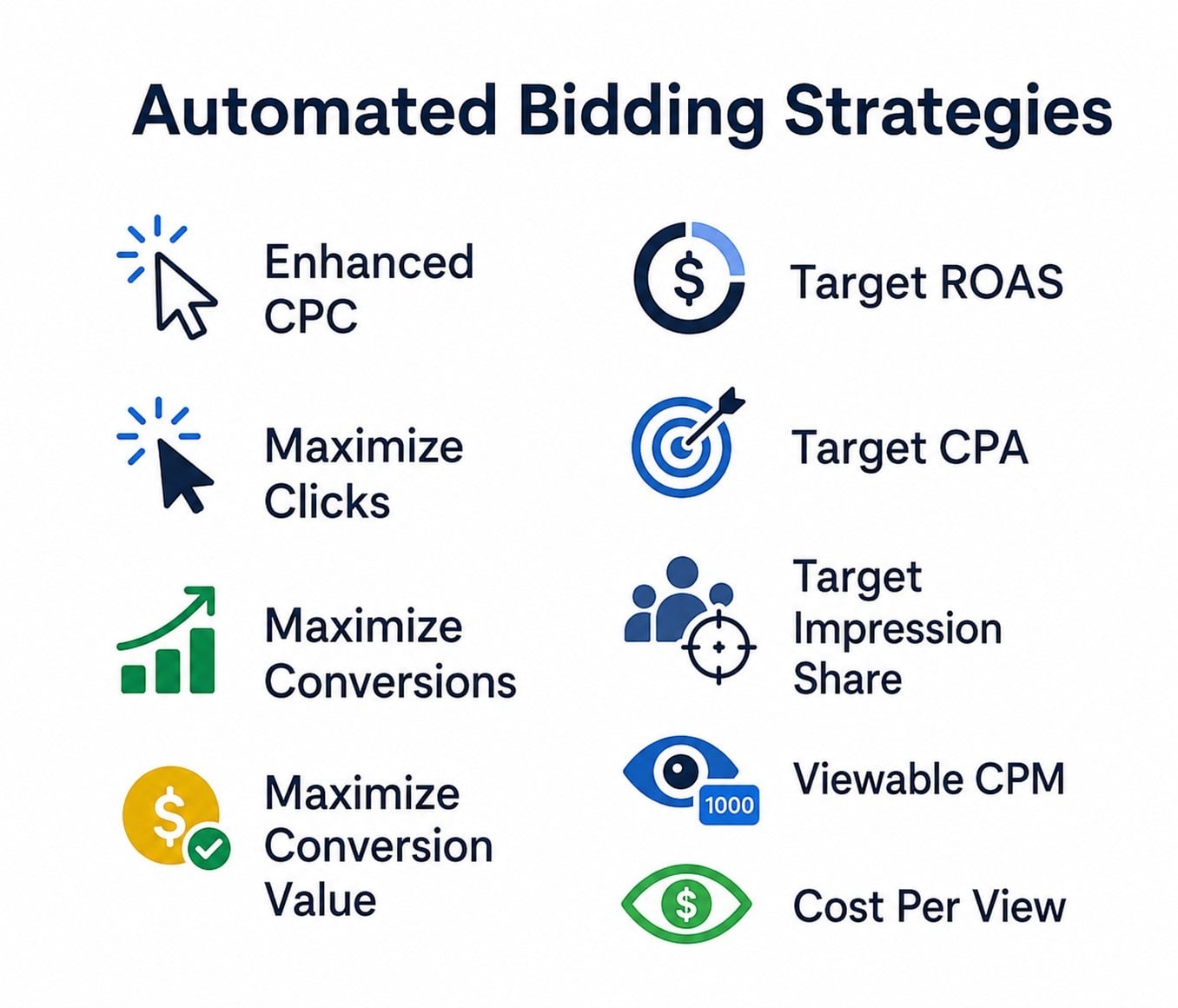
Import offline conversion data (funded accounts, verified users) wherever possible to give Smart Bidding the signal it actually needs.
Build Campaigns Around Search Intent, Not Just Keywords
Crypto users search very differently depending on where they are in the buying process. Grouping campaigns by intent is one of the core principles of any effective crypto advertising strategy.
| Intent Type | Example Queries | Ad Approach | Landing Page Goal |
|---|---|---|---|
| Informational | What is a crypto wallet? How does staking work? | Educational copy, soft CTA | Explainer content, trust-building |
| Commercial | Best crypto exchange, Top Bitcoin wallets compared | Comparison-focused, highlight differentiators | Feature comparison, testimonials |
| Transactional | Open a crypto account, Buy ETH now | Direct CTA, offer-led copy | Sign-up page, minimal friction |
Running the same ad for informational and transactional queries creates mismatched expectations and drives up bounce rates. One intent tier per ad group.
Create a Strong Negative Keyword Strategy
Without negative keywords, broad-match and phrase-match terms will trigger ads for searches with no conversion potential. In a high-CPC vertical like crypto, that waste compounds quickly.
| Negative Category | Examples | Why It Matters |
|---|---|---|
| Free/no-cost seekers | free crypto, earn crypto free | No intent to deposit, zero conversion value |
| Scam/hack-related | crypto scam, Bitcoin hack | Wasted spend, damages brand association |
| Job/career intent | crypto jobs, blockchain developer salary | Deep impressions, zero acquisition potential |
| News queries | crypto news today, Bitcoin price prediction | Informational traffic with no purchase intent |
| Irrelevant finance terms | stock market, forex trading | Crypto ads on Google can trigger adjacent financial queries |
Review the Search Terms report weekly for the first month of any new campaign, then monthly after that. Add negatives proactively, don’t wait for the budget to disappear first.
“Queries such as “free crypto,” “crypto jobs,” “crypto course,” “crypto mining,” “crypto signals,” “airdrop,” and “giveaway” often drain budget because these users are usually seeking free resources, education, or technical help rather than a regulated crypto product.”
Dennis F., PPC Team Lead at NinjaPromo
Use Smart Bidding Strategies Based on Campaign Objectives
Bidding strategy selection is one of the highest-leverage decisions in the campaign setup. Using Target CPA too early, before sufficient conversion data exists, forces the algorithm to guess, and the guesses are expensive.
| Strategy | When to Use | Best For | Data Requirement |
|---|---|---|---|
| Maximize Clicks | Launch phase, data gathering | All campaign types | None — good starting point |
| Maximize Conversions | Once conversion tracking is confirmed | Lead gen, sign-ups, installs | 30 conversions/30 days |
| Target CPA | Stable conversion volume established | Exchange sign-ups, KYC completions | 50+ conversions/month |
| Target ROAS | Revenue-focused with transaction data | Platforms with trackable deposit value | Strong revenue tracking required |
Start with Maximize Conversions to build data, then shift to Target CPA once volume stabilizes. Skipping ahead skips the learning phase that everything else depends on.
Leverage First-Party Data and Audience Signals
With third-party cookies disappearing, first-party data has become one of the most valuable assets in crypto advertising services. Privacy tools and ad blockers often weaken third-party signals, making owned data even more important.
Practical applications include:
- Customer Match to exclude existing users from acquisition campaigns or target them for upsells
- Remarketing based on actions such as visiting a deposit page, completing KYC without funding, or installing a wallet without activating it
- Offline conversion tracking that feeds in-app behavior back into Smart Bidding
Every interaction, from an abandoned deposit to an inactive wallet install, provides valuable targeting data. Many crypto brands still miss opportunities by leaving that information unused in their CRM.

Stay Compliant With Google Crypto Advertising Policies
Compliance rules are an ongoing operational requirement. Google’s crypto policy updates regularly, and campaigns that were clean last quarter may not be today.
“The fastest way to get a Google Ads account suspended is by promoting restricted crypto products without certification or using misleading claims, redirects, or mismatched landing pages. Recovery requires a full compliance audit, fixing all policy violations, securing the necessary certification, and submitting an appeal. Repeatedly resubmitting rejected ads without addressing the underlying issue usually makes recovery harder.”
Dennis F., PPC Team Lead at NinjaPromo
The most common mistakes in Google Crypto Advertising that cause disapproval or account suspensions:
- Advertising in countries not included in your certification approval
- Landing pages that reference prohibited products, even if the ad itself doesn’t
- Ad copy that implies guaranteed returns or constitutes investment advice
- Unverified claims about security or regulatory status
- Failure to renew certifications when Google requires reconfirmation
One of the often-missed regulation challenges: a single disapproved ad won’t suspend an account, but repeated violations in a short window can trigger escalation.
Google provides at least seven days’ notice before any suspension. Google Ads specialists should use that window to appeal or correct, not to ignore. Monitor the Google crypto advertising policy page directly for updates; third-party summaries often lag behind changes.
Continuously Analyze Search Terms and Optimize Performance
Successful Google Ads management in crypto is an iterative exercise. Market conditions shift, competitor bids change, and user search behavior evolves.
The campaigns that hold up are built on a consistent optimization:
- Review the Search Terms report weekly. Add new negatives and identify emerging high-intent keyword opportunities.
- Audit Quality Scores monthly. Low QS raises CPCs, fixed by tightening alignment between keyword, ad copy, and landing page.
- A/B test ad headlines continuously. Test security vs. speed vs. fees as competing value propositions.
- Adjust bids by device, location, and time of day based on actual conversion data.
A regular Google Ads audit will surface wasted spend and tracking gaps before they compound. That matters in a vertical where a single misaligned campaign can quietly drain budget for weeks.
Related Content: Google Ads Pricing: How Much Does Google Advertising Cost?
Examples of How Crypto Projects Became More Recognizable Through Google Ads
Chimpzee: Building Visibility Across Multiple Markets
➤ Challenge:
Chimpzee.io needed to grow through Google Display Ads, social media, and Telegram.
Crypto advertising restrictions created ongoing risks of campaign pauses, while Asia-Pacific and English-speaking markets required precise targeting. Social media had to engage both crypto and environmentally conscious audiences, and Telegram was struggling with spam and negativity.
📈 Solution
The team launched Google Display Ads across key global markets with multiple creative formats, quickly resolving policy issues when they arose. Messaging shifted from fundraising-focused acquisition to engagement-driven campaigns, supported by ongoing A/B testing.
On social media, separate content streams were created for crypto and environmental audiences, blending technical updates with conservation-focused stories. Telegram was rebuilt through moderation, spam filtering, 24/7 management, and regular project updates.
✅ Results
- Google Display Ads delivered lower cost per conversion alongside improved CTR and conversion rates.
- Social media built consistent engagement across both audience segments
- Telegram went from a spam-heavy, toxic space to an active and positive community
Wafee: From Zero to 1.5 Million Unique Users in Three Months
➤ Challenge
Wafee, a banking app supporting both traditional and crypto transactions in 100+ countries, needed to build visibility and trust from the ground up. The main challenge was attracting both crypto-native users and mainstream banking customers while standing out in a competitive fintech market and driving measurable user acquisition.
📈 Solution
Our team began with a marketing audit and customer journey analysis to identify drop-off points and growth opportunities. A refined marketing funnel, brand strategy, and content plan were then developed for both audience segments.
Google Ads targeted high-intent keywords related to downloads and sign-ups, with budgets optimized based on CPA performance. SEO, social media, and website development were executed alongside paid campaigns as part of a unified growth strategy.
✅ Results
- 1.5M unique users reached within the first three months
- 150K monthly website visits, a 200% increase from baseline
- 10K leads generated via Google Ads at an average CPA of $15, with 150% ROAS
- 5,250 new sign-ups from a 3.5% website conversion rate
- Organic traffic grew 80%, ranking in the top 10 for 30 high-intent keywords
- Average session duration improved by 30%
- 25K new social media followers with a 25% increase in engagement
- Customer retention improved by 15% post-launch
Related Content: Are Google Ads Worth It? Key Reasons Why They Still Work
Final Thoughts
Crypto Google Ads work, but only when compliance and performance are built together. For certified products in approved markets, Google gives you something most channels can’t: users who are already searching for what you offer.
Get the certification, target the right markets, set conversion goals that reflect real business outcomes, and keep optimizing. That’s the whole framework.
The competitive advantage goes to advertisers who approach Google Ads for crypto as an iterative system rather than a campaign launch. As more crypto projects obtain certification and enter the auction, that discipline becomes the differentiator.