Key Findings
- SaaS content works best when every asset supports a clear business goal.
- Search intent should guide topics, formats, and funnel placement.
- Topic clusters strengthen authority when internal linking is planned early.
- Content distribution in SaaS matters as much as writing and SEO.
- AI improves execution speed, but human expertise protects accuracy.
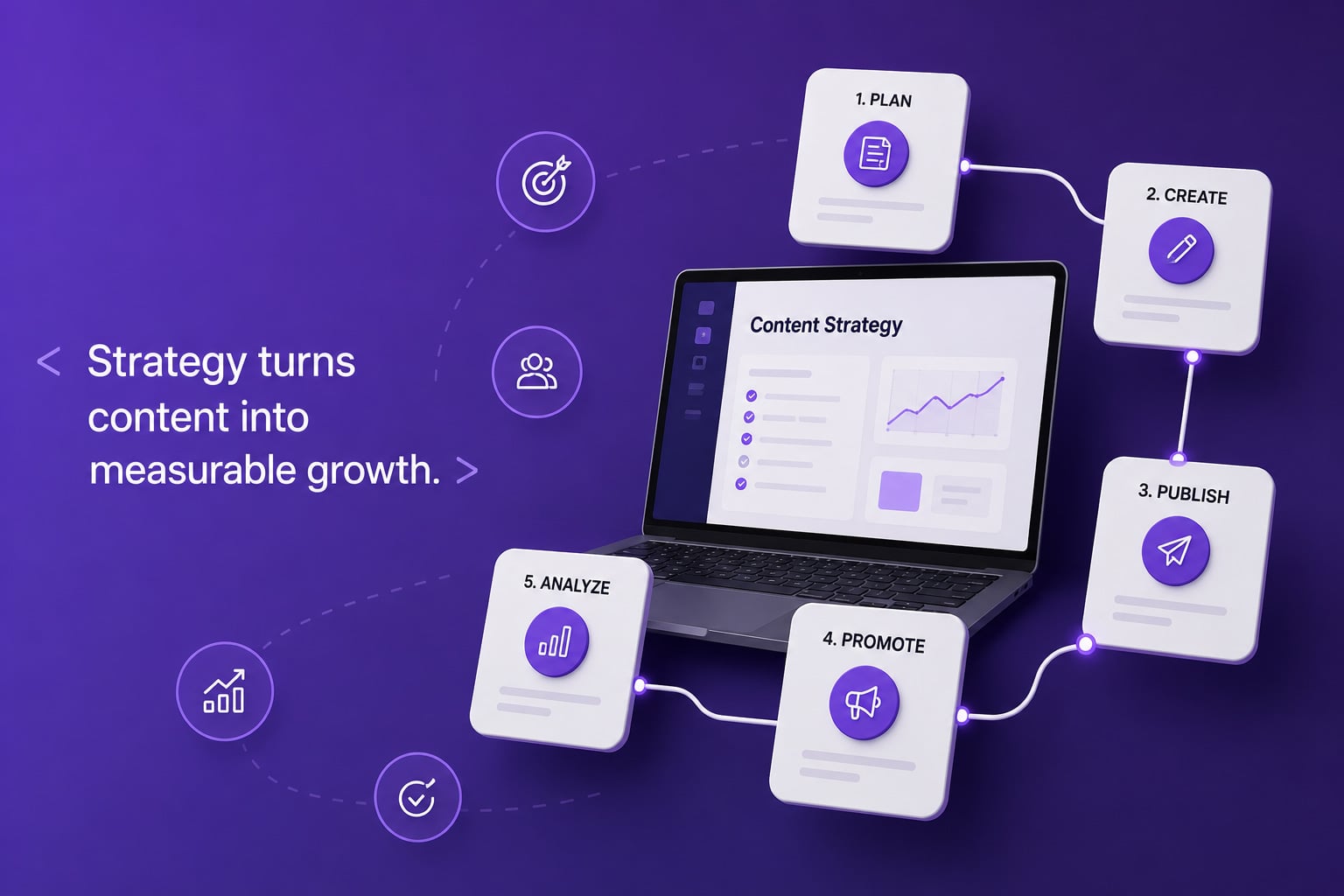
A SaaS content marketing strategy is a structured plan for turning content into measurable growth. It connects topics, formats, distribution, and performance tracking with business goals. Without that system, consistent publishing rarely produces predictable revenue.
This guide shows how SaaS teams build a repeatable growth system with content. Strategy shapes production and distribution across the entire customer journey. Better decisions then improve visibility, conversions, and long-term performance.
What Is a SaaS Content Marketing Strategy?
A SaaS content marketing strategy is a documented framework for revenue-focused content planning. It aligns content with business goals and customer needs. The framework defines what to publish, whom to target, and how success will be measured. Unlike random publishing, it prioritizes measurable business outcomes.
Content alone does not create growth. Strategy determines why every asset exists. That alignment improves efficiency across marketing and sales.
Successful content marketing for SaaS supports awareness before purchase. It also helps customers during onboarding and long after activation.
Every documented SaaS content strategy should include:
- Clear business objectives tied to measurable KPIs.
- A defined target audience and buyer personas.
- Primary search intent for every content category.
- Topic clusters supporting core product themes.
- A documented publishing and distribution process.
- Performance metrics for continuous optimization.
What Makes SaaS Content Marketing Different from Traditional Content Marketing
SaaS companies depend on recurring revenue instead of one-time purchases. Every customer relationship continues after the initial conversion. That reality changes content priorities.
Product education becomes essential. Buyers often evaluate software before requesting a demo. Helpful resources reduce uncertainty during complex purchasing decisions.
Retention also matters more than initial acquisition. Existing customers generate recurring revenue. Educational content supports continued product adoption over time.
| Area | SaaS | Traditional Business |
| Revenue model | Recurring subscriptions | One-time sales |
| Primary goal | Customer lifetime value | Immediate purchase |
| Sales cycle | Often longer | Usually shorter |
| Content focus | Education and adoption | Promotion |
| Success metric | Retention and expansion | Initial conversion |
Why Content Marketing Is Critical for SaaS Growth
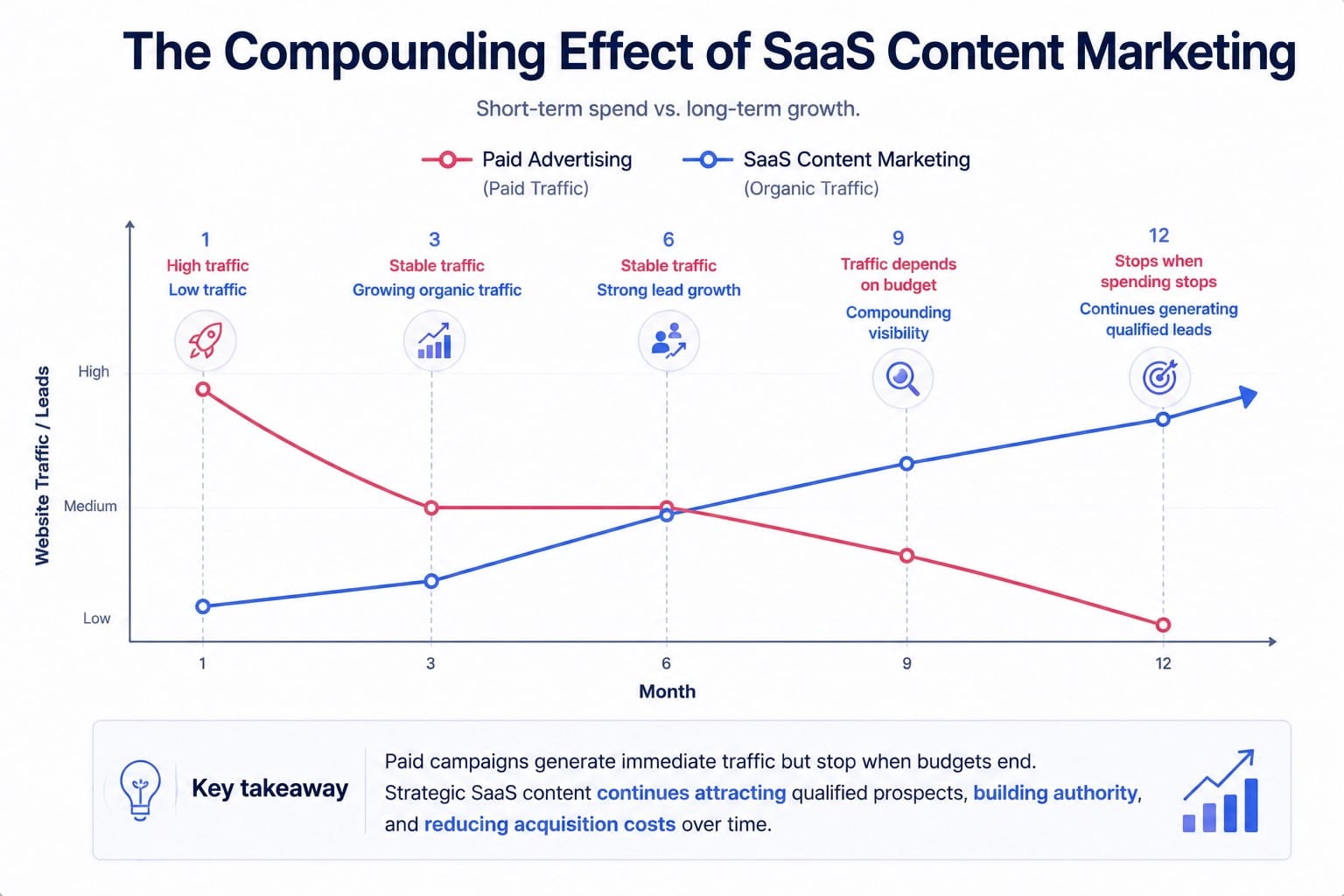
Effective SaaS-focused content lowers customer acquisition costs over time. Organic visibility compounds with consistent publishing. Paid advertising rarely creates similar long-term efficiency.
High-quality resources also establish credibility. Buyers trust companies that solve problems before requesting payment. Educational content demonstrates expertise naturally.
Content Marketing Institute research shows structured content programs improve consistency and resource planning.
How Content Supports Every Stage of the SaaS Customer Journey
Different buyers need different information. Early prospects search for educational guidance. Decision-stage buyers compare products carefully.
Each content format should match customer intent. Blog posts build awareness. Case studies support evaluation. Documentation helps adoption.
Companies investing in SaaS SEO often improve visibility throughout the customer journey. Better search coverage attracts qualified visitors with stronger purchase intent.
Content should answer different buyer questions at every stage:
- Awareness: What problem am I trying to solve?
- Consideration: Which solution best matches my business needs?
- Decision: Why should I choose this SaaS product over alternatives?
- Onboarding: How can I achieve value as quickly as possible?
- Retention: Which features will help me reach better long-term results?
Why SaaS Companies Need a Content Marketing Strategy
A documented content strategy improves consistency and accountability. Every campaign supports defined business priorities. Teams waste fewer resources on low-impact ideas.
Publishing without direction creates inconsistent messaging. Content topics often overlap. Important opportunities remain uncovered.
Risks of publishing without a clear strategy:
- Teams create competing articles for similar queries.
- Sales lacks content for common objections.
- Product updates launch without support assets.
- SEO efforts target low-value topics.
- Strong articles receive weak distribution.
- Performance reports focus on traffic only.
Strategy also simplifies collaboration. Marketing, sales, and product teams follow shared objectives. That alignment improves execution across departments.
Companies should document every major decision. Clear ownership reduces production delays. Regular reviews keep priorities aligned with changing business goals.
| Strategy-Driven Approach | Ad Hoc Publishing |
| Clear KPIs | No measurable goals |
| Planned editorial calendar | Random publishing |
| Funnel-based content | Topic selection by intuition |
| Consistent messaging | Mixed positioning |
| Continuous optimization | Little performance analysis |
How to Build a SaaS Content Marketing Strategy
Building a content marketing framework requires structured planning. Every decision should support measurable business outcomes. Clear priorities improve long-term efficiency.
The framework below helps teams create scalable systems. Each step builds on the previous one. Skipping steps usually reduces future performance.
Define Business Goals and KPIs
Business goals determine content priorities. Objectives should remain measurable. Vague targets rarely improve decision-making.
Choose KPIs that reflect business performance instead of vanity metrics. Traffic alone rarely predicts revenue. Pipeline metrics provide stronger business insight.
Useful KPIs include:
- Organic traffic
- Lead generation
- Marketing qualified leads (MQLs)
- Free trial conversions
- Customer retention
- Content marketing ROI
Every KPI should connect to revenue. That relationship simplifies future optimization.
Understand Your Target Audience
Audience research improves every content decision. Strong assumptions rarely replace customer evidence. Interviews often reveal unexpected buying concerns.
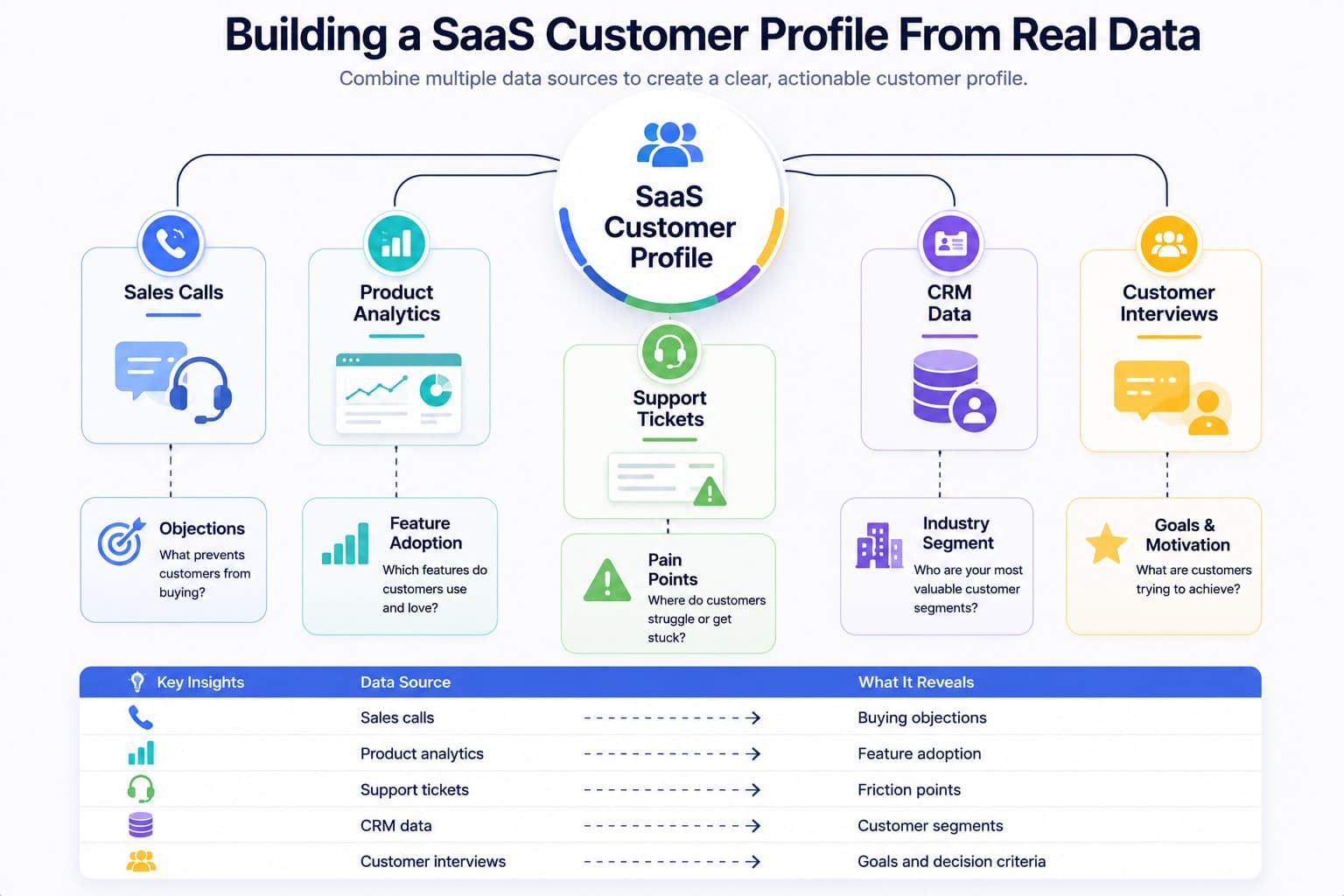
Study customer behavior before planning topics. Sales conversations uncover recurring objections. Support tickets expose common product questions.
Signs your audience research is accurate:
- Different audience segments search for different topics.
- Readers spend more time on relevant content.
- Sales teams receive fewer repetitive questions.
- Qualified leads convert more consistently.
- Existing customers discover more product features.
- Content attracts decision-makers instead of general visitors.
Segment users by business needs instead of demographics. Different industries face different challenges. Content should address those differences directly.
Creating detailed buyer personas also strengthens a broader SaaS marketing strategy because messaging becomes more relevant across every acquisition channel.
Related Content: B2B SaaS Content Marketing Strategy: Turning Planning into Growth
Map Content to the SaaS Marketing Funnel
Content should support every buying stage. Different prospects need different information. One article cannot satisfy every audience.
Map assets across the complete content marketing funnel. Match every format with specific user intent. That structure improves conversion opportunities.
| Funnel Stage | Customer Need | Recommended Content |
| Awareness | Learn about a problem | Educational blogs |
| Consideration | Compare solutions | Product comparisons |
| Decision | Validate the choice | Case studies |
| Onboarding | Learn the product | Tutorials |
| Retention | Increase adoption | Webinars and knowledge base |
Customer intent changes throughout the buyer journey. Content should evolve with those expectations. Better alignment increases conversion rates.
Conduct Keyword and Topic Research
Effective software content marketing starts with research. Keyword volume alone never guarantees results. Search intent matters equally.
Build topic clusters around important business themes. Supporting articles strengthen topical authority. Internal linking improves discovery across related resources.
Topic cluster checks before publishing:
- Each cluster has one clear pillar page.
- Supporting articles target separate search intents.
- Internal links point toward revenue-focused pages.
- Similar keywords do not create duplicate content.
- Product pages receive links from relevant guides.
- Every article answers a distinct buyer question.
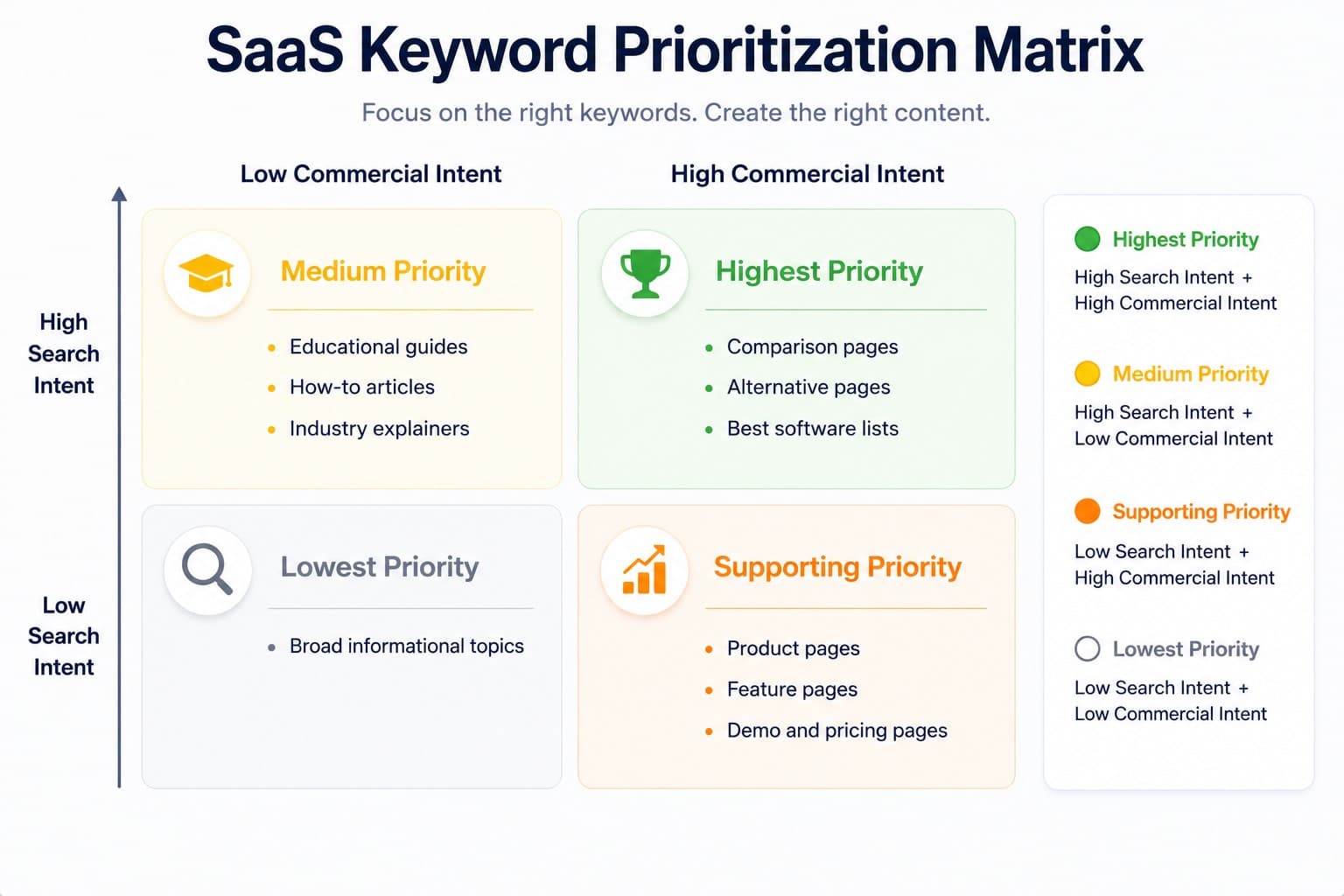
Prioritize keywords with commercial relevance. Educational queries build awareness. Comparison keywords often support purchase decisions.
A structured SEO content strategy also improves long-term visibility because related pages reinforce topical expertise across important subject areas.
Choose Your Content Distribution Channels
Publishing represents only part of success. Distribution determines whether audiences discover valuable content. Strong articles deserve active promotion.
Select channels based on audience behavior. Organic search delivers sustainable growth. Email nurtures existing prospects. Social media expands reach.
Effective content distribution combines owned, earned, and shared channels. Consistency matters more than volume. Continuous promotion extends content lifespan.
Creating a SaaS Content Plan
A strategy becomes valuable only after execution begins. A structured plan transforms priorities into daily work. Consistency creates predictable business results.
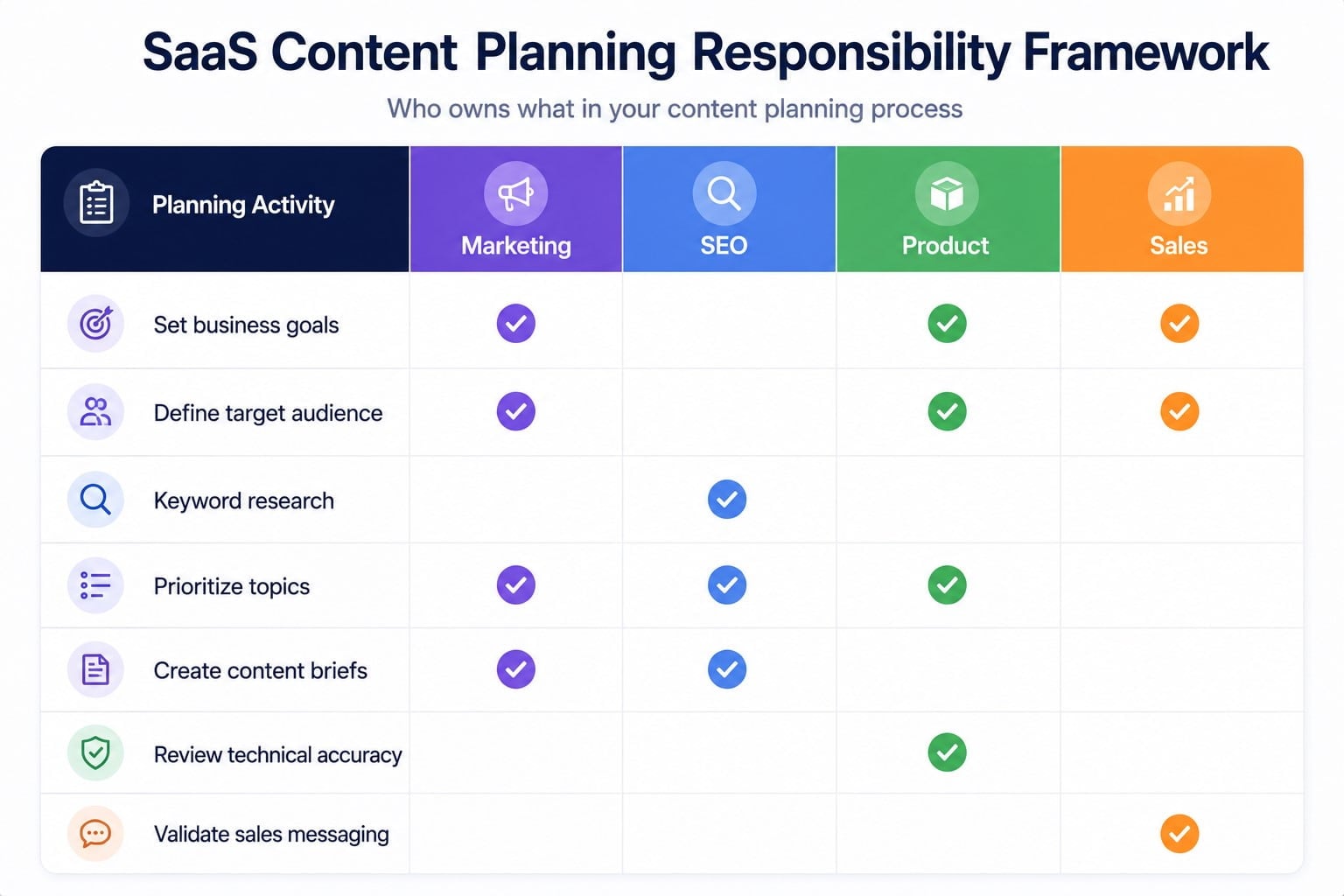
Every plan should define responsibilities before production starts. Clear ownership reduces delays. Regular reviews keep publishing schedules realistic.
Long-term planning also improves resource allocation. Teams avoid duplicated work. Product launches receive better content support.
Building a Content Calendar
A content calendar organizes publishing across weeks and months. It balances production capacity with business priorities. Predictable schedules improve consistency.
Each calendar entry should include publication dates. It should also identify content owners. Review deadlines prevent production bottlenecks.
Many SaaS teams also maintain an editorial calendar. Editorial planning coordinates campaigns across departments. That approach improves messaging consistency.
Content calendar essentials:
- Publication date
- Target keyword
- Search intent
- Content brief
- Distribution channels
- Success metric
Prioritizing High-impact Topics
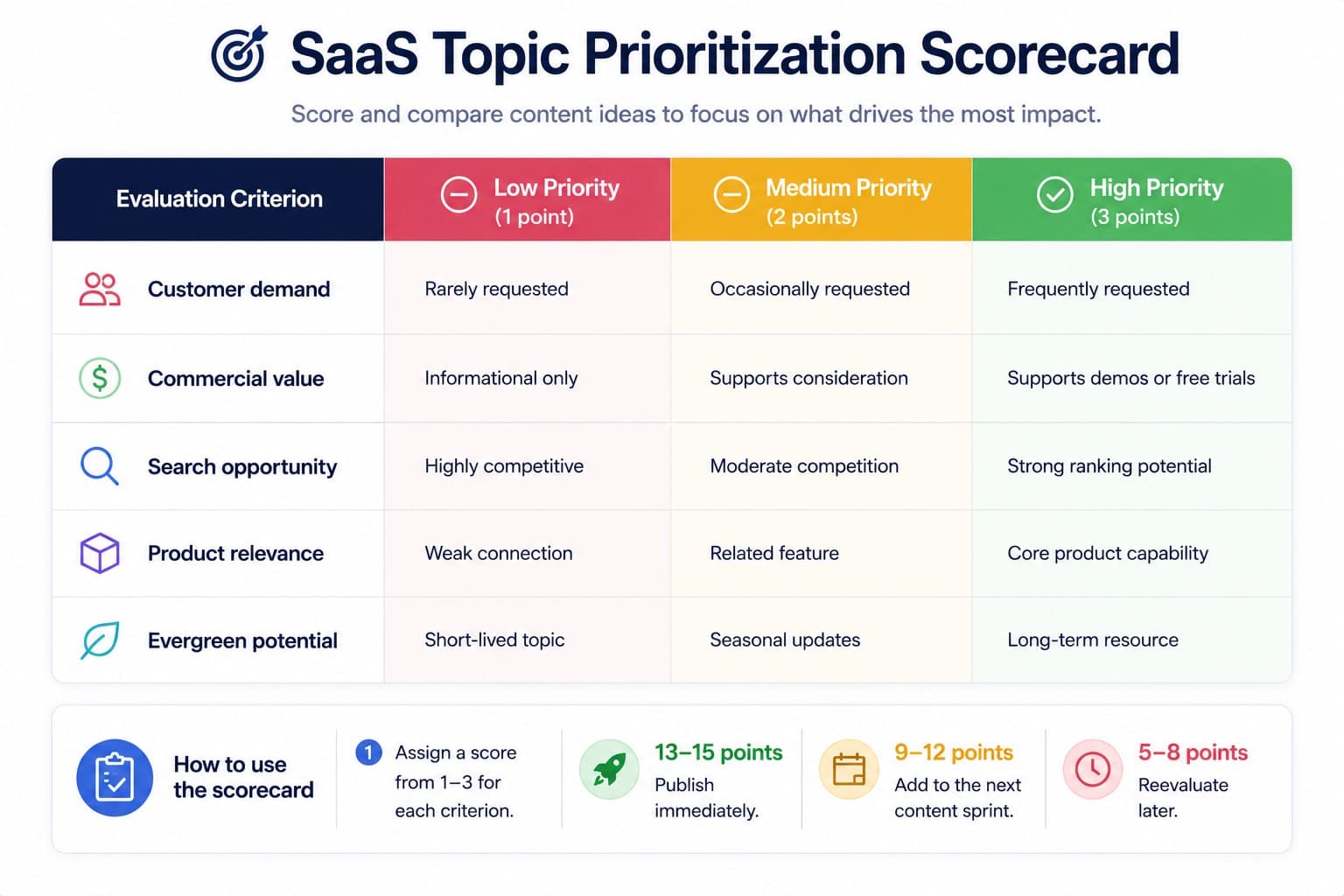
Not every topic deserves equal attention. High-impact subjects solve important customer problems. They also support measurable business goals.
Evaluate opportunities using commercial relevance first. Search volume provides additional context. Customer demand remains the strongest priority.
Content should answer recurring sales questions. Support requests reveal additional opportunities. Product documentation often inspires educational articles.
Balancing Evergreen and Trending Content
Evergreen resources generate value for years. Trending content captures immediate demand. Strong strategies combine both approaches.
Evergreen articles build stable organic traffic. Industry news increases visibility during important events. Each format supports different objectives.
Review evergreen assets regularly. Update statistics when necessary. Refresh screenshots after product changes.
When to refresh evergreen SaaS content:
- Rankings decline for important keywords.
- Product screenshots no longer match the interface.
- Competitor pages cover newer buyer questions.
- Internal links point to outdated resources.
- Conversion rates drop despite stable traffic.
- New product features change the recommended workflow.

Aligning Content with Product Launches
Product releases deserve coordinated communication. Educational assets should be published alongside new features. Customers adopt products faster with proper guidance.
Launch content should explain business value first. Feature lists rarely persuade buyers. Practical examples improve understanding.
Launch content every SaaS team should prepare:
- Feature announcement for existing customers.
- Use case page for new prospects.
- Product walkthrough for onboarding.
- Sales enablement brief for demos.
- FAQ for expected objections.
- Email sequence for active users.
Cross-functional planning reduces confusion. Marketing prepares educational assets. Product teams verify technical accuracy.
Companies using SaaS inbound marketing often align launch content with customer education instead of promotional messaging. That approach supports stronger adoption after release. 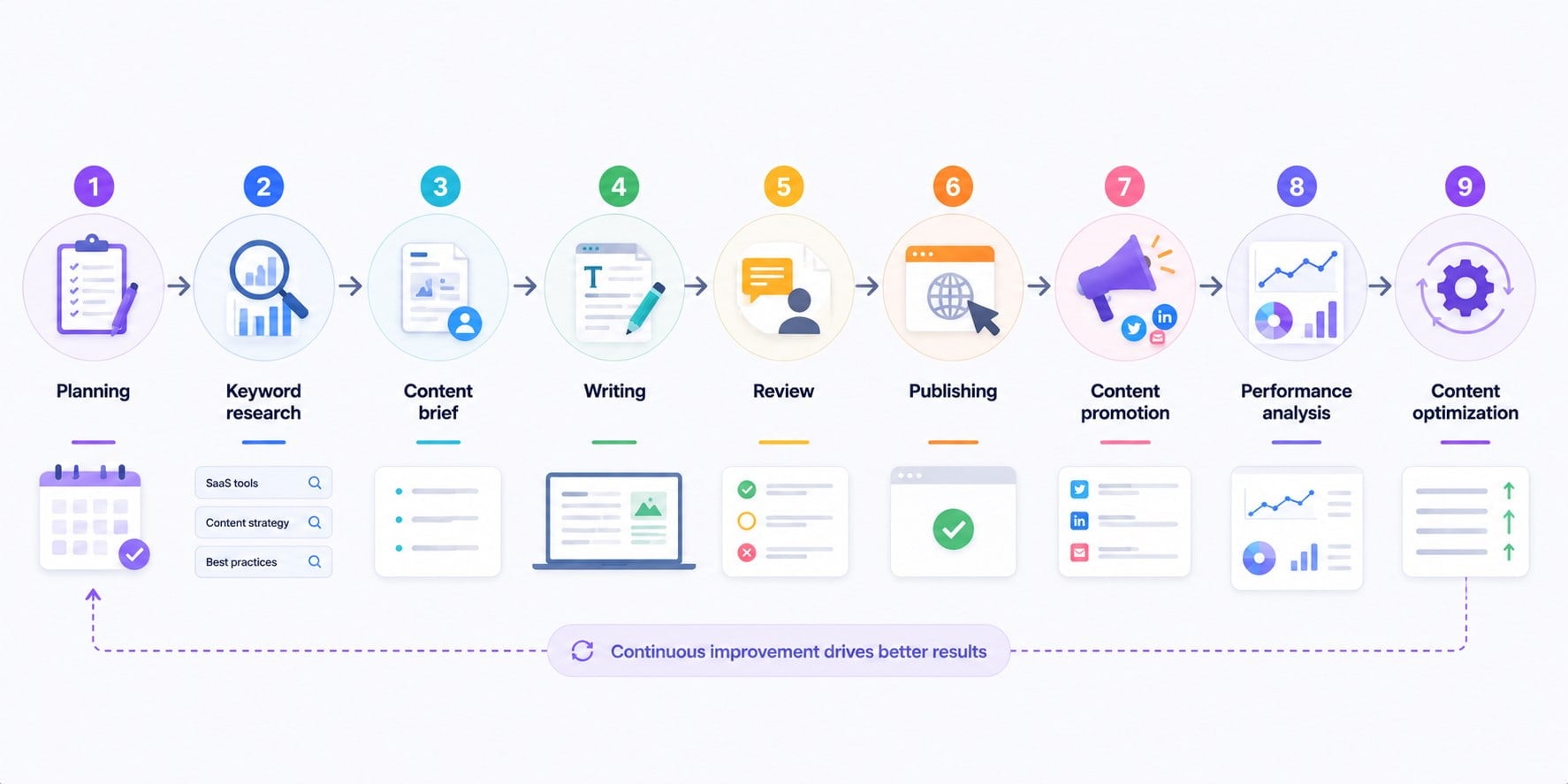
Executing Your SaaS Content Marketing Strategy
Execution determines whether strategy produces measurable results. Efficient workflows maintain quality as production grows. Consistency matters more than occasional publishing bursts.
Strong execution combines planning with continuous improvement. Every published asset becomes future learning. Performance data guides the next iteration.
Habits of high-performing SaaS content teams:
- Review performance after every major publication.
- Document successful content workflows.
- Reuse proven assets across multiple channels.
- Update priorities using customer feedback.
- Test one meaningful improvement at a time.
- Share performance insights across all stakeholders.
Creating Content Briefs
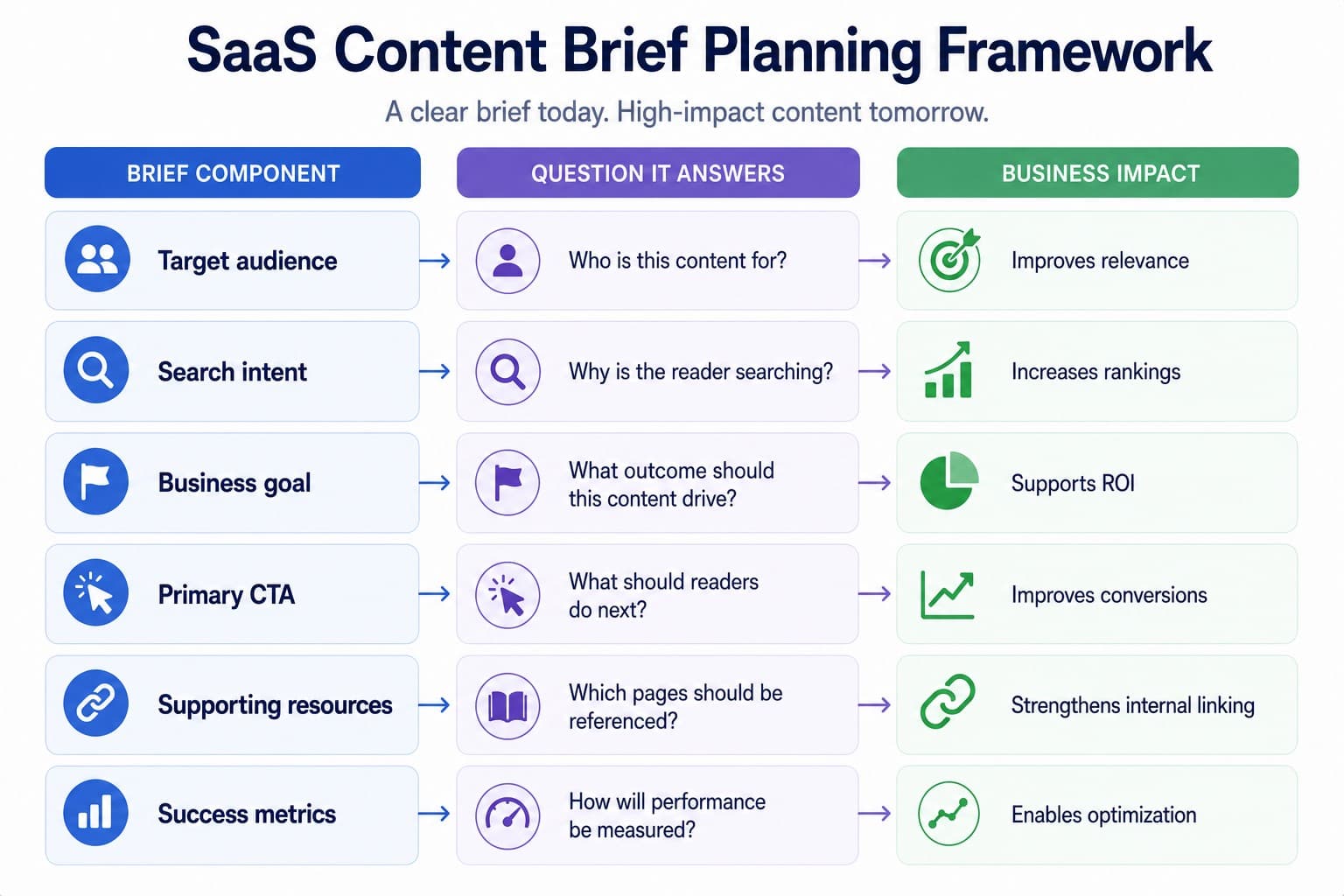
Every article should begin with a detailed content brief. Briefs reduce unnecessary revisions. Writers understand expectations before drafting begins.
Good briefs define audience needs clearly. They specify search intent. They also identify primary business objectives.
Include SEO requirements early. Outline internal linking opportunities. Define measurable success criteria before writing begins.
Writing Content That Converts
Helpful content answers real business questions. Clear explanations reduce uncertainty. Trust develops before sales conversations begin.
Avoid product promotion during educational sections. Demonstrate expertise through practical guidance. Readers recognize genuine value quickly.
Signals that content is conversion-ready:
- It answers one specific buyer question.
- It explains the business problem clearly.
- It shows practical product context.
- It removes a common purchase objection.
- It links naturally to the next step.
- It supports action without sounding promotional.
Strong calls to action appear naturally. They follow meaningful information. They never interrupt the reading experience.
Research from McKinsey’s Consumer Decision Journey shows buyers evaluate multiple touchpoints before choosing a solution. Helpful educational content influences those decisions throughout the evaluation process.
Optimizing for SEO
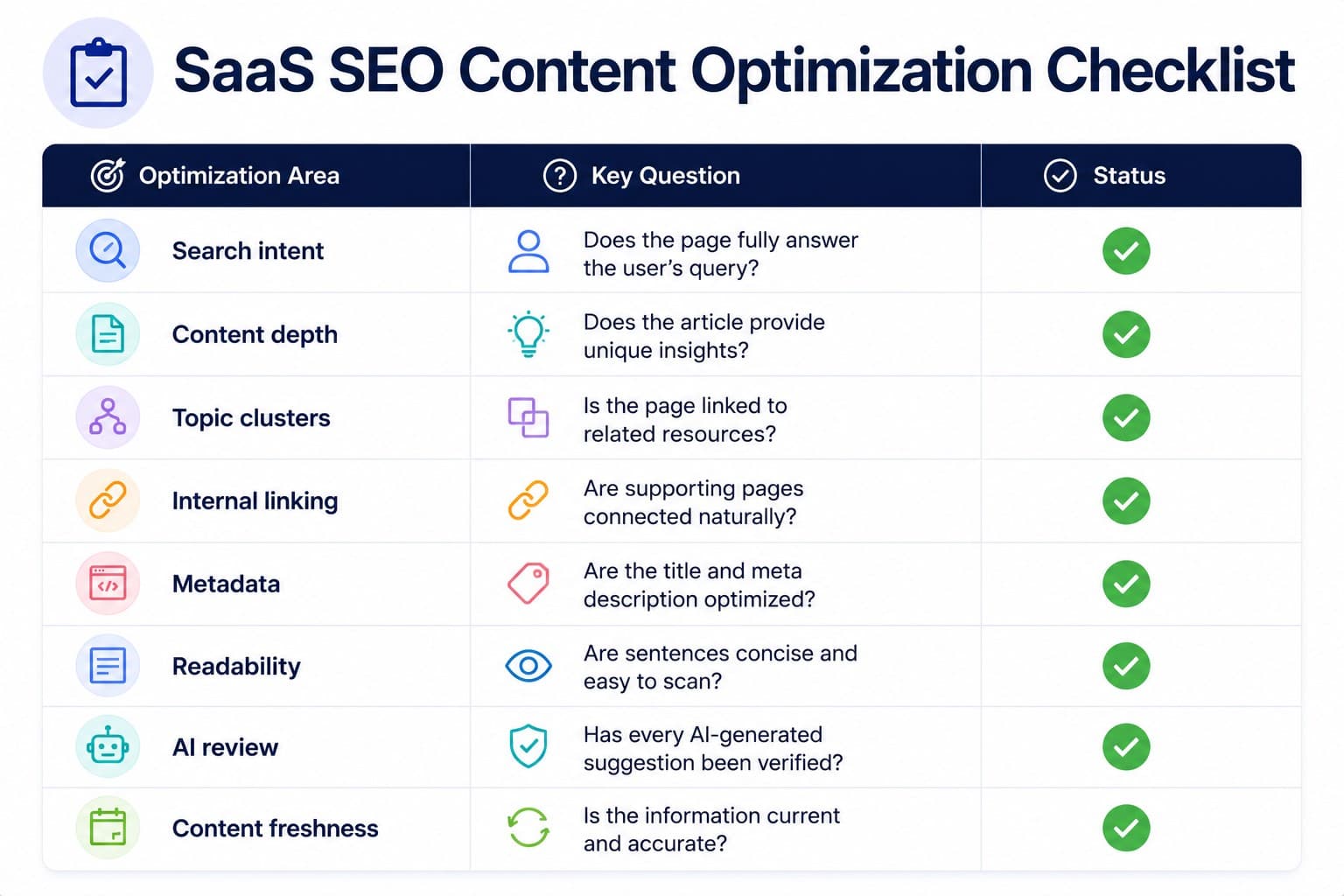
Optimization begins before writing starts. Keyword placement alone never guarantees rankings. Search intent remains the primary priority.
Build related pages into topic clusters. Strong internal linking improves topical authority. Search engines understand subject relationships more clearly.
Common SEO optimization mistakes to avoid:
- Targeting several primary keywords on one page.
- Publishing multiple pages with the same search intent.
- Ignoring orphan pages without internal links.
- Optimizing titles without improving page content.
- Updating keywords while leaving outdated examples.
- Chasing rankings instead of solving user problems.
Teams using AI content optimization should review every recommendation carefully. Human editors protect accuracy, clarity, and brand voice.
Google Search Central recommends creating helpful content that primarily serves readers instead of search algorithms. That principle supports sustainable search visibility over time.
Publishing Workflows
Consistent workflows reduce production delays. Defined responsibilities improve accountability. Standard processes maintain content quality.
Every asset should follow the same review sequence. Editors verify accuracy. SEO specialists confirm optimization before publication.
Document every production step. Teams onboard faster. Quality remains consistent as production scales.
Publishing workflow checklist:
- Complete content brief
- Editorial review
- SEO review
- Legal or product approval
- Final formatting
- Scheduled publication
Content Promotion Strategies
Publishing should begin promotion instead of ending it. Strong distribution extends content lifespan. Repeated exposure increases business impact.
Promote every important resource across multiple channels. Email reaches existing prospects. A structured SaaS email marketing program can also nurture trial users after signup. Social media expands visibility. Sales teams share relevant resources during conversations.
When to redistribute existing content:
- New product features expand the original topic.
- Industry news makes the article relevant again.
- Organic rankings begin to decline.
- Sales teams report recurring customer questions.
- Seasonal demand increases search interest.
- New case studies strengthen the original guidance.
Repurpose successful assets whenever possible. Blog articles become newsletters. Webinars become short videos. Research reports generate multiple supporting articles.
Effective content promotion increases reach without increasing production costs. Consistent distribution improves long-term content performance.
The Role of AI in SaaS Content Marketing
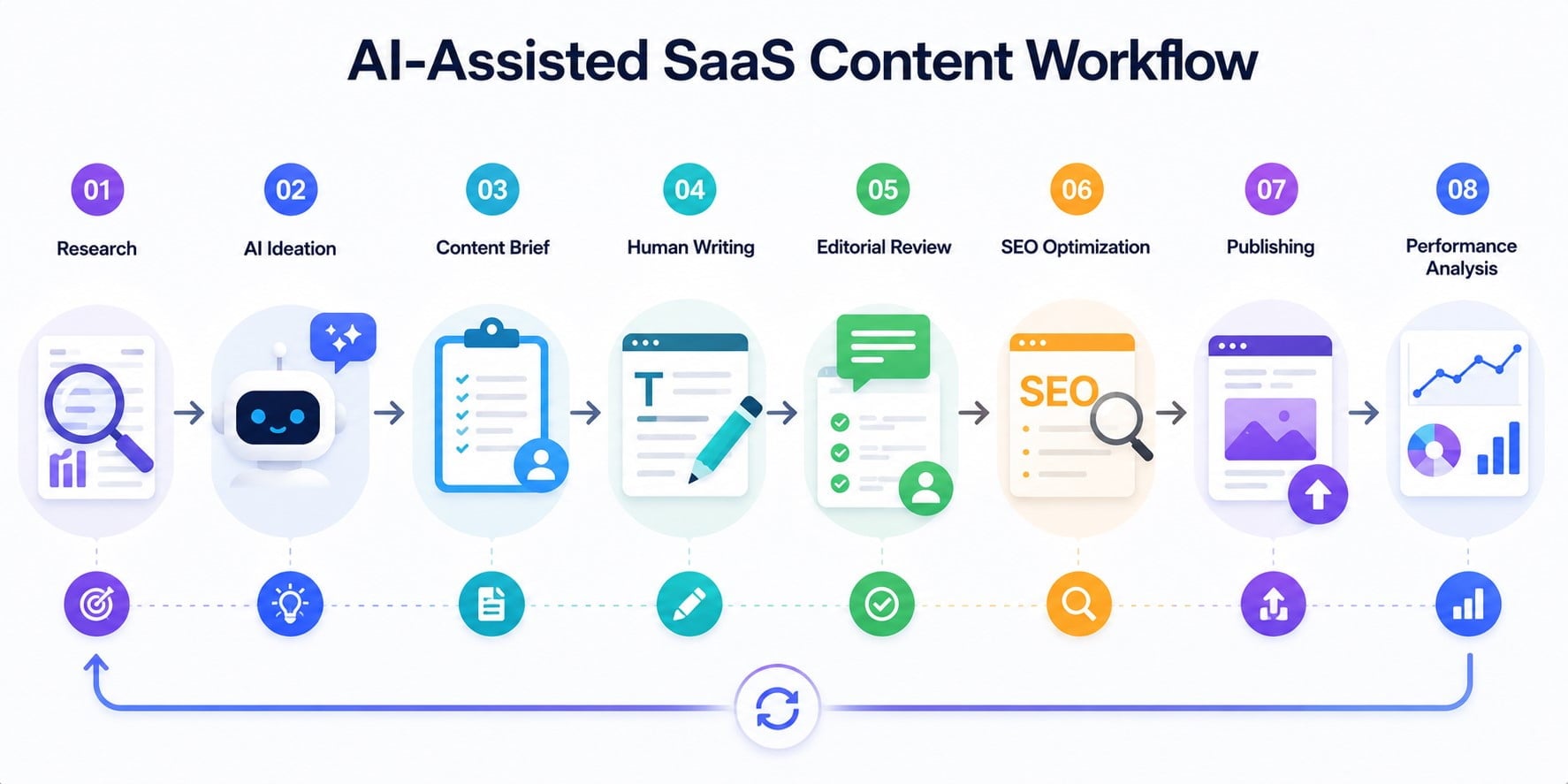
AI helps SaaS teams speed up research, planning, and optimization. It works best when humans control strategy, accuracy, and final decisions. Used well, AI improves execution without weakening expertise.
AI can support SaaS content in several practical areas:
- Analyze search data faster.
- Find content gaps across topic clusters.
- Generate first-draft outlines.
- Repurpose existing assets.
- Suggest internal linking opportunities.
- Support content optimization after publishing.
AI is most useful before and after writing. It can speed up research and performance analysis. Final editing still requires expert judgment.
Teams using AI should create clear review rules. Every draft needs fact-checking. Product claims also need approval from subject experts.
AI also helps personalize content journeys. It can recommend resources based on user behavior. This makes AI content marketing useful for onboarding and retention.
Tasks best suited for AI assistance:
- Summarizing industry research.
- Generating headline variations.
- Organizing topic clusters.
- Identifying internal linking opportunities.
- Suggesting metadata improvements.
- Flagging outdated content for review.
Still, AI has its limits. For example, it can only provide generic advice. AI may also miss product nuances.
Strong teams use AI-assisted review to improve structure, relevance, and performance. Human editors then refine messaging and verify accuracy. This balance keeps content useful and credible.
Measuring Content Marketing Success
Content performance should connect directly to business outcomes. Revenue matters more than pageviews. Consistent measurement improves future decisions.
Track performance across the complete customer journey. Individual metrics rarely tell the full story. Combined analysis reveals stronger insights.
Important metrics include:
- Organic traffic
- Lead generation
- Marketing qualified leads (MQLs)
- Free trial conversions
- Customer acquisition
- Customer retention
- Content marketing ROI
Review performance regularly. Compare results against defined KPIs. Update priorities using measurable evidence.
The Content Marketing Institute recommends evaluating content using business outcomes instead of publication volume alone. That approach supports stronger long-term decision making.
Common SaaS Content Marketing Mistakes
Many SaaS companies publish regularly without measurable business improvements. Execution problems often begin before writing starts. Strategic planning prevents those issues.
Most mistakes appear gradually. Small inefficiencies compound over time. Regular reviews help teams correct problems early.
| Mistake | Business Impact | Better Approach |
| Publishing without goals | Low ROI | Define KPIs first |
| Ignoring search intent | Poor rankings | Match content to user intent |
| Weak keyword research | Low visibility | Build topic clusters |
| Inconsistent publishing | Slower growth | Maintain a content calendar |
| Measuring traffic only | Missed opportunities | Track conversions and revenue |
Publishing without audience research often produces generic content. Buyers rarely engage with broad messaging. Customer interviews improve relevance.
Some teams prioritize quantity over quality. Frequent publishing alone rarely builds authority. Valuable insights create stronger differentiation.
Many companies also overlook conversion rate optimization for SaaS. Traffic has little value without conversions. Landing pages deserve continuous testing.
CRO checks before publishing content:
- Does the page have one clear next step?
- Is the CTA matched to search intent?
- Does the introduction address the buyer’s problem?
- Are trust signals placed near conversion points?
- Is the page easy to scan on mobile?
- Can users reach product pages without friction?
Weak distribution limits strong content. Excellent articles cannot generate results without visibility. Promotion should accompany every publication.
Content also becomes outdated over time. Statistics change regularly. Product screenshots require frequent updates.
Periodic content audits reveal declining performance. Historical articles deserve optimization. High-performing pages often produce quick improvements.
Final Thoughts
A successful SaaS content system combines planning, optimization, and continuous measurement. Every published asset should support measurable business goals. Long-term consistency creates sustainable competitive advantages. Strong SaaS content depends on customer understanding rather than publishing volume. Educational resources shorten buying cycles. Helpful content also improves long-term customer relationships. Businesses should treat content as a strategic investment instead of a marketing expense. Continuous optimization strengthens future performance. Every improvement compounds over time.