

Trial signups don’t always translate into paying customers. People compare products, create an account, spend a few minutes inside the product and disappear. The leak often starts long before revenue does.
A SaaS marketing funnel maps the path from first contact through to long-term product use. Traditional sales funnels stop at conversion. SaaS businesses can’t, because subscription revenue depends on customers continuing to use the product.
Prospects arrive better informed than ever. They compare products, ask AI tools for recommendations, read reviews and community discussions, and seek advice from colleagues before visiting your website.
By the time they reach your website, many buying decisions have already started to take shape. (McKinsey Consumer Decision Journey)
Moreover, it’s surprisingly common to fix the wrong stage. Teams work on retention when onboarding is the real issue or rewrite landing pages when the product is attracting the wrong audience. Finding that disconnect is usually where meaningful improvements begin.
What Is a SaaS Marketing Funnel (and How It Works)
A SaaS marketing funnel, sometimes referred to as a software as a service marketing funnel, is the process of turning interested prospects into long-term customers. Unlike a traditional sales funnel, it doesn’t end with a purchase or signup because recurring revenue depends on what happens afterward.
Subscription businesses work differently from companies selling one-off products. Signing up for a trial or purchasing a subscription isn’t the point where value is created—it’s the point where customers decide whether the product deserves a place in their daily work.
That changes what success looks like. A marketing funnel for SaaS isn’t judged by lead volume alone. It also depends on:
- activation after signup
- product adoption
- customer retention
- account expansion and referrals
Those stages influence one another more than many teams realize. Marketing can generate a steady flow of qualified signups, but weak onboarding will still limit growth. On the other hand, an excellent product experience can’t compensate forever if the wrong audience keeps arriving in the first place.
SaaS vs. Traditional Marketing Funnel: What’s the Difference?
That difference also changes who owns the funnel. In reality, no single team owns the SaaS funnel. It succeeds only when marketing, product, sales, and customer success work toward shared goals.
Marketing attracts potential customers, product teams shape the first experience inside the software, and customer success helps people continue using it over time. When each team measures success independently, it’s easy to improve one metric while another quietly moves in the opposite direction.
| Traditional Funnel | SaaS Marketing Funnel |
| Success ends with a purchase | Success continues after signup |
| Focus on generating sales | Focus on recurring revenue and retention |
| Marketing owns most outcomes | Marketing, product and customer success share responsibility |
| More leads are the primary goal | Sustainable customer growth is the primary goal |
| Conversion measures success | Activation, retention and expansion measure success |
Looking to explore the bigger picture beyond funnels? Learn more about SaaS marketing.
Key Stages of the SaaS Marketing Funnel
A SaaS marketing funnel typically includes five stages: awareness, consideration, decision, retention and advocacy. They don’t contribute equally, though. One weak stage can hold back the rest of the funnel, even when everything else appears to be working.
| Stage | Goal | Common Mistake |
| Awareness | Attract qualified visitors | Focusing on traffic instead of intent |
| Consideration | Build confidence | Generic messaging |
| Decision | Remove friction | Complicated signup |
| Retention | Deliver value quickly | Weak onboarding |
| Advocacy | Turn customers into promoters | Never asking for referrals |
Awareness
Plenty of SaaS teams judge awareness by traffic, then wonder why the pipeline doesn’t move. The problem often starts much earlier: attracting people who were never likely to buy. A blog post that ranks well isn’t especially useful if it answers questions your future customers aren’t asking.
“Shortlists are often formed before anyone visits the website. By then, buyers have already looked at reviews, compared products or asked AI tools for recommendations. It changes where companies need to earn trust, not just where they publish content. We’re also creating ‘X vs Y’ content with clear, extractable answers because that’s the type of content AI tools are most likely to surface.”
Vincent N., Lead Strategist at NinjaPromo
If your product has a longer buying cycle or multiple decision-makers, our guide to sales funnel for B2B SaaS covers the differences in more detail.
Consideration
By this stage, prospects are comparing options rather than looking for general information. Generic feature lists rarely move the decision forward. Practical resources such as comparison pages, customer stories, pricing information and implementation guides help buyers understand why your product is the better fit for their situation.
Decision
Many users who abandon a free trial don’t leave because they’ve changed their mind. They leave because getting started takes more effort than expected.
Extra form fields, confusing setup, or too many choices before the product becomes useful all increase drop-off. A product-led growth funnel keeps those early steps short so users can try the product before they’re asked to invest more time.
Retention
A signup doesn’t create a customer. Regular use does.
Teams often celebrate strong trial numbers, only to find activity drops a few weeks later. That’s usually a sign that people never found a reason to keep coming back. Improving retention means helping customers get ongoing value from the product, which is where much of the return on acquisition spend is realized across the SaaS customer journey.
Advocacy
Customers rarely recommend software after one good experience. They recommend products that consistently save them time, solve a recurring problem or become part of the way they work.
That’s why referrals are usually the result of a good customer experience rather than a referral program. Asking for reviews still matters—but only after customers have something worth talking about.
“Designing the funnel around one buyer moving from awareness to decision is a mistake I see over and over again. Most B2B purchases involve three to seven people entering at different points, so a page built around one persona’s objections loses everyone else. The fix isn’t more content. It’s creating parallel paths from the same entry point.”
Vincent N., Lead Strategist at NinjaPromo
Best Practices for Building a Strong SaaS Marketing Funnel
Very few SaaS funnels need rebuilding from scratch. More often, one stage is doing most of the damage while the rest simply reflect the consequences.
Sometimes that’s trial activation. Sometimes it’s attracting people who were never likely to become customers. Until that weak point is fixed, improvements elsewhere usually have little effect.
The practices below target the issues that most often slow SaaS growth.
| Practice | Why It Matters |
| Align content with buyer intent | Helps prospects find the information they need to move forward |
| Personalize the experience | Makes messaging more relevant to user intent |
| Build trust | Reduces uncertainty before commitment |
| Measure bottlenecks | Shows where optimization will have the greatest impact |
| Improve retention | Increases lifetime value and reduces pressure on acquisition |
Align Content With Every Stage of the Buyer’s Journey
Content should answer the next question a buyer has, not the previous one.
A useful way to think about content is by asking what uncertainty the buyer still has.
- Awareness: educational articles, industry research and problem-focused guides
- Consideration: comparison pages, feature walkthroughs, webinars and FAQs
- Decision: pricing pages, implementation guides, customer case studies and ROI information
It’s common to find detailed blog libraries alongside thin pricing pages, outdated comparisons or almost no implementation guidance. Buyers close to making a decision notice those gaps long before marketing teams do.
Use Behavioral Data to Drive Personalization
Two visitors arriving on the same page rarely have the same intent. One might be comparing vendors before making a purchase, while another is still deciding whether the problem is worth solving.
Behavior provides useful clues that help separate those audiences.
Common signals include:
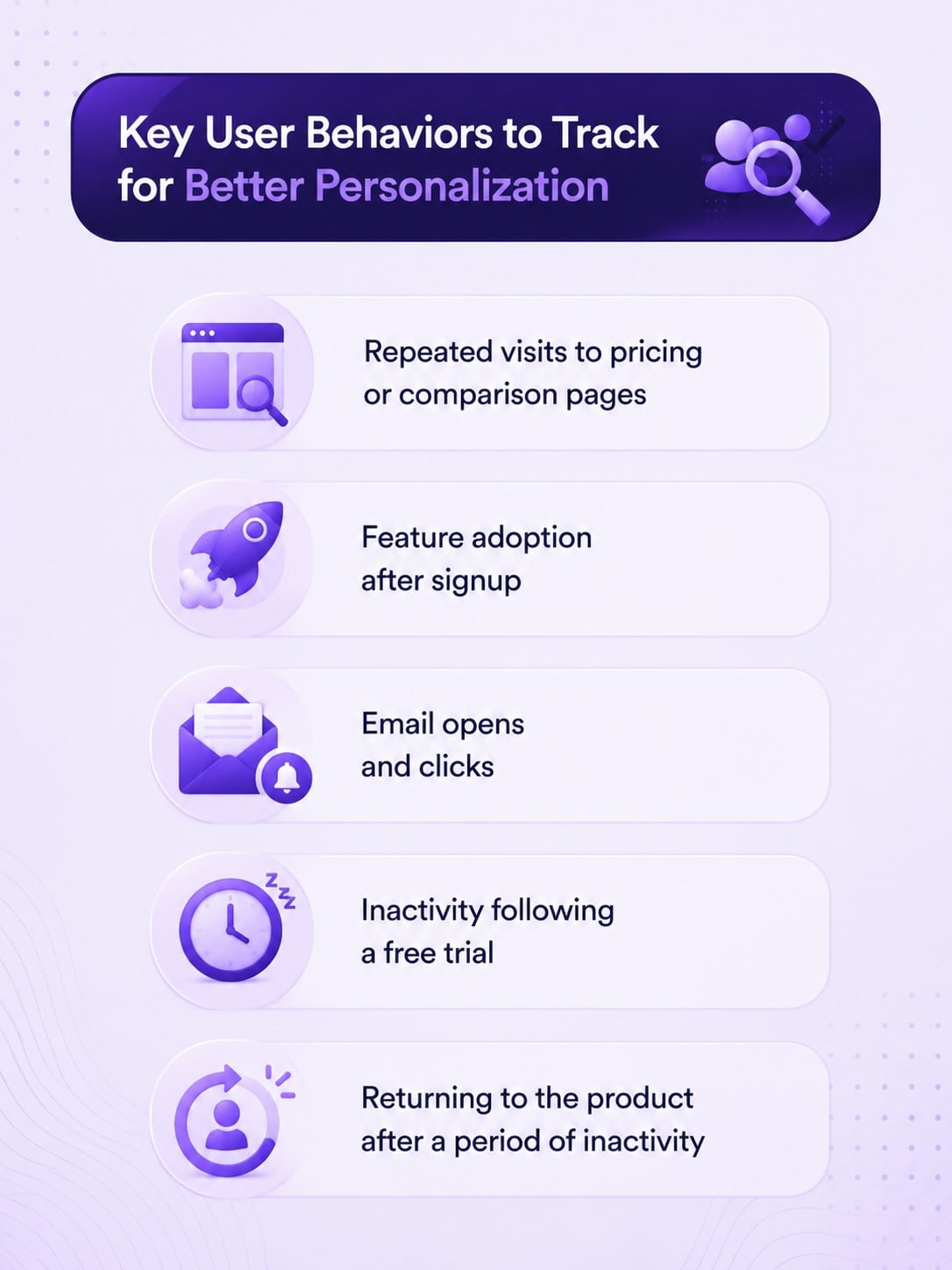
You don’t need complex automation to use this information well. Even simple segmentation makes lifecycle messaging more relevant because people receive content that matches what they’ve already done instead of following the same sequence as everyone else. That’s the basis of a stronger user acquisition system for SaaS.
“Replacing a ‘Request a Demo’ form with a self-serve sandbox had a much bigger impact than we expected. Trial-to-paid conversion improved even more than trial signups because technical evaluators could test the product using their own data before speaking to sales. The change didn’t simply increase volume—it attracted people who were already closer to making a buying decision.”
Vincent N., Lead Strategist at NinjaPromo
Build Trust With Social Proof, Case Studies, and Reviews
Prospects don’t trust software because a website says it’s reliable. They trust evidence that shows it has worked for businesses like theirs.
The strongest trust signals answer practical questions buyers already have:
- Who else uses this product?
- What results did they achieve?
- How difficult was implementation?
- Would it work for a business like mine?
Buyers also look for examples that resemble their own business. A case study from the same industry, a similar company size or a familiar use case often answers questions a generic testimonial can’t. The closer the example feels to their situation, the easier it is to judge whether the product is likely to work for them.
Customer logos, quantified case studies, implementation stories and independent reviews on platforms such as G2 all play a different role in that process. Generic testimonials rarely have the same impact because they offer praise without much context.
Track Funnel Metrics to Identify Drop-Off Points and Bottlenecks
A conversion rate tells you that users are dropping off. It doesn’t tell you why.
Different metrics highlight different parts of the customer journey, which makes them useful for diagnosis rather than reporting.
| Metric | What It Reveals |
| Visitor → Signup | Message and audience fit |
| Activation | Time to first value |
| Trial → Paid | Product fit and buying confidence |
| Retention | Continued product value |
| Churn | Long-term adoption problems |
A dashboard rarely tells the full story at first glance. One week you might see signup numbers holding steady while activation slips. A month later, trials are converting well, but retention starts falling instead. Those shifts usually send teams looking in different places, which is why experienced marketers avoid making decisions from a single chart. Amplitude benchmarks can also provide useful context by showing whether those patterns are unusual for similar products.
Optimize Post-Purchase Experience to Improve Retention
Customers rarely decide to leave on renewal day. In many cases, that decision starts during the first few weeks, when the product either becomes part of their routine or quietly drops off the list.
Keeping people engaged usually comes down to a handful of basics:
- structured onboarding
- timely customer support
- practical educational content
- gradual feature discovery
- communication based on product usage
Those activities sit at the center of SaaS lifecycle optimization. Customers who continue using a product are more likely to renew, expand their subscriptions and recommend it to colleagues, making SaaS retention and growth system improvements some of the highest-return work a team can do.

Is Your Marketing Funnel Working? Here’s How to Check
Strong growth can hide a weak funnel for quite a while. Paid campaigns bring in more visitors, trial numbers increase, and revenue still moves in the right direction. Then acquisition slows, and suddenly the gaps become obvious.
A quick health check usually tells you where to look next.
✅ Look for these signs first:
- Visitors arriving through channels that consistently convert
- New users completing a meaningful action soon after signing up
- Trial-to-paid conversion holding steady or improving
- Customers still active weeks after onboarding
- Churn staying under control
- Recommendations and reviews appearing without chasing every customer
When one of those starts slipping, resist the temptation to redesign the whole funnel. Problems often show up one stage later than where they actually started.
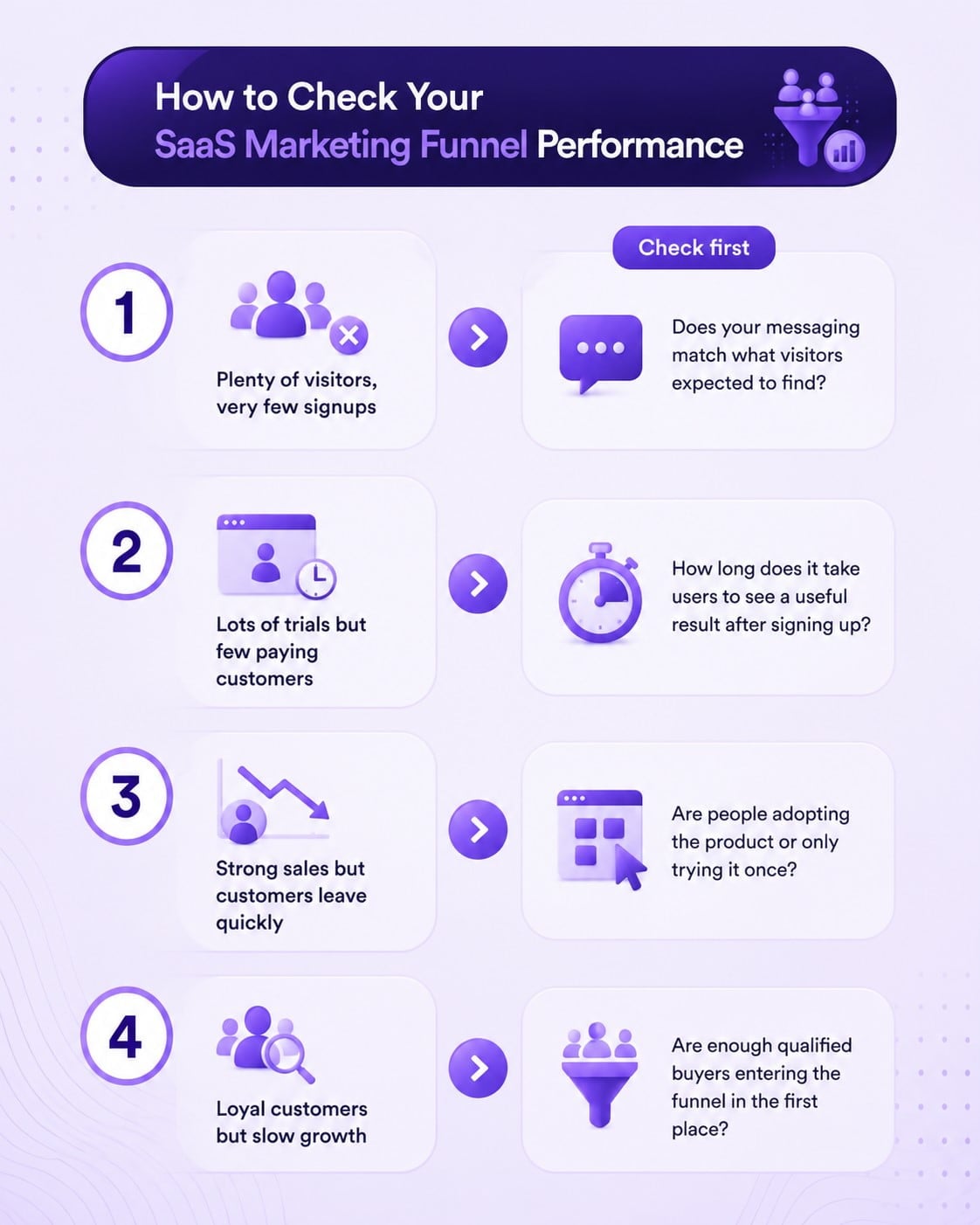
A marketing funnel for SaaS becomes much easier to improve once the real constraint is obvious. Until then, changing several things at once usually creates more questions than answers.
Final Thoughts
No two companies will build exactly the same SaaS marketing funnel, because no two products, customers or buying journeys are identical. What stays consistent is the way successful teams improve them. They look for the point where qualified users stop progressing, solve that problem, then measure the result before moving on to the next one.
That approach is usually more effective than making small changes across every stage at once. Growth comes from removing the biggest obstacle first, then repeating the process as customer behavior, products and markets continue to change. That’s the foundation of an effective SaaS growth funnel strategy.