

SaaS PR is how a software company earns credible media coverage and outside validation to build trust in its product. It works through media relations, thought leadership, and customer stories that shape how buyers and analysts see the brand.
Here’s the problem most software marketers hit. Your product is good. It solves something real. But buyers still go with the name they’ve already heard of, your best features slip by unnoticed, and your ad spend fills the funnel without closing much. Then a deal stalls because the CFO has never heard of you.
That gap is trust. And trust gets built well before anyone books a sales call. This guide walks through how PR earns it, and how to tell what your coverage is actually doing for the pipeline.
What Makes SaaS Public Relations Different?
SaaS public relations differs from traditional PR because it targets technical, subscription-based buyers who value proof over promotion. Coverage has to reach developers, IT leaders, and executives across long sales cycles. It relies on product data, integrations, and customer results instead of launch hype. And it ties media results to adoption and retention.
Two features set it apart:
- The buyer rarely acts alone. A software purchase passes through product, security, finance, and legal reviews, so coverage has to reassure several people at once.
- The product keeps changing. Each release, integration, and pricing update creates a new reason to talk to the press.
Because most software sells to businesses, this work overlaps a lot with B2B PR, where credibility and expertise matter more than raw reach. Review sites and analyst notes also shape decisions, so a mention there can matter as much as a feature article.
The table below shows how SaaS PR differs from regular consumer or corporate PR.
| Feature | Traditional PR | SaaS PR |
| Primary audience | Broad consumer or general press | Developers, IT buyers, and executives |
| Proof point | Brand story and messaging | Product data, usage metrics, and case studies |
| Sales cycle | Short and campaign-driven | Long and multi-stakeholder |
| Success metric | Impressions and sentiment | Pipeline, adoption, and retention |
| Content type | Announcements and events | Thought leadership and technical insight |
The methods differ too. A launch may run under embargo, with analyst briefings before the news breaks. A security update may need one clear statement agreed across support, sales, and press. The common thread is precision, because software audiences spot vague claims fast.
Key Distribution Channels for SaaS PR
Media coverage only pays off when it reaches the right audience more than once. SaaS PR works when you spread earned media across the channels where buyers research, compare, and decide.
“Most of a media placement’s value comes from how it is distributed after publication. Share it through LinkedIn, email, sales outreach, and your website puts the coverage in front of the buyers who matter. The original article creates credibility, but repeated use turns that credibility into trust and pipeline impact.”
Michael M, Head of Influencer Marketing at NinjaPromo
A single feature in a trade publication fades fast. The same story, reused across your own and social channels, keeps working for months. Good PR for SaaS depends as much on distribution as on the coverage itself.
Distribution usually covers several channels:
- Industry and trade media that your buyers already read.
- LinkedIn, where executives and technical audiences follow expert content.
- Your company blog and newsroom, for coverage you own and can search.
- Email newsletters that keep leads warm with credible mentions.
- Podcasts and webinars that reach niche communities.
- Analyst and review platforms such as G2 or Gartner Peer Insights.
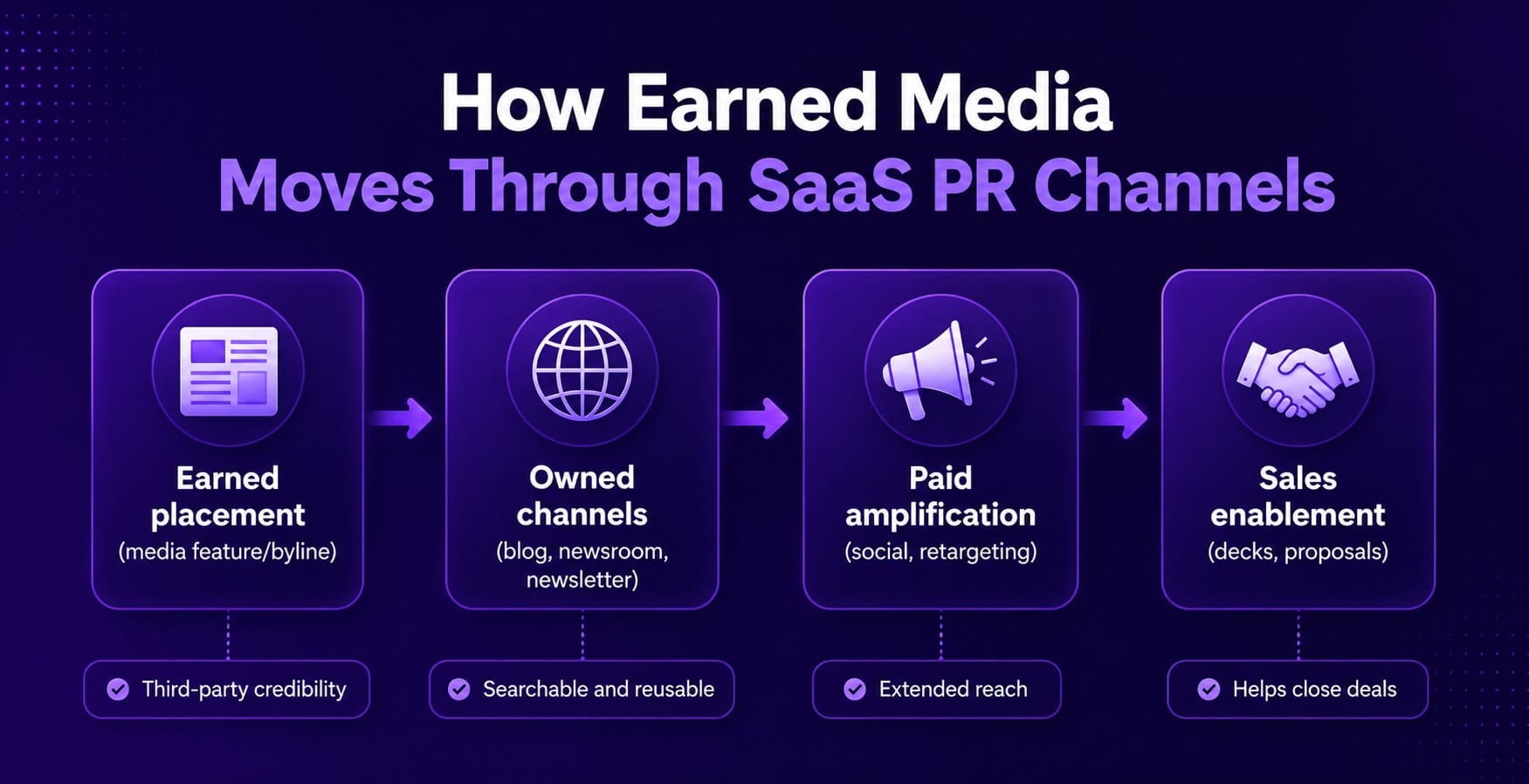
Order matters as much as the mix. Start with the earned placement, since a byline in another outlet carries more weight than a post you publish yourself. Then push it through your own and paid channels, and bring it up later in sales calls. One strong feature can feed a newsletter, a few social posts, and a slide in the sales deck.
Your own channels also protect the value of coverage over time. A newsroom page that links to every mention builds authority and sends search engines a clear signal. When a placement ranks for a buyer’s search, it keeps bringing traffic long after the news fades.
Best Practices for a Successful SaaS PR Strategy
A strong SaaS PR strategy links media work to business results. The goal is to build SaaS credibility through public relations that buyers and analysts trust. You can use each practice below on its own or combine them into a full program.
Align PR with Revenue and Product Growth Metrics
PR in SaaS should move the pipeline. Tie every campaign to a funnel stage and a product goal.
- Match your message to ICP pain points so coverage draws qualified traffic.
- Time announcements around product launches to support adoption.
- Use media mentions as trust signals on high-intent pages.
Buying groups are bigger than they look. More than 40% of B2B deals stall because hidden stakeholders in finance, legal, and operations are not aligned (Edelman). These people rarely take sales calls, yet they can block a deal. Coverage that answers their concerns, such as security, compliance, or cost, helps move it forward.
In practice, this means planning PR around the product roadmap. A feature that answers a common objection deserves a story timed to the sales push. A documented PR strategy keeps your message consistent across the funnel and stops mixed signals between teams.
Leverage Product-Led PR and Customer Advocacy
Product-led PR turns real usage into stories. Let the product and its customers carry the message.
- Publish case studies with specific outcomes, such as time saved or costs cut
- Share anonymized usage data that shows industry trends
- Feature customer testimonials in pitches and coverage
“A customer story becomes publishable when it focuses on a real business problem, measurable results, and a useful lesson for the reader. The customer should remain the central character, with the product supporting the outcome rather than dominating the story. Stories that mainly praise the vendor read like advertising and rarely attract media interest.”
Michael M, Head of Influencer Marketing at NinjaPromo
Reviews and case studies build customer trust in SaaS purchases, since buyers rely on proof from peers. A case study works best when it names a metric, a timeframe, and a role. One example: a 30% drop in onboarding time within a quarter. Vague praise convinces no one.
Partnerships and integrations also create fresh angles, because co-marketing with a known platform earns coverage in both audiences. Community programs, from user groups to Slack channels, create advocates who spread news. Working with niche creators through SaaS influencer marketing reaches technical communities that ignore regular ads.
Create Newsworthy Stories Beyond Product Launches
Coverage dries up when a company only pitches features. Build a calendar of story types that keep media interested all year.
Reliable sources of news include:
- Customer success stories with measurable results
- Original research and benchmark reports
- Funding rounds and product milestones
- New partnerships and integrations
- Notable hires or expansion into new markets
“Strong SaaS stories usually come from market insights. Proprietary data, customer results, industry shifts, contrarian views, and timely expert commentary give journalists something useful to publish. The strongest angle is based on what the company uniquely knows, not what it wants to promote.”
Michael M, Head of Influencer Marketing at NinjaPromo
Clear SaaS product positioning helps journalists see the angle fast, so start every pitch with what changed and why it matters. Funding news needs extra care in the early stage, since PR for startups relies on tight timing and a clear growth story.
Original data is still the strongest angle, since reporters value numbers they cannot find anywhere else. A short survey of your own users can become a benchmark report that earns links for a year. Turn one dataset into a press release, a blog post, and a set of charts for social.
Use Data-Driven Media Outreach and Niche Targeting
Generic mass outreach no longer works. Target journalists who cover your exact space and lead with data. 88% of journalists delete pitches that miss their beat (Muck Rack). Another 40% said original data is one of the most useful parts of a pitch. That makes sector-specific PR far more effective than broad blasts.
Practical steps:
- Build a short list of journalists by beat rather than outlet size
- Personalize each pitch with a relevant angle and data point
- Keep pitches under 200 words
- Nurture relationships before you need coverage
Track what each reporter has written lately, then link your story to that thread. A pitch that mentions a journalist’s last article shows effort and relevance.
Group your list into tiers: priority outlets that shape the category and secondary ones that add volume. Warm relationships, built over months, win the steady coverage that one-off blasts never do.

Repurpose PR Content Across Marketing and Sales Channels
Earned media should not sit in a coverage folder. Extend its life across the funnel.
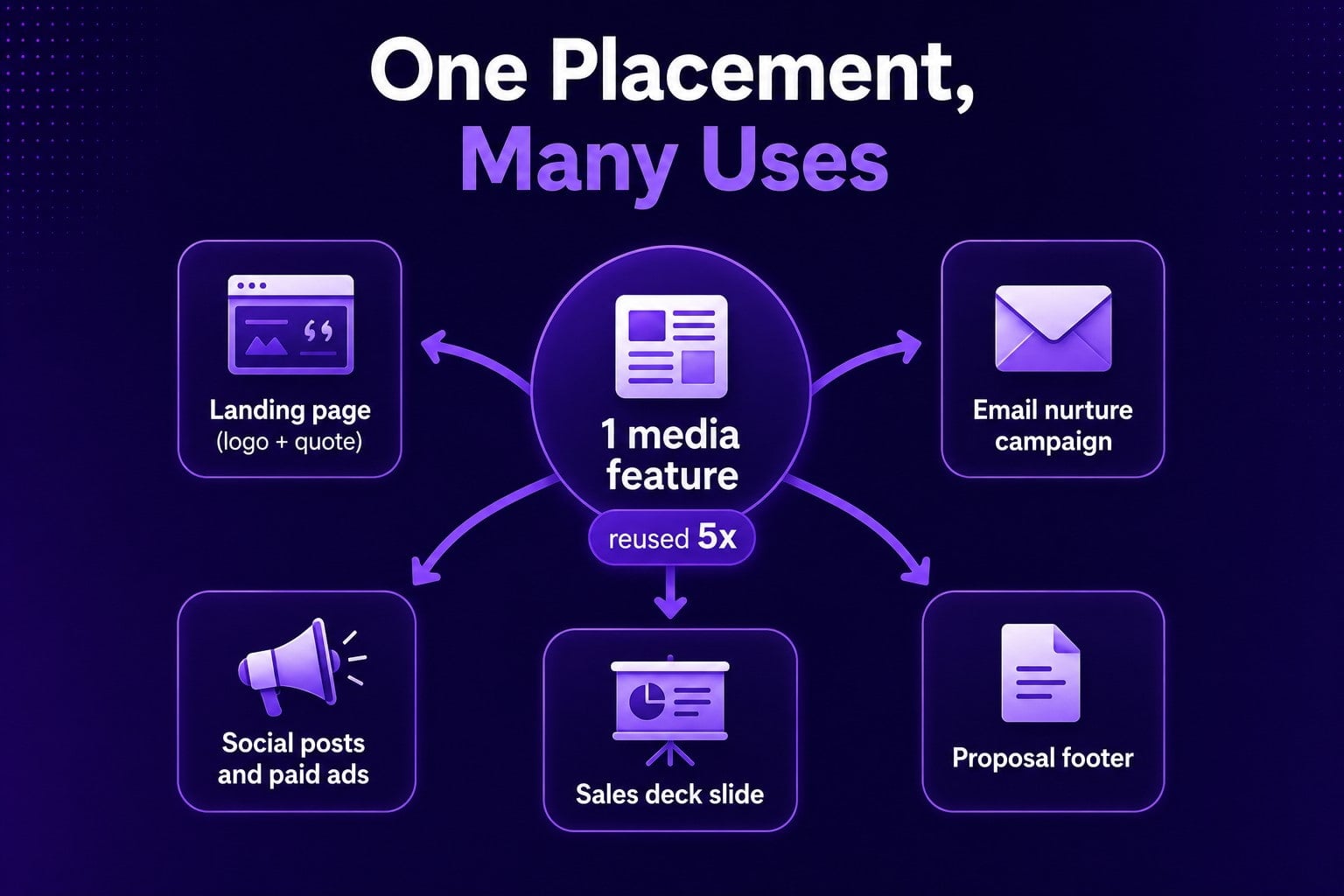
Ways to repurpose PR assets:
- Add media logos and quotes to landing pages
- Feature interviews and awards in email campaigns
- Share coverage in social posts and paid ads
- Include mentions in sales decks and proposals
“The best way to reuse media coverage is to help sales teams answer buyer concerns. An independent article can build trust in the company’s experience, security, or reliability. Sales reps should share it when those concerns come up during a deal.”
Michael M, Head of Influencer Marketing at NinjaPromo
Feeding these assets into the wider SaaS marketing engine reinforces messaging at every stage. This is how teams promote SaaS brands through digital PR that supports demand. A single award can appear in a nurture email, a retargeting ad, and a proposal footer.
Sales teams benefit most when coverage is easy to reach. Keep a shared folder of recent mentions, quotes, and logos that reps can drop into conversations. Repurposing also raises the return on each placement, since the cost of the coverage is fixed while its uses multiply.
Prepare Scalable Reputation and Crisis Management Frameworks
SaaS risks often involve outages, security incidents, or data privacy. Prepare responses before you need them.
A basic framework includes:
- A clear chain of command for approvals
- Pre-drafted holding statements for common scenarios
- Defined channels for customer and press updates
- A post-incident review to rebuild trust
Speed and transparency protect reputation management efforts during a crisis. Silence reads as guilt, and slow updates invite speculation. A mishandled incident also accelerates churn, which is already a constant pressure in subscription businesses.
The goal is a calm, factual update within hours, posted on a public status page. Follow it with a clear fix and a root-cause summary. Assign roles now, so no one improvises under pressure. Some teams retain dedicated SaaS PR services to keep response times fast and messaging consistent when it matters most.
How to Evaluate SaaS PR Performance Effectively
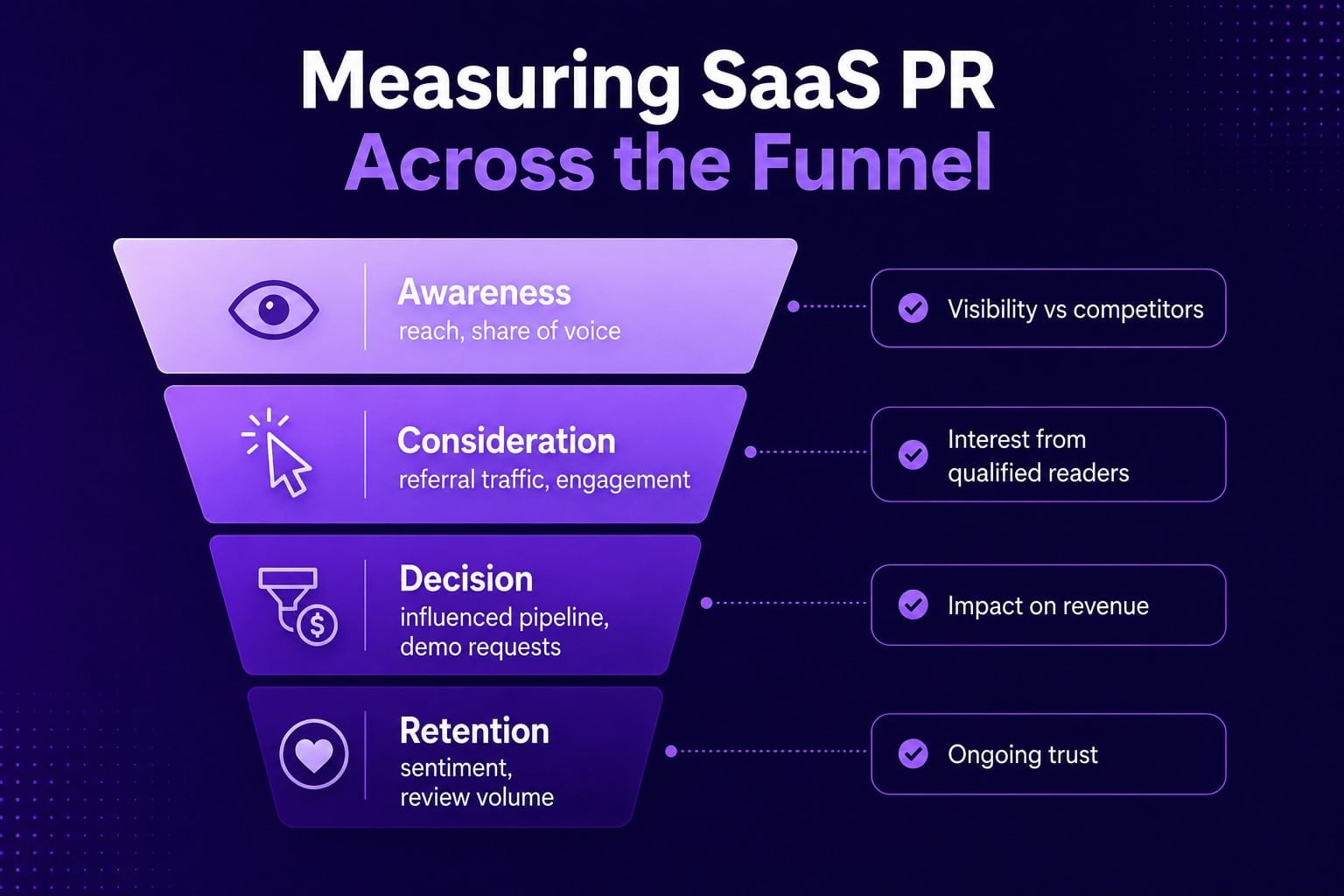
To evaluate SaaS PR performance, track a small set of KPIs that connect coverage to business results, then review them on a fixed cadence. Measure reach and share of voice at the top, engagement and referral traffic in the middle, and influenced pipeline and adoption at the bottom. Compare results against goals each quarter.
A simple process keeps measurement honest:
- Set a baseline for coverage, traffic, and sentiment.
- Define KPIs for each funnel stage.
- Tag PR traffic in analytics with UTM links.
- Track assisted conversions, not only last-click.
- Report monthly and adjust quarterly.
| Funnel stage | KPI | What it shows |
|---|---|---|
| Awareness | Reach, share of voice | Visibility versus competitors |
| Consideration | Referral traffic, engagement | Interest from qualified readers |
| Decision | Influenced pipeline, demo requests | Impact on revenue |
| Retention | Sentiment, review volume | Ongoing trust |
Share of voice is worth watching closely, since it measures your presence against direct rivals, not the whole market. Attribution is the hard part, since PR often influences deals it does not directly close. Self-reported sourcing helps, so ask new leads how they first heard about you.
Results from PR for SaaS take time to compound. A well-run PR campaign for SaaS companies ties these KPIs to a clear quarterly goal and ignores vanity metrics.
Real-World Examples of SaaS PR Success
Two software launches show how earned media builds early trust and measurable reach.
How SaaS PR Took Regolo.ai to 2.6M Impressions

▶️Challenge:
Regolo.ai, a European AI infrastructure product, launched with no media presence. Its niche was dominated by larger US players. Our task was to build trust with a B2B audience of developers and tech teams from a standing start.
🚀Solution:
The work began with a PR strategy across European, UK, and US markets. Our media plan centered on nine relevant B2B technology and AI outlets. Articles, press releases, and expert commentary were tailored to each publication, from neutral announcements to in-depth reviews.
✅Results:
Integrated PR support for SaaS companies gave the product a credible European position from day one. It achieved:
- 2,568,500 total reach across 9 media placements
- 1,864,500 maximum reach from a single publication
- $1.50 lowest CPM
- Media presence in relevant AI and technology publications
- First inbound market inquiries generated after launch
- Clear European brand positioning established for future expansion
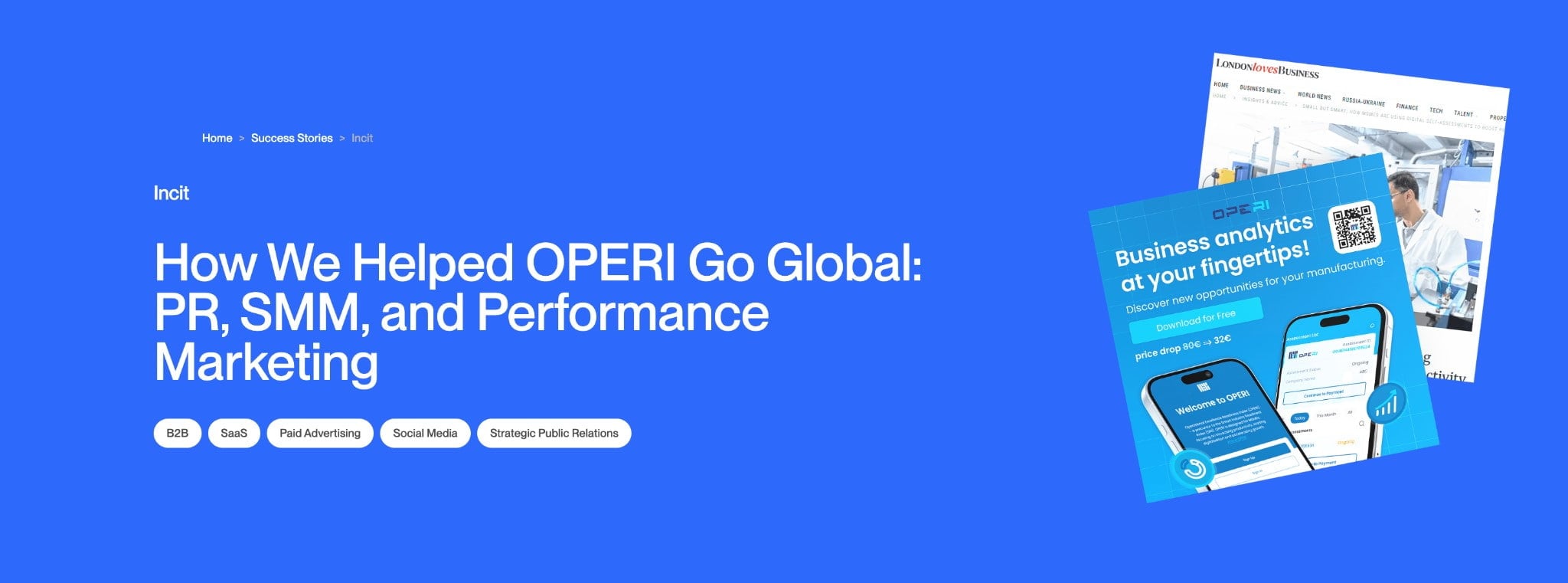
20.8K Installs for OPERI: Full-Cycle SaaS Go-to-Market Launch
▶️Challenge:
Incit, an EdTech company, needed to reach skeptical factory managers for its OPERI app. These buyers ignore banners and distrust pitches for digital transformation. Winning them over required credibility from trusted sources, not promotion.
🚀Solution:
A media plan placed tailored articles in industry blogs and business platforms focused on small manufacturers. The team used a thought-leadership angle for outlets such as London Loves Business. A separate US piece addressed local issues for American small businesses. An official LinkedIn presence supported the media push with expert content and retargeting.
✅Results:
- 20,838 total app installs during the active paid promotion phase
- 13,788 installs from Google Ads
- 5,867 installs from Facebook Ads
- 1,183 organic installs alongside paid and PR activity
- $0.15 lowest CPI from Google Ads
- $0.35 starting CPI from Meta Ads
- Clear acquisition benchmarks and messaging insights for future scaling
Final Thoughts
SaaS PR earns trust that paid channels cannot buy. It works best when tied to pipeline, built on product proof, and led by expert voices. Distribution and measurement turn one placement into lasting value. Prepare for both good news and hard moments, and treat public relations as a long-term system rather than a series of announcements.