

Key Findings
- Crypto SEO captures users already researching products, risks, and alternatives.
- Social media and KOLs create discovery before users actively search for crypto products.
- Community platforms convert initial interest into participation through direct access and support.
- Paid crypto advertising accelerates acquisition but remains constrained by product and market eligibility.
- The strongest channel mix changes between exchanges, DeFi protocols, wallets, tokens, and infrastructure.
Crypto marketing channels are the routes projects use to reach, educate, convert, and retain potential users. Their value depends on audience intent, product type, growth stage, and the action each channel should generate. The best mix connects discovery with measurable adoption rather than maximizing exposure everywhere.
That distinction matters because crypto audiences behave differently across products. Teams evaluating crypto marketing services should therefore start with audience behavior before selecting distribution. A useful crypto marketing strategy then connects those audiences with channels capable of producing measurable actions.
Why You Should Analyze Channels Before Investing in Crypto Marketing
Channel analysis prevents teams from confusing available reach with useful acquisition. Every crypto marketing channel has different economics, audience behavior, measurement limits, and operational requirements. Projects should therefore define the expected user action before allocating resources.
The wrong channel creates costs beyond media spend. A Discord server requires moderation, while SEO needs sustained publishing and technical resources. Influencer campaigns demand creator evaluation and attribution. Running all three without sufficient capacity can weaken execution across each one.
Audience geography adds another constraint. Crypto adoption patterns differ substantially between markets and usage types. Regional differences can change audience behavior, preferred platforms, and viable acquisition tactics. This makes global channel assumptions particularly risky.
Teams should compare channels against four practical questions:
- Can this channel reach the intended crypto audience?
- Can the project execute it consistently?
- Can resulting user actions be measured?
- Does the expected outcome justify its acquisition cost?
This analysis also prevents premature diversification. A project finding one repeatable acquisition route usually gains more from optimization than immediate expansion. Additional channels become useful when they solve another constraint rather than merely increasing activity.
How to Choose the Right Crypto Marketing Channels
Choosing the right crypto marketing channels means matching distribution with audience behavior, objectives, resources, and measurable conversion events. Start with one primary growth problem. Then evaluate channels by their ability to influence that problem within the available budget and operating capacity.
Different Web3 marketing channels also require different commitments. SEO compounds slowly, while paid distribution can produce traffic quickly. Communities demand continuous participation. Those differences should shape testing budgets and performance expectations.
Use this checklist before committing resources:
- Define the target audience and intended action.
- Set one primary marketing goal.
- Identify the project’s current growth stage.
- Assess available budget and execution capacity.
- Find where the target audience already participates.
- Estimate channel-specific acquisition costs.
- Consider the expected conversion cycle.
- Confirm tracking and attribution options.
- Test priority channels with controlled budgets.
- Compare downstream results before reallocating resources.
Useful crypto marketing tools can support research, attribution, automation, and campaign analysis. However, tooling cannot compensate for weak channel selection. Measurement should connect exposure with meaningful actions such as registrations, wallet connections, deposits, or qualified leads.

Key Crypto Marketing Channels That Drive Growth
No single channel performs every acquisition function equally well. Some create discovery, while others capture demand or strengthen trust before conversion. The table below establishes each channel’s primary job before examining where it fits.
| Marketing channel | Primary role |
| Community Platforms | Participation, support, retention |
| Social Media Marketing | Discovery and ongoing visibility |
| Influencer and KOL Marketing | Audience access and credibility |
| Crypto PR and Media Outreach | Third-party validation |
| Content Marketing | Education and consideration |
| Crypto SEO | High-intent organic discovery |
| Airdrops and Incentive Campaigns | Rapid participation |
| Token Launch Marketing | Coordinated launch demand |
| Crypto Advertising | Controlled paid distribution |
| Affiliate and Referral Marketing | Performance-led acquisition |
| Crypto Email Marketing | Lifecycle communication |
| Owned Media | Controlled product communication |
| Crypto Lead Generation | Qualified prospect acquisition |
The strongest cryptocurrency marketing channels become more valuable when their roles remain distinct. Social should not imitate community management, and PR should not substitute for product education. Each route should move users toward a defined next action.
Community Platforms
Community platforms work best when users need continuous access to information, peers, or project teams. Telegram and Discord can support onboarding, product feedback, governance discussions, and user support. Their value comes from participation rather than member totals.
Projects should build a strong crypto community around recurring user needs instead of constant promotion. Member count alone cannot show whether community activity contributes to adoption. Behavioral signals provide a stronger indication of whether participation is producing genuine users.
Signals that a community supports user acquisition include:
- New members ask product-specific questions.
- Support conversations lead to completed actions.
- First-time users return after onboarding.
- Members progress into product participation.
- Recurring questions inform onboarding improvements.
Social Media Marketing
Social media creates repeated discovery where crypto conversations already occur. It particularly suits consumer products, token ecosystems, and projects needing frequent market visibility. Platform choice should follow audience behavior and content depth.
Effective crypto social media marketing connects content with a next step beyond engagement. Measure qualified site visits, community entries, registrations, or product actions. Likes alone cannot show whether social activity is producing users.
Influencer and KOL Marketing
Creators give projects access to established audiences and borrowed credibility. This channel suits launches, technical education, ecosystem expansion, and products requiring explanation. Audience relevance matters more than follower count. Before investing in crypto influencer marketing, verify whether the creator can influence the intended user action.
Check creator fit before launch:
- Review previous crypto product coverage.
- Inspect audience questions for genuine intent.
- Compare audience geography with target markets.
- Check disclosure practices for sponsored content.
- Define a trackable post-content action.
Financial promotion rules can apply to influencers communicating regulated crypto promotions. Teams should verify local requirements before activating creators. Creator selection should therefore consider promotional eligibility alongside audience relevance.
Crypto PR and Media Outreach
PR particularly suits funded projects, infrastructure companies, and established protocols with developments journalists can independently evaluate. Relevant stories include funding, research, integrations, security developments, or meaningful product launches. Generic announcements rarely provide enough editorial value.
Effective crypto PR should support credibility before users encounter stronger conversion messages elsewhere. Track qualified referral traffic, branded search changes, media mentions, and assisted conversions. Coverage quality matters more than raw placement count.

Content Marketing
Content marketing explains why a product matters and what users need before acting. It is particularly useful when technical complexity creates hesitation. Educational guides, comparisons, use cases, and technical explainers can address different decision stages.
Different content formats should remove different adoption barriers:
- Understanding: Explain mechanics and terminology.
- Comparison: Clarify meaningful product differences.
- Trust: Surface evidence and risk information.
- Activation: Explain the next product action.
- Retention: Help existing users gain additional value.
Strong crypto content marketing should connect education with product decisions rather than publishing generic market commentary. Track assisted conversions and progression into higher-intent pages. Content becomes more valuable when other channels distribute it to relevant audiences.
Crypto SEO
Search captures existing intent instead of interrupting users who may not need the product. That makes SEO useful for wallets, exchanges, infrastructure products, and educationally complex platforms. Keyword selection should reflect the decision users are already trying to make.
A focused crypto SEO program separates educational queries from commercial and product-level searches. This structure helps with reaching high-intent cryptocurrency audiences at different decision stages. Search performance should ultimately connect with meaningful product actions.
Airdrops and Incentive Campaigns
Airdrops can generate participation quickly by rewarding a defined behavior. Effective incentives introduce users to genuine product utility. Post-campaign behavior determines whether the campaign created adoption or temporarily rented activity.
After incentives decline, check whether acquired users:
- Return without another reward.
- Repeat the intended product action.
- Keep meaningful capital in the protocol.
- Explore additional product functionality.
- Remain active beyond the rewarded cohort.
Token Launch Marketing
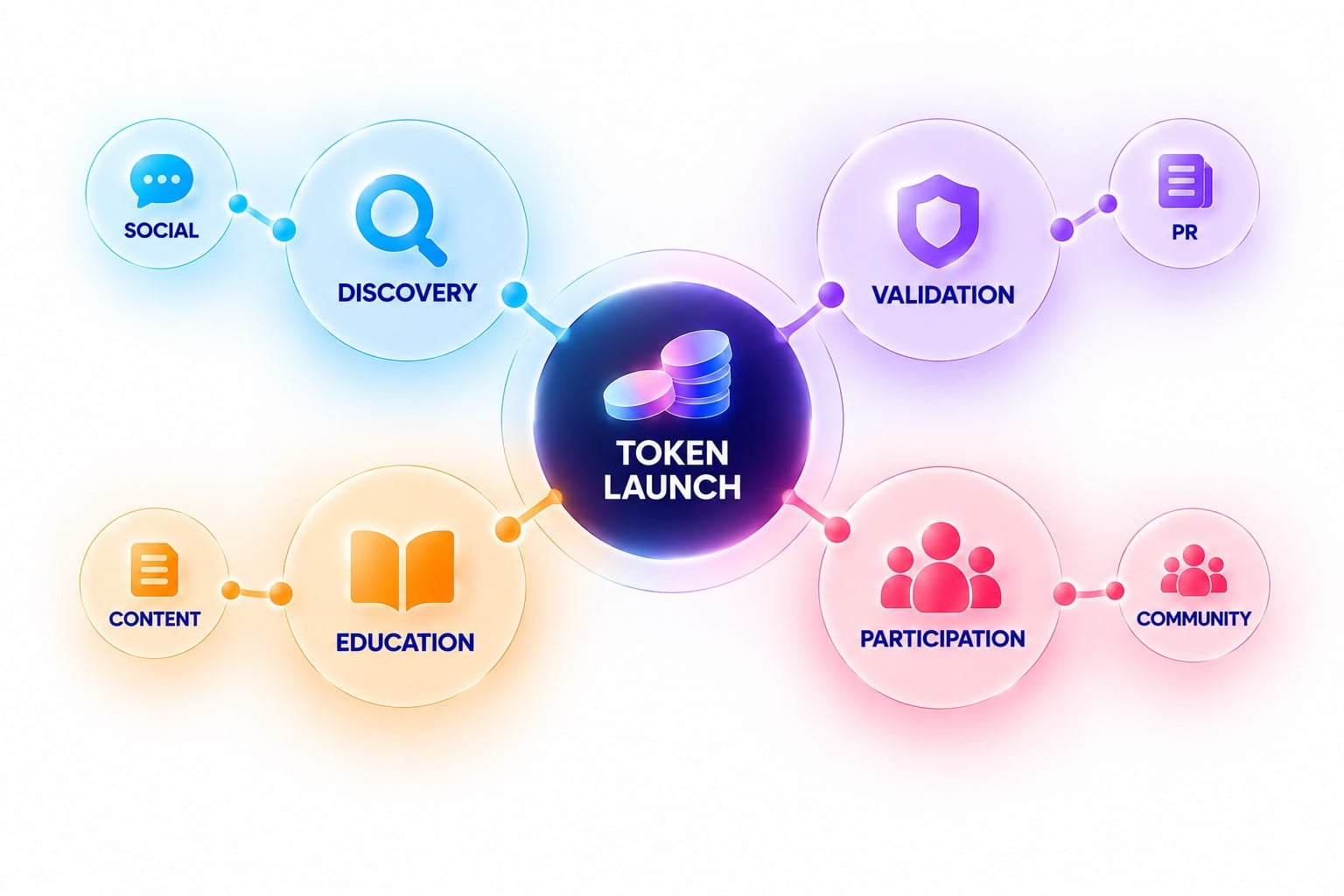
Token launches compress awareness, education, community activity, and conversion into a short period. Channel coordination therefore matters more than isolated reach. Messaging should explain utility, participation mechanics, and relevant risks consistently.
A structured crypto token marketing program should distinguish launch demand from sustainable adoption. Monitor retained holders or users alongside initial participation. Launch metrics can otherwise make temporary attention appear like durable growth.
Crypto Advertising
Paid advertising offers controlled distribution and faster testing, but crypto eligibility varies by product and market. Teams should verify platform rules before budgeting campaigns. This requirement makes advertising less universally available than ordinary digital acquisition.
Before allocating a paid-media budget, confirm:
- The product category is eligible.
- The target market permits promotion.
- Required advertiser certification is complete.
- Campaign claims meet applicable requirements.
- Conversion tracking works in the chosen market.
Current platform rules make eligibility a core constraint for crypto advertising. Exchanges and software wallets may require licensing and advertiser certification in eligible markets. Some crypto product categories remain restricted entirely.
Affiliate and Referral Marketing
Affiliate and referral programs turn existing relationships into measurable distribution. They particularly suit exchanges, wallets, and products with trackable user actions. Compensation should reward meaningful acquisition rather than low-quality traffic.
Use product-specific conversion events and cohort analysis to assess partner quality. Fraud controls become important when rewards can be exploited. The best programs retain partners whose users activate and remain valuable after acquisition.
Crypto Email Marketing
Email works primarily as a lifecycle channel rather than an initial discovery engine. Effective crypto email marketing should respond to user behavior and lifecycle stage. Performance should connect messages with subsequent product actions rather than opens alone.
| User state | Useful email role |
| New subscriber | Continue education |
| Evaluating user | Resolve remaining questions |
| Incomplete activation | Resume the interrupted action |
| Active user | Deliver relevant product updates |
| Inactive user | Address likely return barriers |
Owned Media
Owned media includes websites, documentation, newsletters, research hubs, and other surfaces controlled by the project. These assets provide a stable destination for traffic arriving from less controllable channels. They also preserve explanations beyond short social formats.
Owned media becomes especially important when digital marketing channels for crypto carry platform restrictions. Teams control publication and product context on their own properties. Distribution still requires search, social, PR, partnerships, or another acquisition source.
Crypto Lead Generation
Lead generation matters most when conversion requires sales involvement rather than immediate self-service adoption. Infrastructure providers, institutional services, and B2B blockchain companies often fit this model. Their target action may be a demo or qualified conversation.
Before passing a crypto lead to sales, verify:
- The organization matches the target profile.
- The contact has a relevant business need.
- Product requirements fit the offering.
- Buying intent exceeds educational interest.
- The next commercial step is clear.
Effective crypto lead generation should qualify prospects before handing them to sales. Track accepted opportunities and pipeline contribution rather than form submissions alone. This separates genuine demand from low-intent contact acquisition.

Organic vs. Paid Crypto Marketing: Where Each Fits
Organic channels compound through assets and relationships that can continue producing discovery. Paid crypto promotion remains subject to platform-specific eligibility rules. Neither approach is inherently superior because usefulness depends on timing, availability, and acquisition goals.
| Factor | Organic channels | Paid channels |
| Reach | Builds progressively | Available quickly |
| Speed | Usually slower | Usually faster |
| Cost structure | Production and operations | Production plus media spend |
| Trust | Can compound through authority | Depends heavily on message and placement |
| Control | Influenced by platforms and algorithms | Greater targeting control when eligible |
| Long-term value | Content and communities can persist | Traffic usually slows when spending stops |
Organic Web3 marketing channels fit projects that need education, credibility, and durable discovery. Paid distribution becomes useful when eligibility is confirmed and conversion paths already work. Combining both can shorten feedback cycles without abandoning compounding assets.
Compliance must remain market-specific. Some crypto promotions face additional disclosure, eligibility, and content requirements. Teams should therefore verify channel availability before treating paid distribution as a scalable acquisition route.
Which Crypto Marketing Channels Fit Different Project Types?
Channel selection should follow the product’s audience and required conversion behavior. An exchange seeking traders faces different discovery needs from infrastructure targeting developers. Applying the same blockchain marketing channel mix to both wastes resources.
| Project type | Priority channels | Why they fit |
| Exchange | SEO, affiliates, social, paid where eligible | Captures comparison intent and trading demand |
| DeFi platform | Community, content, KOLs, SEO | Supports education and trust before wallet actions |
| Wallet | SEO, content, creators, paid where eligible | Combines high-intent discovery with product education |
| Token project | Community, PR, KOLs, launch campaigns | Coordinates awareness with launch participation |
| Infrastructure | Content, SEO, PR, lead generation | Reaches developers and professional buyers |
These combinations are starting points rather than fixed formulas. A project’s maturity can change the correct mix. Early teams may need education first, while established products may prioritize scalable crypto user acquisition.
Crypto Marketing Channels Across the User Journey
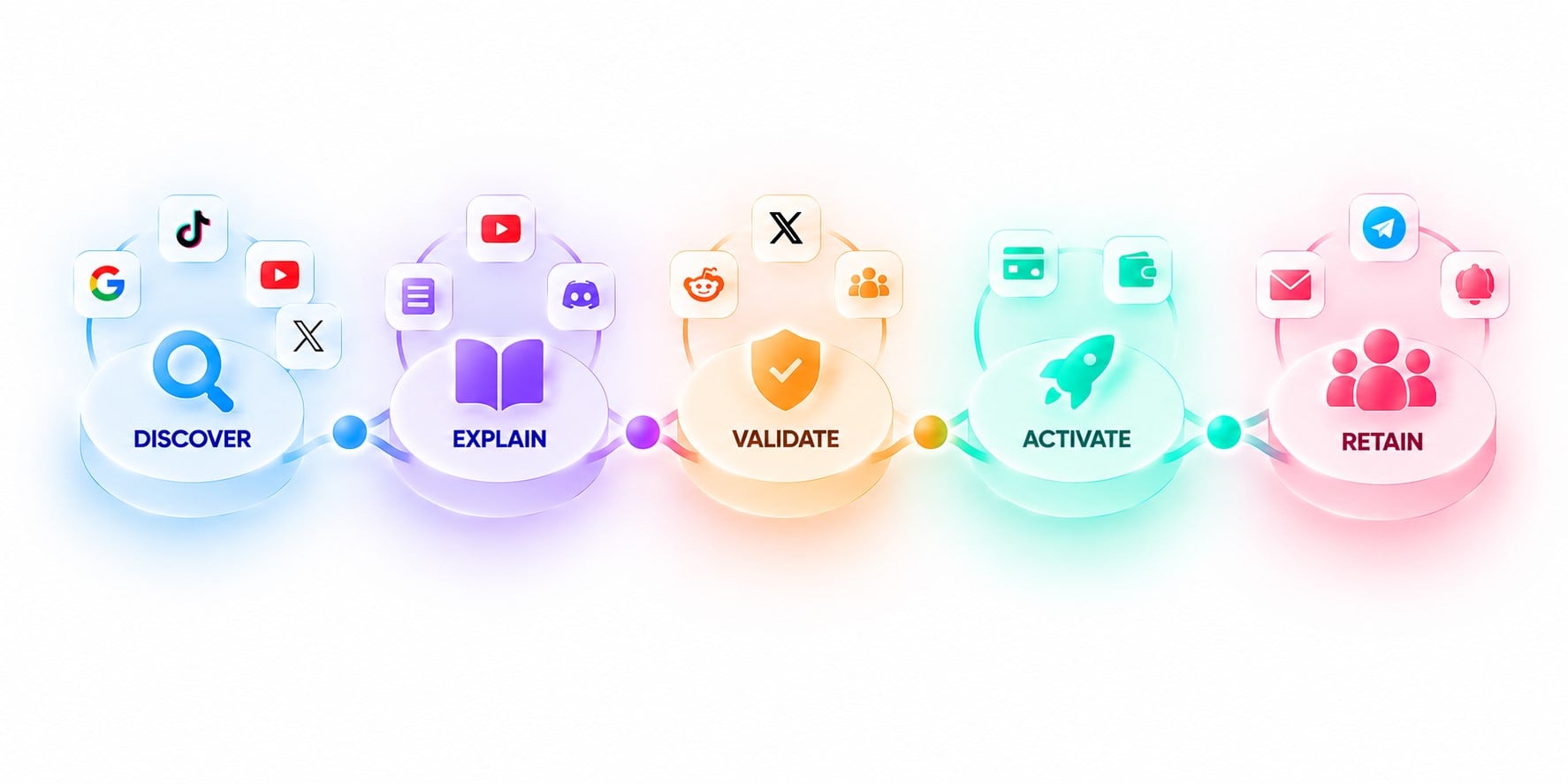
Different channels become useful as users move from discovery toward retention. The crypto marketing funnel should therefore assign each channel a job rather than exposing every user to every tactic. This reduces duplication and makes attribution more meaningful.
A practical journey looks like this:
- Discovery: Social, PR, KOLs, and paid distribution introduce the project.
- Education: Content and owned media explain the product and its mechanics.
- Consideration: SEO, community, and creators address questions and strengthen confidence.
- Activation: Email, retargeting, referrals, and product communication support the intended action.
- Retention: Community, lifecycle email, and owned channels encourage continued participation.
This sequence also reveals different ways to attract users to a crypto brand. Discovery channels create initial exposure, while intent channels capture existing demand. Retention channels become valuable only after acquisition creates a relationship worth continuing.

How to Make Crypto Marketing Channels Work Together
Channels work together when each handles a different acquisition problem and passes users toward the next useful interaction. A social post can create curiosity, while search content resolves deeper questions. The community then provides direct support before activation.
Content can also move between Web3 marketing channels when its role changes with context. AI crypto marketing can support adaptation across formats while human review protects accuracy. PR coverage can inform search content, while educational assets can support subsequent email communication.
A connected system should define four things for every handoff:
- What user signal triggers the next interaction?
- Which channel owns that next step?
- What context should follow the user?
- Which downstream action proves the handoff worked?
Attribution should reflect these relationships. Last-click reporting can undervalue channels that create trust before another channel captures conversion. Teams should compare assisted conversions and cohort quality alongside direct acquisition.
Broader crypto marketing becomes more efficient when channel roles remain explicit. Teams can then identify whether weak growth comes from insufficient discovery, poor education, activation friction, or retention. Adding another channel should solve one of those problems.
Final Thoughts
The best crypto marketing channels are those aligned with a project’s audience, conversion model, and current growth constraint. Channel popularity matters less than the quality of users and actions each source produces. Channel performance should be judged by the user behavior each source is expected to influence.
Strong blockchain marketing also requires coordination rather than constant channel expansion. Search can capture demand, communities can deepen participation, and paid distribution can accelerate eligible campaigns. Sustainable growth comes from assigning each channel a distinct role and measuring whether users progress.