
Key Findings
- DeFi marketing should connect acquisition metrics with measurable protocol activity.
- DeFi protocols need different growth strategies based on users and product mechanics.
- DeFi education reduces knowledge barriers before users connect wallets or commit capital.
- Sustainable DeFi growth requires measuring retention after liquidity incentives decline.
- DeFi marketing channels should support specific protocol goals rather than isolated engagement.
Promoting decentralized finance means selling participation in a financial system users must understand before committing capital. Growth therefore depends on more than visibility. Teams must explain mechanics, demonstrate trust, attract liquidity, and convert attention into meaningful on-chain activity.
Different protocols also need different growth engines. A DEX needs traders and liquidity providers, while infrastructure products may prioritize developers and protocol integrations. This guide covers positioning, acquisition, education, community, liquidity, partnerships, SEO, paid promotion, and measurement.
What Is DeFi Marketing?
This discipline connects decentralized applications and blockchain protocols with audiences capable of creating measurable ecosystem activity. Its objective extends beyond awareness because decentralized products need users, capital, liquidity, and repeated protocol usage. Effective programs connect communication with measurable outcomes across the user journey.
Those outcomes vary by product. A lending platform may prioritize deposits and active borrowers. Decentralized exchanges using automated market makers need trading volume and liquidity providers. Liquid staking platforms may prioritize participation and integrations. Derivatives products need active traders and liquidity. Yield protocols depend more heavily on strategy credibility.
Useful growth objectives include:
- Active users and repeat usage: show whether acquisition creates recurring protocol participation.
- TVL growth: track committed capital while checking whether liquidity remains after incentives decline.
- Trading volume: measure whether acquired users generate meaningful transaction activity.
- Liquidity provision: assess whether campaigns attract capital that supports usable liquidity pools.
- Token adoption: evaluate whether users gain meaningful utility beyond simply holding governance tokens.
- Ecosystem development: track whether governance, integrations, and participation expand the protocol’s practical reach.
The important step is selecting outcomes before channels. A large community cannot compensate for weak protocol usage. Likewise, rising total value locked may hide dependence on temporary incentives.
How Is DeFi Marketing Different From Traditional Crypto Marketing?
Protocol adoption requires users to evaluate more than a project narrative before interacting. DeFi users must understand financial mechanics, assess risks, and often commit capital directly. Marketing therefore has to support informed participation alongside acquisition.
Key characteristics make DeFi marketing distinct:
- Complex product mechanics: Users need clear explanations of protocol actions and outcomes before committing capital or connecting wallets.
- Financial risk and user trust: Direct capital exposure makes transparent risk communication essential before users decide whether to participate.
- Liquidity as a growth driver: Available liquidity affects execution and usability, making capital participation part of the protocol’s growth model.
- Protocol-specific incentives: Rewards can accelerate selected behaviors, but teams should separate temporary activity from sustainable protocol usage.
- On-chain transparency: Public activity lets teams evaluate wallet activation, capital movement, and repeat transactions beyond conventional traffic metrics.
- Smart contract and security considerations: Independent audits and bug bounty programs provide complementary controls and verifiable evidence for prospective users.
- Composability and integrations: Connections with wallets and protocols can expand product access while creating additional distribution paths.
- Highly technical audiences: Developers and experienced users require precise documentation and technical evidence rather than simplified promotional claims.
- Community-driven adoption: Communities can educate users, surface product friction, support governance, and encourage informed advocacy.
Campaign measurement should reflect these differences. Acquisition metrics become more useful when connected with subsequent on-chain activity and retained protocol usage.
How to Build a DeFi Marketing Strategy
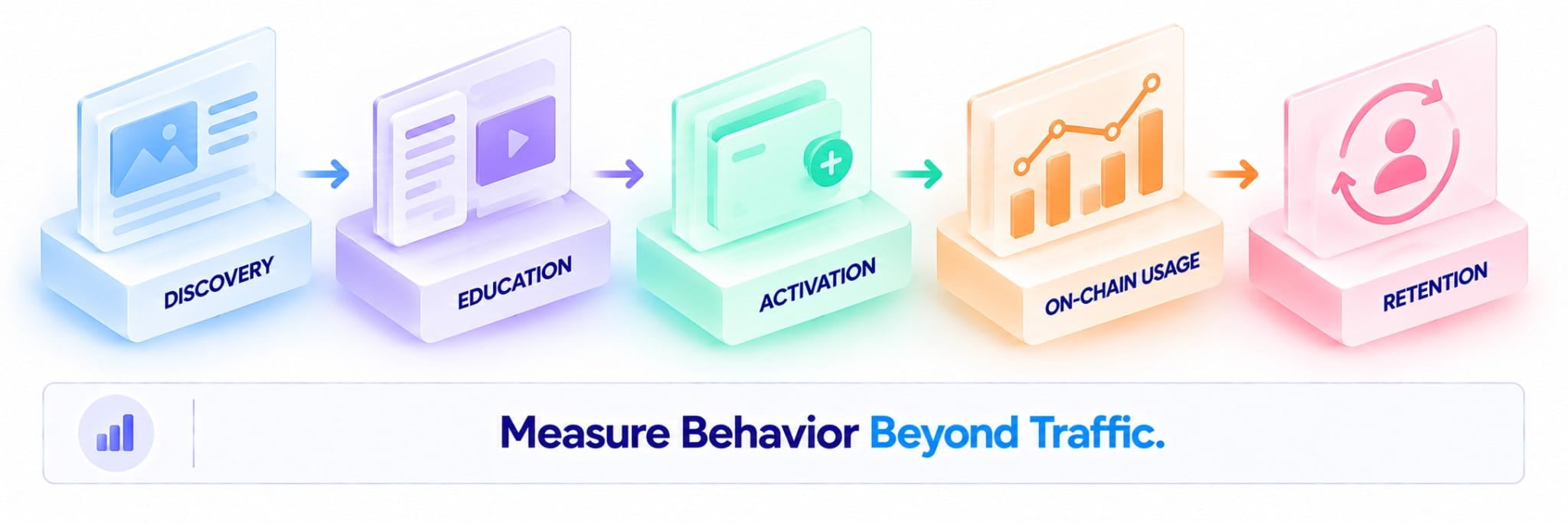
Start with the protocol’s growth constraint rather than a preferred channel. Diagnose whether growth is limited by discovery, understanding, liquidity, activation, or retention. Then choose audiences and channels capable of changing that constraint.
A practical DeFi marketing strategy should connect every channel with a measurable user action. Search might drive qualified discovery, while onboarding improvements increase wallet connections. Community programs may improve retention when members receive useful support and product information.
Define the Protocol’s Growth Goals
Select one primary growth objective and several diagnostic metrics. A DEX might track active traders and transactions. Lending protocols can instead prioritize deposits and liquidity. Measuring only impressions would hide whether acquired attention becomes actual usage.
Avoid treating TVL as a universal success metric. Capital can move quickly when incentives change. Pair TVL growth with retention, transaction activity, and concentration data to understand whether growth is durable.

Identify Your Core Users
Segment audiences by their intended protocol action rather than broad demographic profiles. Liquidity providers evaluate different trade-offs than borrowers. Developers require completely different evidence from yield seekers.
| User segment | Primary question | Useful proof |
| Liquidity providers | Is deployed capital productive? | Fees, utilization, withdrawal mechanics |
| Traders | Can I execute efficiently? | Liquidity depth, supported assets, transaction flow |
| Borrowers and lenders | Does the market fit my needs? | Rates, collateral, available assets |
| Stakers | What happens to my capital? | Staking mechanics, liquidity, integrations |
| Yield seekers | How is yield generated? | Strategy mechanics, risk disclosure |
| Developers | Is integration worthwhile? | Documentation, APIs, protocol integrations |
| Token holders | Does participation create meaningful utility? | Token utility, governance rights, protocol role |
| Institutional users | Can the protocol meet professional requirements? | Liquidity, controls, security, operational transparency |
Messages should change with these questions. A developer campaign emphasizing headline yields misses developer intent. Likewise, traders rarely need the same onboarding narrative as governance token holders.
Define Your Value Proposition
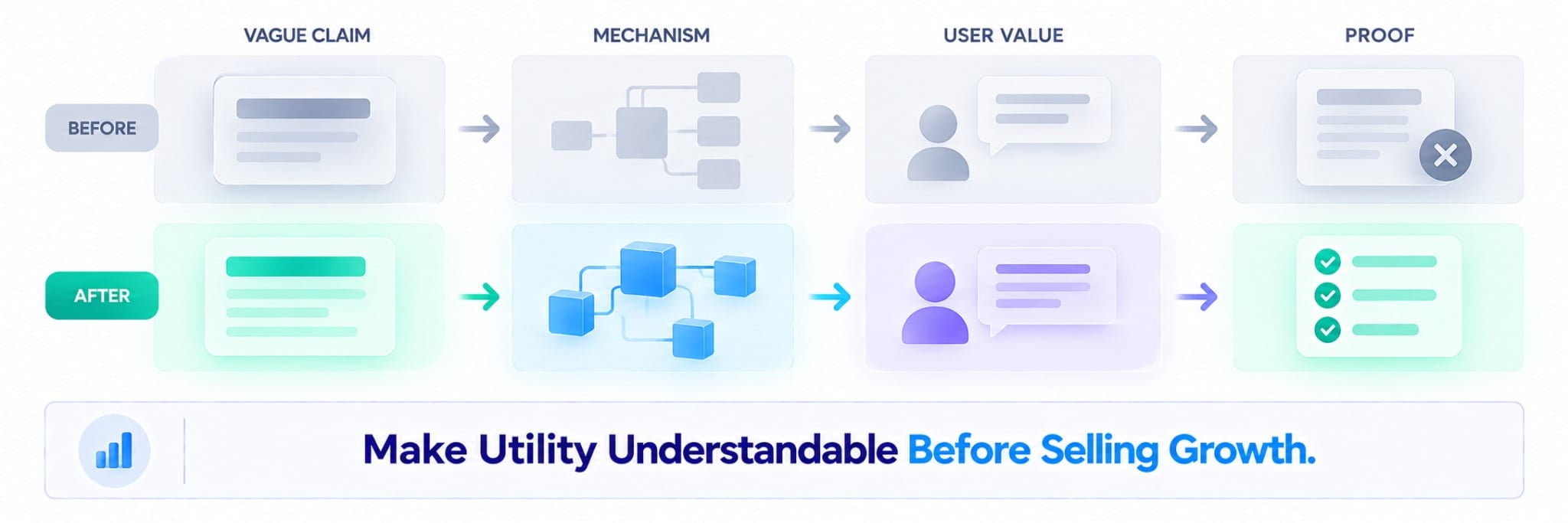
A strong value proposition explains why a specific user should choose the protocol for a specific action. Avoid vague claims such as “the future of finance.” Instead, connect product mechanics with practical outcomes users can evaluate.
Build the value proposition around factors that materially affect user decisions:
- Protocol functionality: Explain what users can actually do and which problem the protocol solves.
- Capital efficiency: Show how the protocol helps users deploy or access capital more effectively.
- Supported assets: Identify relevant assets so users can immediately determine whether the protocol fits their needs.
- Yields or fees: Explain applicable returns or costs alongside the conditions that can change them.
- Liquidity: Show how available liquidity affects execution, withdrawals, borrowing capacity, or other core actions.
- Integrations: Explain how connected protocols or infrastructure expand access, utility, or available user workflows.
- User experience: Show how the product reduces friction across onboarding and recurring protocol interactions.
- Security architecture: Explain the safeguards and controls that help users evaluate technical exposure before committing assets.
- Decentralization: Clarify which functions are decentralized and what practical control or transparency that gives participants.
- Unique technology: Connect technical differentiation with a measurable user benefit rather than presenting innovation as value itself.
The strongest proposition prioritizes only factors that genuinely differentiate the product. Tokenomics or yield optimization should appear when they materially influence user value, not simply because they sound relevant.
Choose the Right Growth Channels
Choose channels by the problem they solve. Organic search works when users actively research financial concepts and alternatives. Education and email can nurture understanding. Referrals and incentives can accelerate specific actions when retention is measured separately. Communities support participation, while KOLs and PR expand relevant reach.
Paid distribution can accelerate qualified reach, but restrictions require market-specific planning. Partnerships work differently because integrations can create direct product access. Working with a DeFi marketing agency becomes relevant when execution across these channels exceeds internal capacity.
The DeFi Marketing Funnel
A useful funnel tracks increasing commitment rather than simple website progression. Connecting a wallet or depositing capital requires more trust than reading content. Education therefore sits between discovery and activation for a reason.
| Funnel Stage | User Goal | Marketing Focus |
| Awareness | Discover the protocol | Search, social, PR, KOLs |
| Education | Understand mechanics | Guides, documentation, explainers |
| Consideration | Evaluate suitability | Comparisons, security, risk information |
| Activation | Start using the protocol | UX, onboarding, incentives |
| Retention | Continue meaningful usage | Updates, community, lifecycle communication |
| Advocacy | Recommend or contribute | Referrals, ambassadors, governance |
Teams should measure leakage between stages because wallet adoption alone does not prove successful activation. Strong traffic with weak wallet connection suggests education or trust friction. Successful wallet connections followed by abandoned transactions point toward product experience rather than acquisition.
12 DeFi Marketing Strategies for Protocol Growth
The strongest DeFi marketing strategies connect distribution with product behavior. Each tactic should answer one question: which measurable obstacle does this activity remove? That discipline prevents teams from accumulating channels without improving adoption.
1. Build a Clear DeFi Brand and Value Proposition
Lead with utility rather than category language. State who the protocol serves, what action users perform, and what mechanism creates value. Supported chains or assets can then establish immediate relevance.
Before: “Access the future of decentralized finance.”
After: “Swap supported assets through liquidity pools designed for efficient on-chain execution.”
Test positioning with unfamiliar users before launch. Ask participants to explain the product after viewing the homepage for ten seconds. Their answers reveal whether visual communication and messaging communicate actual functionality.
2. Invest in DeFi SEO and Educational Content
Organic search captures users while they investigate products, risks, and financial mechanisms. Map keywords to decisions rather than publishing generic blockchain commentary. Product pages should target usage intent, while guides address earlier educational questions.
Useful formats include comparison pages, glossaries, technical explainers, and ecosystem content. A broader crypto SEO framework can help connect technical optimization with high-intent search journeys. Measure qualified visits against wallet connections or other downstream actions.
3. Turn Complex DeFi Concepts Into Accessible Content
Education becomes acquisition when product complexity blocks action. Explain lending and borrowing, decentralized derivatives, and yield farming around actual user decisions. Cover liquid staking and AMM mechanics when explaining staking or liquidity pools. Avoid simplifying away material risks.
Before publishing a DeFi explainer, verify that it answers four practical questions:
- Define the action: show exactly what the user does inside the protocol.
- Explain the mechanism: connect each user action with the underlying financial process.
- Expose material risk: identify conditions that can change outcomes or capital exposure.
- Explain hidden dependencies: clarify impermanent loss, bridge exposure, and staking constraints when they affect user decisions.
- Support the decision: clarify when the mechanism fits a particular user objective.
Readers should understand what changes their decision. Yield optimization requires enough context to evaluate mechanisms and risks. Simplified explanations fail when they remove information required for informed protocol use.
4. Build and Grow a Strong DeFi Community
Treat communities as operating infrastructure, not audience counters. Discord, Telegram, X, and governance forums can surface product questions before analytics explain abandoned activity. Moderators should classify recurring friction and route it to product teams.
Track active contributors, resolved questions, governance participation, and returning members. Decentralized governance deserves separate measurement, especially when governance tokens give users formal participation rights. Community governance therefore benefits more from informed contributors than large groups of passive members.
5. Work With DeFi Influencers and KOLs
Select creators by audience fit and demonstrated subject knowledge. Review previous protocol coverage before negotiating reach. Follower count alone cannot show whether viewers include traders, developers, or liquidity providers.
Before approving a creator, check evidence that their audience matches the protocol:
- Review protocol coverage: verify whether previous content demonstrates genuine DeFi knowledge.
- Inspect audience questions: look for comments about mechanics, risks, integrations, or actual protocol usage.
- Check format fit: choose creators capable of explaining the product beyond short promotional mentions.
- Verify disclosure practices: confirm that sponsored relationships are consistently identified to audiences.
Give creators room to explain mechanics rather than reading promotional scripts. Product walkthroughs, technical discussions, AMAs, and ecosystem analysis can demonstrate understanding. Effective crypto influencer marketing also requires transparent disclosure of paid relationships.
6. Use DeFi PR and Crypto Media
Earned coverage works best when something verifiable has changed. Major integrations, research, funding, product updates, and ecosystem partnerships create stronger stories than generic launch announcements. Give journalists evidence they can independently examine.
Founders can also contribute informed commentary when market developments connect directly with their expertise. Avoid forcing the protocol into unrelated news cycles. A focused crypto PR program should strengthen credibility rather than manufacture urgency.
7. Use Incentives, Referral Programs, and Community Campaigns
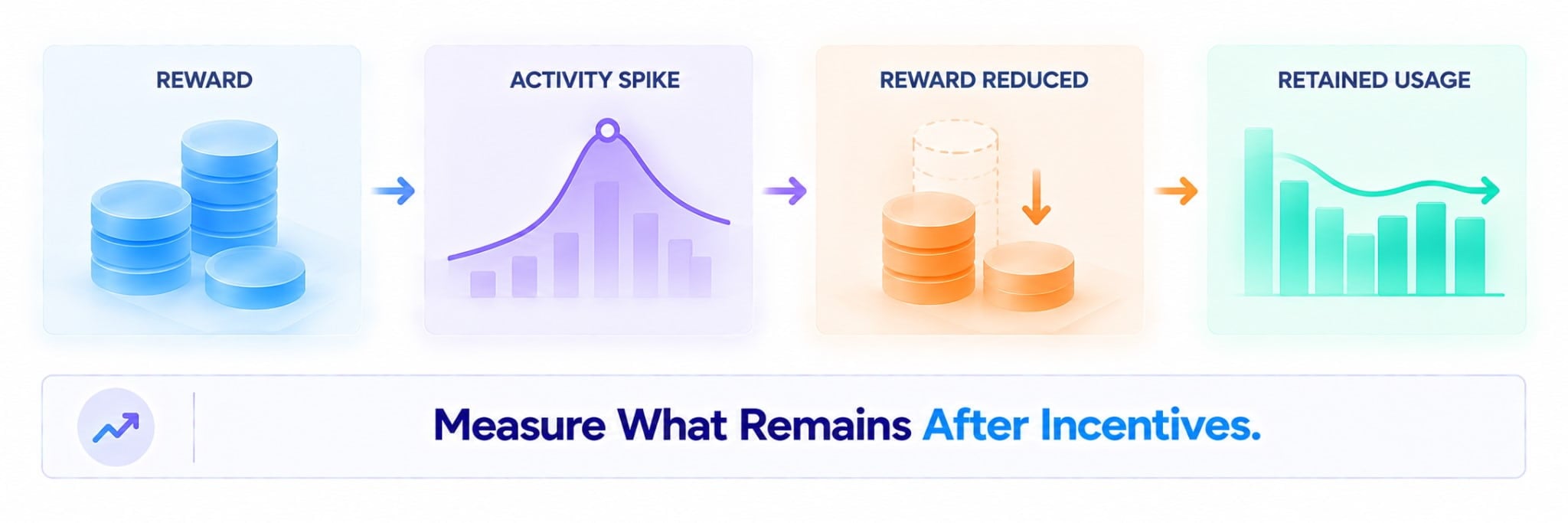
Match each incentive format with a specific behavior. Referrals and ambassador programs can support qualified introductions, while quests encourage defined protocol actions. Liquidity incentives and points programs require stronger retention checks because participation may disappear with rewards.
Evaluate incentive quality after launch through behavioral signals rather than participation totals:
- Compare retained cohorts: measure how many rewarded users remain active after incentives decline.
- Track repeat actions: distinguish one-time reward claims from recurring protocol usage.
- Measure capital persistence: check whether deposited liquidity remains after reward conditions change.
- Separate organic behavior: identify activity continuing without additional token or points incentives.
Sustainable growth appears when useful behavior persists without continuously increasing subsidies.
8. Build Strategic DeFi Partnerships
Prioritize integrations that remove distribution barriers rather than generate announcement value. Wallets and bridges can improve discovery or cross-chain liquidity. DEX and lending integrations can create direct product access. Infrastructure and data partners can extend distribution across broader blockchain ecosystems.
Partnership value should be measurable after launch. Track referred users, connected wallets, transaction activity, or integration usage. Announcing ecosystem partnerships without measuring subsequent behavior turns distribution into PR theatre.
9. Optimize the DeFi User Experience
User acquisition creates little value when poor user onboarding prevents the intended action. Test wallet connection, network switching, transaction flow, error states, and mobile experience as one journey. Product explanations should appear where uncertainty occurs.
Run a first-use DeFi journey audit:
- Connect: record confusion during wallet selection and permission requests.
- Configure: test whether users understand networks, assets, and required settings.
- Transact: observe whether risk disclosures, approvals, and transaction status remain clear before confirmation.
- Recover: test whether error messages explain the next corrective action.
- Return: verify that users can understand positions and resume activity later.
Record where first-time users hesitate or abandon the journey. Those moments expose activation friction that traffic analytics cannot explain.
10. Use Email and Lifecycle Marketing
Lifecycle communication should respond to user context rather than broadcast constant promotions. Onboarding can explain first actions, while protocol updates support existing participants. Integration announcements and ecosystem news should target users they actually affect. Governance messages belong with participants who have relevant opportunities.
Segment communication by behavior when consent and available data permit. A practical crypto email marketing program can separate inactive users from engaged participants. Re-engagement messages should address likely friction rather than simply repeat incentives.
11. Use Paid Advertising Carefully
Treat eligibility as a planning constraint before allocating media budgets. Platform restrictions can invalidate a channel plan before creative testing begins.
Before approving paid media spend, confirm four conditions:
- Market eligibility: verify that the product can legally target the intended jurisdiction.
- Platform eligibility: confirm current rules for the specific DeFi product and campaign format.
- Certification requirements: complete required advertiser verification before allocating launch budgets.
- Tracking feasibility: confirm compliant attribution and retargeting options before forecasting acquisition performance.
Apply these checks separately to paid search, paid social, and crypto advertising platforms. Compare eligible channels before allocating budgets. Verify retargeting availability separately before modeling downstream conversions.
12. Build Thought Leadership Around the Protocol
Publish expertise that competitors cannot reproduce from public documentation. Researchers can explain protocol design choices, while founders interpret relevant market developments. Core contributors can document technical lessons from integrations.
Long-form research and technical articles can document protocol insights. Industry commentary can work through podcasts, conference appearances, or focused X threads. Strong crypto content marketing turns internal expertise into discoverable evidence. Avoid publishing opinion solely to maintain posting frequency.

DeFi Marketing and Regulatory Considerations
Requirements depend on jurisdiction, product structure, audience, and promotional activity. Teams should therefore review financial promotion rules before distributing campaign materials. This section provides marketing context rather than legal advice.
Advertising platforms add separate eligibility requirements. Verify current policies before approving markets or paid-media budgets.
A pre-launch compliance review should cover:
- Financial promotion rules: verify applicable requirements separately for every target jurisdiction.
- Token-related claims: review performance and yield statements for assumptions, limitations, and supporting evidence.
- Consumer protection: present material risks clearly before users make decisions involving capital.
- Influencer disclosures: require sponsored creators to identify commercial relationships clearly and consistently.
- Privacy obligations: verify how campaign data is collected, processed, and used across acquisition channels.
- Advertising eligibility: confirm product and geographic restrictions before approving platform-specific media spending.
DeFi Marketing by Protocol Type
Channel priorities should follow product mechanics because different protocols require different user actions and evidence.
| Protocol Type | Primary Audience | Marketing Focus |
| DEX | Traders, liquidity providers | Liquidity, volume, execution UX |
| Lending Protocol | Borrowers, lenders | Rates, assets, security, usability |
| Liquid Staking | Stakers, DeFi users | Yield mechanics, liquidity, integrations |
| Derivatives Protocol | Traders | Functionality, liquidity, risk |
| Yield Protocol | Yield seekers | Strategy, transparency, risk |
| DeFi Infrastructure | Developers, protocols | Technical capabilities, interoperability |
A derivatives product supporting perpetual trading needs risk-aware trader education. Infrastructure products should instead demonstrate technical reliability and integration value. Cross-chain products may emphasize interoperability and available blockchain networks.
How Much Does DeFi Marketing Cost?
Budget requirements depend on protocol stage and target market. Competitive environment, execution scope, and channel mix also affect spending. Teams comparing crypto marketing cost should build budgets from required capabilities instead of generic industry averages.
Separate fixed production costs from variable distribution spending. Community management and technical content create different cost structures from paid media or KOL programs. Compliance requirements can also create additional review work across jurisdictions.
A practical budget model should separate:
- Foundation: Budget for positioning, analytics, and content systems depends primarily on product complexity.
- Organic growth: SEO, education, and community costs increase with publishing requirements and moderation volume.
- Distribution: PR, KOLs, and partnerships depend on required reach and access to specialized audiences.
- Paid acquisition: Media, creative, and testing costs vary significantly by geography and platform eligibility.
- Operations: Analytics, compliance, and reporting costs increase with the number of markets and campaign complexity.
Crypto marketing budgets become more meaningful when compared with post-activation performance. Compare channel costs against subsequent protocol usage. Cheap acquisition still fails when users never activate.
Common DeFi Marketing Mistakes
Most mistakes disconnect promotional activity from actual protocol behavior. The problem usually becomes visible after teams compare campaign metrics with on-chain data. Fixing that disconnect requires changing both messaging and measurement.
| Mistake | Why It Fails | Better Response |
| Leading with hype | Utility remains unclear | Explain mechanism and user value |
| Overly technical messaging | Knowledge barriers remain high | Layer explanations by expertise |
| Unsupported APY claims | Trust and compliance risks increase | Explain assumptions and variability |
| Hiding security context | Users cannot evaluate risk | Surface audits and limitations |
| Chasing community size | Passive members inflate progress | Measure active participation |
| Overusing token incentives | Rewards can rent activity | Measure post-incentive retention |
| Publishing generic content | Searchers gain little new information | Answer protocol-specific questions |
| Ignoring search demand | Educational intent goes uncaptured | Map content to real queries |
| Choosing KOLs by followers | Audience quality stays unknown | Verify relevance and engagement |
| Measuring only TVL | Capital concentration stays hidden | Pair TVL with usage metrics |
Security deserves particular attention. DeFi suffered $92.45 million in losses across 15 incidents in April 2025. Security audits and bug bounty programs therefore provide practical trust evidence.
DeFi Marketing Trends to Watch
The most useful trends change discovery, onboarding, or distribution. AI-assisted DeFi discovery may change how users find protocols. AI search can also reshape how educational content becomes visible. Teams should structure expert content around answerable user problems rather than chasing AI-related terminology.
Product interfaces are reducing technical friction, but simpler interactions create new communication requirements. Teams should prepare for these changes before redesigning acquisition journeys.
- Explain intent before execution: show what users request and what the protocol performs on their behalf.
- Simplify account abstraction onboarding: remove unnecessary wallet terminology while preserving transaction and permission clarity.
- Design cross-chain education around outcomes: explain destination assets, expected steps, and risks before users move capital.
- Audit hidden complexity: identify where simplified interfaces conceal fees, network changes, permissions, or transaction dependencies.
- Test comprehension before conversion: verify that first-time users understand consequences before signing or confirming transactions.
Institutional DeFi deserves separate messaging because professional participants evaluate protocols differently from retail users. On-chain reputation may eventually improve segmentation without recreating conventional identity systems. Community-led growth will remain valuable when contributors create measurable ecosystem activity. Security and protocol transparency should become more visible as products compete for increasingly sophisticated capital.
Conclusion
Sustainable protocol growth connects communication with useful on-chain behavior. Education builds understanding, while security evidence strengthens trust before users commit capital. Product experience then determines whether acquired attention becomes activation.
Community, partnerships, organic discovery, and paid distribution should support measurable protocol objectives. Teams should judge channels by retained usage rather than surface engagement.