

Key Findings
- AI delivers measurable marketing gains only when better decisions translate into better execution.
- Successful automation depends more on high-quality data than on sophisticated AI models.
- Human review remains essential for brand credibility, regulatory awareness, and community trust.
- AI performs best when each workflow has measurable business objectives and clear success metrics.
- Long-term Web3 growth depends on improving workflows before expanding AI automation.
AI crypto marketing uses artificial intelligence to improve campaign planning, audience analysis, content production, and performance optimization. Rather than replacing marketers, AI automates repetitive processes while helping teams make faster, data-driven decisions. For Web3 companies competing in fast-moving markets, the technology can improve efficiency without sacrificing strategic oversight.
The growing complexity of Web3 ecosystems has made traditional marketing workflows increasingly difficult to scale. Crypto projects now manage fragmented audiences across social platforms, community channels, decentralized ecosystems, and search engines. AI helps organize those data sources into actionable insights that support better business decisions.
This guide explains where AI creates value and where automation introduces risk. It also shows how human expertise supports Web3 growth.
What Is AI Crypto Marketing?
AI crypto marketing applies artificial intelligence to planning, executing, and optimizing marketing activities for blockchain businesses. It combines predictive analytics, automation, natural language processing, and machine learning to improve campaign performance across multiple digital channels. Rather than replacing marketers, AI accelerates research while supporting better strategic decisions.
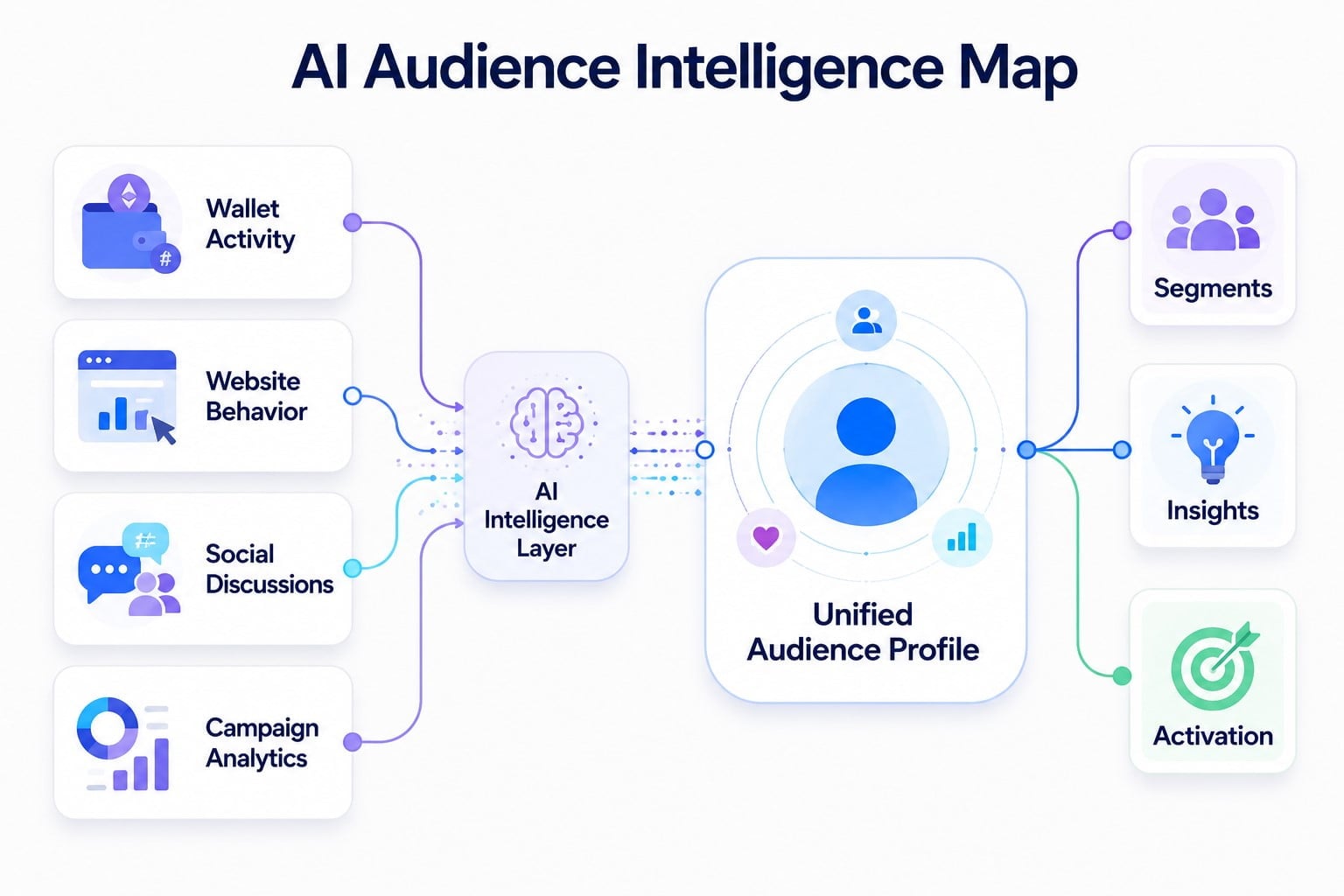
Modern Web3 companies generate substantial behavioral data from wallet activity and website interactions. Community engagement adds context that manual analysis may miss. McKinsey research on generative AI also explains why organizations increasingly use AI to interpret complex business information.
Before investing in AI, successful Web3 teams usually verify that they already have:
- Reliable marketing and product data collected in one reporting workflow.
- Clearly defined KPIs that AI can optimize instead of vague growth goals.
- Consistent brand guidelines for reviewing AI-generated content.
- A documented approval process for campaigns involving regulated financial messaging.
- Human specialists responsible for validating AI recommendations before publication.
Unlike conventional automation, AI in crypto marketing continuously adapts as new information becomes available. Algorithms evaluate campaign performance, audience behavior, and engagement trends before suggesting adjustments that improve future outcomes. This adaptive approach makes AI particularly valuable in markets where user sentiment changes rapidly.
Businesses should also recognize that AI supports many marketing functions simultaneously. Audience research and content planning benefit from intelligent automation. Paid media and SEO also gain efficiency. Retention workflows still require human oversight.
Challenges and Risks of Using AI in Web3 Marketing
Artificial intelligence can improve efficiency, but it also introduces new operational risks. AI Web3 marketing succeeds only when automation supports business objectives instead of replacing strategic judgment. Projects that automate without governance often create inconsistent messaging, compliance concerns, and declining community trust.
Crypto markets change faster than most AI models can learn. Market sentiment shifts after regulatory announcements, security incidents, or token volatility. Historical data alone cannot predict these changes, making human oversight essential when campaigns require immediate adjustments.
Another challenge involves data quality. AI systems produce recommendations based on the information they receive. Incomplete analytics, inaccurate attribution, or fragmented customer data often generate misleading insights that appear statistically convincing.
For me, it’s when teams start treating AI output as basically ready to ship. If prompts, context, and validation are solid, most obvious mistakes get caught early. The harder ones are subtle shifts in positioning, messaging, or audience assumptions. They can look fine on paper but only show up later in CTR, CVR, or retention.
Maya Miller, Strategist at NinjaPromo
The table below summarizes the most common implementation risks.
| Risk | Business Impact | Recommended Safeguard |
| Poor-quality training data | Weak audience targeting | Validate data sources regularly |
| Over-automation | Generic brand messaging | Require human editorial review |
| Regulatory changes | Compliance exposure | Monitor legal developments continuously |
| Hallucinated content | Loss of credibility | Verify factual claims before publishing |
| Black-box decision making | Limited accountability | Document AI-assisted decisions |
Successful teams treat AI as a recommendation engine rather than an autonomous decision-maker. Every workflow should define where automation ends and where experienced marketers review the outcome. This balance protects both campaign quality and brand reputation.

Organizations need clear governance before expanding AI-powered crypto marketing initiatives. Following the NIST AI risk management framework helps teams establish stronger accountability. Teams should then document approvals and define acceptable use cases. Shared quality standards keep every campaign aligned.
What Separates Successful AI Implementation From Wasted Investment?
AI digital marketing for crypto projects creates value when adoption begins with a measurable business problem. A crypto go-to-market strategy should define commercial priorities before teams select AI tools. Otherwise, new platforms may automate existing inefficiencies instead of improving performance.
Successful implementation starts by identifying repetitive tasks that consume significant resources. Campaign reporting and audience segmentation often improve first because both rely on structured data. Performance forecasting becomes useful after data quality stabilizes. Creative direction, strategic positioning, and partnership decisions remain primarily human responsibilities.
Another important factor is integration. AI produces better recommendations when marketing platforms share reliable information. Connecting CRM and analytics systems creates a stronger data foundation. Advertising dashboards can then add campaign context.
The comparison below highlights practical differences between effective and ineffective implementation.
| Decision Area | Successful Approach | Common Mistake | Business Outcome |
| AI adoption | Start with one measurable business objective | Deploy AI across every workflow immediately | Faster ROI and easier scaling |
| Data quality | Validate marketing and customer data first | Train models on inconsistent information | More reliable recommendations |
| Human oversight | Review AI outputs before publication | Publish AI-generated content automatically | Better compliance and brand consistency |
| Performance tracking | Measure conversions and retention | Measure content volume only | Clearer business impact |
Projects evaluating modern AI marketing tools should compare workflow compatibility before feature lists. The most sophisticated platform creates little value if teams cannot integrate it into existing marketing operations.
Effective AI in crypto marketing also depends on realistic expectations. Artificial intelligence accelerates analysis and execution, but sustainable growth still requires strategic planning, creative differentiation, and consistent community engagement.
Best AI Marketing Practices for Crypto Projects
Artificial intelligence produces the greatest value when it improves existing marketing processes instead of replacing them. Successful AI crypto marketing combines automation with measurable business objectives, allowing teams to improve efficiency while maintaining strategic control. The following practices demonstrate where AI consistently supports stronger Web3 marketing performance.
Analyze Crypto Audiences and Market Trends With AI Tools
Audience analysis becomes significantly more valuable when AI processes behavioral patterns instead of isolated metrics. Modern models evaluate on-chain activity, website behavior, community participation, and campaign interactions simultaneously. This broader perspective helps marketers identify emerging audience segments before competitors recognize the same opportunities.
AI also improves market research by combining specialized analytics platforms. Nansen helps identify wallet behavior and on-chain audience segments, while Santiment connects blockchain metrics with social sentiment. LunarCrush highlights emerging narratives across crypto communities, and Google Trends verifies whether those discussions translate into growing search demand. Together, these tools help marketers validate opportunities before they become widely visible.
The comparison below illustrates how AI improves audience research.
| Marketing Signal | Manual Review Detects | AI Detects Earlier | Why It Matters |
| Topic fatigue | After engagement drops | Before performance declines | Prevents campaign fatigue |
| Audience migration | After users leave | Early behavioral changes | Improves retention |
| Buying intent | Limited behavioral clues | Multiple intent signals | Better campaign targeting |
| Community sentiment | Overall discussion tone | Emerging sentiment clusters | Faster communication decisions |
Projects using modern crypto marketing tools can combine AI segmentation with blockchain analytics. This approach reduces reliance on demographic assumptions. Wallet activity, participation history, and engagement quality frequently reveal stronger marketing opportunities than age or location alone.
It really depends on the product, funnel and user journey. In DeFi or on-chain trading, wallet count alone can be misleading. One hundred wallets might represent 100 users or just a few traders, bots, MMs, or sybil farmers. I’d look beyond wallet growth at repeat usage, retention, deposits, fee-generating volume, and how much activity is actually organic.
Maya Miller, Strategist at NinjaPromo
Create Data-Driven Crypto Content Strategies With AI
Crypto content marketing becomes more effective when editorial decisions follow measurable audience demand instead of assumptions. AI identifies recurring questions, content gaps, and emerging search behavior before those topics become highly competitive. This allows marketing teams to prioritize resources where educational value is greatest.
AI in crypto marketing also accelerates content research. Large language models organize technical documentation, summarize industry reports, and identify relationships between complex blockchain concepts. Human specialists then verify technical accuracy while adapting every article to the brand’s tone and business objectives.
A practical content workflow typically follows this sequence:
- Analyze search demand and community discussions.
- Cluster related topics into content themes.
- Prioritize articles by business impact.
- Draft supporting outlines with AI assistance.
- Review technical accuracy before publication.
AI research should guide editorial priorities without controlling publication decisions. Automation accelerates preparation, but expert review protects credibility and preserves subject-matter authority.
Usually the problem happens before the content is written. Weak audience research, bad segmentation, poor positioning, or no real PMF will make even good-looking copy underperform. AI is great for moving faster and testing more angles. But vague prompts, limited context, or incomplete inputs can turn weak assumptions into polished content and scale them much faster.
Maya Miller, Strategist at NinjaPromo
Optimize Crypto Advertising Campaigns With AI-Based Insights
Advertising platforms generate more performance data than most teams can evaluate manually. AI identifies bidding opportunities, audience patterns, and creative fatigue before campaign performance declines significantly. Earlier detection allows marketers to optimize budgets while maintaining acquisition efficiency.
Predictive models also estimate future performance using historical campaign behavior. Instead of reacting after conversion rates decline, marketing teams receive recommendations that support proactive optimization. These forecasts remain most reliable when supported by high-quality attribution data.
| Campaign Task | AI Contribution | Human Validation | Risk if Ignored |
| Budget allocation | Predicts efficient spending | Confirms commercial priorities | Budget waste |
| Audience targeting | Identifies high-intent users | Reviews audience relevance | Low-quality traffic |
| Creative testing | Selects winning variations | Protects brand messaging | Inconsistent positioning |
| Performance forecasting | Estimates likely outcomes | Adjusts business strategy | Misleading expectations |
Organizations investing in crypto advertising should evaluate AI recommendations alongside commercial objectives instead of accepting automated suggestions without review. Human oversight remains essential whenever campaign decisions influence budget allocation or regulatory compliance.
I probably wouldn’t implement any AI-generated campaign recommendation without additional validation. Marketing decisions can come from data, user behavior, strategist instinct, or broad testing with limited signals. All of those approaches can be valid. I’d use AI as another input, but I’d still assess the goal, upside, downside, and risk before making the call.”
Maya Miller, Strategist at NinjaPromo
Use AI to Personalize Crypto Social Media Engagement
Crypto social media marketing depends on relevance rather than publishing frequency. AI identifies topics that resonate with each audience segment. It also predicts when conversations may generate meaningful interaction. These insights improve communication without removing the human voice from community management.
Natural language processing also analyzes discussion quality across social platforms. Instead of measuring simple engagement totals, AI distinguishes constructive conversations from negative sentiment or automated activity. This context allows community managers to prioritize discussions requiring immediate attention.
AI can also identify community signals that traditional engagement metrics rarely capture:
- Recurring questions that appear before support requests increase.
- Small discussion clusters that consistently influence broader community sentiment.
- Shifts in conversation themes following product updates or governance proposals.
- Audience segments that engage with educational content but rarely respond to promotional posts.
- Time periods when experienced community members become most active in discussions.
Personalization becomes particularly valuable during product launches or governance announcements. Different audience groups often require different explanations despite discussing the same update. AI recommends message variations while human marketers ensure clarity, consistency, and regulatory accuracy.
AI Web3 marketing improves community engagement when automation supports conversation management. It should never replace authentic human interaction.

Improve Crypto Influencer Selection With AI Analytics
Crypto influencer marketing produces better results when partner selection depends on measurable audience quality instead of follower counts. AI evaluates engagement authenticity, audience overlap, posting consistency, and historical campaign performance before recommending potential collaborators. This approach reduces the risk of investing in creators with inflated metrics or low commercial value.
Predictive analytics also estimates partnership suitability based on campaign objectives. AI identifies creators whose audiences show meaningful interest in specific blockchain products. This analysis goes beyond topical relevance. Better alignment improves both engagement quality and conversion potential.
The comparison below highlights the practical difference.
| Evaluation Criterion | Manual Review | AI Analysis | Business Value |
| Audience authenticity | Sample checks | Detects suspicious patterns | Reduces partnership risk |
| Audience relevance | Manual research | Behavioral similarity analysis | Better campaign fit |
| Engagement quality | Visible interactions | Interaction quality trends | More accurate forecasting |
| Creator consistency | Recent content review | Long-term performance history | Lower campaign uncertainty |
AI-powered marketing for crypto companies becomes more efficient when influencer selection follows objective performance indicators instead of subjective impressions. Marketing teams should still review every recommendation manually to confirm brand alignment and content quality.

Leverage AI to Improve Crypto SEO Rankings and AI Search Visibility
Search optimization increasingly depends on understanding user intent rather than matching keywords. AI analyzes search behavior, identifies topical relationships, and recommends content structures that better satisfy informational needs. These insights help marketing teams build stronger topical authority while improving long-term visibility. AI Web3 marketing can also connect search demand with relevant on-chain audience signals.
Artificial intelligence also simplifies technical crypto SEO research. It detects internal linking opportunities, identifies duplicate content risks, and prioritizes optimization tasks according to expected business impact. Human specialists then validate recommendations before implementation. Those recommendations should also align with Google Search’s guidance on creating helpful content instead of focusing only on keyword coverage.
Successful optimization follows a structured process.
| SEO Activity | AI Speeds Up | Human Expertise Adds | Expected Benefit |
| Topic clustering | Semantic grouping | Business prioritization | Stronger topical authority |
| Technical auditing | Issue detection | Solution selection | Faster optimization |
| Internal linking | Opportunity discovery | Context validation | Better crawl efficiency |
| Performance reporting | Trend analysis | Strategic interpretation | More informed SEO decisions |
AI-powered crypto user acquisition works best when educational content supports discovery. Transactional landing pages alone rarely build sustained visibility. High-quality resources continue attracting qualified visitors long after publication.
Increase Crypto Email Retention Through AI-Powered Optimization
AI crypto marketing improves retention when communication reflects customer behavior instead of fixed schedules. AI evaluates engagement history, product interactions, and lifecycle milestones to recommend personalized email sequences. Better timing increases relevance while reducing message fatigue.
Predictive models also help crypto email marketing teams identify subscribers at greater risk of disengagement. Marketing teams can intervene with educational resources, product updates, or tailored offers before inactivity becomes permanent. This proactive approach strengthens long-term customer relationships.
Effective lifecycle optimization typically includes:
- Behavioral segmentation.
- Predictive send-time optimization.
- Dynamic content recommendations.
- Automated re-engagement workflows.
- Continuous performance testing.
Artificial intelligence in crypto marketing helps automate these processes, but marketers remain responsible for messaging quality and regulatory compliance. Personalized communication should always reinforce trust rather than maximize email volume.
Automate Community Support and Engagement With AI Chatbots
Crypto communities expect immediate answers regardless of time zone. AI chatbots improve responsiveness by handling repetitive questions, directing users to relevant documentation, and collecting preliminary support information. Faster responses reduce operational pressure while improving the overall user experience.
Automation also helps moderators identify recurring issues before they escalate into larger community concerns. AI summarizes conversations, detects unusual activity, and highlights discussions requiring human intervention. Community managers can then focus on higher-value interactions that build a strong crypto community instead of repetitive requests.
A balanced support model assigns responsibilities according to complexity.
| AI Handles | Human Team Handles |
| Frequently asked questions | Complex technical support |
| Basic onboarding | Sensitive customer issues |
| Documentation guidance | Partnership discussions |
| Status updates | Crisis communication |
| Routine moderation | Strategic community engagement |
Successful crypto marketing automation strengthens operational efficiency without replacing authentic conversations. Communities remain loyal when automation accelerates support while experienced specialists continue leading meaningful discussions.
How to Blend AI Automation With Human Creativity
The most effective AI crypto marketing strategies combine automation with human expertise instead of treating them as competing approaches. AI processes large datasets, identifies patterns, and accelerates repetitive workflows. Human marketers provide strategic judgment, creative direction, and the contextual understanding that algorithms cannot replicate.
Creative marketing decisions depend on factors that extend beyond historical data. Brand positioning, product narratives, partnership opportunities, and crisis communication all require experience, intuition, and an understanding of market sentiment. AI can support these activities with research, but final decisions should remain under human control.
Probably the biggest decision that still requires human judgment is taking real brand or market risk. In Web3, you’re dealing with retail, token holders, CT, KOLs, LPs, and institutions simultaneously. Reactions can be very unpredictable. AI can suggest the most rational option, but sometimes the winning move feels risky, controversial, or completely outside the usual playbook.
Maya Miller, Strategist at NinjaPromo
The table shows where AI can assist and when human review becomes mandatory.
| Marketing Task | AI Can Support | Human Must Control | Escalate When |
| Audience analysis | Detect behavioral patterns and segment users | Interpret motives and commercial relevance | Data conflicts with market context |
| Campaign optimization | Flag anomalies and suggest budget shifts | Approve changes affecting spend or targeting | Recommendations alter campaign risk |
| Content development | Organize research and generate draft structures | Verify claims, tone, and technical accuracy | Content includes financial or regulatory statements |
| Brand positioning | Compare messaging patterns and audience response | Define differentiation and long-term narrative | AI output weakens brand consistency |
| Community management | Classify requests and surface urgent discussions | Handle conflict, trust issues, and sensitive questions | Sentiment changes rapidly or complaints escalate |
| Regulatory review | Detect potentially risky wording | Approve every compliance-sensitive statement | Messaging concerns tokens, returns, or financial claims |
| Performance reporting | Consolidate data and highlight trends | Explain causation and business impact | Metrics disagree across platforms |
Organizations adopting the future of AI in crypto marketing should establish clear boundaries between automation and strategic leadership. AI performs well when objectives are clear. Human specialists remain responsible for judgment and long-term business direction.

Another important principle is continuous validation. AI recommendations should be reviewed against commercial objectives rather than accepted automatically. Teams that regularly compare AI outputs with real campaign performance develop more reliable workflows over time.
Successful Web3 companies also encourage collaboration between specialists and AI systems instead of separating them into independent processes. Analysts use AI to identify opportunities, while writers refine messaging. Designers improve communication before marketers evaluate commercial impact.
Final Thoughts
AI crypto marketing creates measurable business value when automation supports informed decision-making rather than replacing experienced marketers. Artificial intelligence accelerates research, improves operational efficiency, and identifies opportunities that would be difficult to detect manually. Long-term success, however, depends on combining those capabilities with strategic oversight and continuous human evaluation.
The strongest Web3 marketing teams view AI as a collaborative technology instead of a complete solution. Organizations combining intelligent automation with creative expertise build more resilient campaigns. They also strengthen trust and adapt faster as markets evolve.