

SaaS startup marketing is the effort an early-stage software company takes to find, educate, and convert its first paying users. It covers positioning, channel selection, content, paid acquisition, and lifecycle communication. Most of that work starts before the product ships.
In this guide, we explain why the timing matters, which assumptions waste budget, which practices produce users, and how priorities shift as the company grows.
Why Early Marketing Efforts Matter for SaaS Startups
Early SaaS startup marketing produces evidence. It tells you whether the problem you solve matches the words buyers use to describe it, months before you commit a budget to a channel.
Teams that wait until launch day guess at positioning. Teams that market during the build cycle test messaging against real reactions. Every landing page, cold email, and community post returns data on which pain points land and which get ignored.
That data compounds. Positioning informs pricing. Pricing informs which segment you target. Segment choice determines which channels are worth funding. Promoting SaaS products without those inputs means buying traffic for a message nobody has validated.

Early activity also maps the SaaS customer journey before it exists. You learn where prospects stall, what they compare you against, and which objection kills deals. Mature SaaS marketing programs are built on exactly these inputs, gathered early and cheaply.
Early marketing work delivers:
- A value proposition written in buyer language
- A shortlist of channels worth funding
- Objection patterns from real sales conversations
- A waitlist or design partner group at launch
- Baseline numbers to measure later spend against
Marketing Misconceptions That Hold SaaS Startups Back
Five assumptions account for most of the wasted budget in marketing for SaaS startups. Each one sounds reasonable at seed stage. Each becomes expensive within two quarters.
“The biggest pre-launch marketing mistake SaaS founders make is waiting until everything is polished before starting marketing. Founders should begin much earlier by talking to potential customers, validating the problem, starting conversations around it, and testing acquisition channels. That early feedback can save time and money while helping shape both the product and go-to-market strategy.”
Kate Buckley, Strategist at NinjaPromo
The paid channel assumption costs the most. Benchmark data puts the median at $2.00 of sales and marketing spend per $1.00 of new customer ARR (Benchmarkit). That is a 14% rise in a single year. Fourth-quartile companies spend $2.82. A startup funding growth from ads alone bids for the same inventory that pushed those numbers up.
| Misconception | Why it misleads | What works instead |
| Marketing can wait until after launch | Launch day traffic is the output of months of earlier demand building. A cold launch has no audience to convert. | Run positioning tests, build a waitlist, and publish during the build cycle. |
| Paid ads alone will drive growth | Paid costs rise with competition, and the pipeline stops the day spend stops. | Pair small paid tests with organic assets that compound, then reinvest what paid teaches you. |
| A great product sells itself | Buyers cannot evaluate a product they never encounter. Word of mouth needs a first cohort to start it. | Treat distribution as a product requirement, with an owner and a budget line. |
| Every startup needs to be on every channel | A three-person team spread across six channels reaches depth on none of them. | Fund two channels until one produces a repeatable pipeline, then add a third. |
| Results should appear immediately | Content and search compound over quarters. Paid returns signal in weeks at higher cost. | Set a timeline per channel and review each against its own timeline. |
Most SaaS marketing challenges at this stage trace back to one of those five beliefs rather than to execution quality. Correcting them early is the cheapest SaaS startup marketing decision a founder makes.
“A common misconception is that a good product will naturally create growth. It usually will not. Marketing is as important as the product itself, especially in a crowded SaaS market where companies are competing heavily for customer attention.”
Kate Buckley, Strategist at NinjaPromo
Best Practices for Successful SaaS Startup Marketing Strategy
A workable SaaS startup marketing strategy has few moving parts at the start. The eight practices below run roughly in sequence, although content and search overlap from day one.
Build a Strong Marketing Foundation Before Scaling
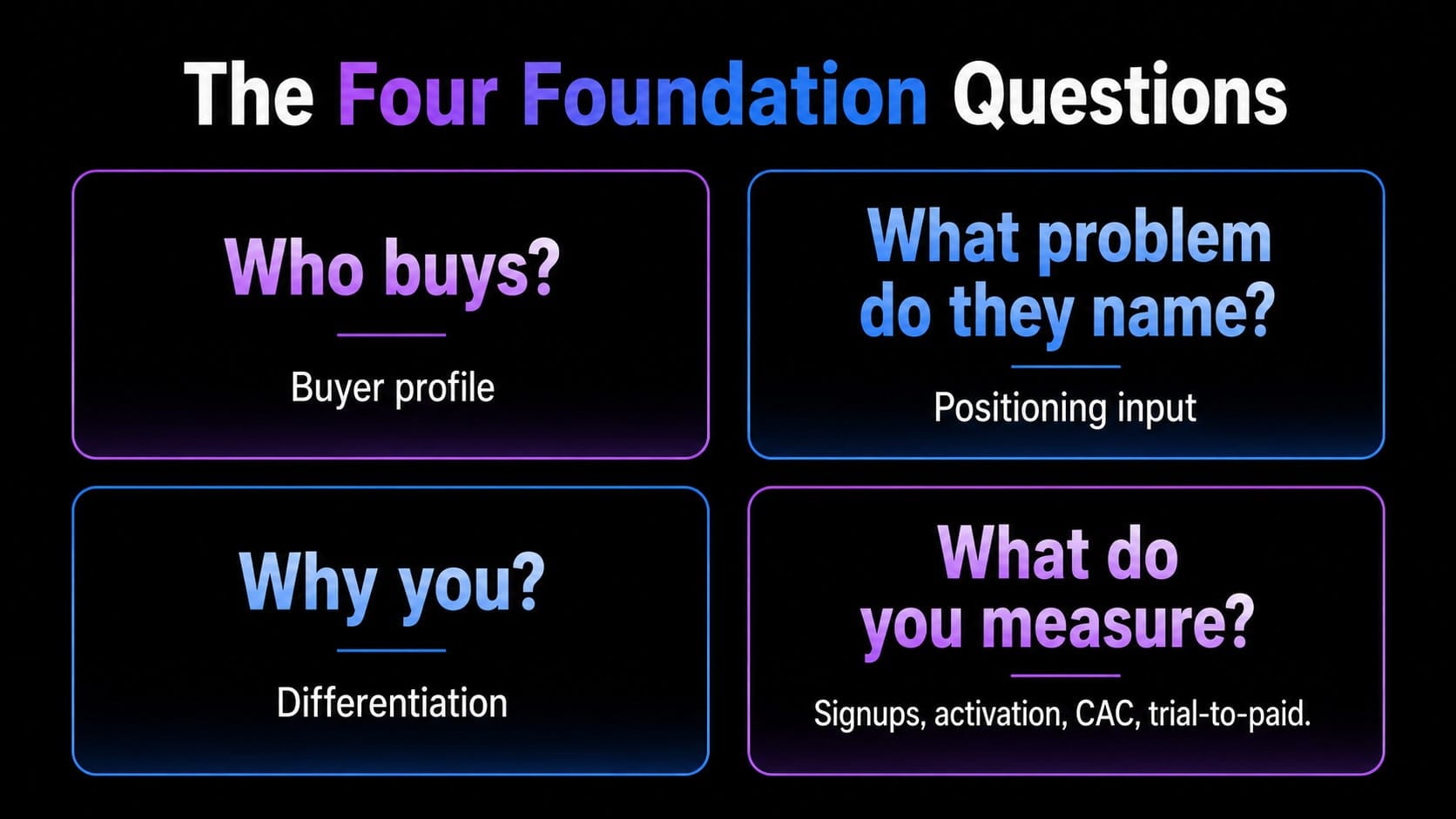
Foundation work answers four questions before any budget is committed: who buys, what problem they name, why they choose you, and what you measure. Skip one and channel spend becomes unmeasurable.
Write positioning as a single sentence a customer would repeat back to a colleague. Test it in live sales calls before it reaches the homepage. A SaaS go-to-market strategy built on untested positioning simply scales the wrong message faster. Pricing, packaging, and launch narrative all sit downstream, which is why SaaS product marketing belongs in the foundation rather than after it.
Define measurement next. A full-funnel SaaS marketing strategy for startups gives every stage of the SaaS marketing funnel one owner and one number, even when that owner is the founder. Start with four:
- Signups per week by source
- Activation rate within seven days
- Cost per activated user
- Trial-to-paid conversion rate
“When choosing marketing channels, we start with the business goal: where the startup needs to be in the next few months. From there, we look at the market, competitors, available resources, and budget, then choose channels based on the objective, whether that is awareness, acquisition, trust, or launch. The strategy also needs enough flexibility to change when the data shows something is not working.”
Kate Buckley, Strategist at NinjaPromo
Founders arriving from other sectors often find that general digital marketing for startups guidance underweights retention.
Create a SaaS Content Marketing Strategy to Educate Users
Content earns first users by answering the questions buyers ask before they know your product exists. At the seed stage, depth beats frequency.
Four formats carry most of the weight:
- Problem explainers rank for symptoms buyers search before they know solutions exist
- Comparison pages capture buyers already evaluating a named alternative
- Implementation guides reduce trial abandonment by showing setup steps
- Customer teardowns give sales a reusable proof asset
One thorough comparison page usually outperforms a dozen shallow posts, because it matches a specific decision-stage query. A documented SaaS content marketing plan also gives a small team a defensible reason to decline off-topic requests.
Set a floor rather than a quota. Two well-researched pieces per month beat eight thin ones, and the gap shows in rankings within two quarters.
Reuse aggressively. One research piece becomes a landing page section, three social posts, and two nurture emails. That reuse ratio is what keeps software as a service marketing for startups affordable before a marketing hire.
Optimize SaaS SEO from the Basics to Technical Improvements
SEO for early-stage software starts with pages that convert, then moves to crawl and rendering problems. Traffic without conversion context misleads the whole team.
“In the early stage, marketing should generate useful data as well as results. You need to know whether you are reaching the right audience, whether people are moving toward conversion, and whether those actions create business value. Growing impressions, traffic, or followers means little if none of it contributes to real customer acquisition.”
Kate Buckley, Strategist at NinjaPromo
Website conversion rates average 5.13% across industries, based on more than 5 million tracked conversions (Ruler Analytics). Dedicated pages behave differently: the SaaS landing page median sits at 3.8%, against 6.6% across all industries (Unbounce).
The practical reading is that ranking a blog post and converting a visitor are two separate jobs. Build decision-stage pages for alternatives, pricing comparisons, and integrations. Then point informational content at them with internal links.
Technical work follows. Most SaaS SEO problems at this size come from indexation rather than authority. Check that marketing pages sit outside the app subdomain and render without JavaScript. Programmatic pages for integrations and use cases need genuinely unique content, or technical SEO for SaaS turns into a thin-content cleanup project six months later.
Launch Targeted PPC Campaigns to Accelerate SaaS User Acquisition
Paid search buys speed and signal. At the seed stage, its main value is learning which message and which segment convert, faster than organic can tell you.
| Campaign type | What it buys | When to run it |
| Branded search | Protection against competitors bidding on your name | As soon as you have any brand search volume |
| Competitor alternatives | High-intent buyers already evaluating a named tool | Once you have a comparison page worth sending them to |
| Category and problem terms | Volume at higher cost and lower intent | Only after branded and competitor terms show payback |
| Retargeting | A second chance at trial abandoners | Above roughly 1,000 monthly visitors, below that the pool is too small |
Cap early tests at a budget you can afford to lose. Measure cost per activated user, because cost per click and cost per signup both hide trial quality. PPC for SaaS becomes a scaling lever once one campaign type shows repeatable payback. That is the point where scaling SaaS customer acquisition through paid ads starts to make sense.
Build an Email Marketing System to Nurture SaaS Leads
Behavior-triggered email outperforms scheduled broadcasts by a wide margin, and the gap is large enough to justify building triggers before building a newsletter.
Automation and transactional email averages a 30.63% open rate and 7.39% click-through rate across industries (Brevo). Standard marketing campaigns in the same dataset sit at 20.73% and 2.27%. Timing explains most of that gap, since triggered messages arrive at a moment of user action.
Treat reported open rates as directional. Apple Mail Privacy Protection preloads tracking pixels and logs opens that never happened. Judge sequences on replies, activations, and trial-to-paid movement instead.
Four sequences are worth building first:
- Welcome and setup, triggered at signup
- Feature nudge, triggered by an unused core action
- Pricing revisit, triggered by a second visit to the pricing page
- Trial expiry, timed three days before the end
SaaS email marketing works best when triggers fire on product events rather than calendar dates.

Use SaaS Influencer Marketing to Expand Brand Reach
Influence in software marketing sits with practitioners rather than with follower counts. Audience overlap with your buyer matters more than audience size.
The people who move software purchase decisions are consultants, agency owners, community moderators, and newsletter writers inside your category. Four formats tend to work:
- Sponsorships in niche industry newsletters
- Paid teardowns from practitioners who actually use the product
- Community partnerships with Slack and Discord moderators
- Co-hosted workshops with consultants who implement tools like yours
Ask for usage before endorsement. A creator who has run your onboarding produces specific content, and specificity is what buyers check. SaaS influencer marketing fails most often when the brief asks for generic praise.
Broader startup influencer marketing guidance on outreach and contracting still applies, with tighter claim verification.
Implement PR Strategies to Increase SaaS Brand Awareness
PR at seed stage buys credibility signals that shorten buyer evaluation. Funding announcements are the weakest version of it.
Journalists and buyers respond to proprietary data, customer outcomes, and category arguments. A startup with 200 users holds usage data nobody else has, which is a stronger pitch than a raise.
Build a small, repeatable set of angles:
- Original benchmark data drawn from your own product usage
- Customer results with named numbers and a named company
- A contrarian position on a common category practice
- Founder commentary tied to a live news event
Keep three live angles ready at all times. Reporters work to deadlines, and the startup that answers within an hour gets the quote.
Pitch trade publications and category newsletters before national outlets. PR for SaaS compounds when each placement becomes evidence for the next one.
General PR for startups guidance on timing and relationship building applies without modification.
How Marketing Changes Across SaaS Startup Stages
SaaS startup marketing priorities shift from learning to repeatability to efficiency as the company grows. The channel mix changes at each transition, and so does the number worth reporting.
| Stage | Common challenge | Marketing priorities | Channels that work |
| Pre-Launch | No product and no proof to point at | Positioning tests, waitlist, design partners | Founder outreach, niche communities, landing page tests |
| Launch | Attention lasts days | Launch assets, onboarding email, press angles | Product directories, newsletters, waitlist email |
| Early Growth | Budget spread too thin | Activation, content depth, first paid tests | Search, comparison content, branded and competitor PPC |
| Scaling | Rising paid costs and weak attribution | Full-funnel measurement, lifecycle email, referrals | Paid search and social, partnerships, referral program |
| Expansion & Maturity | Message stops fitting the new buyer | Localization, segment positioning, brand investment | Field events, PR, partner ecosystems, ABM |
Two transitions cause most of the damage. The first runs from early growth to scaling, where founders add channels before the first one repeats. The second runs from scaling to SaaS startup market expansion, where proven messaging gets reused for a buyer with different pain.
“A SaaS startup should first validate demand and prove there is a market for the product. From there, the focus shifts to finding effective channels and building a repeatable acquisition engine. As the company scales, marketing moves toward optimization, sustainable growth, and stronger market positioning.”
Kate Buckley, Strategist at NinjaPromo
Review the SaaS marketing metrics that define each transition before funding the next stage. A startup SaaS growth strategy that adds headcount ahead of proven payback shortens runway rather than extending reach. Strategic promotion for SaaS companies works when spend follows evidence, at every stage.

Final Thoughts
Getting the first users is largely a sequencing problem. Positioning comes before channels. Activation comes before scale. Referral and PR need existing users before they produce anything at all.
The teams that handle this well pick two channels, measure activation rather than signups, and let evidence choose the third channel. Effective SaaS startup marketing strategies share that discipline more than they share any particular tactic.
Marketing for SaaS startups rewards patience in content and speed in learning. Both are affordable at seed stage. Neither is recoverable once the budget has been spent on a message nobody validated.