
Multi-location business marketing means promoting your brand across multiple locations while adjusting your approach for each market. You keep one brand, but you change how you reach and convert customers in different cities or regions.
Most businesses try to run the same campaigns everywhere. That leads to wasted budget and uneven results. Each location has different demand, competition, and customer behavior.
To get results, you need to adapt your marketing by location, track performance clearly, and focus on what works in each market. In this article, we’ll show you how to do it.
How Marketing Differs for Single vs Multi-Location Businesses
Marketing for a multi-location business is different because you are not managing one market but many. Each location has its own audience, competition, and performance. You need to adjust your approach for every location while keeping one consistent brand.
With a single location, marketing is simple. You target one area, run one set of campaigns, and track one set of results. What works usually works across your entire business.
With a multi-location approach, that breaks. One campaign will not perform the same in every city. One location may convert well, another may fail. That is why you need location-specific marketing instead of one global approach.
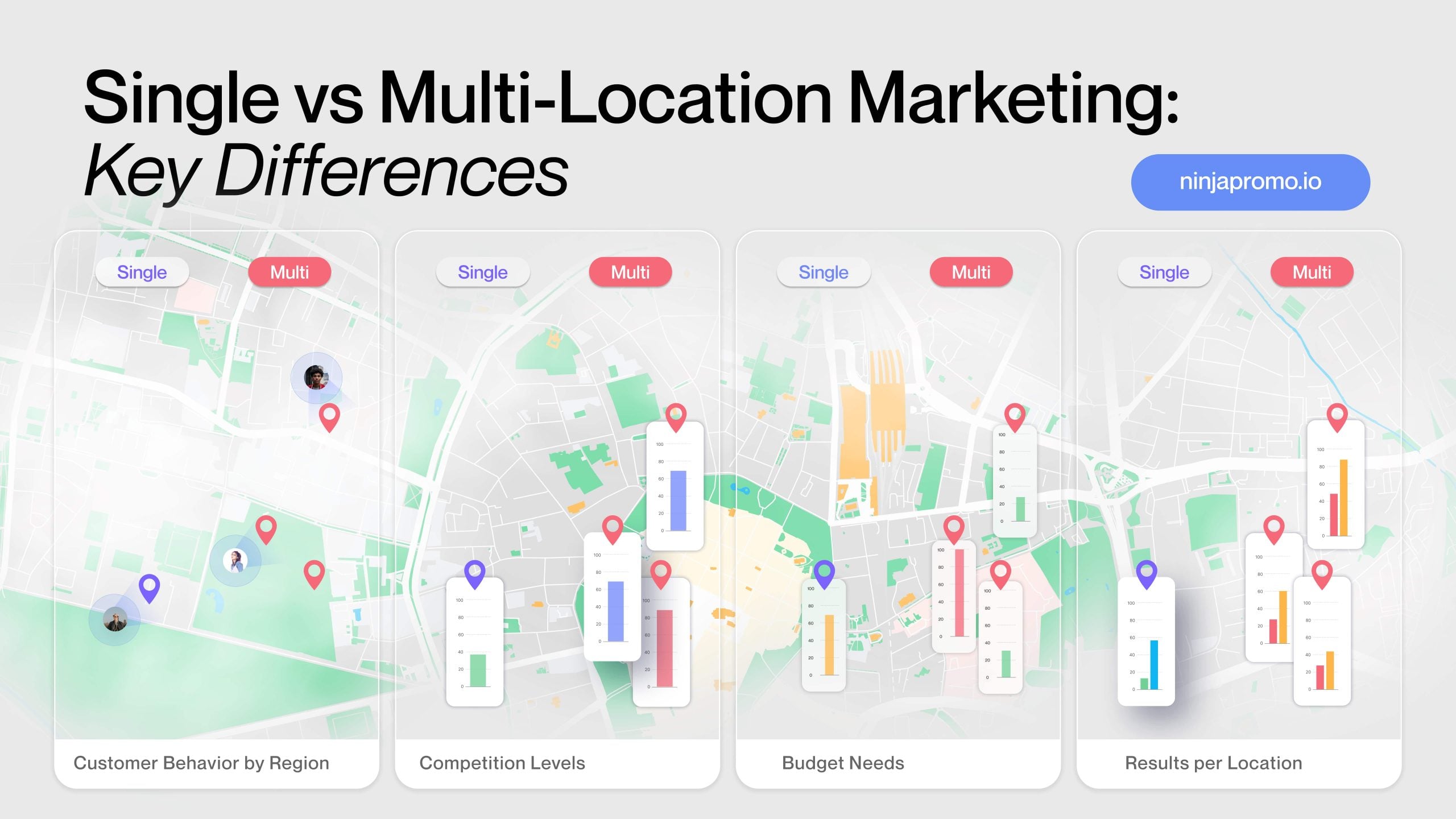
You also deal with more complexity:
- Different customer behavior by region
- Different competition levels
- Different budget needs
- Different results per location
This is where many businesses lose control. They scale campaigns, but not structure.
“The biggest challenge when scaling to multiple locations comes down to two things. First, balancing consistency and local relevance, since controlling everything centrally weakens local connection while too much freedom leads to brand inconsistency, so the solution is a fixed core with flexible local execution. Second, understanding that performance varies by market, as costs like CPC and CAC can differ 3–5x, which is normal, so instead of comparing locations too early, it is better to set a baseline for each market and track progress over time.”
Vincent N, Lead Strategist at Ninja Promo
You can see a clear difference in the following table:
| Aspect | Single Location Business | Multi-Location Business |
| Audience | One local audience | Multiple audiences across regions |
| Strategy | One marketing plan | Requires marketing strategies for multiple locations |
| Campaigns | Same campaigns for everyone | Multi-branch campaigns adapted per location |
| SEO | One focus area | Local SEO for each location |
| Advertising | Broad targeting | Location-specific ads with geo-targeting |
| Budget | One budget pool | Split budgets based on location performance |
| Data | One dataset | Multiple datasets with location tracking |
| Brand | Easy to control | Needs a balance between global and local |
| Growth | Limited | Scalable but more complex |
| Customer Reach | Local only | Expanded across regions |
Key Benefits of Multi-Location Marketing
A multi-location marketing strategy works because it aligns your approach with how people actually search, choose, and buy locally. You stop running generic campaigns and start winning in each specific market.
In practice, you get:
1. Higher Local Visibility
When you invest in location-specific marketing, each location competes in its own local search environment. That is where most purchase decisions start.
✅What this means:
- You appear in “near me” searches
- You rank for city and neighborhood queries
- You capture high-intent local traffic
Businesses in the top 3 local results get 126% more traffic and 93% more actions. If you are not visible locally, you lose customers who are already ready to act.
2. Better Understanding of Each Audience
Every location behaves differently. A multi-location strategy forces you to analyze performance at the local level instead of relying on averages.
✅What this means:
- You identify what works in each market
- You adjust messaging, offers, and channels
- You improve audience segmentation with real data
80% of customers prefer personalized experiences. Localization makes your marketing feel relevant, not generic.
3. Smarter Budget Allocation
Locations perform differently. Some generate strong revenue, others underperform. Without location-level insight, you waste the budget.
✅What this means:
- You scale high-performing markets
- You fix or cut low-performing ones
- You reduce wasted spend
4. Consistent Brand with Local Flexibility
You need one brand identity, but different execution. A multi-location approach lets you adapt without breaking consistency.
✅What this means:
- Same brand voice and visuals everywhere
- Localized offers, content, and campaigns
- Strong multi-location brand presence without confusion
94% of high-performing brands use a local marketing strategy. Local adaptation helps you compete with both small local businesses and large national brands. You become both recognizable and locally relevant.
5. Stronger Customer Engagement and Trust
People trust businesses that understand their environment. Local relevance builds credibility faster than generic messaging.
✅What this means:
- More engagement with local-first campaigns
- Higher conversion rates
- Stronger long-term relationships
Businesses with complete local profiles are seen as significantly more trustworthy. This is especially important in franchise marketing and regional marketing, where trust drives performance.
What ties it all together?
✅These benefits are connected:
- Visibility brings qualified traffic
- Local insight improves targeting
- Better targeting increases conversions
- Data improves budget decisions
If you execute a multi-location digital marketing campaign correctly, each location can become a source of income, instead of being just another expense. So, if you want results, stop thinking globally and start optimizing marketing for each location.

Step-by-Step Framework for Multi-Location Business Marketing
You can’t scale marketing for multiple locations without a system. Running campaigns is not enough. You need a clear process that tells you where to invest, how to adapt, and how to measure results per location.
This framework shows you how to build that system step by step. You will move from understanding your markets to executing and optimizing campaigns at the local level.
Audit Your Location Portfolio and Prioritize High-Impact Markets
Start by identifying which locations actually drive growth. You should audit every location using real performance and market data.
✅Focus on:
- Revenue and conversion rates by location
- Cost per lead or acquisition
- Local demand and search volume
- Competition level in each market
- Operational factors (response time, staffing, service quality)
This step is critical because one location may generate fewer leads but convert more because the team responds faster. Another may waste leads due to poor follow-up.
Next, group your locations based on performance. This is where a real multi-branch strategy starts.
You can segment locations into:
- High-performing (scale aggressively)
- Average performers (optimize campaigns)
- Low-performing (fix operations or reduce spend)
This approach turns marketing by location into a controlled system instead of guesswork.
✅What you get from this step:
- Clear visibility into which locations generate real value
- Better audience segmentation by region
- Smarter budget decisions
- Stronger foundation for all future campaigns
If you skip this step, everything else breaks. You will keep investing in locations that cannot convert and ignore the ones that can grow.
“To decide which market to prioritize, look at TAM size, competitive density (how hard is it to win share), unit economics from existing locations (what does CAC and payback period look like where you already operate), and operational readiness (can you actually deliver the product/service well there). I also look at search demand trends and any organic interest – are people already looking for what you do in that market without you being there yet?”
Vincent N, Lead Strategist at Ninja Promo
Launch a “Local-First” SEO
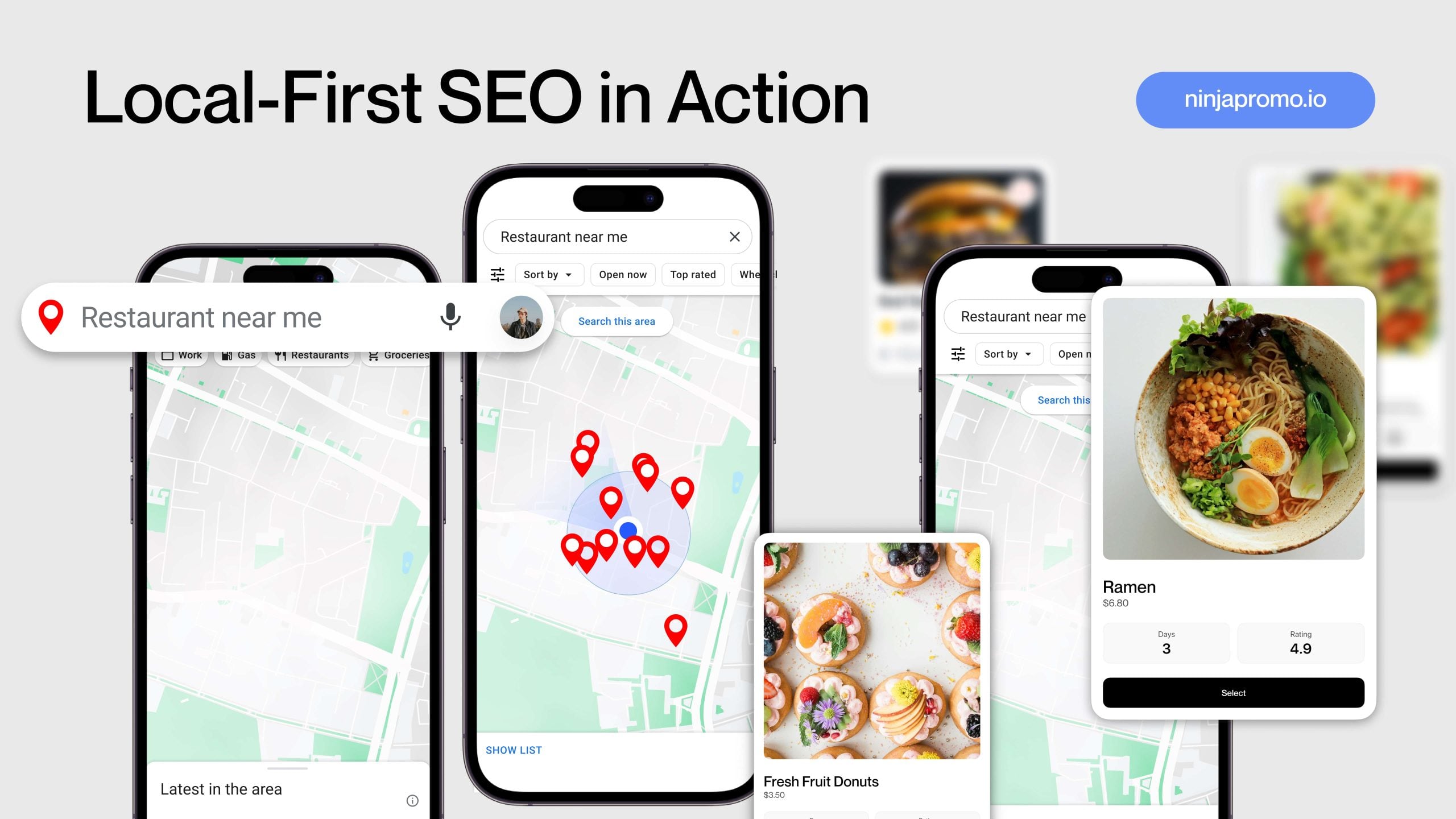
If people cannot find your locations in search, your marketing does not matter. A local-first approach means you optimize every location to show up when someone searches nearby. You are trying to rank every location in its own market.
✅What you should do:
- Create a dedicated page for each location
- Use city and neighborhood keywords
- Keep name, address, and phone consistent everywhere
- Optimize Google Business Profiles for every branch
- Collect and manage reviews per location
This is the foundation of local SEO, and it directly impacts whether customers find you or your competitors.
🚀Why this works: Search behavior is local by default. People look for services “near me” or in a specific city. If your pages and profiles are not optimized per location, you will not appear in those results.
A local-first setup increases:
- Visibility in maps and search results
- Clicks from high-intent users
- Store visits and conversions
AI also changes how local SEO works. Search engines now use AI to understand intent, not just keywords. They analyze:
- Location relevance
- User behavior
- Reviews and engagement
- Content quality on location pages
Generic pages will not rank. Each location needs real, useful, and specific content. If you do this right, each location becomes a separate entry point for customers.
Implement Location-Level Paid Media with Geo-Targeting
Running one paid campaign for all locations does not work. Each market has different demand, competition, and costs. If you treat them the same, you waste budget and miss local opportunities.
You should run paid media per location. That means separate campaigns, budgets, and targeting.
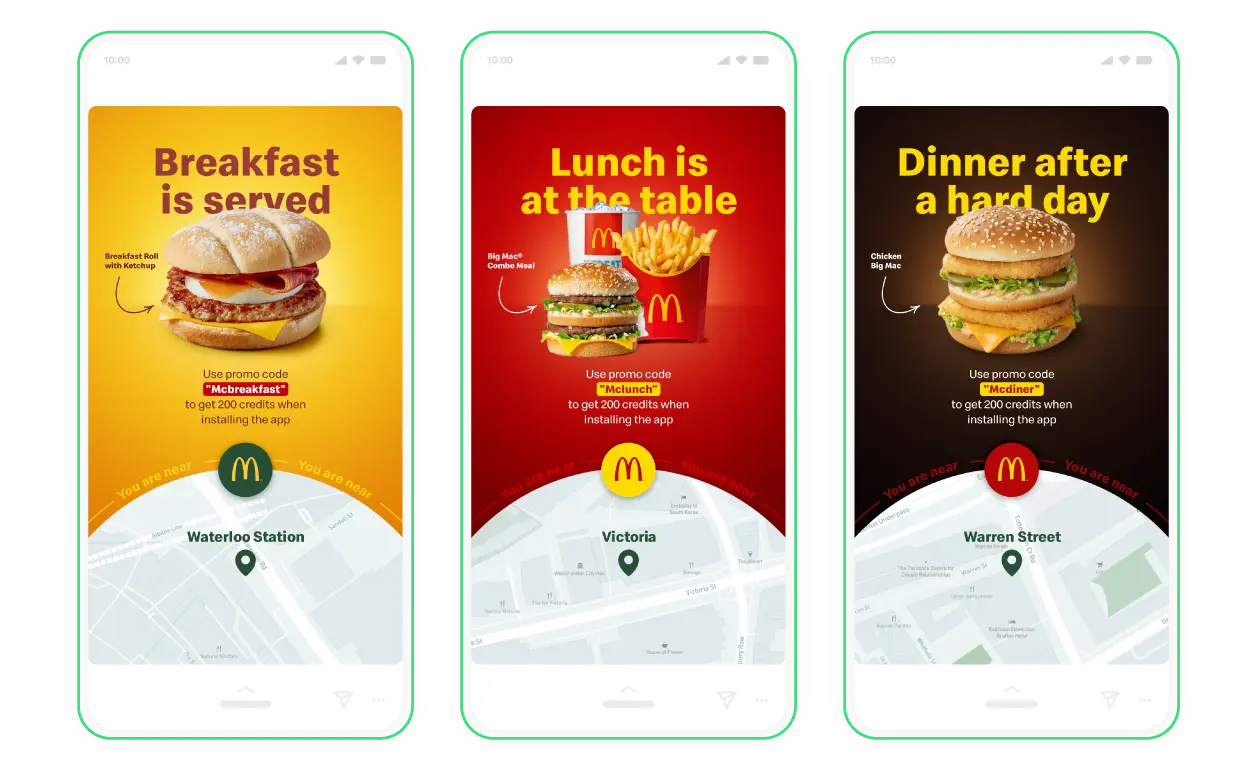
✅What this looks like:
- Geo-targeted ads for each city or region
- Location-specific ads with local offers
- Different budgets based on performance
- Messaging adapted to local audience needs
🚀Why this works: People respond to what feels relevant. An ad that mentions their city, local offer, or nearby store performs better than a broad message.
Location-level campaigns improve:
- Click-through rates
- Conversion rates
- Cost efficiency
You stop paying for irrelevant traffic and start reaching people who can actually convert.
Geo-targeting also lets you go deeper:
- Radius targeting around store locations
- Time-based ads (e.g., lunch offers near restaurants)
- Retargeting users who visited a specific location page
And that is how you scale targeted digital campaigns for local businesses.
If you operate across countries or languages, you also need to adapt messaging and targeting accordingly. This is where multilingual PPC becomes important, allowing you to match ads to local language and intent without losing performance.
Partner with Local Micro-Influencers
If you want to connect with people in a specific area, you need voices they already trust. Local micro-influencers help you reach those audiences in a natural way.
Their audiences are smaller, but more engaged. People follow local influencers because they are part of the same community. That makes their recommendations feel real, not like ads. You are not pushing one message everywhere. You are building trust in each market.
✅What you get:
- Stronger local awareness
- Higher engagement than traditional ads
- More trust in your brand
- Better results at the location level
To make this work, you need a simple system:
- Choose creators who are active in that location
- Make sure their audience is real and local
- Check if their content fits your brand
- Give clear direction, but let them stay natural
- Track results for each location
In local markets, trust matters more than reach. Micro-influencers help you build it faster.
Standardize Location Tracking: UTMs, Location IDs, Call & Store Visit Capture
If you cannot measure performance by location, you cannot manage it. That is where most multi-location approaches break. You see total leads, total traffic, total spend—but you do not know which location actually generates revenue.
You need standardized location tracking across all channels. This is what turns your data into decisions.
Here is how each part works:
| Tracking Element | What It Does | Why It Matters |
| UTMs (Tracking Parameters) | Track where traffic comes from (campaign, channel, location) | Lets you compare campaigns across locations and identify what drives results |
| Location IDs | Assign a unique identifier to each location in your systems | Connects marketing data, CRM data, and revenue to the correct location |
| Call Tracking | Tracks phone calls back to specific campaigns and locations | Captures offline conversions that would otherwise be lost |
| Store Visit Tracking | Measures physical visits driven by digital campaigns | Links online activity to real-world results |
| CRM Integration | Connects leads, deals, and revenue to source and location | Shows which locations turn leads into actual revenue |
| Naming Conventions | Standardizes how campaigns and locations are labeled | Prevents data confusion and makes reporting consistent |
Without proper tracking, you can’t:
- Compare locations
- See which campaigns actually work
- Optimize budget allocation
You end up relying on averages, and averages hide problems.
Set Up Continuous Test-and-Learn Cycles Across Clusters of Locations
You should not treat every location separately all the time. You should test across groups of similar locations and learn what works faster.
“You should expect results based on the type of campaign, and change strategy only when the data clearly shows it is not working. For brand campaigns, wait 6–9 months. For performance campaigns, 8–12 weeks per market is enough. Watch for warning signs: rising CAC, conversion rates below 50% of your benchmark, and no organic or referral growth after three months. If you see this, the issue is not optimization, but a strategy. The market or message is wrong, and spending more will not fix it.”
Vincent N, Lead Strategist at Ninja Promo
Start by grouping locations into clusters:
- Similar size markets
- Similar audience behavior
- Similar performance levels
Now you can test changes across these clusters instead of one location at a time. Check:
- Messaging and offers
- Location-specific ads
- Landing pages
- Budget distribution
- Channels and formats
Run the same test across a cluster, compare results, and keep what works.
Make budget decisions accordingly:
- Increase spend in clusters that perform well
- Adjust campaigns in underperforming areas
- Stop wasting money on strategies that do not convert
Over time, this builds a system where every test improves the next campaign. If you do this consistently, your marketing stops being random and starts becoming a controlled growth engine.
Final Thoughts
Multi-location marketing requires adapting your strategy to the market. If you treat all locations the same, results will always be uneven. Some will perform, others will waste budget, and you will not know why. The moment you start looking at performance by location, everything changes. You see what works, what does not, and where to focus.