Running PPC ads in more than one language forces you to rethink how people search, compare, and buy in each market. A direct translation rarely captures this complexity.
At NinjaPromo, we’ve managed campaigns across dozens of markets, and we’ve seen how much PPC performance improves when your ads reflect local habits and language.
In this guide, we’re breaking down practical approaches to building multilingual PPC campaigns that work.
What Is Multilingual PPC and Why It Matters
Multilingual PPC refers to paid advertising campaigns built for different languages and markets.
The key? Adapting and localizing your campaigns — not just translating them.
It matters because people rarely search the same way across regions, and small wording differences can completely shift the intent behind a query. This, in turn, affects key metrics like click-through rates and ad revenue.
Here are some of the top benefits of PPC advertising in local markets:
- You reach untapped markets where competitors still run English-only ads
- Ad relevance improves when keywords match actual search patterns
- CTR and conversion rates climb because users see messaging that feels native
- ROI grows as you stop wasting spend on mismatched audiences or awkward phrasing
- Brand trust strengthens when people interact with content that respects their language and culture
Key Challenges in Multilingual PPC Management
Managing global pay-per-click advertising campaigns comes with obstacles that don’t exist in single-language setups — like translation errors, keyword mismatches, and fragmented tracking.
These issues usually stem from treating each market like a copy-paste job instead of a distinct audience with its own search behavior and expectations.
Such common local PPC roadblocks include:
- Translation fails: Word-for-word translations often miss colloquialisms, search intent, and tone
- Keyword mismatches: Direct translations ignore how people search in each language, leading to low CTRs or irrelevant clicks
- Tracking complexity: Multi-market campaign management across local platforms, currencies, and time zones makes attribution messy
- Cultural missteps: Ads that work in one region can offend or confuse in another if imagery, humor, or messaging doesn’t fit local norms
- Unclear budget allocation: Deciding how much to spend per market without historical data or clear benchmarks can also get complicated
- Platform limitations: Not every ad network supports all languages or geo-targeting optimization features
Overcoming these challenges requires more than having a set of tools.
You need cultural awareness, technical precision, and often input from native speakers or international PPC experts who understand regional nuances.
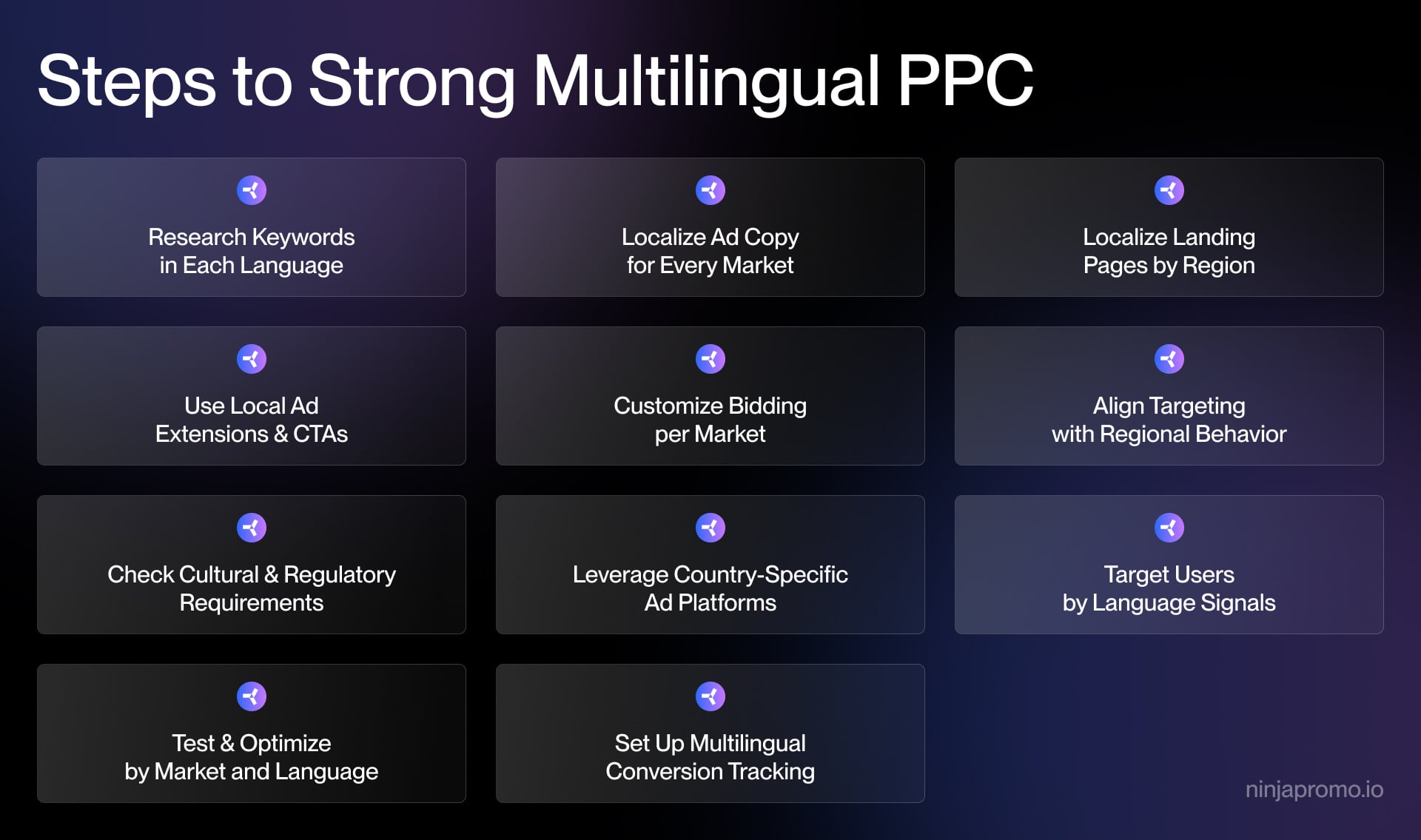
11 Best Practices for Effective Cross-Language PPC Campaigns
Running ads across multiple languages means adapting to how audiences search and buy in each local market.
What works in one location doesn’t necessarily directly translate to another.
These practices help you build cross-border PPC advertising campaigns that perform consistently — based on what we’ve seen work for our clients over the years.
These 11 practices help you build cross-border PPC advertising campaigns that perform consistently — based on what we’ve seen work for our clients over the years.
1. Conduct In-Depth Multilingual Keyword Research
First, work on multilingual keyword research in each target language — identify terms natively instead of translating to account for regional phrasing, slang, search volume, and intent differences.
“The most common mistake companies make when translating keywords or ad copy is assuming that a direct translation equals the keywords people actually search.
A term might be linguistically correct, but completely misaligned with real local behavior.
- Classic example: translating “online casino bonus” into the technically correct “bono casino online.”
- In Mexico, though, people search for “bonos de apuestas” or “bonos de bienvenida.”
Same meaning on paper — totally different intent in practice.
And the impact is immediate: You end up with irrelevant impressions, low CTR, higher CPC, poor Quality Score, and a lot of wasted spend chasing the wrong intent.”
Dennis F, PPC Team Lead at NinjaPromo
Start by working with a native speaker or translator to identify a few core terms in the target language.
For example, if you wanted to promote a meal delivery service in Spanish, you could pick a few seed keywords like “servicio de comida a domicilio,” “entrega de comida,” or “comida preparada.”
Then, use Google’s free Keyword Planner tool to find relevant keywords for each language.
Open the tool and select “Discover new keywords.”

Then, add your seed keywords and set the target language and location.

From here, explore the list of keyword ideas generated by the tool.
Review search volume, competition level, and suggested bid ranges that show what locals are searching.

Check the “Broaden your search” suggestions at the top — these show related phrases locals use.

Finally, select the keywords that fit your goals and click “Add keywords to create plan” to build your list for the campaign — or create a new ad group to organize keywords by theme or intent before launching.

You also download your keyword lists and use an AI tool like ChatGPT to organize high-intent keywords by market and sort search intent by language.

✅Tip: Run a PPC competitor analysis with tools like Semrush’s Advertising Research to find more local keyword opportunities.
“When translation doesn’t match how natives actually search, you need validation — not assumptions.
Our workflow has three main parts:
Validate keywords by market:
- Use Google Keyword Planner (correct language + region), Google Trends per country,
- Semrush/Ahrefs regional databases, and the AlsoAsked tool for local PAA patterns.
Run competitive analysis:
- Review Google Ads Transparency Reports, Meta Ad Library, and inspect local SERPs via VPN — this step is crucial.
Look at native autocomplete suggestions:
- Autocomplete in ES-MX vs ES-ES or AR-EG vs AR-GCC can differ wildly — and it’s often the fastest way to surface real phrasing.”
Dennis F, PPC Team Lead at NinjaPromo
2. Localize Ad Copy, Don’t Just Translate It
Next, localize your ad copy by adapting tone, phrasing, and emotional triggers for each market.
Remember: translation converts words, but ad copy localization adjusts meaning, style, and cultural context to match what truly resonates in each region.
“The biggest gap is matching local intent and local tone. A direct translation might be technically correct, but it rarely reflects how people in that market actually search or think.
Real example:
- A fintech project expanded from Italy to Mexico. The translated headline was “trading sin comisiones” — CTR: 1.2%.
- A local copywriter suggested “Invierte sin comisiones ocultas” (“invest with no hidden fees”). CTR jumped to 3.8%, and CPL dropped by 27%.
Localization converts because it speaks to local pains, not perfect grammar.”
Dennis F, PPC Team Lead at NinjaPromo
Here’s what to focus on when localizing your ad copy:
| Element | Why it matters | For example |
| Tone and formality | Some markets expect formal language in B2B and casual in consumer ads. Wrong tone makes your brand feel disconnected. | German might banks use “Sie” (formal). Fashion brands might use “du” (informal). |
| Idioms and expressions | Direct translation often sounds awkward. Local equivalents convey the same idea naturally. | Phrases like “Break a leg” don’t translate. Use culturally appropriate expressions instead. |
| Emotional triggers | What motivates clicks varies by market. Some respond to urgency, others to authority. | “Limited time offer” might drive more clicks in the U.S. German users might respond better to “Trusted by 10,000+ customers.” |
| Calls-to-action (CTAs) | Direct CTAs work in some cultures but feel aggressive in others. Softer phrasing can increase conversions. | “Buy now” might perform well in the U.S., while Japanese ads could use a softer alternative to reduce pressure. |
| Cultural references | Holidays and symbols don’t translate globally. What works in one market can confuse others. | Black Friday drives U.S. sales but might have lower impact in China. |
| Measurement units and currency | Unfamiliar units or foreign currency create friction. Show what users expect. | Display “5 km away” for Europe, not “3 miles.” Show prices in euros for France, not dollars. |
| Brand voice consistency | Your brand should feel recognizable while adapting to local norms. Balance identity with relevance. | Maintain your core brand personality but adjust phrasing and formality per market. |
And here’s a quick summary of how to approach localized content creation:

“Ads sound ‘foreign’ when companies translate literally instead of writing for how people actually speak.
The biggest offenders: word-for-word idioms, the wrong tone (too casual in DE, too formal in BR, too flat in IT), and CTAs that feel robotic — for example, ‘Register now’ is unnatural in many markets.
What varies most across languages is emotion and directness.
Germany wants facts. Arabic-speaking markets respond to emotional anchors. CTA phrasing shifts completely: BR uses ‘Comece agora’, DE uses ‘Jetzt starten’, FR uses ‘Commencez maintenant’.”
Dennis F, PPC Team Lead at NinjaPromo
3. Adapt Landing Pages to Each Language Market
Next, create dedicated landing page variations for each language market — adjusting UX, currency, visuals, offers, and social proof.
The key: country-level targeting performs better when landing pages reflect the same level of localization as your ads.
Here’s what to adapt on landing pages for each market:
- Language, layout, and form structure. Translate your content and validate the results with native speakers, adjust page layout for right-to-left languages (Arabic, Hebrew), and reorder form fields based on local expectations (postal code placement, address format).
- Currency, pricing, and payment methods. Display prices in local currency with region-appropriate formatting. Include payment options locals use — e.g., Alipay in China, iDEAL in the Netherlands.
- Visuals and cultural context. Use images that reflect local culture, people, and settings. Adjust CTA positioning and phrasing to match cultural preferences for tone and urgency.
- Social proof and trust signals. Show testimonials, reviews, and trust badges relevant to the region. Highlight local customers or region-specific certifications that build credibility.
- Legal compliance. Include required disclaimers, privacy policies, and cookie notices per local regulations (e.g., GDPR, CCPA).
- Units of measurement. Use kilometers, Celsius, and metric units for most markets outside the U.S. Display distances and dimensions in familiar terms.

“The biggest conversion lifts on localized landing pages rarely come from language — they come from local expectations.”
The top drivers we see:
- Payment methods: BR = Pix, MX = Oxxo, PL = Blik, EG = Fawry. If users don’t see their method, they drop.
- Currency: Showing USD prices to Italian or German users can cut conversion rates in half.
- Local social proof: “Trusted by 20,000 users in Italy” consistently beats generic testimonials.
- Imagery: Local people and settings convert; American stock photos underperform in LATAM and MENA.
- Page structure: DE users want long-form clarity and FAQs. IT and ES respond more to emotional, benefit-led layouts.”
Dennis F, PPC Team Lead at NinjaPromo
4. Use Native Ad Extensions and Local Calls-to-Action (CTAs)
We also recommend adding local ad extensions and region-specific CTAs to match how users interact with ads in each market — these build trust and make it easier for users to take action.
For example, a U.S. phone number or a generic “Contact Us” link won’t resonate with someone searching in Tokyo or Berlin.
Here’s what to localize in ad extensions and CTAs:
- Use local phone numbers with country codes formatted correctly (+49 for Germany, +81 for Japan).
- Display physical locations in the local language with proper formatting and show nearby stores or offices relevant to the searcher’s location.
- Create site links to pages localized for that market, like “Lieferung & Rückgabe” (Delivery & Returns) for Germany instead of English equivalents.
- Highlight benefits in callout extensions using natural local phrases like “Kostenloser Versand” (Free Shipping) in German or “Livraison gratuite” in French.
- Adapt CTAs for cultural context — direct CTAs like “Buy Now” work in the U.S. and UK, while Japanese ads might use “詳細を見る” (See Details), and French users respond to “Découvrir” (Discover)
For instance, this crypto PPC ad on Google also localizes its ad extensions to feel relevant and trustworthy to Spanish searchers:

5. Customize Bidding Strategies per Market
Next, work on adjusting your budget allocation by country and setting up geo-specific bid adjustments.
Here’s how:
- Let Google’s automated bidding handle markets where you’re already getting consistent conversions.
- For new markets where you don’t have data yet, start with manual bidding until you learn what clicks actually cost there.
Why?
Because automated bidding needs conversion history to work properly. Without it, the algorithm is guessing — and guessing burns through your PPC budget fast.
Here’s a quick summary:
| Market situation | What to do | Why it works |
| 30+ conversions/month | Switch to automated bidding (tCPA or tROAS) | The algorithm has enough data to optimize |
| Brand new market, no data | Start with Manual CPC | Discover local CPCs before automating |
| High-competition (e.g., US, UK, Germany) | Tighter targets + daily budget caps | Expensive CPCs waste money without limits |
| Lower-competition (e.g., Eastern Europe, Southeast Asia) | Looser targets | Room to find cheaper conversions |
| Brand keyword campaigns | Keep manual control | You want the top position regardless of cost |

6. Align Targeting Settings with Regional Nuances
From here, adjust your country-level targeting settings to match when and how people in each market search and buy — consider time zones, local holidays, device preferences, and shopping habits.
For example, running US ad schedules in Germany means your ads peak while your audience sleeps. While ignoring Singles’ Day in China or Diwali in India means missing massive buying windows.
To set up effective geo-targeting optimization:
- Research local buying habits
- Schedule ads around local peak hours
- Pause or boost spend around region-specific holidays and shopping events
- Check device breakdowns per country and adjust bids accordingly
- Build cultural sensitivity into your timing
“My rule for multilingual bidding is simple: automate when the data is stable, control manually when it’s not.”
- I rely on automated bidding when a country/language already produces 20–30+ conversions per week and the market is stable (US, UK, DE).
- I switch to manual or portfolio bidding when launching low-volume markets (EG, KSA, Indonesia), when CPC volatility is high, or when there’s too much low-quality traffic that needs filtering.
My workflow:
Start on Manual CPC + Impression Share → let the market train → move to Target CPA or Max Conversions.”
Dennis F, PPC Team Lead at NinjaPromo
In Google Ads, you can adjust your bidding approach by selecting your campaign, clicking the “Settings” tab, and expanding “Bidding” under “Budget and bidding optimization.”

Then, scroll down to manage location and language settings:

7. Ensure Cultural and Regulatory Compliance
Always verify local advertising laws and cultural norms before launching — skipping this step can shut down your international paid search marketing efforts extremely fast.
For example, financial services ads face strict regulations in the EU, while alcohol, gambling, and political advertising have their own requirements depending on where you’re targeting.
“The biggest surprises in multilingual campaigns usually come from regional ad policies — not the ads themselves.
Common blockers:
- EU: Consent Mode v2 is mandatory, and missing it breaks tracking and remarketing.
- Finance/crypto: Meta and Google enforce strict rules; some markets require local licenses.
- Healthcare: Claims are heavily restricted, especially in DE and FR.
- MENA: Full bans on gambling, alcohol, and anything sexual.
- India: Many financial categories require formal disclaimers or are prohibited outright.
Our prevention workflow is simple: policy scan → compliance check on copy and creatives → region-specific disclaimers → gradual testing with low-risk ads first.”
Dennis F, PPC Team Lead at NinjaPromo
Beyond legal compliance, your cultural adaptation strategy matters too: imagery, colors, and messaging that work in one country can offend or confuse in another.
Here’s what you can do:
- Research advertising regulations for each target country before launching
- Review Google’s country-specific ad policies for restricted categories
- Run ad copy and visuals by native speakers to catch cultural missteps
- Keep global brand messaging consistent while allowing for local brand adaptation
- Monitor your international PPC campaigns for disapprovals and address policy violations immediately
- Document compliance checks as part of your PPC account management process
For example, Apple’s 2024 “Underdogs: OOO” Thailand ad drew massive local backlash for portraying the country as shabby and outdated (dingy hotels, old tuk-tuks) — forcing Apple to apologize and pull the YouTube video after 5M+ views.
8. Leverage Country-Specific Search and Social Ad Networks
Another thing we always point out: don’t limit your regional campaigns to Google and Meta.
Platforms like Baidu, Yandex, Naver, and LINE dominate in their own markets and often outperform the global players.
And Google and Meta aren’t the only social ad networks worth testing either.
Here’s a quick snapshot of the options available:
| Region | Platform | Type | What it’s for |
| China | Baidu Ads | Search engine | Search ads, display, Brand Zones ads |
| Russia | Yandex Direct | Search engine | Search ads, display, retargeting |
| South Korea | Naver Ads | Search engine | Search ads, shopping ads, blog content |
| Japan | LINE Ads | Messaging app | In-chat ads, display, sponsored stickers |
| China | WeChat Ads | Social + messaging app | In-app ads, mini-program promotions |
| Southeast Asia | Grab Ads | Ride-hailing app | In-app ads targeting commuters and shoppers |
For example, here’s what a Shopping Mall Product Type ad looks like on Naver:

Source: Hyien Yoon

9. Use Dynamic Language Targeting and Audience Segments
You can also target users by the language their browser is set to, and layer in audience segmentation by language to refine who sees your ads.
For example, Google figures out what language someone speaks by looking at their browser settings, their search queries, and the websites they visit.
In Google Ads, open your campaign and go back to the “Settings” tab.

Scroll to “Languages,” click to expand, and select the relevant language for each campaign.
Google will show your ads to users whose signals match — even if they search in a different language.

Other platforms like Meta Ads and LinkedIn let you build custom audience segments by language preference — useful for remarketing to language groups or creating language-specific messaging for different user bases.
“When multiple markets share one domain, the only way to get clean insights is to segment by language and country at every layer of reporting.”
We break it down into three levels:
Google Ads:
Separate campaigns per language–country pair, a clear label structure like “ES-MX | Search | Brand,” and custom columns that surface conversions by event name.
Google Analytics (GA4):
Use Explore reports with country + language dimensions, pathing by region, and side-by-side comparisons (ES vs FR vs DE).
Looker Studio / BI:
Normalize currency, group conversions by language code, and apply multi-touch attribution across countries.
This setup keeps cross-market performance transparent — even when everything runs on a single domain.”
Dennis F, PPC Team Lead at NinjaPromo
10. Continuously Test, Monitor, and Optimize by Language and Market
Run A/B testing multilingual ads for each market and track results separately by language and country — because what converts in one region might not work well in another.
The only way to know is to test ad variations, compare performance by language, and adjust based on actual data.

Focus your regional performance analysis on these metrics:
| Metric | What it tells you | What to do |
| CTR by language | Whether your messaging resonates | Low CTR? Test new headlines and CTAs in that language |
| Conversion rate by country | Whether clicks turn into actions | Low conversions? Check landing page localization and relevance |
| Cost per conversion by region | Which markets are efficient | High costs? Tighten targeting or adjust bids |
| ROAS by language | Which audiences return the most | Low ROAS? Shift budget to better-performing languages and locations |
11. Implement Multilingual Conversion Tracking
Finally, set up multilingual conversion tracking so you can see which languages and regions drive results.
Proper setup also lets you compare multilingual attribution models to understand the full customer journey across regions — like when a user clicks your German display ad, then searches later and clicks your German search ad.
For example, in Google Ads, you can create separate campaigns by country or language
for proper tracking — with each campaign including localized ads and landing pages.

You’ll also need to set up a conversion action.
In Google Ads, open Goals → Conversions → Summary → Create conversion action, then make sure the Google tag is installed and firing on your site.

Pick the event you want to track, set the value and attribution model, and use that conversion for the campaigns you want to optimize.
The biggest tracking issues in multilingual PPC come from mismatched setups across currencies, URLs, and conversion events.
Most of the problems I see fall into five buckets:
- Currency mismatches: Google Ads reports revenue in USD while GA4 shows EUR, so performance looks misaligned.
- Regional URLs + redirects: Automatic redirects on example.com/es break gclid/fbclid or strip UTM parameters.
- Different conversion events per language: lead_en, lead_es, lead_fr all exist separately — but aren’t mapped to one unified action.
- Double counting: Running CAPI and browser pixels (Meta/GA4) without proper deduplication.
- Consent Mode issues: If Consent Mode v2 isn’t configured, a big portion of EU traffic becomes unattributable.
Consistency across markets matters. One tiny mismatch in setup can destroy your ability to measure performance accurately.”
Dennis F, PPC Team Lead at NinjaPromo
Take Your Multilingual PPC Campaigns to the Next Level
Growing across multiple regions is easier when your PPC campaigns reflect how people search in each market.
Here’s what you get when working with NinjaPromo:
- A clear multilingual PPC strategy shaped around real local demand
- An optimized campaign structure for international markets
- Support from an experienced PPC agency that manages global accounts daily
- Ongoing performance reviews and continuous optimization by market
Ready to get started? Chat with our international PPC experts today!