Key Takeaways
- Medical sites require prominent author credentials, clinical experience, and citations from trusted sources to meet YMYL standards and secure top rankings.
- Targeting high-intent local queries such as “dentist emergency NY” focuses on patient pain points like symptoms and procedures for stronger conversions.
- Continuous content audits ensure guidelines, stats, and treatments stay fresh with expert vetting, avoiding penalties from outdated health information.
- Physician bios with education, specialties, and real case studies signal deep expertise to both patients and algorithms.
- Healthcare-specific schema like MedicalClinic, Physician, and Service powers rich snippets, maps, and LLM extractions for voice search dominance.
Effective healthcare SEO strategies help build patient trust, attract local high-intent traffic to clinic websites, and support patient acquisition while reducing marketing costs.
But how do you construct such a strategy effectively in the era of both traditional organic search and rapidly evolving AI-driven discovery? The challenge lies in balancing time-tested tactics like keyword optimization and local signals with forward-looking AI readiness.
Let’s break it down step by step here, blending proven SEO foundations with cutting-edge adaptations for maximum visibility.
The Importance of SEO for the Healthcare Industry
SEO is critical for the healthcare industry to boost online visibility, with 77% of patients turning to search engines before booking appointments. Below are the key factors explained in more detail:
Greater Visibility for Potential Patients
A robust online presence expands reach to prospective patients actively seeking care. For instance, optimizing for queries like “inflammation treatment near me” positions clinics prominently in search results, capturing high-intent local traffic. This drives more inquiries and appointments without relying on paid ads alone.
Increased Trust and Credibility
Top-ranking sites are perceived as more authoritative and reliable by searchers. For healthcare providers, this elevates brand reputation and fosters long-term patient loyalty. SEO also enables proactive education through valuable content, empowering patients with clear information on conditions and treatments to build deeper trust.
Competitive Advantage
Custom SEO strategies differentiate providers in oversaturated markets, especially for specialized practices. By outranking rivals in relevant searches, clinics attract more qualified leads and secure market share.
Features of SEO for Medical Websites
SEO for healthcare demands elevated standards due to their classification as “Your Money or Your Life” (YMYL) pages, where accuracy directly impacts health decisions.
| Aspect | Description | Strategic Recommendations |
| E-E-A-T Emphasis | Author credibility is vital; content must be created or vetted by qualified healthcare professionals. | Feature bios, credentials, and expert bylines on all medical content. |
| Google Scrutiny | Sites face stricter evaluation; trust signals like citations from reputable medical sources and certifications boost rankings. | Integrate links to authoritative sources (e.g., NIH, WHO) and display awards prominently. |
| Reputation Management | Transparency about operations, staff, and patient processes builds trust; active review responses demonstrate responsiveness. | Publish team profiles, service overviews, and reply publicly to reviews across Google, Yelp, and health forums. |
| Regulatory Compliance | Content must adhere to laws like HIPAA for privacy and avoid misleading claims. | Implement secure data handling, clear disclaimers, and legal reviews for all patient-facing materials. |
| Content Updates | Ongoing revisions are needed to reflect latest guidelines and discoveries. | Establish editorial calendars with periodic audits by medical experts. |
Key Steps to Building an Effective Healthcare SEO Strategy
As we’ve seen, medical SEO strategy is more complex, as search engines demand much more from websites. To increase the online visibility, you’ll need to use a range of healthcare SEO techniques:
Conduct Comprehensive Keyword Research With a Focus on Search Intent
It means that you need to identify and analyze the keywords potential patients use when searching for information about the health sector. The goal is to understand the intent behind these searches to ensure that the content you offer meets users’ needs.
Search for Main Keywords
You can identify the main keywords in the health sector with tools that provide detailed information on search volume, the difficulty of competition, and the relevance of keywords to the sector. Common options include:


Next, you need to identify the keywords that patients use when searching for medical services, symptoms, treatments, or healthcare providers. This includes specific keywords for medical conditions, procedures, drug names, and more generic terms such as “best dermatologist near me.”… Once you’ve accomplished this step, it’s time to strike a balance with keywords that have a high search volume and moderate competition. This increases the chances of achieving better visibility on search engine results pages.
Search Intent Analysis
Intent is the goal a user has when typing something into a search bar. Therefore, understanding exactly what the user wants can influence the effectiveness of communication and the relevance of information.
In healthcare SEO, analyzing the intent of each search is crucial. This is due to the sensitive and often urgent nature of the information sought. Such a process helps digital marketers and healthcare providers deliver content that meets users’ expectations.
Examples of Search Intents:
| Keyword | Intention | Description |
| “Causes of diabetes” | Informative | Understand the causes of diabetes |
| “Mayo Clinic hospital website” | Navigation | Access this hospital’s website |
| “Buy glucose meter” | Transactional | Buy a glucose meter |
| “Best health plans” | Commercial | Compare different health plans |
| “Dermatology clinics in New York” | Local | Find dermatology clinics in a specific city |
How to Align Content With Search Intent:
- Informative Intent: Ideal for blog posts, FAQs, and educational articles. For example, an article on “How to prevent hypertension” can provide useful information for users looking to better understand this condition.
- Navigational Intent: It means that a user is looking for specific web pages. Make sure you have optimized SEO, so people can easily find your clinic or hospital website.
- Transactional Intent: Create detailed product pages with information on purchasing, how to use, and the benefits of healthcare products. Ensure a simple checkout process.
- Commercial Intent: Develop buying guides and comparisons that help users make decisions. Include product reviews, user ratings, and quality certifications.
- Local Intent: Optimize content for local keywords, including city or neighborhood names. Include your exact address, opening hours, and contacts.
Cluster Keywords by the Rule: One Keyword Cluster, One Page
One of the most important SEO rules is to organize keywords into groups. This way, you can assign each group to a specific page. Medical content needs to be highly specialized. So, clustering related keywords according to their topic and search intent is an excellent way to keep content organized and relevant.
Instructions for Clustering Keywords:
- Identification and grouping: Use keyword research tools to identify relevant keywords. Group them according to similar themes and search intentions.
- Page designation: Assign each group of keywords to a specific page on your website. This way, associated search queries will perceive the page content as highly focused and relevant.
- Avoid keyword cannibalization: Cannibalization occurs when several internal pages on the same site compete with each other for the same search terms. To avoid this, make sure that each group of keywords is unique.

Example of effective and ineffective healthcare keywords clustering
Assess Competition and Potential
To optimize healthcare SEO, you’ll need to assess the competitiveness and potential of the keywords you’ve selected.
The first step is to use specialized SEO tools to get detailed metrics on each keyword, including the keyword difficulty score. This score indicates the level of competition in search results based on the quantity and quality of content already positioned for that keyword. A higher score means greater difficulty in ranking.
Each keyword has a monthly search volume. It indicates how often users search for it. By combining this information with competitor analysis, you can estimate the potential traffic for your site. Moreover, it is important to consider the type of intent behind the search for each keyword. Keywords with transactional intent generally offer higher conversion rates.
Finally, prioritize keywords with a balance between high potential and manageable competition. Select those that, while they may have moderate competition, also offer a high search volume. It’s significant that you align those words with the site’s content, too. For example, a clinic may focus on “type 2 diabetes treatment” if it offers information and services for this disease, even if competition is high.
Regularly Update Content to Reflect Accurate Medical Information
Fresh content is significant in medical topics. Discoveries and guidelines are constantly being developed, so for an effective SEO content strategy, periodic reviews should be made…. Therefore, you need to establish a schedule of periodic revisions. Depending on the nature of the content, it can be quarterly, biannually, or annually. During these reviews, it is essential to evaluate the accuracy and also identify opportunities to improve healthcare SEO. Google and other search engine algorithms favor regularly updated content.
Checklist for Content Updates
| Step | Description |
| Check Current Guidelines | Verify health practices and medical data align with the latest guidelines or studies for accuracy. |
| Keyword Integration | Re-evaluate page keywords based on current SEO trends and industry developments. |
| Improve Readability | Use subheadings, lists, and short paragraphs to enhance content accessibility. |
| Update Meta Descriptions/Titles | Refresh titles and meta descriptions to be compelling and keyword-relevant. |
| Add Multimedia Content | Incorporate or update images, videos, and infographics to engage users. |
| Review Statistics and Data | Update outdated stats and data to preserve content credibility. Actual data example: For YMYL pages, Google’s 2025 update penalized stale health info by up to 20% in rankings. |
Optimize Your Content for Keywords
You need to use keywords naturally in your content without overdoing it. The practice of “keyword stuffing” can penalize your site, as mechanisms see this as an attempt to manipulate search engine rankings.
It is necessary to integrate in a way that makes sense in the context with fluid reading. Understanding search intent helps align your website content with people’s needs. So, when optimizing your content, focus on keywords that match user intent.
Here are some tips on how to write SEO technical specifications for a writer:

What else should be included:

Optimize Your Medical SEO Strategy for AI
Optimizing healthcare websites for AI-driven promotion is essential as LLMs power most searches, prioritizing structured, trustworthy signals to drive patient referrals from voice and chat interfaces.
✅AI Promotion Tips for Medical Sites
- Embed conversational triggers: Add natural Q&A flows on service pages (e.g., “How to book a same-day cardiology consult?”) that mirror voice queries, training AI to cite your site in spoken responses.
- Create entity co-occurrence graphs: Interlink 20+ pages around core terms like “Frankfurt cardiologist telehealth” to form AI-recognized topical clusters beyond simple schema.
- Inject predictive intent signals: Use dynamic elements like “Next available slot: March 15” updated via API, giving AI real-time availability data for instant booking suggestions.
- Leverage inverse review funnels: Publish patient success stories with before/after metrics that AI can parse as proof-of-results, outperforming generic testimonials.
- Deploy ambient authority beacons: Host live clinic cams, virtual tours, and specialist availability tickers that signal operational transparency AI favors for local recommendations.
Improve Your Website’s E-E-A-T
The concept of E-E-A-T (Experience, Expertise, Authoritativeness, and Trustworthiness) is a critical ranking factor for healthcare sites. So, improving these elements can increase users’ trust and enhance visibility in search engines. 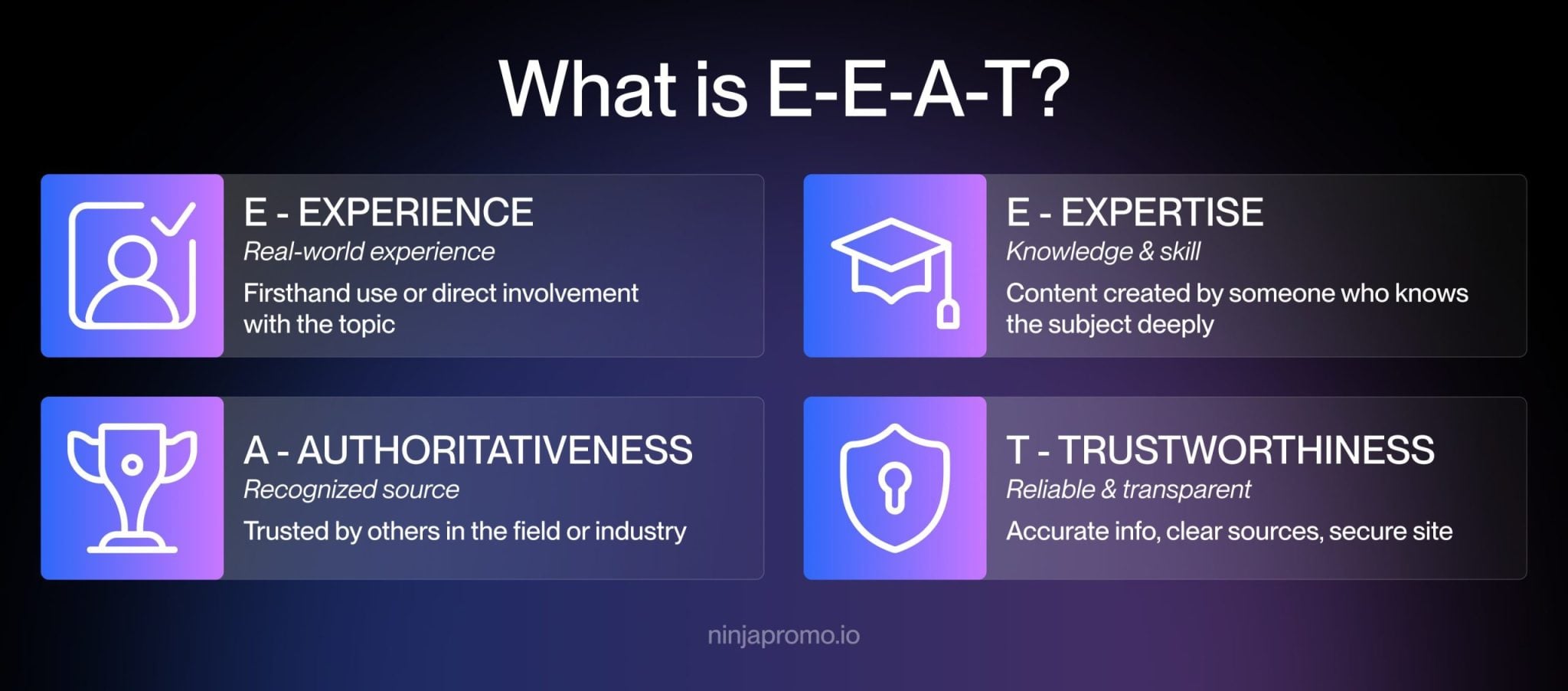
Experience
- Usability and accessibility: A website must be easy to navigate, and users of all abilities should be able to access information without difficulty.
- Site speed: Fast websites are essential for a good user experience. Tools such as Google PageSpeed Insights help evaluate and improve speed.
Expertise
- Qualified specialists: Medical professionals should write and review the health-related content. This increases expertise.
- Expert profiles: Include links on your website to the experts’ profiles who validate or write the content. These profiles should include qualifications, experience, and any other information that highlights their expertise.

Articles on this website are reviewed by experts with relevant education and experience
…
Authoritativeness
- Publications and recognition: Demonstrate the site’s authority by presenting publications in recognized journals. Citations of studies or articles and awards in the health sector are also interesting. Include collaborations with renowned health institutions, too.
- Expert contributions: Encourage experts to contribute to other respected domains. This can increase the authority of your own site by association.
Trustworthiness
- Certifications and site security: Make sure your site uses HTTPS to protect users’ privacy and security. Certifications from recognized health entities and security seals can also increase the site’s reliability.
- Transparency of practices: Offer clear information on privacy practices, terms of service, and any necessary warnings, including an easily accessible page with contact details and user support.
Optimize Your Website Architecture
The site architecture also needs to be well-planned. It makes it easier for search engines to understand the content and improves the users’ browsing experience. This also positively influences visitors’ behavioral factors and can boost conversion into desired actions. 
However, each page should be specific to each service offered, following the principle that a group of keywords should correspond to a separate page. For example, if a clinic offers magnetic resonance imaging services, it is essential to create a dedicated service page for MRI.
Here are some MRI related keywords and their metrics:

Users who are looking for an MRI scan near them will have the following Google search results:

The clinics that appear at the top of the search results for MRI queries also have dedicated pages for X-ray services. Here are examples of popular queries related to finding nearby X-ray services:


Technical Website Audit: Identify Key Performance Issues
The technical aspects of the site must also be optimized to improve SEO performance. Technical errors can have a very negative impact, affecting everything, such as Google page crawling. Here are some examples of such errors: 
Healthcare websites face technical breakdowns from issues like broken internal links, slow server response times exceeding 3 seconds, or poor mobile responsiveness, which disrupt Google’s crawling and indexing. For example, outdated HTTPS certificates trigger security warnings, while duplicate content without canonical tags confuses search engines, leading to deprioritization in rankings for vital local queries like “emergency dentist near me.”
These failures spike bounce rates and erode patient trust through frustrating 404 errors or unreadable mobile pages, slashing organic traffic and bookings. Learn more about how user experience affects SEO to prevent such issues and maintain high performance.
Make Sure Search Engines Can Crawl and Index Your Site Correctly
In order for a health sector website to rank well in search engines, all its pages must be correctly crawled and indexed. This means properly configuring two critical files: robots.txt and sitemap.xml.
Robots.txt File
These files tell Googlebot which pages of the site they can and cannot access. To configure this file correctly, you must first make sure to locate it in the root of the domain (e.g., https://www.mysite.com/robots.txt).
You can also use the file to control access to areas of the site that you don’t need to index, such as administrative directories, or to limit crawling in areas with sensitive or duplicate content. Use the Allow and Disallow directives to specify what to crawl clearly:

Syntax errors can lead to pages being indexed improperly or important pages being blocked.
Sitemap.xml File
This is an XML sitemap that helps search engines understand your site’s structure and discover all the important pages. In this case, the best thing is to set up a content management system (CMS) to automatically update the sitemap whenever people create new pages or update the existing ones.
In addition to the URLs, include information about the last modification of the pages (lastmod), the frequency of changes (changefreq), and the priority of each page (priority). This data helps search engines understand the importance and timeliness of pages.
 … Useful Tools:


Implement Structured Data Markup
Schema markup is essential for healthcare websites to provide structured data that boosts SEO, rich results, and AI visibility by clearly defining clinics, providers, and services. The main types of markup include both healthcare-specific schemas, such as MedicalOrganization and Physician, as well as general schemas commonly used across all websites, like Organization, Breadcrumb, and FAQ markup.
| Schema Type | Key Properties |
| MedicalOrganization | Subtypes: MedicalClinic, Physician, Dentist, Hospital. Includes name, address, hours, geo, sameAs. |
| Physician/Person | medicalSpecialty, affiliation, alumniOf, languages. For provider profiles. |
| MedicalSpecialty | Examples: Cardiology, Dermatology. Referenced in Physician/Service. |
| Service | name/serviceType (e.g., MRI Scan), provider, areaServed. Per service page. |
| LocalBusiness | NAP, hours, geo. Nested with MedicalOrganization. |
| Review/AggregateRating | ratingValue, reviewCount. On-site only. |
| FAQPage | Question/Answer arrays for insurance, bookings. |
| BreadcrumbList | Navigation paths sitewide. |
| WebSite/WebPage | Site entity, isPartOf, about/mentions. |
| ImageObject | For headshots, clinic images, caption, author. |
Focus on Local SEO
To increase the visibility of medical services online, the SEO strategy must take into account the specific needs of the region. The Google Business profile is an excellent tool for local businesses. Clinics and healthcare professionals can improve their local visibility with a well-optimized profile:
- Complete and accurate information: Includes all important information, such as name, address, telephone number, and opening hours.
- Responses to reviews: Responds to positive and negative comments professionally and thoughtfully.
- Quality photos and videos: Publishes photos and videos that professionally represent the installation and services.
- Regular posts: Keeps the profile updated with new services, events, or useful information.

Example of a healthcare Google Business profile
The essence of this strategy is developing content that speaks directly to the local community. For example, publications specific to the region or information about local health events and partnerships with other local health institutions are useful.
Another option is to add links to other sites within the same community to boost local SEO presence. By partnering with local businesses, you can collaborate on cross-promotions. Participating in local events such as conferences and publishing articles in local newspapers or news websites also helps medical SEO.

Build High-Quality Backlinks
The links that lead to your site, called backlinks, act as a “vote” from the perspective of search engines, indicating that the content on your site is trustworthy. However, it’s not just the quantity that matters, but quality. Links from reputable and relevant sites in the health sector carry much more weight.
Useful Backlink Analysis Tools


 … Strategies for getting high-quality backlinks include:
Guest Posting
Writing and publishing articles on reputable sites within the health sector can generate a strong backlink profile. These articles must offer real value to the readers of the host site. However, you also need to identify influential blogs and websites in the health sector that accept guest posts. You should propose topics that are useful to their audience and beneficial to your site.
Link Insertion
This technique involves contacting webmasters to include your link in existing content. To do this, look for articles that are already classified under relevant topics and could benefit from the addition of your link. You will have to contact the site owners with a proposal for how your link could add value to their text. 
Example of an email to a webmaster
Press Releases
Issuing press releases about important news, research, or events can help attract backlinks if relevant sites and portals reproduce the news. Prepare convincing materials and distribute it via specialized platforms that can guarantee visibility.
Build a Successful Internal Linking Strategy
Internal links help search engines understand the site’s structure and distribute page authority. They also improve user usability and navigability. Ensuring that they can easily navigate to relevant content.
Types of website internal links:

It is important to use varied and relevant anchor texts for internal links. This helps avoid search engines’ penalization for link manipulation and improves the destination page’s relevance. The anchor text should accurately describe the content of the target page.
Internal links should also be monitored to ensure that they don’t lead to 404 (page not found) errors, as this can damage user experience and the site’s rating by search engines.
How to Determine Which Pages Are Most Important to Link
- Identify key content: Pages critical to the business, such as services offered, product pages, or key articles you want to position better.
- Use analysis tools: Tools like Google Analytics or Ahrefs can show you which pages have the most visits and conversions. These pages should have frequent internal links to increase their authority and visibility.
A Real Example of a Successful Strategy for a Medical Brand
The client is a leader in enzyme supplements. The brand faced the challenge of establishing itself as a provider of inflammation treatments in the Czech Republic and Germany. Using an integrated SEO strategy, content marketing, and paid ads, We helped the client improve online visibility and strengthen brand authority.
✅Implemented Strategies
- Keyword research and on-page optimization: We conducted in-depth keyword research to identify high-impact search queries related to healthcare services. Based on these insights, we optimized key website pages, improving metadata, headings, content structure, and other SEO mistakes.
- Content-driven SEO: Our strategy focused on creating educational healthcare content designed to rank in search results. We developed informative articles and blog posts that answer common patient questions, address misconceptions, and follow medical compliance standards.
- Technical and authority improvements: We audited the website to identify technical SEO issues affecting search performance and implemented improvements to site structure, indexing, and content quality.
🚀Results Achieved
- Significant increase in organic traffic, reaching 25,000 monthly visits.
- Growth in the number of followers and expansion of reach to 500,000 users.
- Improved conversion rates, resulting in 15,000 new conversions.
Conclusion
Effective SEO strategies are vital for elevating healthcare providers’ online presence, going far beyond conventional search tactics. They encompass intelligent site architecture, hyper-localized content, technical optimizations like schema markup, and AI-ready signals that capture high-intent traffic from both traditional SERPs and emerging voice/chat interfaces.