SEO and PPC often feel like a dilemma for marketers: should you build long-term visibility or pay for immediate results?
In reality, both channels matter because search plays a direct role in buying decisions. In fact, 39% of purchasers are influenced by a relevant search, which makes search visibility critical at every stage of the journey.
That is why the real question is not which one is better, but how to use SEO and PPC in the right way for your goals. Let’s take a more detailed look at each channel to better understand how they work and what role they play.
What Is SEO?
SEO (Search Engine Optimization) is the practice of improving a website’s visibility across both traditional search results and AI-generated answers (such as Google’s AI Overviews or Bing Copilot). It involves optimizing content, structure, and authority so that search engines and AI systems can understand, trust, and surface your content as a relevant source, either as a ranked result or as part of generated responses.
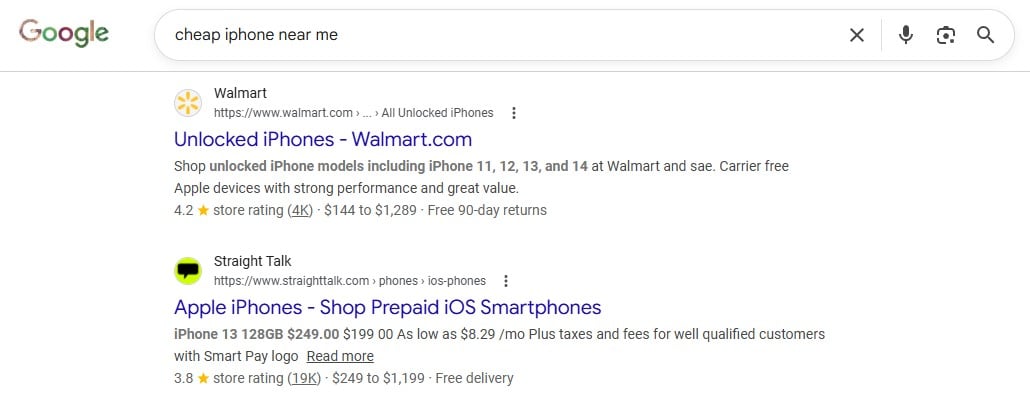
Here is example of SEO search results in Google:
Main Components of SEO
Knowing the core SEO components helps shape an effective modern search strategy. Today, SEO goes beyond traditional rankings and also includes optimization for AI-driven search experiences.
On-Page SEO
On-Page SEO focuses on optimizing elements within your website—such as content, headings, internal links, and metadata—to improve relevance and clarity. The goal is to make your pages easy for both search engines and AI systems to understand and match with user intent.
Off-Page SEO
Off-Page SEO involves building your site’s authority and trust through external signals like high-quality backlinks, brand mentions, reviews, and digital PR. These signals help search engines and AI models assess credibility and determine whether your content should be surfaced or cited.
Technical SEO
Technical SEO ensures your website is accessible, fast, and structured correctly for crawling, indexing, and rendering. This includes site architecture, mobile optimization, page speed, structured data, and clean code. Factors that directly impact how both search engines and AI systems process your content.
Content SEO
Content SEO focuses on creating high-quality, intent-driven content that answers user queries clearly and comprehensively. This includes keyword strategy, topical depth, and content structure, with an increasing focus on providing direct, well-structured answers that can be easily extracted by AI systems.
AI SEO (Generative Engine Optimization)
AI SEO is the practice of optimizing content to appear in AI-generated answers (such as Google AI Overviews, Bing Copilot, or ChatGPT-style search). It involves creating authoritative, well-structured, and factually clear content that AI models can confidently reference, summarize, or cite. This includes using concise explanations, strong topical authority, semantic clarity, and structured data.
Local SEO
Local SEO focuses on improving visibility in location-based searches. This includes optimizing your Google Business Profile, ensuring consistent business information, earning local reviews, and appearing in map-based results and localized organic listings.
Related Content: SEO Pricing Guide: How to Choose the Right Plan for Your Business
Pros and Cons of SEO
SEO offers a powerful way to grow visibility and attract users organically, but it comes with its own challenges and limitations. Understanding both sides helps set realistic expectations and build a more effective, long-term strategy.
| ✅ Pros of SEO | ❌ Cons of SEO |
| Drives consistent organic traffic over time | Results take time |
| Cost-effective compared to paid acquisition in the long run | Requires upfront investment and ongoing effort |
| Builds trust, credibility, and brand authority | Needs expertise across content, tech, and strategy |
| Compounds over time (content keeps generating traffic) | Highly competitive in most niches |
| Captures high-intent users actively searching | No guaranteed results or rankings |
| Expands visibility beyond classic search (AI answers, snippets) | Constant algorithm and AI changes require adaptation |
| Improves overall site quality and user experience | Measuring impact (especially with AI traffic) is becoming harder |
It’s worth evaluating SEO carefully to decide whether it aligns with your goals, resources, and expected timelines.

What Is PPC?
PPC stands for pay-per-click, a form of digital advertising where you pay only when someone clicks your ad. It’s a fast way to get traffic and promote your website, products, or services through search engines and other online platforms.
Here is example of PPC ads in Google:

Related Content: Competitor PPC Analysis: Complete Guide
Main Components of PPC
PPC success hinges on mastering these interconnected elements that control targeting, spend, and conversions across platforms.
Keyword Research
Foundation step: identify high-intent search terms, analyze volume/competition, expand to long-tail variations. Set up everything that follows.
Campaigns & Ad Groups
Group related ads, keywords, and budgets by theme (product, audience, goal). Sets the scale and organization.
Keywords and Match Types
Your triggers. Apply match types (exact, phrase, broad) + negatives to control who sees ads and prevent irrelevant clicks.
Ad Copy and Extensions
Punchy headlines, descriptions, sitelinks, callouts, and visuals that compel clicks.
Bid Management
Manual CPC, automated strategies, or smart bidding (Target ROAS) based on goals and competitor activity.
Audience Targeting
Who sees ads: location, demographics, interests, devices, remarketing lists. Layer with keywords for precision.
Landing Pages
Must match ad promise, load fast, mobile-optimized, single clear CTA. Quality Score depends on this.
Performance Tracking
The feedback loop: Pixels/tags measure clicks→actions. Real-time data drives optimization decisions.
Optimization Cycle
Pause losers, scale winners, A/B test everything. Data → decisions → better performance.
Related Content: PPC Optimization: How to Improve Your Pay-Per-Click Performance
Pros and Cons of PPC
Paid ads are a fast and highly controllable way to drive traffic, making it especially useful for testing, scaling, and short-term campaigns where speed matters.
There are several benefits of PPC. With it, users can immediately see your ads, as these typically appear above the fold. Because PPC ads are, well, advertisements, you have more control over how and where your marketing messages are delivered. Let’s also look at the downsides:
| ✅ Pros of PPC | ❌ Cons of PPC |
| Immediate visibility at the top of search results | Can become expensive quickly, especially in competitive niches |
| Precise targeting (keywords, demographics, retargeting) | Traffic stops as soon as you stop spending |
| Full control over messaging, creatives, and placements | Requires constant monitoring and optimization |
| Fast testing of offers, creatives, and landing pages | Ad fatigue can reduce performance over time |
| Clear and measurable performance data (clicks, conversions, ROI) | High competition drives up cost-per-click |
| Scalable campaigns with predictable outcomes | Platform dependency (Google Ads, Meta, etc.) |
PPC works best when aligned with clear goals, budget discipline, and ongoing optimization to maintain efficiency and performance over time.
Related Content: Smart PPC Budgeting: Maximize ROI Without Overspending
SEO vs PPC: Key Differences
SEO and PPC each serve different purposes in digital marketing, so the better choice depends on your goals, timeline, and budget. SEO is built around earning visibility in organic search, while PPC delivers visibility through paid placements.
To understand which approach fits your strategy best, it helps to compare how they differ in cost, speed, control, and long-term impact.
In the PPC vs SEO debate, which one you use will depend on the situation and your marketing goals.
| Criterion | SEO | PPC |
| Traffic source | Earned visibility in organic and AI-assisted search results | Paid visibility through ads |
| Time to results | Slower, usually builds over time | Fast, traffic can start right after launch |
| Cost structure | Requires upfront investment in content, technical work, and authority building | Pay per click, so spend continues while the campaign runs |
| Longevity | Can keep bringing traffic after the work is done | Stops when the budget stops |
| Control | Less direct control over placement and timing | High control over targeting, messaging, budget, and timing |
| Trust and credibility | Often perceived as more credible and stable | Can drive strong intent, but users may treat ads differently |
| Testing speed | Changes take longer to reflect in rankings | Easy to test offers, landing pages, and ad copy quickly |
| Scalability | Grows with content, authority, and technical improvements | Scales faster when budget and performance are strong |
| AI search visibility | Can appear in AI Overviews and other AI-driven search experiences | May lose visibility when AI answers push ads lower on the page |
| Measurement | Harder to connect every action directly to one page or query | More direct performance data for clicks, conversions, and ROI |
When to Use SEO?
SEO is the better choice when you want to build lasting visibility and attract traffic over time. It works best for brands that can invest in content and site improvements before expecting results.
- ✅ Build long-term organic visibility.
- ✅ Grow trust and authority in your niche.
- ✅ Publish helpful content that matches user intent.
- ✅ Improve technical health and site structure.
- ✅ Reduce dependence on paid traffic.
When to Use PPC?
PPC is the better choice when speed and control matter most. It helps you get immediate visibility, test offers quickly, and direct traffic to a specific goal.
- ✅ Get traffic fast.
- ✅ Promote a new product, offer, or campaign.
- ✅ Target specific audiences with precision.
- ✅ Test ad messages and landing pages quickly.
- ✅ Control spend and scale results more easily.
How to Combine SEO and PPC
SEO and PPC are most effective when they work as one system. SEO builds durable visibility over time, while PPC gives you speed, control, and immediate testing power. Together, they create a stronger search presence and a more efficient acquisition strategy. In practice, the goal is not to choose one channel over the other, but to let them support each other at every stage of the funnel.
What this gives you:
- You show up in more places at once, which increases your visibility in search results.
- You can test ideas in PPC first, then move the best-performing ones into SEO.
- You can use organic traffic data and paid campaign data to make better decisions overall.
- You can keep users engaged by bringing them back with paid ads after an organic visit.
- You reduce dependence on one channel and make your search strategy more stable.
How to actually do it:
- Start with the keywords that already convert in PPC and build SEO content around them.
- Use PPC to test headlines, CTAs, and landing page angles before investing in long-form content.
- Keep your ad copy, snippets, and landing pages aligned so the user experience feels consistent.
- Retarget organic visitors with paid ads to bring them back later.
- Check both channels together, then shift budget toward what brings the best results.
📈 Practical approach
Start by comparing your best-performing PPC keywords with your organic search data, then build SEO pages around the terms that show both intent and conversion potential. Use PPC as a testing ground for new messages, and let SEO carry the long-term value once a topic proves itself. When both channels are coordinated, they stop competing for budget and start compounding each other’s results.
Related Content: SEO and Paid Search: How to Align Efforts for Maximum Impact
Real-World Example of SEO and PPC Integration
Integrating PPC and SEO lets you target relevant keywords and provide users with high-quality content. In the example below, you can see how we were able to successfully combine it for one of our campaigns.
In the Damex campaign, we used both channels to build visibility, grow the community, and attract new subscribers in a coordinated way.
What we did:
- Researched and mapped high-intent keywords for the SEO content.
- Created an optimized article designed to rank for relevant search terms.
- Improved on-page elements such as metadata, structure, and content clarity.
- Launched Facebook ads to drive targeted traffic and support audience growth.
- Used paid promotion to amplify the same message across different touchpoints.
- Focused both channels on the same goal: community growth and brand awareness.
These combined efforts helped the article gain strong search visibility, attract relevant traffic, and support steady community growth. The campaign showed how SEO and PPC can work together to create stronger results than either channel alone.

Conclusion
SEO and PPC are not competing strategies so much as different tools for different goals. The best choice depends on your timeline, budget, and growth priorities, and in many cases, the strongest results come from using both together. By combining long-term organic visibility with the speed and precision of paid search, you can build a more resilient and effective marketing strategy.