Combining SEO and paid search into a unified search marketing strategy multiplies your visibility and drives stronger returns.
At NinjaPromo, we build holistic search strategies that create real paid and organic synergy.
The result: better brand visibility and improved efficiency of your marketing efforts.
This guide shows you how to align your SEO and paid search efforts. You’ll learn how to use shared keyword data, coordinate messaging, and capture more traffic at every stage of the buyer journey.
Understanding SEO and Paid Search
Before diving into alignment tactics, let’s clarify what each channel does and how they differ from one another.
What is SEO (Search Engine Optimization)?
SEO means optimizing your website to rank higher in organic search results and attract relevant traffic without incremental costs.
It was traditionally about ranking on Google’s SERPs — search engine page results:

Today, however, optimizing for organic search extends to LLM SEO — getting cited and mentioned in Google’s AI features and AI search engines like ChatGPT and Perplexity.

Key elements of effective SEO include:
- Technical SEO, including site speed, mobile-friendliness, and structured data markup
- On-page optimization, like creating quality content, structuring headings, and ensuring semantic relevance
- Building external authority signals like links and brand mentions
- Content creation with consistent quality and content velocity
- Keyword research aligned with search intent for informational queries and transactional queries
✅Pro tip: Learn more about the importance of SEO in achieving organic visibility.
What is Paid Search?
Paid search is a form of advertising where you pay to appear at the top of search engine results pages — getting instant visibility and precise targeting.
Platforms like Google Ads and Microsoft Ads let you bid on keywords and display ads to users actively searching for your products or services.
For example:

Key paid search elements typically include:
- Search campaigns targeting specific keywords and transactional queries
- Creating ad copy and optimized landing pages to convert users into leads
- Dynamic search ads that automatically match your ads to relevant searches
- Segmentation and audience retargeting to re-engage previous visitors
- Quality score optimization to lower costs and improve ad placement
- Brand bidding to protect your branded search terms from competitors
✅Pro tip: Learn more about the benefits of PPC advertising for your strategy.
Paid Search vs SEO: Key Differences
Long story short: SEO requires upfront investment that compounds into long-term organic visibility, while paid search delivers immediate placement for ongoing ad spend.
Each channel serves different goals at different stages of your marketing strategy
“The biggest misconception is that SEO and PPC are just two ways to get ‘the same traffic ’— one free and one paid. The truth is, they work on totally different timelines and for different reasons. SEO takes time and structure, but once it’s working, the payoff lasts. PPC is instant — you pay, and you see results right away. Issues show up when businesses expect SEO to deliver quick leads, or cut PPC because ‘we already rank first organically.’ That’s not enough. Each channel plays a different role, and one can’t replace the other.”
Dennis F, PPC Team Lead at NinjaPromo
Here’s how they compare:
| Factor | SEO | Paid Search |
| Timeframe | 3-12 months for results (can speed up with LLM visibility, but the results are hard to predict and control) | Immediate visibility |
| Cost model | Investment in content and optimization | Pay per click |
| Longevity | Traffic continues after work stops | Traffic stops when the investment stops |
| Control | Limited control over rankings | Greater control over placement |
| Trust signals | Higher perceived trust from users | Labeled as ads |
| Best for | Evergreen content, informational queries | Product launches, commercial investigation, promotions |
“Organic users generally show up earlier in the process. They’re learning, comparing, and figuring out the landscape. Paid Search users are further along — their queries signal intent with words like ‘buy,’ ‘hire,’ or ‘download.’ This is exactly why SEO and PPC work so well together: SEO builds awareness and trust, and PPC captures ready-to-convert traffic. And since users jump between channels constantly, the real task is making sure the messaging stays connected the whole way through.”
Dennis F, PPC Team Lead at NinjaPromo
Why Aligning SEO and Paid Search Matters
Combining your SEO and paid search efforts increases brand visibility, improves click-through rate, and maximizes return across both channels.
Let’s look at each factor in detail.

Combined Visibility Across SERPs
Appearing in both paid and organic listings builds trust and increases the likelihood of clicks.
SEO statistics show that 49% of Americans trust organic results more than paid, while 46% trust both equally. Only 5% trust paid results more.
Besides, 59% of users in the US click on search results of brands they know instead of prioritizing top-ranking results.
Appearing in both positions captures users regardless of their trust preference — and builds the brand familiarity that drives clicks.
“Appearing in both paid and organic listings has a noticeable impact on CTR and trust. When users see the same brand twice in the SERP (an ad and an organic result), they automatically perceive it as more credible and established. I had a B2B SaaS client where adding a simple branded search campaign nearly doubled the CTR overnight. Nothing magical—people just trusted the brand more because it showed up twice. Dual visibility almost always lifts clicks and conversions. It’s basic psychology.”
Dennis F, PPC Team Lead at NinjaPromo
The core benefits of this approach include:
- Stronger brand visibility when users see you twice on the same page
- Higher overall click-through rate compared to single placement
- Increased trust through organic presence while paid ads capture high-intent clicks
- Protection against competitors bidding on your branded terms
Unsurprisingly, many successful brands like Semrush follow this logic and capture both paid and organic results in search:

SEO and PPC teams working with shared keyword data tend to make smarter decisions on both channels.
PPC reveals which keywords drive real conversions, making it easier to decide which ones deserve long-term SEO effort.
On the flip side, if you already rank #1 organically for a term, you might be able to reduce PPC spend on it.
In fact, data tools like Semrush even provide a Traffic Cost metric that shows how much money you save by ranking organically instead of covering everything with PPC:

There are several ways you can share keyword intelligence, such as:
- Find high-converting long-tail queries worth creating SEO content for — and high-converting SEO terms that could benefit from a PPC boost
- Apply keyword segmentation to divide terms by channel: high-CPC competitive terms for SEO, high-intent converting terms for PPC
- For low-competition terms where you rank #1-3 organically, test pausing ads to see if organic captures those clicks
“We had a strong case with a fintech client. We started with PPC to identify which queries brought the highest-quality conversions. Terms like ‘crypto tax calculator’ delivered far more valuable users than the broader keywords they had been targeting. We passed these insights to the SEO team, and they created detailed content around those terms. A few months later, organic traffic grew dramatically, and the SEO content began outperforming PPC in total volume. PPC highlighted the opportunities, and SEO turned them into a long-term traffic engine.”
Dennis F, PPC Team Lead at NinjaPromo
Faster Testing Through Paid Search and Long-Term ROI Through SEO
You can also use paid search to test your messaging quickly, then apply what works to SEO for longer-term results.
For example, paid ads let you test keywords, headlines, value propositions, and calls-to-action (CTAs) with real click and conversion data within a week.

Once you know what resonates, apply those insights to your content plans and on-page elements like meta descriptions.
Here’s what you can do:
- Test multiple headline angles in Google Ads to find the highest click-through rate, then use the winner in your SEO title tags
- Run landing page testing and apply conversion rate optimization learnings from paid campaigns to improve organic landing pages
- Use PPC conversion data to validate which pain points and benefits drive action — then build SEO content around those angles
“The easiest way is to treat PPC as a fast-testing machine that fuels your SEO strategy. For example, we often launch Paid Search campaigns on keywords that SEO is just starting to target. While the page slowly climbs in the organic results, PPC brings traffic immediately and shows which messaging resonates. Later, SEO uses the winning headlines and value props.
Another common scenario is brand protection. Even if a client ranks #1 organically, competitors will bid on their brand name. Many clients only realize this when their leads suddenly drop. Running PPC and organic listings together protects the brand and keeps conversions stable.”
Dennis F, PPC Team Lead at NinjaPromo
Improved Conversion Rates Through Unified Messaging
Aligning your SEO and PPC messaging can also increase overall trust and boost conversion rates.
When your ad copy and organic listing promise the same thing, users arrive at your website with clear expectations.
For example, TikTok’s PPC page for agencies promotes its Agency Incubator Program by positioning it as a way to help agencies grow with expert support.

At the same time, TikTok’s main organic business page uses the same core message — driving business growth through TikTok ads.

This consistency can only be achieved by ensuring close collaboration between your SEO and PPC teams.
How SEO and Paid Search Work Together in the Customer Journey
SEO and paid search serve different roles at each stage of the buyer journey.
In a nutshell, paid drives fast visibility, while organic builds trust and captures research-phase traffic.

Awareness: Paid Search as the Fast Accelerator, SEO as the Long-Term Builder
Paid search delivers immediate visibility for time-sensitive campaigns, while SEO captures the broader set of informational queries that might be too expensive to cover with ads.
In a nutshell:
- PPC works best for product launches, seasonal promotions, or new market entry where you need traffic now.
- SEO builds awareness over time for high-funnel educational topics where paying per click doesn’t make financial sense.
| Scenario | Often better suited for | Why |
| Product launch | Paid search | You need traffic from day one before any rankings exist |
| Seasonal promotion | Paid search | SEO takes months; your sale is in two weeks |
| High-volume educational content | SEO | Companies with limited PPC budgets (which is true for almost anyone) might prioritize keywords for high-converting assets |
| Industry trends and evergreen topics | SEO | One article can drive traffic for years without ongoing ad spend |
| Bidding on competitor brand terms | Paid search | You won’t rank organically for a competitor’s brand name |
For example, brands typically use PPC ads to show up when users search for their competitors:

At the same time, it’s common to create long-form SEO content to appear for informational queries that may not attract high-intent users but still build trust and brand awareness.

“When prioritizing budget, I look at two things: time horizon and competitive pressure. If the business needs leads now and the niche is competitive, PPC is essential. If the company wants to reduce acquisition costs over the next 6–12 months, SEO is worth investing in.
Most of the time, SEO and PPC don’t fight for budget — they complement each other. But if the budget is truly limited, I’d start with PPC to gather real data and validate value propositions. Then, once we know what resonates, we use those insights to shape a more efficient, targeted SEO strategy.”
Dennis F, PPC Team Lead at NinjaPromo
✅Pro tip: Learn how to effectively set up SEO for a new website.
Consideration: SEO Content Supporting Research Intent, PPC Accelerating Reach
At the consideration stage, users search for guides, reviews, and comparisons.
You can target these queries for long-term organic traffic while PPC accelerates reach by promoting the content or bidding on high-intent comparison terms.
Here’s how it works:
| Content type | How SEO helps | How PPC helps |
| In-depth guides and tutorials | Ranks for long-tail research queries over time | Promotes top guides to new audiences faster |
| “Best X” and “X vs Y” comparisons | Captures ongoing search volume | Bids on comparison terms for faster conversions |
| Case studies and testimonials | Builds trust when users find them organically | Retargets visitors with proof content |
| Product/service pages | Long-term visibility for core offerings | Generates immediate traffic for priority pages |
For example, Writesonic uses PPC to promote its “Profound alternative” PPC landing page when people search for Profound-branded keywords:

At the same time, the brand has organic comparison pages — like Writesonic vs Copy AI — that are created to rank organically:

Conversion: Unified CRO, Landing Pages, and SERP Experience
During the conversion stage, SEO and PPC work together by capturing users with the strongest intent and sending them to dedicated landing pages.
SEO attracts bottom-funnel traffic from transactional and branded queries, while PPC captures ready-to-buy users instantly.
For example, at NinjaPromo, we optimize our home page with elements like highly visible CTAs, social proof, bold headings, etc. to fit both PPC and organic traffic.

“The most common issue is mixed messaging: SEO promises one thing, and PPC promises another. For example, the organic listing might say ‘Free access,’ while the paid ad says ‘7-day free trial.’ The user goes through the funnel, sees conflicting information, and loses confidence. Conversion rates drop fast — especially in B2B and high-ticket offers. You can’t run SEO and PPC as separate universes. The messaging needs to feel like one consistent story.”
Dennis F, PPC Team Lead at NinjaPromo
Here’s how optimizing the landing page experience aids both channels:
| Element | How SEO helps | How paid search helps |
| Bottom-funnel demand | Brings users searching for specific solutions, pricing, or branded terms | Targets the same high-intent keywords for immediate visibility and higher positions |
| Landing page performance | Sustains long-term conversions through fast, technically strong pages | Sends traffic that quickly reveals which layouts and elements convert |
| CTAs & forms | Shows long-term behavioral patterns and where organic users hesitate | Identifies winning CTA copy, placement, and form length through rapid tests |
| Page speed and UX | Reduces bounce for high-intent visitors and aids rankings | Faster pages improve quality score and lower CPCs |
| Cross-channel insights | Highlights pages that consistently convert organically | Validates which value props or page elements drive immediate action |
Retention and Remarketing: Using SEO Audiences for Paid Campaigns
Finally, using SEO alongside PPC helps you bring back organic visitors with targeted, relevant paid campaigns.
Use audience retargeting to group people by the pages they viewed and the topics they explored — giving you warmer audiences to bring back into the funnel.
For example, you can:
- Re-engage visitors with messages tied to the content they viewed
- Personalize offers based on their topic interest
- Prioritize high-value segments that showed deeper engagement
- Reduce wasted spend by excluding low-intent users

How to Align SEO and Paid Search Strategies
Cross-channel integration of SEO and PPC starts with shared data, coordinated keywords, and consistent messaging across both channels.
Let’s see how you can implement it, step by step.
Step 1: Align Keyword Strategies (Organic + Paid)
Start by mapping which keywords you target organically and which you bid on — then prioritize based on value, competition, and current performance.
A keyword map helps you decide where dual visibility makes sense, where to invest in SEO to reduce long-term ad spend, and where PPC fills gaps while organic catches up.
First, download your PPC keywords from Google Ads and your organic rankings from Google Search Console.
If you’re using a tool like Semrush’s Position Tracking, you can also see the high-level metrics like search volume and COC for both organic search and paid search in one view.

Then, combine this data into one spreadsheet with columns for: keyword, organic rank, PPC status, CPC, conversion rate, competition level, and prioritized actions. Here’s how to map these out:
- For high-intent transactional queries — prioritize PPC where immediate conversions justify the cost.
- For high-CPC informational keywords — prioritize SEO to capture that traffic without ongoing ad spend.
- For low-competition keywords where you rank #1-3 — test reducing PPC spend.
- For keywords where you need traffic now but SEO will take months — run PPC while building organic presence.
Next, set up regular reporting between SEO and PPC teams to share performance data and surface insights.
For example, you can set up a regular sync where both teams review key metrics and surface insights — and use a shared dashboard that pulls data from Google Ads, Search Console insights, and your CRM.
Here’s how to approach it:
| Metric | What SEO learns from PPC | What PPC learns from SEO |
| Click-through rate | Which headlines and messaging drive clicks | Which organic titles outperform in ads |
| Conversion rate | Which keywords drive revenue | Which landing pages convert best organically |
| Top keywords | High-converting terms worth targeting with content | High-traffic and high-conversion organic terms worth bidding on |
| Customer lifetime value | Which PPC keywords bring the most valuable customers | Which topics and pages have the highest LTV |
| First-party data | Audience insights from paid campaigns for content targeting | Organic user behavior data to refine ad audiences |
| Cost data | High-CPC terms to prioritize for SEO | Where to prioritize or deprioritize spending based on organic rankings |
Step 3: Optimize Landing Pages for Both Channels
From here, optimize your landing pages to satisfy both SEO best practices and PPC quality score requirements — or create dedicated pages for each channel when goals differ.
Some pages work for both channels: product pages, service pages, and key landing pages. For example, we optimized our home page to both drive SEO traffic and convert PPC users.

Others need separation — some PPC campaigns benefit from focused pages without navigation, while SEO pages need longer copy, internal linking, and proper SEO taxonomy.
For example, Semrush creates dedicated PPC landing pages for its paid search campaigns:

Here are the best practices we recommend following:
- Use the same page for SEO and PPC for evergreen product or service pages with consistent messaging
- Create dedicated PPC pages for promotions, A/B testing, or high-intent transactional queries where a focused page converts better
Regardless of the path you choose:
- Prioritize page speed — slow load times hurt quality score and organic rankings
- Ensure mobile optimization since many clicks come from mobile
- Structure content with clear headings for user experience and search engines

Step 4: Coordinate Messaging, Creatives, and Offers
Next, align your ad copy, organic meta titles, and landing page headlines so users see consistent messaging whether they click a paid or organic result.
When your ad, organic listing, and landing page deliver the same promise, users trust your brand and convert at a higher rate.
How to coordinate messaging across SEO and PPC:
- Write your meta title and PPC headline around the same core value proposition
- Use the same offer language across organic pages and ads — if your ad says “free trial,” your organic listing and page should too
- Keep the same brand voice in your organic content and dynamic search ads
- Update meta descriptions, ad copy, and landing pages together when offers or positioning change
For example, Semrush’s PPC landing page leverages the “win every search, from AI to SEO” message…

…while the same narrative is instantly visible on the home page.

Step 5: Run A/B Tests in Paid Search to Improve SEO Pages
Finally, use PPC to test headlines, CTAs, and messaging — then apply what converts best to your SEO titles, meta descriptions, and page content.
Since PPC delivers faster results, running tests in paid search first lets you validate messaging before committing to SEO changes.
What to test in PPC and apply to SEO:
- Keywords and audiences: which terms convert and which segments engage
- Headline angles: which value propositions drive the most clicks
- CTA design and language: which action phrases convert best
- Offer framing: pricing, benefits, and urgency messaging
- Page layouts: placement of key visuals and text blocks
“Messaging is where PPC testing delivers the biggest lift. Headlines, offers, value props, and hero copy can be validated within a day through Paid Search. The same goes for CTAs — we’ve seen ‘Book a consultation’ outperform ‘Learn more’ by 3×, even when everyone predicted the reverse. If a message hits in PPC, it usually works just as well in SEO.”
Dennis F, PPC Team Lead at NinjaPromo
Make sure to track results using data-driven attribution and document winning variations accordingly.
Paid Search vs SEO: When to Prioritize One Over the Other
Long story short: prioritize PPC when you need immediate results or lack organic presence; prioritize SEO when you’re building long-term traffic and the math favors organic over ongoing ad spend.
Let’s explore this in detail.
When Paid Search Is the Better Investment
Paid search is the better investment when you need traffic now, want to test a specific approach, or pursue keywords you can’t realistically target organically.
It’s also a good idea to use paid search alongside SEO whenever you’re working with the high-priority, essential keywords that attract high-intent visitors.
In a nutshell, here’s when to prioritize paid search:
- Product launches, especially those where you have no existing organic rankings
- Seasonal promotions with fixed deadlines
- Entering new markets or testing new keywords before SEO investment
- High-intent transactional queries where conversion value justifies CPC
- Competitive terms where organic ranking will take months
- Navigational intent searches for competitor brand names
For example, keywords such as “CRM for small businesses” tend to attract PPC advertisers because they signal strong purchase intent:

When SEO Provides Superior ROI
SEO is the better investment when ad costs eat your margins, when your topic can drive traffic for years, or when you’re targeting queries that don’t convert immediately but build a pipeline.
It’s also the smarter play when you want visibility in organic search results, featured snippets and AI overviews to build trust.
Here’s when to prioritize SEO:
- Markets with CPCs above $30-50, where paid campaigns drain budgets quickly
- Evergreen topics that generate traffic long after publication
- Educational content where paying per click doesn’t make financial sense
- Industries like health, finance, and lega,l where EEAT principles (Experience, Expertise, Authoritativeness, Trustworthiness) matter more than ad spend
For instance, informational queries like “how to save money” often surface organic results and AI features such as AI Overviews:

How to Balance Budget Across SEO and Paid Search Efforts
Balancing your SEO and PPC budgets depends on three factors: how quickly you need results, how competitive your market is, and what your margins can sustain.
There’s no universal split. But reviewing performance monthly and shifting spend toward what’s driving revenue keeps your marketing mix efficiency high.
Here’s a quick framework you can use:
| Situation | Lean toward | Why |
| New product launch | Paid | You need traffic before organic rankings exist |
| Established brand, stable market | SEO | Organic compounds; paid fills visibility gaps for high-intent terms |
| High-CPC industry | SEO | Ad costs become unsustainable at scale |
| Seasonal business | Paid | Captures demand spikes when timing matters |
| Testing new markets | Paid | Validates demand before committing to SEO |
| Tight budget | SEO | Build assets that keep working without ongoing spend while keeping your PPC budget for priority projects |

Best Practices for Maximizing Impact From SEO and Paid Search
Below, we share best practices that help our clients align their SEO and PPC teams, work more efficiently, and turn shared insights into stronger performance.
Shared workflows make SEO and PPC work as one system instead of two disconnected teams.
The simplest way to get started is to sync on a set schedule, use shared calendars, and work from the same data so both sides move in the same direction.
What this looks like in practice:
- Weekly or biweekly check-ins to review wins, blockers, and insights
- A shared dashboard covering SEO, PPC, and revenue metrics (use a tool like Tableau)
- One content and campaign calendar so launches don’t overlap or conflict
- Shared documentation for keyword ownership, landing pages, and messaging
- Slack or Notion channels where both teams drop new opportunities in real time
Use Search Query Reports for SEO Content Planning
Paid search query reports are one of the fastest ways to uncover new SEO content opportunities you’re not ranking for yet.
They show the exact phrases people search before clicking your ads, which helps you spot gaps, validate demand, and decide which topics deserve SEO content.
“Search terms are the most useful signal we have. They show what people actually type into Google, not what we assume they type. More than once, search terms have completely changed the direction of our SEO strategy. You often discover that people search by problem, not by product name. PPC also shows which queries actually convert, which helps SEO avoid wasting months on content that never brings revenue.”
Dennis F, PPC Team Lead at NinjaPromo
In Google Ads, open Campaigns and head to Search terms within the Insights and reports sub-menu.
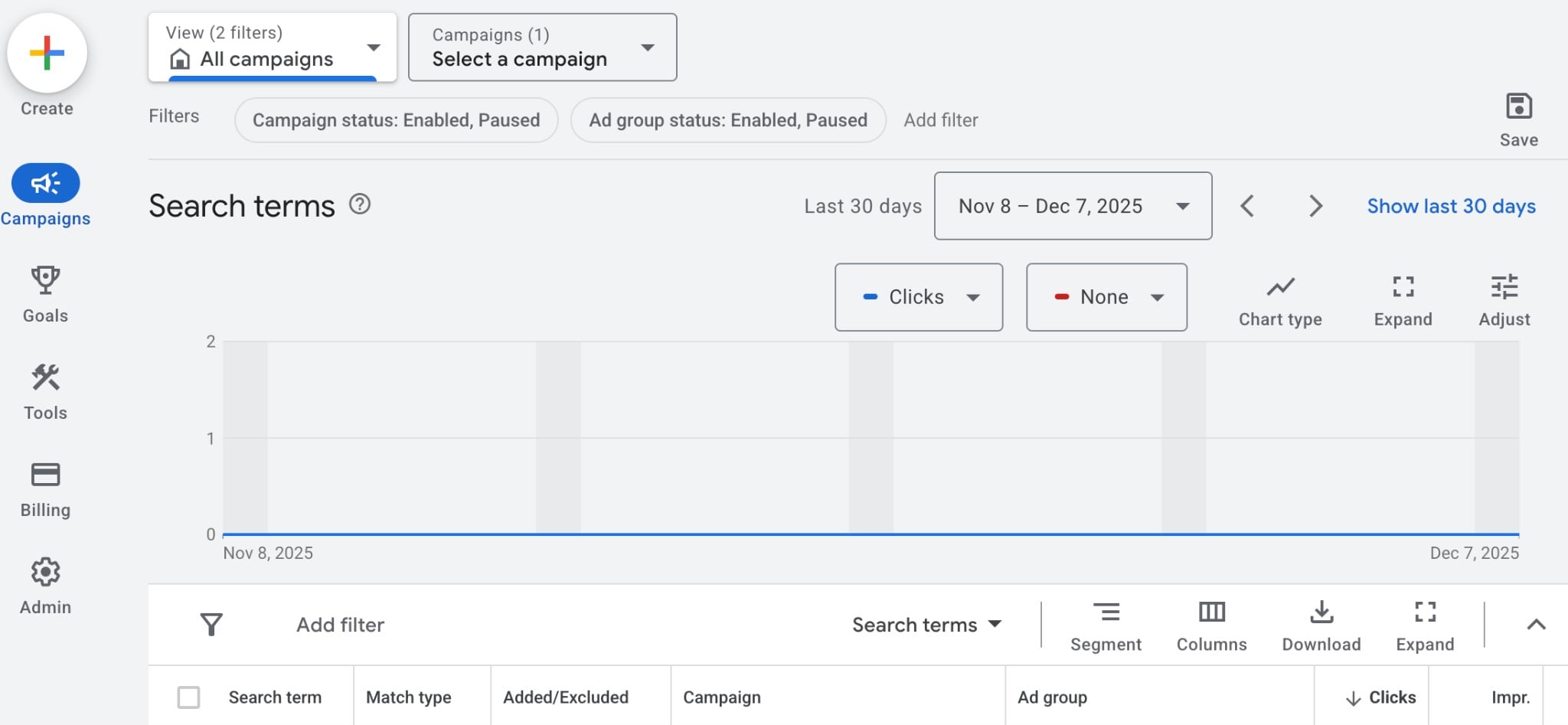
Then, use this data to:
- Spot real phrases, variations, and themes users search beyond your keyword list
- Identify questions, modifiers, and pain points that point to new SEO content
- Prioritize topics that consistently show demand and match your intent goals
- Flag high-CPC terms that make more financial sense to target with SEO
- Turn strong converting queries into new pages or deeper content sections
Use Organic Rankings to Lower Paid Search Costs
Strong organic rankings let you cut back on PPC spend because you no longer need as many ads to stay visible on high-intent keywords.
When your top pages consistently rank in positions 1-3, you can lower bids, shift budget to campaigns that actually need support, and protect your total search margin.
For example, according to Semrush, ClickUp has over 1,800 informational keywords where it ranks in the top 3:

Some keywords from this list — like “custody calendar template” — might not need PPC investment.

Optimize for SERP Features Across Both Channels
Finally, optimize your organic pages for SERP features like featured snippets, FAQs, and AI overviews — while aligning your paid strategy to support the same topics and user intents.
The goal is simple: make your organic results eligible for richer placement. Then use paid ads to reinforce visibility on the same queries where users compare, skim, or need quick answers.
Here’s what you should focus on:
- Format content clearly so it can qualify for featured snippets
- Add structured data markup to unlock FAQ, HowTo, and other rich elements
- Track which pages surface in Google AI overviews and update content accordingly
- Use PPC to cover competitive queries while SEO works to earn those features
- Keep the same core message across ads and organic snippets so users see one story
For example, Semrush runs paid search ads to show for the “How to track chatGPT visibility” query:

At the same time, a Semrush article is included in the AI Overview displayed beneath the ad, resulting in a brand mention inside the AI summary itself:

Future of SEO and Paid Search Collaboration
SEO and paid search keep evolving as AI reshapes how people discover, compare, and evaluate brands.
To stay ahead, teams will need shared processes, faster experimentation, and a flexible approach that adapts to new search patterns.
Watch out for these trends:
- AI summaries and search generative experience are shaping early-stage research — for example, 77% of U.S. ChatGPT users now treat it like a search engine.
- Zero-click searches will rise as AI gives full answers instantly — for example, Google’s AI Mode already sees 92-94% of sessions end without a click.
- PPC and AI results appear together on the same query: ads sit above the AI box, and when your organic page is cited in the summary below, you get a double presence on one screen.
- Entity-based optimization becomes more important as AI relies on the knowledge graph to recognize brands it understands, not pages that simply repeat keywords.
- Predictive analytics will guide both channels, helping teams forecast demand, spot emerging topics earlier, and shift budgets before trends peak.
The bottom line is: AI search is no longer experimental. 78% of companies now fund generative engine optimization, nearly identical to the share investing in SEO and PPC.
Ready to Supercharge Your SEO and Paid Search?
If you want faster results, better visibility, and a stronger pipeline, you need a holistic search strategy that treats SEO and PPC as one system.
That’s what you get when working with NinjaPromo: a strategy where your paid and organic efforts support each other and compound over time.
Our packages include:
- An organic and PPC growth plan built around real performance data
- Full-funnel SEO and PPC support that scales with your goals
- Optimization workflows that improve both traffic quality and conversions
- Actionable tactics to improve your paid search through PPC optimization
- Strategies that prioritize SEO for lead generation and AI-first optimization
Ready to give it a try? Book a free strategy call today.