
- Building consistent visibility across every digital touchpoint is critical, since trust grows through repeated and reliable brand presence.
- AI-driven personalization helps make messaging more relevant by aligning offers with user behavior, intent, and timing.
- High-quality content that answers key customer questions supports informed decision-making during longer consideration cycles.
- Interactive tools such as premium calculators, coverage comparison widgets, and eligibility checkers reduce friction and strengthen trust in expertise.
- Automation and integrated multichannel communication are shaping the future of scalable and effective marketing.
Effective marketing helps simplify complex insurance products and educate potential customers, improving both acquisition and retention. As the global insurance market is expected to grow to nearly $10 trillion by 2030, driven by digital distribution and evolving customer expectations, standing out requires more than just visibility. It demands clarity and credibility.
Building that trust remains a challenge in an industry often seen as nontransparent. From proven channels like email marketing to more interactive tools like calculators, the following insurance marketing ideas are designed to drive real results.
Importance of Marketing in the Insurance Industry
Digital transformation has fundamentally changed how consumers behave. They expect personalized experiences, instant responses, and seamless interactions across multiple channels.
Not only do insurance companies need to reach consumers on a channel of their choice, but they also need to use these interactions as an opportunity to communicate their expertise. Taking out medical insurance requires more research than buying something from Amazon. With well-rounded insurance marketing campaign, you can turn engagements into educational opportunities that build trust needed to increase insurance sales.
Proven Marketing Strategies to Drive Insurance Success
Each of the following strategies is tailored for the insurance sector and chosen for its proven effectiveness. When combined, they help build a strong foundation for successful marketing.
Develop Valuable and Educational Content
With the help of educational content, insurance companies can establish credibility and reliability. Both qualities are crucial in this industry that’s selling a product that can be the difference between life and death.
Distributing educational content allows insurance companies to address common pain points and unpack complex insurance concepts. You can, for example, create:
- A blog post that explains the difference between different insurance packages
- A whitepaper that explores the impact of regulatory changes on insurance policies
- An eBook that shares tips for choosing the right home insurance policy
Aside from helping to establish your insurance company as a customer-centric expert in the field, this type of actionable advice presented in an easy-to-understand format can also help nurture strong relationships. This way, you can guide potential clients through the decision-making process.
Adapt Insurance Content Across All Pages for AI Optimization
Optimizing insurance website content for AI search engines like Google AI Overviews, ChatGPT, and Perplexity involves structuring pages with clear hierarchies, schema markup, conversational language, and scannable formats to boost visibility and citations in generative responses.
| Action | Brief Example |
| 🔎 Research conversational keywords and questions | Find long-tail insurance-related queries (auto, home, life) using tools like Semrush or Ahrefs. Build topic clusters. Example queries: “how to file car insurance claim near me”, “best home insurance for apartments”. Cluster structure: main page “Home Insurance” + subpages “Claims Process”, “Coverage Options”. |
| ✍️ Rewrite titles and introductions | Make H1 unique and clear, with a 30–50 word intro that directly answers the main question using a definition → detail → example pattern. Example: H1 “How to Choose Affordable Car Insurance”. Intro: “Affordable car insurance covers liability and collision at rates under $100/month…” |
| 📊 Improve structure with lists, tables, and FAQs | Break content into short paragraphs (≤20 words per sentence). Use H2/H3 headings, bullet points, tables, and FAQ sections for better AI readability. Example: Coverage Types: Liability, Collision + comparison table of policies with pricing and pros/cons. |
| 🧩 Implement schema markup | Add JSON-LD markup for FAQPage, InsuranceAgency, and Product across all pages. Validate using Google Rich Results Test. Example includes structured FAQ entries like deductible explanations. |
| 📍 Optimize for local and voice search | Include location signals, reviews, and CTAs like “Get Quote”. Ensure mobile optimization and AI crawler accessibility (e.g. GPTBot in robots.txt). Example: “Get free auto insurance quote in Frankfurt…” + voice-style FAQ queries. |
| 📈 Add visuals and tracking | Use infographics and charts (e.g. insurance cost comparisons). Track AI-driven traffic sources such as Perplexity and ChatGPT via analytics tools. Example: chart showing “Insurance Costs: Auto vs Home”. |
Run Paid Advertising Campaigns
Paid advertising is one of the fastest ways for insurance companies to reach potential clients and generate qualified leads. Platforms like Google Ads, Meta Ads, and LinkedIn Ads allow precise targeting by location, demographics, interests, and financial behavior, helping insurers connect with the right audience at the right moment.
Modern ad platforms also provide detailed performance insights. You can compare creatives, adjust targeting, and shift budgets based on real results, using digital marketing tools to make optimization faster and more accurate. This helps improve efficiency and reduce wasted spend over time.
Key advantages:
- ⚡ Fast visibility — Your offers appear in front of potential clients without delay.
- 🎯 Precise targeting — Reach specific groups such as drivers, homeowners, or business owners.
- 📊 Performance tracking — Measure clicks, conversions, and cost per lead in real time.
- 💼 Stronger brand presence — Stay visible across search and social platforms, building trust through repetition.
- 📈 Flexible scaling — Increase or reduce budgets depending on campaign performance and market demand.
Effective ad formats in the insurance industry:
- 🔎 Search ads — Show up when users actively search for terms like “car insurance quote” or “affordable health coverage”.
- 📣 Display and social ads — Use visuals, testimonials, or short videos to build credibility and emotional connection.
- 🔁 Retargeting campaigns — Re-engage visitors who left your site without completing a quote or application.
✅Pro tip: Choose insurance marketing agencies that don’t just run ads, but build a full funnel for acquiring and retaining customers in this industry.
Invest in Local SEO
Google remains one of the first places people turn to for information, making optimizing for local search results a necessity. This type of promotion is a great addition to a comprehensive marketing for a small business in the insurance industry. Your Google Business Profile is one of the most important elements. Combine it with localized content and customer reviews to help you appear in relevant online searches, making it easier for nearby clients to find you.

You can, for example, create blog posts about common insurance issues in the area that you service. This way, you can develop educational content and boost your local SEO at the same time. In addition to blog posts, also integrate local keywords strategically into the rest of your website content.
Unlike localized content, you can’t write customer reviews yourself. However, it’s not completely out of your control. If you take the time to write a response to a review, it will show to other clients that you value their input which can encourage them to leave reviews.
Related Content: Insurance SEO Practices to Help Agents & Brokers Get More Clients
Implement Interactive Insurance Tools
Interactive tools like insurance calculators are great lead magnets. The promise of receiving instant personalized estimates will keep visitors on your website longer and encourage them to share valuable personal data.
This data can, in return, be used to improve your follow-up marketing and actual product. You can, for instance, use the data collected for audience segmentation and message personalization (more about this later).
It can also reveal trends and common preferences. You can use these insights to tweak your insurance products so that they better align with the needs of your target audience.

Other interactive tools worth adding:
- Coverage comparison widgets that help users evaluate different policy options.
- Premium affordability sliders that visualize pricing based on selected parameters.
- Risk assessment quizzes to educate users while collecting segmentation data.
- Chatbots for instant policy recommendations or quote assistance.
- Claim estimation tools that simplify post‑incident reporting and build trust.
Create a Referral Program
While there are many great advertising platforms available, they don’t replace the power of word-of-mouth marketing. It’s essentially free advertising from satisfied customers.
It’s especially helpful for insurance marketing campaigns that focus on brand awareness. Like with customer reviews, there are actions that you can take to incentivize existing customers to recommend your insurance company. One such action is to set up a referral program.
To give your program the best chances of success:
- Identify who your best clients are and target your efforts on them so that they become advocates
- Design attractive, yet sustainable, rewards, like access to special services or discounts on insurance premiums, that will motivate them to join and participate
- Clearly communicate the benefits for participants (both the referrer and new customer)
- Simplify the process by generating user-friendly referral forms and shareable links
- Use metrics like conversion rate to monitor your referral program’s performance and refine it accordingly

Utilize Email Marketing
The secret of using email for marketing in the insurance industry lies in audience segmentation and personalization. Sending an email to long-term renters suggesting that they take out home insurance won’t get you new insurance buyers.
By segmenting audiences into distinct groups based on specific criteria, such as demographics, policy types, or life stages, you’ll ensure that they receive information that’s relevant to their needs.
Once you’ve segmented your audience, the next step is to decide which type of email to send. You can, for example, use:
- Email newsletters that share tips and industry news
- Policy updates to keep them informed about changes to their policies
- Promotional offers to introduce other insurance products
Email campaigns in your insurance marketing strategies can be used to build long-term relationships. You can use it to nurture leads as well as retain current clients.
Be Active on Social Media
Being present and active on social media platforms can help insurance companies stay top of mind. Aside from using it as a platform to share the valuable content you created for your insurance marketing strategy like that customer testimonial video or eBook, it’s also a great way to engage with potential clients.
As mentioned earlier, insurance consumers will likely have a few questions. A platform like Facebook, Twitter, or even Instagram equips you to answer their queries in real time. Real-time communication can show how committed you are to customer service, a quality on which all insurance agents are evaluated.
Instead of waiting for insurance buyers to drop their question in your comments, you can take a proactive approach and host live Q&A sessions. During such a session, an insurance broker can answer FAQs, offer professional advice, and debunk myths.
Another way that you can engage your followers is to share interactive content like polls, surveys, or quizzes. For example, a LinkedIn poll asking them about their biggest insurance concern can double up as a way to gather valuable data.
Host Webinars on Insurance and Financial Planning
One of the main benefits of hosting a webinar is that it gives insurance agencies a platform to showcase their expertise. If they see that you understand insurance and how it fits into financial planning, they’re more likely to trust your recommendations
As part of your marketing plan, you can use it to address common concerns and then guide attendees through the insurance-buying process. Unlike pre-recorded videos, you can engage directly, making it easier to nurture leads.
To further improve your lead nurturing strategy, consider each webinar as part of an educational journey for your clients. This way, you can gradually build their knowledge.
You can, for example, offer follow-up resources, like downloadable guides or one-on-one consultations. It might sound like a lot of extra effort, but insurance buyers are more likely to remember and choose an insurance agency that offered value from the start.
Develop Loyalty Programs Based on Customer Data
Unlike a referral program that rewards clients for recommending your insurance business to their network, a loyalty program simply rewards them for their continued support. It can give you a strategic advantage over competitors by encouraging your current clients to renew their policy each year, helping to optimize the customer lifecycle which is key for growth marketing.
To make your loyalty program truly rewarding, turn to your customer data. Use their purchase history and offer personalized incentives.You can, for example, offer complimentary travel resources to clients who regularly buy travel insurance.
You can also look at their claims history. For example, if you’re selling car insurance, you can offer a cashback bonus to clients after three claim-free years, for instance. Not only does this encourage them to stay with you for at least three years, but it can also encourage better driving habits.
Create Personalized Insurance Products
Personalization in the insurance industry means designing flexible products that reflect each customer’s lifestyle, preferences, and risk profile. Modern clients expect insurance solutions that feel relevant and adaptable rather than one‑size‑fits‑all packages.
To achieve this, use customer data to develop tailored offerings based on demographics, behavior, and needs. This can be achieved through analysis using AI tools:
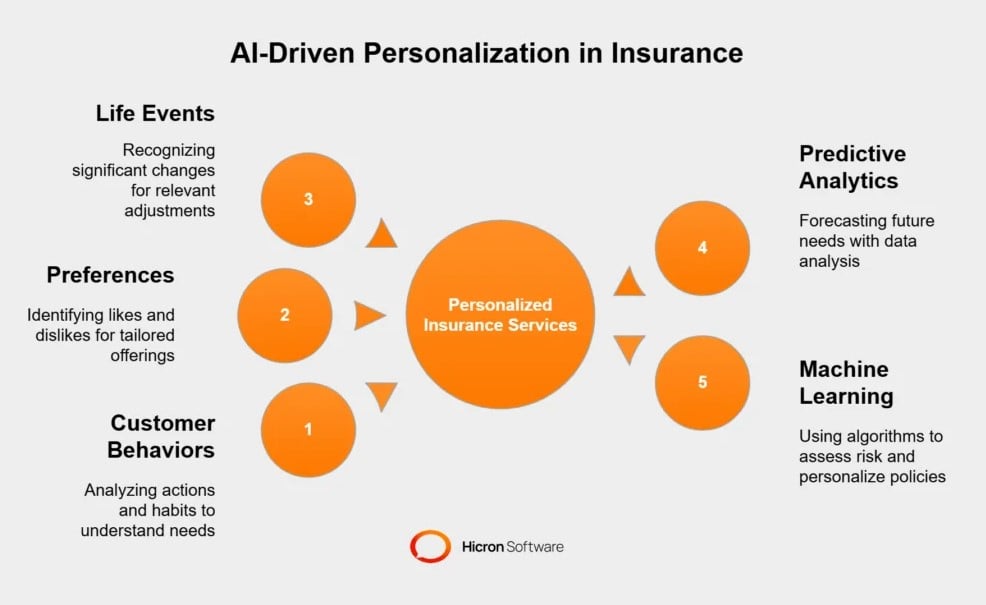
For example, you can offer reduced auto insurance rates to drivers who travel short distances, create dynamic life insurance plans that adjust premiums based on healthy lifestyle indicators, or propose travel insurance that automatically covers multiple trips each year.
Examples of personalized insurance solutions:
- Usage-based car insurance calculated by mileage or driving behavior.
- Health insurance that rewards customers for regular exercise or preventive checkups.
- Home insurance that adapts coverage limits to smart home data or property improvements.
- Modular travel insurance allows customers to add extra protection for pets, sports, or luggage.
Where Is Insurance Marketing Headed Next?

Insurance marketing is becoming more customer-centric, automated, and seamlessly integrated across channels. Brands are shifting toward clear, accessible communication that helps audiences quickly understand complex products.
AI and automation continue to transform campaign planning and execution, enabling real-time personalization and more responsive engagement. At the same time, omnichannel strategies are no longer optional, as customers expect consistent experiences across search, email, social media, and websites.
Another key shift is the growing focus on education and prevention rather than pure promotion. Marketers are expected to clarify risk, support informed decision-making, and apply behavioral insights to make their messaging more relevant.
Conclusion
Effective insurance marketing is built on trust, consistency, and a multi-channel presence that helps audiences become familiar with your expertise over time. Sharing valuable insights and answering customer questions strengthens credibility and attracts potential clients. At the same time, continuous measurement and optimization are essential to improve results and stay aligned with industry changes.