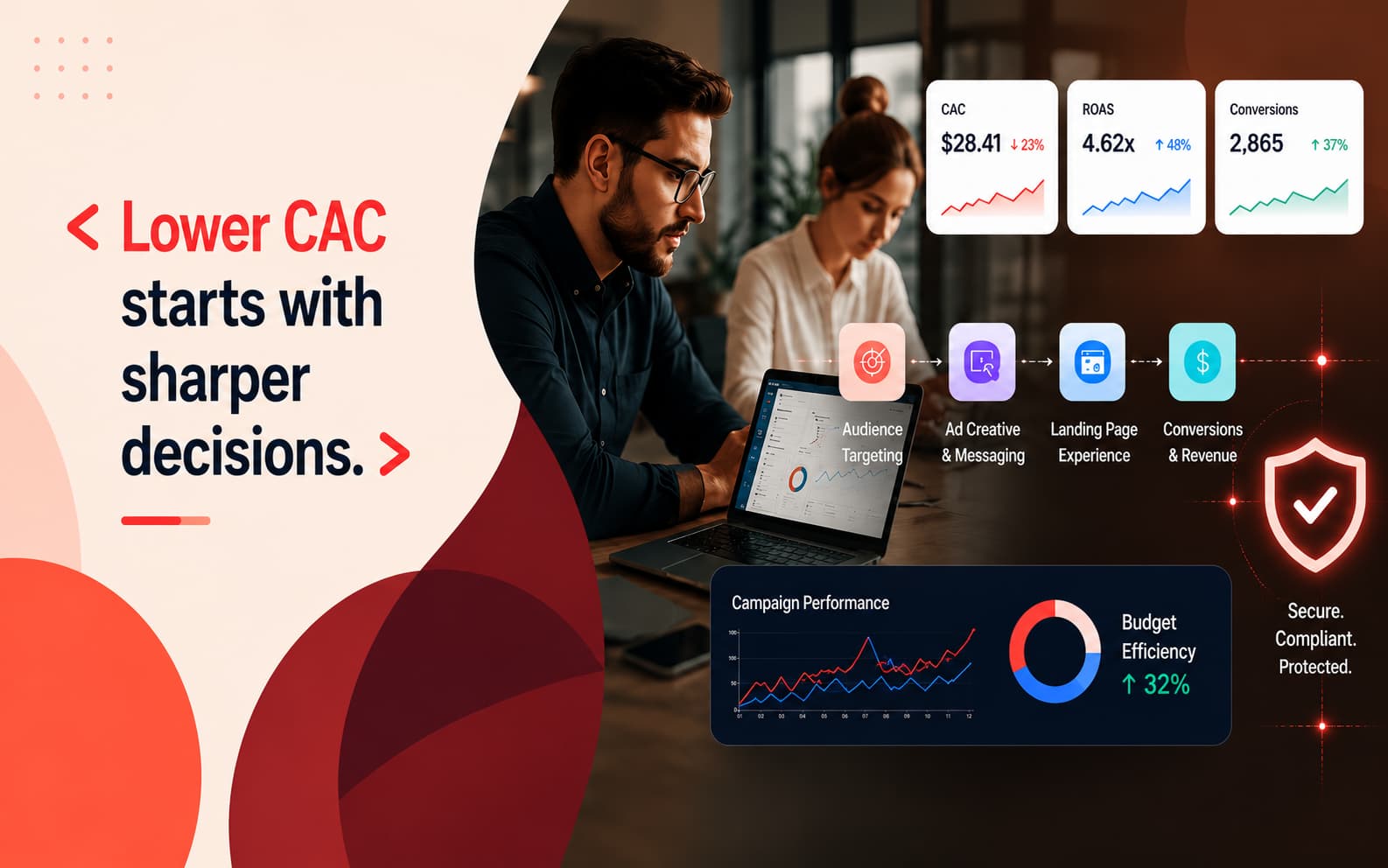
A Google Ads agency can help a business turn paid search into a structured growth channel instead of a series of disconnected campaigns. For some companies, that means generating more qualified leads. For others, it means lowering acquisition costs, improving conversion tracking, fixing wasted spend, or scaling into new markets without losing control of performance. A strong agency should not just know how to launch ads — it should know how to manage budget, interpret intent, improve account structure, and connect ad spend to measurable business outcomes.
That distinction matters because many accounts do not fail at setup alone. They fail in the weeks and months after launch, when bidding, targeting, tracking, and landing pages are not managed with enough rigor. The best Google Ads partners therefore combine execution with judgment: they continuously evaluate what is driving conversions, what is wasting budget, and how campaigns should evolve as data accumulates.
What Is a Google Ads Agency?
A Google Ads agency is a paid media partner that plans, launches, manages, and optimizes advertising campaigns across Google’s ecosystem. Depending on scope, that can include Search, Display, Shopping, YouTube, remarketing, Performance Max, audience targeting, conversion tracking, reporting, and landing page recommendations.
Compared with running campaigns in-house, an agency usually gives a company access to broader specialist coverage: media buyers, strategists, copywriters, analysts, and tracking experts. Compared with hiring one PPC freelancer or one in-house specialist, an agency can also offer deeper bench strength across analytics, creative testing, feed optimization, audience strategy, and multi-market scaling. That does not automatically make an agency the better choice, but it does change the operating model and the level of expertise available.
What Does a Google Ads Agency Do?
A good Google Ads agency does much more than set up campaigns and wait for results. The core responsibilities usually include account audits, keyword research, campaign architecture, ad creation, audience targeting, bid and budget management, conversion tracking, landing page feedback, A/B testing, remarketing, and performance reporting. The key point is that campaign management is ongoing: search intent shifts, competitors change bids, creative fatigues, audiences evolve, and platform automation needs human oversight.
The strongest agencies also manage the areas that sit around Google Ads but strongly affect performance: CRM integration, offline conversion import, measurement quality, funnel alignment, and landing page fit. That is often the difference between an agency that only “runs campaigns” and one that actually improves business outcomes.
Which Google Ads Services Can You Outsource?
Most companies outsource Google Ads because they need support across multiple campaign types, not just Search Ads.
| Service | What it includes | Best for |
| Search Ads | Keyword targeting, ad copy, bidding, extensions, query management | High-intent lead generation and demand capture |
| Display Ads | Banner creative, placements, audience targeting, remarketing | Awareness, retargeting, and wider reach |
| Shopping Ads | Product feed management, Merchant Center, bid strategy | Ecommerce brands with product catalogs |
| Performance Max | Cross-network campaign setup, asset groups, signal tuning, budget guidance | Brands that want Google-wide automation with expert oversight |
| YouTube Ads | Video campaign setup, audience targeting, sequencing, reporting | Demand generation, product education, branded reach |
| Remarketing | Audience creation, sequencing, exclusions, frequency control | Recovering non-converting visitors and re-engaging warm traffic |
| Conversion Tracking | GA4, Tag Manager, CRM sync, offline conversions, QA | Any business that wants reliable optimization and reporting |
When Should You Hire a Google Ads Agency?
Outsourcing Google Ads usually makes sense when a business reaches one of a few common inflection points:
- ad spend is growing and mistakes are becoming expensive;
- ROAS or CPA is trending in the wrong direction;
- internal teams lack time or specialist depth;
- the company is expanding into new campaigns, products, or regions;
- tracking is unreliable and optimization decisions are becoming unclear;
- the business wants a more disciplined testing and reporting process.
On the other hand, some companies may be better served by one strong in-house PPC specialist, especially if spend is modest, the offer is simple, campaign scope is narrow, and leadership wants daily hands-on control. The right choice depends less on ideology and more on budget size, complexity, pace of growth, and the cost of getting paid media wrong.
How Much Does a Google Ads Agency Cost?
Google Ads agency pricing usually depends on the scope of work, the complexity of the account, and the level of strategic involvement required. Most agencies use one of several common pricing models: a monthly retainer, a percentage of ad spend, a flat management fee, or a performance-based structure.
The right model depends on how your campaigns are managed, how much support you need, and how complex the account is. A simple local lead generation account will usually cost far less to manage than a multi-market ecommerce or B2B account running Search, Display, remarketing, YouTube Ads, and advanced conversion tracking.
| Pricing model | How it works | Typical range | Best for |
| Monthly retainer | A fixed monthly fee for ongoing campaign management and optimization | $1,500–$10,000+ per month | Businesses that want predictable monthly costs |
| Percentage of ad spend | The agency fee is calculated as a percentage of media spend | 10%–20% of ad spend | Accounts with larger or steadily growing budgets |
| Flat fee | A fixed charge tied to a defined scope of work | $1,000–$7,500+ per month | Smaller or more clearly structured accounts |
| Performance-based pricing | Part of the fee is tied to leads, sales, or other agreed outcomes | Custom | Businesses that want stronger incentive alignment |
| Setup + management fee | One-time setup fee plus ongoing monthly management | $500–$5,000 setup + monthly fee | New accounts that need full buildout before optimization |
Several factors usually have the biggest impact on cost:
- monthly ad spend;
- number of campaigns and campaign types;
- number of products, services, or locations;
- number of target markets;
- landing page support needs;
- tracking and analytics complexity;
- creative production requirements;
- reporting depth and meeting frequency.
In general, higher fees are usually tied not only to larger budgets, but to accounts that require more strategic planning, tighter optimization, more testing, cleaner data, and more cross-functional support.
When reviewing a proposal, the most important question is not just how much the agency charges, but what exactly is included in the fee. Some agencies include strategy, setup, reporting, testing, and tracking support in one monthly price, while others charge separately for audits, landing page recommendations, creative work, or analytics implementation.
What Results Can You Expect From a Google Ads Agency?
The right metrics depend on the business model, but the most meaningful ones are usually qualified leads, conversions, cost per acquisition, ROAS, revenue, conversion rate, and — for B2B — pipeline quality or sales-qualified leads. That is a much better lens than clicks or impressions alone. Agencies like Intero Digital explicitly frame success around leads, SQLs, CPA, ROAS, and revenue, while Directive emphasizes qualified pipeline and closed-won impact rather than top-of-funnel activity.
What you should not expect is a universal promise. Performance depends on budget, market demand, competition, product-market fit, landing page quality, conversion data quality, and how realistic the offer is. A strong agency should help improve the odds and the operating system behind results, but no credible partner can truthfully guarantee a certain ROAS for every account in advance.
How to Choose a Google Ads Agency
Choosing well is less about awards and more about operating fit. A strong comparison process usually follows these steps:
-
Check Google Ads depth, not just general digital marketing breadth.
The agency should demonstrate real capability in campaign structure, query control, bidding logic, audience strategy, and conversion tracking — not just generic “PPC management.” -
Look for relevant industry or funnel experience.
Ecommerce, B2B, local services, SaaS, healthcare, and multi-location brands all behave differently in Google Ads. The more complex your buying cycle, the more category-relevant experience matters. -
Review case studies critically.
Ask what the starting budget was, what the business goal was, what changed, and how success was measured. A rising click chart is not enough. -
Assess tracking and measurement maturity.
If the agency cannot explain how it validates conversions, connects CRM data, or checks lead quality, its optimization may be built on weak signals. -
Evaluate transparency and communication.
You should know who works on the account, how often you get reporting, whether you keep access to the account, and how recommendations are prioritized. -
Compare pricing in context.
Lower fees are not automatically cheaper if the account is mismanaged. Compare cost against experience, tracking quality, testing depth, and expected involvement.
Simple comparison framework
| Agency | Google Ads depth | Tracking maturity | Industry fit | Reporting clarity | Pricing clarity |
| Agency A | |||||
| Agency B | |||||
| Agency C |
Use this table internally when comparing proposals so you are not choosing based only on brand recognition or personality fit.

What to Look for in a Google Ads Agency’s Case Studies
A case study should help you understand how the agency thinks, not just prove that it has clients. The most useful case studies include:
- starting budget or spend range;
- campaign goal;
- account or funnel context;
- CPA, ROAS, conversion lift, or revenue impact;
- timeframe;
- major changes made to structure, targeting, bidding, or landing pages;
- whether results were sustained.
Be cautious when a case study focuses mainly on clicks, CTR, impressions, or “traffic growth” without explaining business outcomes. Those metrics can be directionally useful, but they are not enough evidence that the agency improved profitability or lead quality.
What Should Be Included in a Google Ads Agency Proposal?
A strong proposal should be concrete enough that you can understand the operating model before you sign. It should include:
| Proposal element | What it should cover |
| Campaign strategy | Core channels, intent capture plan, priorities, and goals |
| Target audiences | Search intent, segments, remarketing logic, exclusions |
| Account structure | Campaign types, naming logic, landing page alignment, network approach |
| Budget allocation | Where spend will go and why |
| Projected KPIs | Target metrics or directional benchmarks, with caveats |
| Optimization process | Testing cadence, bid changes, keyword refinement, creative iteration |
| Tracking setup | Conversion actions, attribution approach, analytics/CRM integration |
| Reporting | Frequency, dashboards, meeting cadence, metrics included |
| Deliverables | What the agency will actually produce and manage |
| Pricing | Fee model, setup fees, minimum term, and what is excluded |
The most important commercial detail is scope clarity. You should know exactly what is included in the fee, what requires extra budget, and whether landing page work, creative production, feed management, tracking repairs, or CRM integration are included or sold separately.
Questions to Ask Before Hiring a Google Advertising Agency
The best questions are the ones that reveal how an agency makes decisions, not just how well it sells.
-
How would you audit our current account in the first 30 days?
This shows whether the team has a real diagnostic process or just a sales script. -
How do you decide what to optimize first?
Good agencies prioritize based on business impact, not random surface-level tweaks. -
How do you approach keyword selection and search term control?
This reveals how seriously they take intent quality and wasted spend. -
How do you handle Performance Max?
Important because many accounts now depend on PMax, but it needs structure and strong signals to work well. -
How do you validate conversion tracking?
If the answer is weak, the whole optimization process may be weak. -
Can you connect ad performance to CRM or offline outcomes?
Especially important for B2B and high-ticket lead generation. -
Who will actually work on the account?
You need to know whether senior strategists stay involved after the sale. -
How often will we receive reporting and what will it include?
You want reporting that shows business impact, not vanity metrics. -
Do we keep ownership and access to the ad account?
This should almost always be yes. -
How do you manage budgets when performance drops?
A strong answer shows discipline, testing logic, and escalation rules. -
What would make you say we are not a good fit?
This is a useful honesty test. -
What results would be realistic in the first 90–180 days?
Mature agencies set expectations; weak ones overpromise.
Red Flags When Hiring a Google Ads Agency
Some warning signs are commercial, some are technical, and some are simply strategic.
| Red flag | Why it matters |
| Guaranteed ROAS or lead volume | No serious agency can promise fixed outcomes before seeing real-world market conditions |
| No account access | Lack of transparency creates operational and legal risk |
| Vague fees or “management extras” | Hidden pricing often becomes expensive later |
| Generic strategy | If every client gets the same structure, optimization will be shallow |
| Weak tracking explanation | Bad data leads to bad bidding and bad decisions |
| Obsession with clicks and impressions | Vanity metrics can hide poor lead quality or poor profitability |
| No explanation of optimization process | If they cannot explain how they improve accounts, they probably do not have a clear method |
| Overreliance on Google recommendations | Platform suggestions can increase spend without improving return |
This last point matters more than many buyers realize. NinjaPromo explicitly notes that Google’s automated recommendations should be judged against actual performance data rather than followed blindly, while Intero Digital makes a similar point about automation without strategy leading to waste.
Google Ads Agency vs In-House PPC Team
| Factor | Agency | In-house PPC team |
| Cost structure | Variable fee, easier to start without full hiring overhead | Fixed salary and hiring cost |
| Specialist access | Broader bench across strategy, creative, analytics, tracking | Usually narrower unless the team is large |
| Scalability | Easier to expand into new campaigns or markets quickly | Can be slower to scale |
| Speed to launch | Often faster if onboarding is efficient | Faster only if the internal capability already exists |
| Control | Requires coordination and clear process | Greater day-to-day direct control |
| Context knowledge | Needs onboarding into product and sales process | Naturally closer to the business |
| Best for | Growing brands, complex accounts, limited in-house depth | Companies with stable spend and strong internal media leadership |
For many businesses, the right answer is hybrid: internal ownership of goals and commercial direction, with agency support for execution, testing, tracking, and scale. That model often combines control with specialist depth.
How to Work Effectively With a Google Ads Agency
Even a strong agency will underperform without good client-side inputs. To give an agency the best chance of success, provide:
- access to Google Ads, GA4, Tag Manager, CRM, and analytics tools;
- clear business goals and priority conversion actions;
- historical campaign data where available;
- product, offer, pricing, and sales-process context;
- definitions of lead quality or revenue quality;
- landing pages and creative assets;
- one clear communication owner on your side.
The working relationship also improves when both sides agree upfront on KPIs, review cadence, testing priorities, and how budget decisions will be made when results fluctuate. Google Ads management works best when reporting, strategy, and feedback loops are structured rather than reactive.
Top 10 Google Ads Agencies Worth Considering
The agencies below are not interchangeable. Some are stronger for B2B, some for ecommerce, some for broader performance marketing, and some for tracking-heavy or multi-channel programs.
| Agency | Best for | Key Services | Industries | Pricing |
| NinjaPromo | Businesses wanting flexible, KPI-driven Google Ads support | Search, Display, YouTube, tracking, audience targeting, audits | Crypto, fintech, SaaS, iGaming, eCommerce, healthcare, AI, real estate etc. | From $3,200/month subscription pricing |
| KlientBoost | B2B, SaaS, and ecommerce brands needing strong testing discipline | Search, PMax, Display, remarketing, YouTube, Shopping, audits | B2B, SaaS, ecommerce | Custom |
| HawkSEM | Brands needing senior-led SEM with deep optimization | SEM, PPC, paid search, analytics, dashboards | SaaS, finance, ecommerce, education, healthcare | Custom |
| Directive | B2B companies focused on pipeline and revenue | Paid search, paid social, ABM, programmatic, retargeting, reporting | B2B | Custom |
| Disruptive Advertising | Companies that want audit-led performance improvement | Google Ads, AI-assisted optimization, audience targeting, click-to-close optimization | Multi-industry | Custom |
| WebFX | Businesses wanting full-service Google Ads management with public entry pricing | Keyword research, copy, bids, testing, tracking, audience targeting | Lead gen, ecommerce, multi-industry | From $650/month |
| SmartSites | Businesses needing PPC plus landing page and segmentation support | PPC, landing pages, remarketing, reporting, bidding | B2B, healthcare, automotive, retail, industrial | Custom |
| Tinuiti | Retail and commerce brands with full-funnel search needs | Paid search, Shopping, shoppable media, AI search, measurement | Retail, commerce, large brands | Custom |
| Single Grain | SaaS startups to enterprise brands wanting custom paid growth strategy | Strategy, ROAS tracking, GTM, CRM reporting, bidding, keywords | SaaS, enterprise, Fortune 500, tech | Custom |
| Intero Digital | Brands that need strong tracking infrastructure and modern paid search strategy | Search, Shopping, YouTube, PMax, server-side tracking, OCI, ROI reporting | Multi-industry, retail and lead gen | Custom |
Pricing above reflects public entry pricing where published; otherwise, custom quote.
1. NinjaPromo
Description
NinjaPromo is a Google Ads agency focused on performance, scalability, and measurable business outcomes. We manage Google Ads as an active growth channel, not as a set-it-and-forget-it campaign type. We build strategy around account structure, keyword intent, audience targeting, ad testing, budget control, and conversion tracking so that spend is aligned with real business goals. We also continuously review performance data, challenge inefficient automation when necessary, and refine campaigns to improve lead quality, efficiency, and long-term account health.
Best for
Businesses that want flexible, subscription-based marketing support with strong Google Ads execution and multi-industry experience.
Key services
Google Ads audits, campaign strategy, keyword research, ad copy creation and testing, bid strategy, budget management, conversion tracking, audience targeting, landing page optimization recommendations, performance reporting.
Pricing
Subscription pricing starts from $3,200/month on the main pricing page.
Why they stand out
- Flexible subscription model instead of a rigid one-size retainer
- Explicit focus on KPI-driven decision-making and spend efficiency
- Broad industry coverage across both lead generation and consumer campaigns
- Willingness to challenge Google’s own automation when the data does not support it
2. KlientBoost
Description
KlientBoost is a Google Premier Partner that emphasizes structured testing, account visibility, and performance across Google Search, Display, YouTube, Shopping, and Performance Max. Its Google Ads page is unusually process-heavy, highlighting named frameworks and systematic keyword and audience mining rather than vague “campaign management.” The company also positions itself strongly for B2B, SaaS, and ecommerce accounts.
Best for
SaaS, B2B, and ecommerce companies that want a rigorous testing culture and strong Google Ads specialization.
Key services
Search Ads, PMax, Display and remarketing, YouTube Ads, Shopping Ads, Google Ads audits, audience targeting, strategy development.
Pricing
Custom pricing; the page indicates a strong fit for companies spending $5,000+/month on Google Ads.
Why they stand out
- Strong formal recognition, including Google Premier Partner status
- Clear methodology rather than generic PPC language
- Strong fit for B2B, SaaS, and ecommerce use cases
- Clients retain ownership and visibility over the account from day one
3. HawkSEM
Description
HawkSEM is an SEM-focused agency that combines paid search with a senior-only staffing model and proprietary reporting through ConversionIQ. Its positioning is built around solving efficiency problems and helping brands break through paid media plateaus with tighter data visibility and optimization discipline. The agency also showcases strong results across multiple industries.
Best for
Companies that want senior-led paid search management with robust reporting and optimization oversight.
Key services
SEM, PPC management, Google Ads optimization, analytics, reporting dashboards, cross-channel performance support.
Pricing
Custom pricing; HawkSEM discusses common industry models such as flat fee, performance-based, and percentage-of-spend structures.
Why they stand out
- Senior-only account model, which is a meaningful differentiator
- Proprietary ConversionIQ dashboard for cross-channel performance visibility
- Strong published performance outcomes across SaaS, finance, ecommerce, education, and healthcare
- Deep SEM positioning rather than generic digital marketing packaging
4. Directive
Description
Directive is a B2B growth agency that treats paid media as a pipeline engine rather than a traffic channel. Its PPC offer spans paid search, paid social, ABM, programmatic, retargeting, and performance reporting, all framed around revenue accountability and qualified pipeline. The positioning is narrower than some competitors, but that focus is exactly why it appeals to B2B teams.
Best for
B2B companies that care more about pipeline and revenue than about surface-level lead volume.
Key services
Paid search, paid social, ABM, programmatic advertising, retargeting, performance reporting, revenue-focused optimization.
Pricing
Custom pricing.
Why they stand out
- Clear B2B specialization
- Strong revenue and pipeline orientation
- Broader paid media integration beyond Google Search alone
- Useful fit for companies with longer, multi-touch buying cycles
5. Disruptive Advertising
Description
Disruptive Advertising frames its Google Ads service around wasted-spend reduction, click-to-close optimization, and a mix of human strategy with AI support. The company says it has worked with more than $1 billion in ad spend and highlights a diagnostic approach that begins with identifying inefficiencies before scaling. Its messaging is especially strong on accountability and campaign quality over raw traffic.
Best for
Companies that suspect waste in their current account and want a more audit-driven, efficiency-focused partner.
Key services
Google Ads strategy, audience targeting, AI-assisted optimization, click-to-close optimization, measurement improvement, audits.
Pricing
Custom pricing; the company promotes a free audit and 30-day strategy proposal.
Why they stand out
- Strong focus on identifying and removing wasted spend
- Emphasis on optimizing beyond the click and toward downstream outcomes
- Heavy use of AI with clear human oversight
- Large review volume and strong market visibility in PPC
6. WebFX
Description
WebFX offers one of the most clearly structured public Google Ads management pages in the market, outlining services such as keyword research, ad copy, audience targeting, bid management, ad testing, and tracking. It also distinguishes itself by publishing entry-level pricing and by framing Google Ads management around ROI and lead or sales growth rather than platform activity alone. For many buyers, the clarity itself is part of the value.
Best for
Businesses that want full-service Google Ads management with public pricing signals and broad service depth.
Key services
Keyword optimization, audience match targeting, industry analysis, ad copywriting, ad testing, ad tracking, bid management.
Pricing
Plans start from $650/month on the public Google Ads management page.
Why they stand out
- Public entry pricing, which many competitors do not publish
- Broad in-house team depth and long operating history
- Strong emphasis on ROI tracking and scalable solutions
- Clear service breakdown that makes proposal evaluation easier
7. SmartSites
Description
SmartSites positions its PPC offering around data-driven strategy, proprietary tools, expert analysis, landing page support, remarketing, bidding, segmentation, and real-time reporting. It serves a broad set of verticals, including B2B, healthcare, automotive, retail, and industrial categories. The positioning is practical and execution-focused rather than overly abstract.
Best for
Businesses that want PPC management combined with landing page input, audience segmentation, and reporting depth.
Key services
PPC strategy, landing pages, remarketing, advanced bidding, segmentation, display ads, real-time reporting.
Pricing
Custom pricing; the site offers a free PPC analysis rather than public packages.
Why they stand out
- Strong operational focus on testing, segmentation, and reporting
- Proprietary tools for faster analysis and decision-making
- Broad multi-industry applicability
- Good fit for brands that need more than just media buying
8. Tinuiti
Description
Tinuiti approaches search from a broader, full-funnel perspective than many Google Ads agencies. Its search practice covers paid search, shoppable media, and AI-influenced discovery, with a strong focus on retail and commerce journeys that move across platforms before conversion. The company also highlights Bliss Point, its operating system for connecting audience, creative, media, and measurement.
Best for
Retail and commerce brands that need Google Ads embedded within a larger multi-channel discovery and shopping strategy.
Key services
Paid search, shoppable media, AI search support, media planning, measurement, audience and creative integration.
Pricing
Custom pricing.
Why they stand out
- Strong full-funnel commerce orientation
- Long search heritage combined with newer AI-search positioning
- Proprietary operating system for connecting media and measurement
- Good fit for brands with complex retail-to-purchase journeys
9. Single Grain
Description
Single Grain positions its Google Ads offer around custom-built strategy, ROAS tracking, Google Tag Manager, CRM integration, keyword research, bidding, and ongoing consulting. It explicitly argues against formulaic PPC and emphasizes alignment with sales quality rather than optimizing only for form fills. That makes it especially relevant for companies that care about revenue quality, not just lead volume.
Best for
SaaS and growth-stage companies that want tailored paid media strategy tied to revenue quality.
Key services
Strategy planning, ROAS tracking, GTM implementation, ad optimization, competitor analysis, keyword discovery, bid strategy, CRM reporting.
Pricing
Custom pricing.
Why they stand out
- Explicit rejection of copy-paste PPC management
- Strong CRM and sales-alignment mindset
- Good fit for SaaS startups through enterprise brands
- Quarterly planning approach adds strategic structure
10. Intero Digital
Description
Intero Digital presents one of the more modern Google Ads narratives, centered on guiding automation with strategy, improving conversion data quality, and coordinating Search, Shopping, YouTube, and Performance Max as one system. The company places unusual emphasis on server-side tracking, offline conversion import, and the idea that bad measurement causes Google’s AI to optimize toward the wrong outcomes. That positioning feels especially relevant for more sophisticated advertisers.
Best for
Brands that need advanced tracking, modern paid search strategy, and stronger control over AI-driven campaign behavior.
Key services
Search and PMax management, Shopping, YouTube, server-side tracking, GA4 support, Offline Conversion Import, keyword strategy, competitor analysis, reporting.
Pricing
Custom pricing.
Why they stand out
- Strong measurement and conversion-infrastructure focus
- Clear point of view on guiding automation instead of trusting it blindly
- Full-funnel paid search logic across Search, Shopping, and YouTube
- More technically mature than many generic PPC offers
Final Thoughts
Choosing a Google Ads agency should come down to more than certifications, sales confidence, or recognizable client logos. The right partner should show relevant experience, clear strategic thinking, solid tracking discipline, and a realistic understanding of how budget turns into business outcomes. In practice, the best agencies are the ones that can explain not only how they launch campaigns, but how they improve them over time, how they validate conversions, and how they decide where your next dollar should go.
A polished proposal is useful, but the real hiring decision should rest on depth of thinking, transparency, and operational fit. If an agency can tie strategy, tracking, testing, and reporting back to qualified leads, CPA, ROAS, revenue, or pipeline, it is much more likely to help you build a sustainable paid acquisition channel instead of an expensive ad account.