
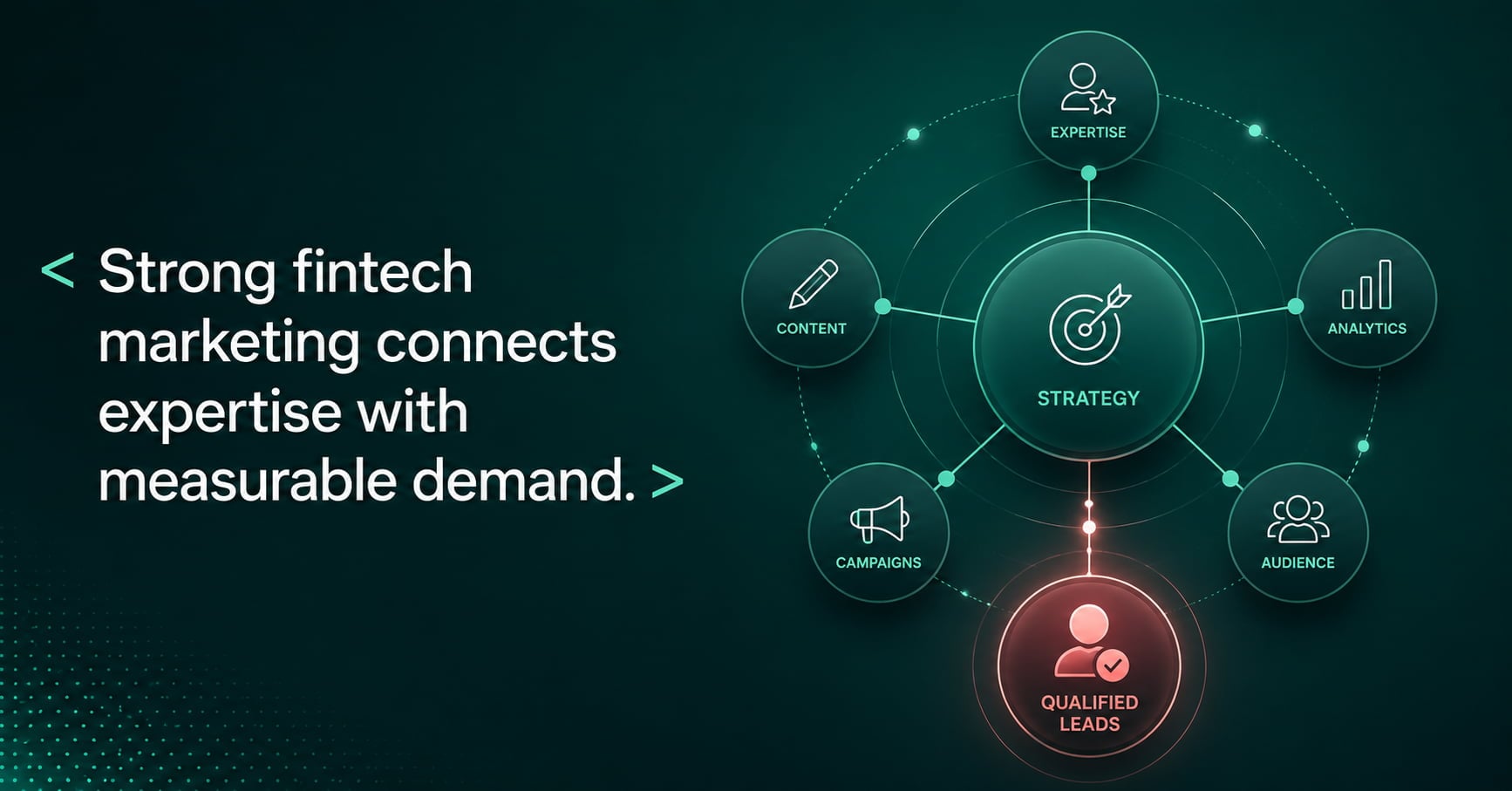
A fintech marketing agency helps financial technology businesses acquire customers while navigating complex buying decisions and marketing restrictions. Specialists must understand financial products, regulated claims, trust signals, and customer acquisition economics.
Against that complexity, the right fintech marketing company connects acquisition with measurable commercial outcomes. These may include qualified leads or funded accounts. This guide explains how to evaluate that capability and compares fintech marketing agencies worth considering.
What Is a Fintech Marketing Agency?
A fintech marketing agency promotes financial technology products and services to consumers or business buyers. Its work combines digital acquisition with financial product knowledge, trust requirements, and compliance awareness. Effective fintech marketing must adapt to different business models, from payment platforms and lenders to financial software providers.
Fintech conversions may require identity verification, disclosures, security checks, or procurement approval. Marketing must therefore build confidence throughout the journey rather than optimize only the initial click.
How Is Fintech Marketing Different From Traditional Digital Marketing?
Fintech marketing must account for product complexity, financial trust, regulation, and longer decisions. These constraints change both campaign execution and performance measurement.
| Fintech Constraint | How It Changes Marketing | Practical Implication |
| Regulation | Claims and promotions may require additional review | Build approval time into campaign schedules |
| Financial trust | Buyers assess credibility before acting | Place proof and risk information near decision points |
| Product complexity | Buyers may need education before comparison | Match content depth to product understanding |
| Longer decisions | Conversion may involve several interactions | Measure progression beyond the first lead |
| Multiple stakeholders | B2B purchases can involve finance, security, and compliance | Create evidence for different decision roles |
| Market differences | Rules and platform access can vary by jurisdiction | Validate campaigns before geographic expansion |
These constraints also increase the value of industry expertise. Specialists must understand how financial products, buyer expectations, and market rules interact.
What Are the Benefits of Working With a Fintech Marketing Company?
A specialist fintech marketing company reduces the industry context an internal team must teach its agency. It also provides access to multiple disciplines without separate hires. This can shorten the path from strategy to execution.
The practical benefits usually include:
- Faster onboarding around financial audiences and terminology
- Access to SEO, paid media, content, creative, and analytics specialists
- More informed treatment of regulated claims and approval workflows
- Easier scaling across channels without multiple separate hires
- External experience identifying acquisition and conversion problems
Specialization does not replace client involvement. Product accuracy, legal interpretation, and commercial priorities remain internal responsibilities. Strong financial technology marketing firms use that knowledge to improve execution.
What Can a Fintech Marketing Agency Do for Your Business?
A specialist partner should match its capabilities to the commercial bottleneck. That means choosing services according to the problem they need to solve.
| Business Challenge | Agency Capability | What It Should Change |
| Low qualified organic demand | SEO | Increase discovery among high-intent prospects |
| Expensive or uncertain acquisition | Paid media | Test audiences, offers, and acquisition economics |
| Buyers struggle to understand the product | Content | Reduce the knowledge gap before conversion |
| Limited market credibility | PR | Build third-party visibility and authority |
| Weak audience engagement | Social media | Create repeated contact with priority audiences |
| Insufficient pipeline | Lead generation | Turn defined audiences into qualified opportunities |
| Traffic converts poorly | CRO | Identify and remove avoidable conversion friction |
| Channel performance is unclear | Analytics | Connect activity with pipeline and customer outcomes |
Buying isolated channels can be inefficient. Effective fintech marketing services should solve a defined commercial problem rather than increase activity. Qualified-demand problems require different capabilities from conversion problems.
How Do Fintech Marketing Agencies Help With Compliance?
Fintech marketing agencies can build compliance reviews into campaign production before assets reach customers. Reviews may cover claims, disclosures, platform policies, and market restrictions. Qualified compliance professionals should retain responsibility for legal approval.
Compliance also affects whether campaigns can run in the first place, because platform eligibility can determine market access. Google requires financial-services advertisers in specified markets to complete verification and comply with applicable local regulations. Agencies managing affected advertising accounts can also face verification requirements.
A workable compliance process should establish:
- Who approves financial claims before publication
- Which disclosures must accompany specific messages
- How regulatory feedback enters creative revisions
- Which platforms require advertiser verification
- Which rules change across target jurisdictions
Compliance should enter planning before creative production. Late revisions can delay launches and invalidate assumptions about channel access.
What Should You Know Before Hiring a Fintech Marketing Agency?
Before hiring a fintech marketing agency, match its experience to your product, market, and growth problem. Companies planning expansion should also assess whether the agency can support their fintech go-to-market strategy. That evaluation should test relevant evidence, operating processes, and commercial fit across the factors below.
| Before You Evaluate | What You Need to Define | What the Agency Must Demonstrate |
| Industry experience | Product category and buyer type | Relevant experience with comparable fintech journeys |
| Case studies | Outcome you need to improve | Evidence from a similar commercial challenge |
| Target markets | Countries and customer segments | Ability to adapt execution by market |
| Services | Current growth bottleneck | Capabilities directly connected to that bottleneck |
| Reporting | Business metrics that matter | Reporting from channel activity to commercial outcomes |
| Communication | Internal owners and approval speed | Clear account ownership and working cadence |
| Pricing | Budget and required capacity | Transparent scope, inclusions, and additional costs |
| Compliance | Internal approval responsibilities | A defined process for reviews and revisions |
Confirm who will execute the account and which responsibilities remain internal. Ownership should be explicit before work begins.
What Results Can You Expect From a Fintech Marketing Company?
Fintech marketing companies should produce different evidence as an engagement develops. Early signals include campaign efficiency, qualified traffic, and lead quality. Organic growth and brand visibility usually take longer. Brand demand may develop later as awareness compounds.
Short-term indicators can include:
- Higher-quality traffic from priority audiences
- More qualified leads or applications
- Better conversion performance on existing demand
- Clearer channel-level customer acquisition cost
Longer-term outcomes can include stronger organic visibility, lower blended CAC, and more predictable pipeline. A fintech marketing strategy should establish baselines before forecasting improvement. Results should also separate agency-controlled outcomes from sales or product constraints.
How Much Does a Fintech Marketing Agency Cost?
Agencies may charge through retainers, fixed projects, dedicated capacity, or channel-management models. Total cost depends on scope, markets, complexity, and specialist involvement. Media spend and production may be billed separately. Costs can also rise with additional channels or deeper strategic support.
| Pricing Model | Works Best When | Usually Covers | Check Before Signing |
| Monthly retainer | Priorities require ongoing execution | Agreed recurring services or capacity | Included work, limits, and unused capacity |
| Fixed project | Scope and deliverable are clearly defined | Specific strategy, launch, audit, or build | Revision limits and scope-change fees |
| Dedicated capacity | Priorities shift across disciplines | Reserved team time or specialist capacity | Allocation rules and available expertise |
| Channel management | One acquisition channel needs specialist ownership | Management and optimization of that channel | Whether creative, tracking, and strategy cost extra |
Compare price against required capability, not headline fees. Cheap engagements become expensive when internal teams must replace missing expertise. The opposite problem occurs when a broad retainer includes capacity the business does not need.
Questions to Ask a Fintech Marketing Agency Before Signing a Contract
Ask questions that expose how the agency makes decisions, executes work, reports results, and manages compliance.
Expertise
- Which fintech products and buyer types have you marketed?
- Which comparable problems have you solved?
Strategy
- How will you diagnose our primary growth constraint?
- What evidence determines channel selection?
Execution
- Who will work on our account?
- Which capabilities are handled internally?
Reporting
- Which metrics connect marketing with revenue?
- How will you separate lead volume from lead quality?
Compliance
- Where does compliance review enter production?
- How do you handle market-specific advertising restrictions?
Communication and contract
- How frequently will priorities and results be reviewed?
- What happens when scope or priorities change?
- Which costs sit outside the agreement?
- What are the termination and handover terms?
Use the answers to compare how providers diagnose your problem and justify their recommendations. Specific reasoning reveals more than capabilities lists or confident promises.
Red Flags to Watch for When Hiring a Fintech Marketing Agency
Warning signs appear when agencies promise outcomes without explaining the conditions required to produce them. Fintech results depend on product economics, market access, customer intent, and compliance constraints.
| Red Flag | What It Can Sound Like | What to Ask Instead |
| Unrealistic guarantees | “We can guarantee a specific growth result.” | Which variables could prevent that result? |
| Vague reporting | “You’ll receive a comprehensive monthly report.” | Which metrics connect activity to customers or revenue? |
| No relevant fintech evidence | “We work across many regulated industries.” | Which comparable fintech problem have you solved? |
| Weak compliance process | “Your legal team can check everything before launch.” | Where does compliance enter your production workflow? |
| Unclear pricing | “We can adjust the scope as we go.” | What is included, excluded, and billed separately? |
| One-size-fits-all strategy | “We normally start clients with these channels.” | What evidence will determine our channel mix? |
Another warning sign is proprietary tactics without clear measurement. A capable agency should explain its hypothesis and what evidence would change the strategy.
Fintech Digital Marketing Agency vs In-House Team: Which Is Right for You?
A fintech digital marketing agency provides faster specialist access. An in-house team offers greater daily control and institutional knowledge. The right model depends on required capabilities, management capacity, and changing priorities.
| Decision Factor | Agency Model | In-House Model |
| Expertise | Provides external expertise across different marketing disciplines | Builds deeper knowledge of the company, product, and customers |
| Cost | Converts specialist access into a defined external engagement cost | Adds salaries, benefits, recruitment, and management overhead |
| Hiring | Adds capabilities without recruiting each specialist separately | Requires recruitment, onboarding, and retention of required specialists |
| Scalability | Can shift capacity as channels and priorities change | Scales through additional hiring or redistribution of existing capacity |
| Control | Requires agreed workflows, ownership, and approval processes | Provides closer day-to-day control over execution and priorities |
| Speed | Can add established specialist capacity without a full hiring cycle | Can move quickly once the required capabilities already exist internally |
| Access to specialists | Provides multiple specialist disciplines through one external relationship | Provides direct access only to capabilities already built into the team |
In practice, early fintech businesses often use agencies before permanent hiring becomes economical. Larger companies may retain core strategy while using fintech digital marketing agencies for specialist execution or expansion. Hybrid models preserve internal product knowledge while adding external expertise.
How to Get the Most From Your Fintech Marketing Agency Partnership
A productive agency partnership depends on shared information, fast decisions, and agreed commercial objectives. Clients should provide product and compliance context early. Agencies should translate that knowledge into measurable execution.
To make that collaboration practical, agree on a small set of outcomes. Share customer research, sales objections, previous findings, and approval responsibilities. Clear ownership prevents routine decisions from stalling.
The relationship should then operate as a learning system:
- Review performance against agreed business outcomes
- Share product and regulatory changes early
- Document important campaign findings
- Resolve approval bottlenecks before they delay launches
- Reprioritize work when evidence changes
- Provide timely feedback through an agreed communication process
Regular reviews should examine decisions, not merely deliverables. Changes in fintech marketing trends matter only when they affect target customers or channel economics. Evidence should determine whether priorities need to change.
Top Fintech Marketing Agencies Worth Hiring
The best provider depends on the product, target market, growth stage, and internal capabilities. Different parts of the fintech industry create different acquisition and positioning demands. Choosing a fintech digital marketing agency therefore requires matching specialist depth to the company’s immediate commercial constraint.
1. NinjaPromo
NinjaPromo is a subscription-based fintech marketing agency built around coordinated multi-channel growth. We connect acquisition with applications, demos, deposits, and qualified leads. Execution remains tied to commercial outcomes rather than isolated channel metrics.
That coordinated model becomes clearer when applied to a real fintech campaign. In our HTX campaign, PPC, PR, creative, and conversion work generated $20 million in deposits within 180 days. It also achieved a 16.8% conversion rate and 1.5 million PR reach.
Our subscription model lets fintech teams shift specialist capacity as priorities change. This reduces the need to coordinate separate providers while keeping execution accountable.
🔝 Best for: Fintech companies needing coordinated, multi-channel execution.
💻 Key services:
- Fintech marketing strategy
- Paid media management
- Search engine optimization
- Social media marketing
- Content marketing
- Influencer marketing
- Fintech brand development
- Conversion-focused web design
💸 Pricing: Starts at $3,200/month — See pricing.
✅ Why we stand out: Our subscription model combines multidisciplinary fintech execution with measurable commercial accountability.

2. CSTMR
Financial-services specialization is central to CSTMR’s positioning. Its experience spans banking, lending, payments, investing, insurance, and related fintech categories. That sector depth reduces the learning curve when brand strategy depends on financial context.
Positioning work can therefore come before acquisition. The agency suits established financial brands reshaping their proposition, customer experience, or market presence.
🔝 Best for: Financial brands needing positioning, brand development, and ongoing marketing under one specialist partner.
💻 Key services:
- Fintech marketing strategy
- Financial brand strategy
- Performance marketing
- Content marketing
- Search engine optimization
- Financial services PR
- Social media marketing
- Conversion-focused web design
💸 Pricing: Starts at $15,000/month.
✅ Why they stand out: Brand and customer-experience work can precede acquisition, making the engagement useful before media scaling begins.
3. ProperExpression
Lead volume can hide a weak B2B fintech pipeline. ProperExpression addresses that gap by connecting demand generation with CRM, nurturing, sales alignment, and revenue measurement.
Beyond lead capture, the model follows how prospects progress toward revenue. This suits companies selling complex financial software through longer buying cycles.
🔝 Best for: B2B fintech and financial businesses that need demand generation connected to sales and RevOps.
💻 Key services:
- B2B growth strategy
- B2B search engine optimization
- Paid search management
- Paid social advertising
- Content marketing
- Lead generation campaigns
- Marketing automation
- Revenue operations
💸 Pricing: Starts at $5,000.
✅ Why they stand out: Its operating model follows the buyer beyond lead capture, where many B2B fintech acquisition programs lose visibility.
4. Andava Digital
Case evidence gives Andava Digital a performance-led profile. Its fintech SaaS work reports fivefold year-over-year organic traffic growth for a buy-now-pay-later platform. Social engagement also improved during the engagement.
That performance focus is most relevant when search visibility, paid acquisition, or conversion efficiency limits growth. Fundamental positioning problems require a different type of support.
🔝 Best for: Fintech SaaS companies prioritizing SEO, PPC, and conversion-focused user acquisition.
💻 Key services:
- Search engine optimization
- PPC campaign management
- Social media marketing
- Content marketing
- Email marketing
- Conversion-focused web design
- Conversion rate optimization
💸 Pricing: Starts at $1,000.
✅ Why they stand out: Its acquisition model treats organic discovery and paid demand as connected performance problems rather than separate channel mandates.
5. Fox Agency
International fintech infrastructure creates a demanding B2B marketing environment. Buyers can include financial, technical, compliance, and commercial stakeholders with different information needs. Fox Agency is positioned around that complexity.
Its category exposure includes regtech, open banking, embedded finance, BaaS, AML, and eKYC. This context supports positioning, launches, and international market entry for sophisticated propositions.
🔝 Best for: Complex B2B fintech products selling to multiple technical and commercial stakeholders.
💻 Key services:
- B2B fintech positioning
- Financial brand strategy
- Go-to-market strategy
- Financial technology PR
- Content marketing
- Demand generation
- Integrated campaign planning
💸 Pricing: Starts at $25,000.
✅ Why they stand out: Experience across infrastructure-heavy fintech categories gives its positioning work unusually specific technical context.
6. Stramasa
Breadth defines Stramasa’s model more than any single channel. Its content and demand-generation work can support complex B2B products that require buyer education. The wider service mix can then extend that work across research, communications, and acquisition.
That breadth makes depth the key diligence question for prospective clients. Buyers should verify the specialists assigned and confirm sufficient expertise in each required capability.
🔝 Best for: Fintech teams whose marketing brief spans several functions and may change during the engagement.
💻 Key services:
- B2B fintech strategy
- Search engine optimization
- Content marketing
- Paid advertising management
- B2B demand generation
- Financial services PR
- Market research
💸 Pricing: Starts at $2,500/month.
✅ Why they stand out: Its model can accommodate assignments that move between research, market communication, and execution as priorities develop.
7. Aimers
Paid acquisition sits at the center of Aimers’ proposition. The agency connects performance activity with demos, trials, opportunities, or revenue rather than clicks alone.
Enterprise buying complexity changes how that model should be evaluated. Legal, security, IT, and compliance stakeholders can make conversion quality more important than volume.
🔝 Best for: Fintech and financial software businesses focused on measurable paid acquisition and pipeline.
💻 Key services:
- Paid search management
- Paid social advertising
- Performance marketing
- Conversion rate optimization
- Marketing analytics
💸 Pricing: Recommends at least $3,000/month per ad platform.
✅ Why they stand out: Its performance framing evaluates paid acquisition against pipeline value rather than treating front-end conversion volume as sufficient.
8. Fleekbiz
Marketing and digital production sit unusually close in Fleekbiz’s model. This can help younger fintech companies when acquisition performance depends on the website or digital experience receiving traffic.
Campaign learning can then move directly into website or experience improvements. Mature organizations with established product teams may instead prioritize deeper marketing specialization.
🔝 Best for: Fintech companies that need marketing alongside web, design, or development support.
💻 Key services:
- Digital marketing strategy
- Search engine optimization
- PPC campaign management
- Marketing content production
- Fintech UX/UI design
- Conversion-focused web development
💸 Pricing: Starts at $10,000.
✅ Why they stand out: Campaign learning can move directly into changes to the digital destination without introducing another production vendor.
Final Thoughts
Comparing fintech marketing companies should start with the business constraint, not an agency services list. Product complexity, regulation, target market, sales cycle, and internal capabilities should determine which expertise matters most.
Strong partnerships require evidence on both sides. Agencies need reliable customer context, while fintech clients need transparent reasoning and measurement. Both should understand how marketing activity connects with commercial outcomes.