
Key Takeaways
- Insurtech vendors must prove integration feasibility before insurers commit to enterprise software.
- Carrier buying committees require distinct evidence for underwriting, IT, compliance, and finance stakeholders.
- Insurance technology campaigns should connect automation benefits to expense ratios and claims processing costs.
- Insurtech ABM performs best when account selection reflects core systems and modernization triggers.
- Insurtech marketers should prioritize qualified carrier pipeline over downloads and unqualified demo requests.
B2B insurtech marketing is the process of promoting insurance technology products to insurers, brokers, and other insurance businesses. It combines education, trust-building, and demand generation for buyers who evaluate software through committees and risk reviews. The goal is to turn a complex product into a clear business case for insurance carriers and brokers.
Business-to-business insurtech marketing works differently from consumer insurance promotion. Sales cycles are longer, regulation shapes every claim, and several stakeholders must agree before a contract is signed. That is why strategy depends on precise targeting, credible proof, and close cooperation with sales.
The Role of Marketing in Scaling B2B Insurtech Businesses
Marketing helps insurtech companies turn technical innovation into commercial traction with insurers that change slowly. Traditional carriers run on legacy policy, claims, and billing systems that are expensive to replace. Each new vendor means integration work, compliance review, and operational exposure. Before sales conversations can move forward, marketing has to make that exposure feel manageable.
Resistance to change is a major obstacle in insurance technology adoption. In a recent survey of insurance executives, 75% worried that current investments could soon become obsolete. That fear of obsolescence shapes messaging, which needs to show longevity, interoperability, and a credible product roadmap. To win over such cautious organizations, effective digital marketing for insurance technology providers handles four jobs at once.
- Education: explain new concepts such as embedded insurance or parametric coverage in plain language.
- Proof of value: connect the product to loss ratios, processing time, or distribution reach.
- Risk reduction: document security, integration paths, and implementation timelines upfront.
- Confidence building: show pilots, references, and partner ecosystems that make adoption feel familiar.
Insurance digital transformation creates demand, yet demand alone does not make an unknown vendor credible. Repeated exposure helps buying committees assess unfamiliar vendors before inviting them into formal evaluations. B2B insurtech marketing uses content, events, and peer references to build brand awareness in the B2B insurance market.
How Does B2B Insurtech Marketing Differ from B2C Insurance Marketing?
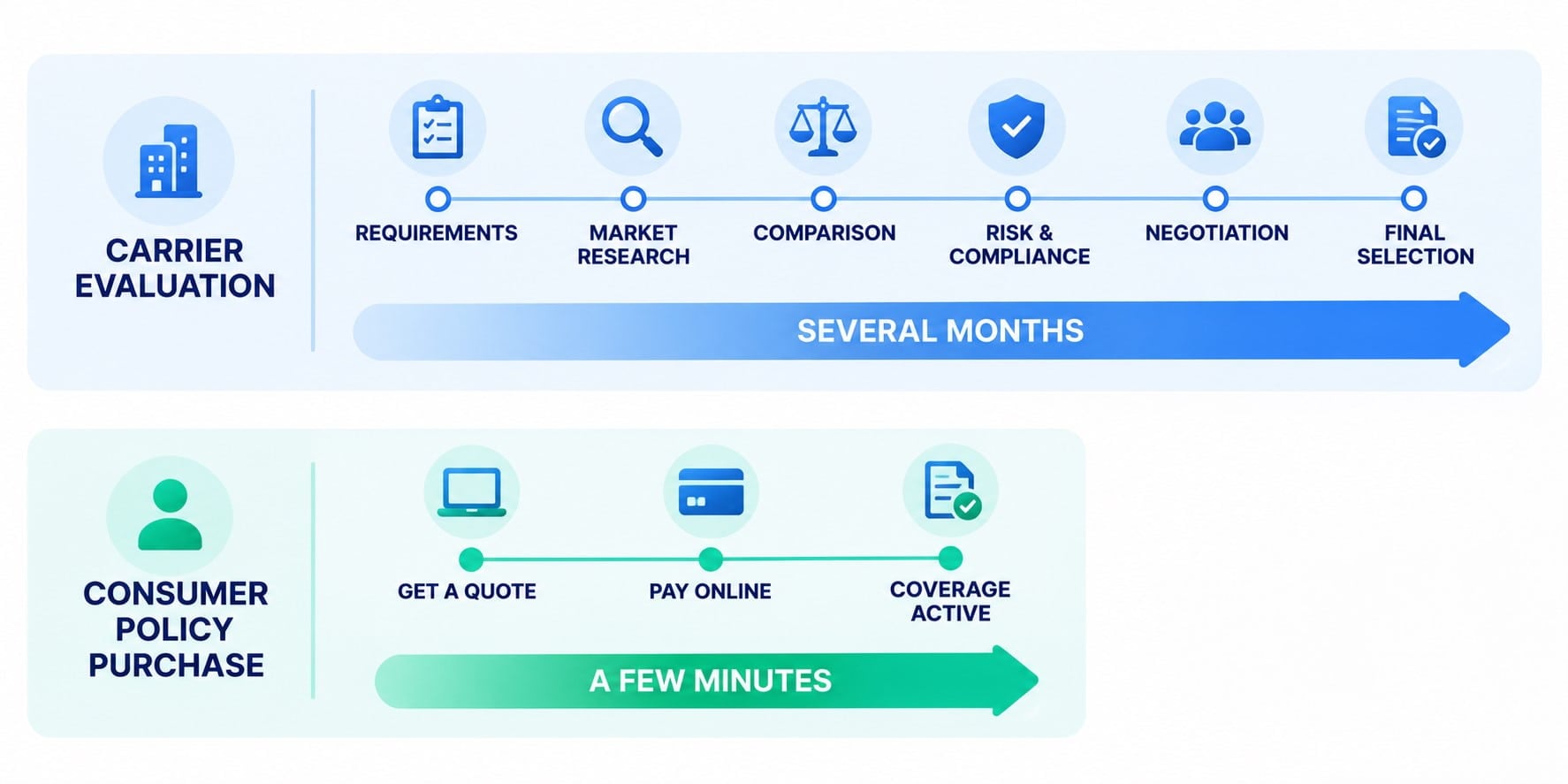
B2B insurtech marketing targets organizations that buy technology, while B2C insurance marketing targets individuals who buy policies. Business buyers evaluate integrations, compliance, and return on investment over months. Consumers compare price, coverage, and convenience, often within one session. As a result, messaging, channels, and trust signals differ at almost every stage.
| Factor | B2B Insurtech Marketing | B2C Insurance Marketing |
| Target audience | Insurance carriers and brokers, MGAs, reinsurers | Individual policyholders and families |
| Buying cycle | Several months, often including pilots | Minutes to days |
| Decision-making | Committees across IT, underwriting, compliance, and finance | One person or a household |
| Messaging | Operational efficiency, risk reduction, revenue growth | Price, coverage, and peace of mind |
| Trust-building | Case studies, security documentation, peer references | Reviews, ratings, and brand recognition |
| Main channels | LinkedIn, industry events, ABM, search, email nurturing | Paid social, comparison sites, TV, and search |
Partner-focused campaigns change the marketing math as well. A single broker network or carrier deal can distribute a product to thousands of end customers. Because each deal carries that reach, teams invest more per account and track pipeline value instead of lead counts. Many principles overlap with B2B fintech marketing, where regulated buyers also expect proof before they commit.
What Regulatory Challenges Should B2B Insurtech Marketers Be Aware Of?
B2B insurtech marketers must comply with insurance advertising rules, data protection laws, and limits on performance claims. US insurance oversight is primarily state-based, while other markets apply different national and regional regulatory frameworks. Requirements cover how products are described, how data is processed, and who may legally sell or solicit insurance. Legal review belongs in campaign planning, not in final approval.
Most campaign compliance work comes down to five areas.
- Insurance advertising rules: materials that describe coverage terms may fall under state advertising regulations.
- Data privacy: assess applicable GDPR, CCPA, or GLBA obligations before collecting prospect or policyholder information.
- Product and performance claims: figures on savings or loss ratio improvements need documented support.
- Intermediary communication: messaging to brokers must respect licensing rules and carrier appointment agreements.
- Cross-market differences: frameworks vary between US states, the EU, and Asia-Pacific.
Data security deserves special attention because insurers remain accountable for their vendors. The insurance data security model law requires licensees to exercise due diligence when selecting third-party service providers. Publishing security documentation early helps procurement teams assess vendor risk before formal due diligence.
Performance claims face the same scrutiny as security documentation. A line about faster claims processing may sound harmless in a webinar. If the figure comes from one pilot, the audience should hear that context too.
Best Practices for Building a Successful B2B Insurtech Marketing Strategy
A successful B2B insurtech marketing strategy connects research, positioning, and sales handoff into one system. Research should map each target carrier’s core systems, lines of business, and active modernization projects. Positioning then ties product capabilities to those projects, so sales receives accounts with documented technical fit.
Define Your Ideal B2B Customer Profile
Research starts with an ideal customer profile identifying organizations most likely to buy, implement, and renew your product. Insurtech products rarely fit every carrier, so precise segmentation protects budget. Firmographic and technographic data together show where demand is realistic.
| ICP Attribute | Example Criteria | Why It Matters |
| Line of business | Commercial property, specialty, life, or health | Products usually solve line-specific workflows |
| Company type | Carriers, MGAs, brokers, or reinsurers | Each type has different buyers and budgets |
| Core system stack | Guidewire, Duck Creek, or in-house platforms | Integration fit shortens technical evaluation |
| Geography | Licensed states or countries | Regulation affects deployment scope |
| Trigger events | Core migration, new product launch, M&A | Change periods open budgets for new vendors |

Position Your Solution Around Business Outcomes
A profile shows which carriers to approach, not what will persuade them. Insurers purchase measurable improvements rather than technology features. Positioning should translate product capabilities into outcomes that appear in board reports. For underwriting automation, demonstrate how rules-based processing can reduce quote turnaround without compromising risk controls.
Most strong positioning statements anchor on one of five outcomes.
- Lower loss ratios through better risk selection.
- Lower expense ratios through automation.
- Faster speed to market for new products.
- Wider distribution through embedded or digital channels.
- Better retention through improved policyholder experience.
Implement Account-Based Marketing (ABM)
In B2B insurtech marketing, account-based marketing treats each high-value account as a market of one. The approach suits insurtech well, since the number of relevant carriers in any region is often limited. For high-value enterprise deals, focused account campaigns can produce better-qualified opportunities than broad lead generation.
A practical ABM program moves through four connected stages.
- Select accounts: prioritize 20–50 organizations that match the ICP and show trigger events.
- Research stakeholders: identify committee members and their current priorities.
- Personalize assets: create account-specific landing pages, business cases, and demo scenarios.
- Orchestrate touchpoints: coordinate ads, email, and sales outreach around each account.

Results should be tracked by account too, through engagement and pipeline creation. Activity from several committee members usually signals real buying interest. A single download from one junior contact carries less weight.
Use LinkedIn Marketing to Reach Insurance Decision-Makers
LinkedIn is one of the most direct channels to reach insurance decision-makers through digital marketing. Its filters can target job titles and seniority at specific carriers. Underwriting leaders need risk-selection evidence, while IT teams expect integration details and security documentation.
Paid and organic formats work best together.
- Matched audience campaigns built from ABM account lists.
- Document ads with gated benchmark reports or checklists.
- Executive posts that help leaders become recognizable among insurance industry decision-makers.
- Conversation ads that invite prospects to a demo or webinar.
Develop Thought Leadership Through Industry Content Marketing
Thought leadership earns attention by offering original insight that insurance professionals cannot find elsewhere. Generic articles about digital transformation rarely sway a buying committee. Proprietary data and candid analysis of industry problems usually carry more weight.
Four formats tend to deliver that kind of insight most consistently.
- Benchmark reports: anonymized data from your platform on claims cycle times or quote volumes.
- Implementation guides: realistic timelines and resource needs for integration projects.
- Regulatory explainers: plain-language summaries of new rules affecting operations.
- Webinars with practitioners: sessions featuring carrier or broker speakers.
Capture High-Intent Demand Through Insurance Technology SEO
Unlike thought leadership, search captures prospects who are already researching a problem your product solves. Insurance technology marketing through SEO focuses on specific, high-intent queries such as claims automation software or embedded insurance API. These terms have modest search volume but attract evaluators with real projects.
A focused SEO plan for insurtech covers three layers:
- Solution pages: one page per use case, line of business, or integration.
- Comparison content: honest pages comparing approaches, build-versus-buy decisions, or vendor categories.
- Educational articles: glossary and how-to content that answers questions from committee members.
Technical credibility supports search visibility as well. Clear documentation, security pages, and integration directories serve both search engines and procurement reviewers. Regular updates keep pages accurate as regulations change.
Launch Targeted Email Marketing and Lead Nurturing Campaigns
Email nurturing helps B2B insurtech marketing teams keep prospects engaged during long evaluation cycles. Insurance buyers may need months to secure a budget or finish a core system migration. Integration guides and pilot results help prospects revisit proposals when implementation budgets become available.
Nurturing works best when tracks are segmented by role and stage. A CIO may receive integration content, while an underwriting executive receives risk selection case studies. Sales should intervene when multiple stakeholders revisit integration guides or request implementation details.
Build Strategic Partnerships and Co-Marketing Campaigns
Strategic partnerships give B2B insurtech marketing teams access to credibility that took others years to build. Prioritize partners whose customer base, integration ecosystem, and geographic reach match your target insurance accounts. Joint campaigns introduce newer vendors through relationships that target buyers already recognize and trust.
Common co-marketing formats in insurance include:
- Marketplace listings with core platform providers.
- Joint webinars with consulting or implementation partners.
- Co-authored research with industry associations.
- Shared event sponsorships and speaking slots.

Run Conversion-Focused Advertising Campaigns
While partnerships build familiarity, targeted advertising accelerates insurtech lead generation among narrowly defined buyer groups. Different B2B marketing channels serve distinct buying stages, from active solution research to targeted outreach. Retargeting should prioritize visitors who reviewed integration documentation, security requirements, or enterprise pricing.
Landing pages influence conversion quality, but targeting and lead qualification determine whether inquiries become viable opportunities. Each insurtech landing page should address one buyer segment, one business problem, and one conversion goal. Verified security credentials and relevant carrier references can help buyers assess implementation risk.
Align Marketing and Sales Around Qualified Opportunities
Even well-targeted campaigns lose value if marketing and sales work from different assumptions. Both teams should agree on what qualifies a lead before campaigns start. Shared definitions also prevent later disputes about lead quality.
Practical alignment rests on a few shared agreements:
- A written definition of marketing-qualified and sales-qualified leads.
- A response time commitment for demo requests.
- A feedback loop on why opportunities stall or close.
- One CRM view of the pipeline that both teams rely on.
Regular pipeline reviews help both teams adjust targeting and offers. This shared process supports more predictable B2B customer acquisition as the company scales. Unlike broader B2B marketing, insurtech requires sales teams to address integration and compliance objections before qualification.
How to Measure the Effectiveness of Your B2B Insurtech Marketing Strategy
The effectiveness of B2B insurtech marketing is measured by its contribution to qualified pipeline and revenue. Vanity metrics such as impressions say little about progress with enterprise insurance solutions. Teams should instead track a compact set of indicators across the funnel and review them monthly.
| Metric | What It Shows | How to Use It |
| Marketing-qualified leads (MQLs) | Volume of prospects matching ICP and engagement criteria | Compare channels by MQL quality |
| Cost per qualified lead | Spend efficiency of each channel | Reallocate budget toward efficient sources |
| Demo-to-opportunity conversion | Fit between messaging and real buyer needs | Refine positioning when the rate drops |
| Sales pipeline contribution | Share of pipeline sourced or influenced by marketing | Justify investment to leadership |
| Customer acquisition cost (CAC) | Total cost to win one customer | Compare against contract value and retention |
| Deal velocity | Speed at which opportunities move through stages | Identify stages where content or sales support is missing |
A deeper quarterly review by channel and segment reveals longer-term patterns. Self-reported fields on demo forms can reveal influence from events or referrals that tracking misses. Consistent B2B marketing metrics help teams compare channel efficiency without confusing activity with revenue contribution.
How B2B Insurtech Brands Build Market Recognition: Real Example
The DiscoverMarket insurtech campaign involved a Singapore-based company offering embedded insurance through an ecosystem platform. One of its products protects hotels against revenue losses caused by rainy weather. The company needed to reach hospitality decision-makers who had never considered weather insurance as a revenue tool.
The NinjaPromo team started with research into hoteliers’ pain points around unpredictable weather. That research shaped a dedicated landing page and ad messaging tied to seasonal revenue dips. Google and LinkedIn campaigns then targeted hospitality decision-makers directly. A CRO audit focused on mobile usability, since 84% of visitors arrived on mobile devices.
The work gave DiscoverMarket clearer visibility within a specific B2B audience:
- 1,226 clicks at a $1.33 cost per click.
- A 3.34% landing page conversion rate with 41 conversions.
- A 12% conversion rate on the demo request form after CRO improvements.
- An 18% increase in mobile traffic conversions after optimization.
The case shows how narrow audience targeting can introduce an unfamiliar insurance concept to a defined market. Messaging built around a recognizable business problem made the product easier for hoteliers to understand. Although targeting hospitality buyers, the campaign demonstrates how insurtech marketing can translate unfamiliar coverage into measurable business demand.
Final Thoughts
B2B insurtech marketing succeeds when it reduces perceived risk for cautious insurers. Clear positioning around business outcomes, precise targeting, and compliant messaging form its foundation. Channels such as ABM, LinkedIn, and search then build familiarity across the buying committee.
Measurement keeps the strategy honest over long sales cycles. Qualified pipeline, acquisition cost, and deal velocity show which efforts deserve more investment. Teams that review these signals regularly can refine their approach as the market and regulations evolve.