
Social media marketing pricing covers strategy, content creation, management, and paid campaigns across platforms like Facebook, Instagram, LinkedIn, and TikTok. Costs swing based on who runs your campaigns, how much content you produce, and what you spend on ads.
You budget $4,000 monthly. Then you add the designer, analytics software at $200/month, the video editor, someone answering comments within 48 hours. Boosted posts eat $800. You’re at $6,500 wondering what happened.
Pricing models multiply confusion. Agencies lock you into retainers. Freelancers bill hourly. Subscriptions bundle what you don’t need. Performance contracts tie fees to metrics that tank when platforms tweak algorithms.
This guide explains what drives costs, which pricing structures work, and where surprise charges hide.
Main Drivers of Social Media Expenses
Social media costs don’t scale linearly. A retail brand posting product shots daily spends differently than a B2B software company publishing one thought leadership piece weekly. Five factors determine where your budget lands.
| Cost Driver | How It Affects Budget | Example Impact |
| Industry & Content Type | Visual-heavy industries need constant production; regulated industries require compliance review | Fashion brand: $3K/month photography vs. fintech: $1K/month but $500 for legal review per campaign |
| Company Size | Affects ad spend more than content creation; larger companies amplify the same content with bigger budgets | Startup and enterprise both need 12 posts monthly (~$2K), but enterprise spends $50K on ads vs. startup’s $2K |
| Business Objectives | Brand awareness spreads budget across platforms; lead gen concentrates spend on conversion-optimized channels | Awareness campaign: 4 platforms, video content, broad targeting vs. lead gen: 2 platforms, conversion focus, landing pages |
| Campaign Complexity | Multi-platform launches with influencers and UGC programs cost exponentially more than simple posting | Single-platform static posts: $2K vs. coordinated 6-platform launch with influencers: $15K+ |
| Technology Stack | Tools range from free native analytics to enterprise platforms connecting social to revenue | Small team: Canva + native tools ($50/month) vs. enterprise: scheduling, listening, attribution, asset management ($3K/month) |
Social media ad spending grows 10-11% annually, pushing both organic content costs and paid media rates higher. What worked on a $5,000 budget last year needs $5,500 now just to maintain the same reach.
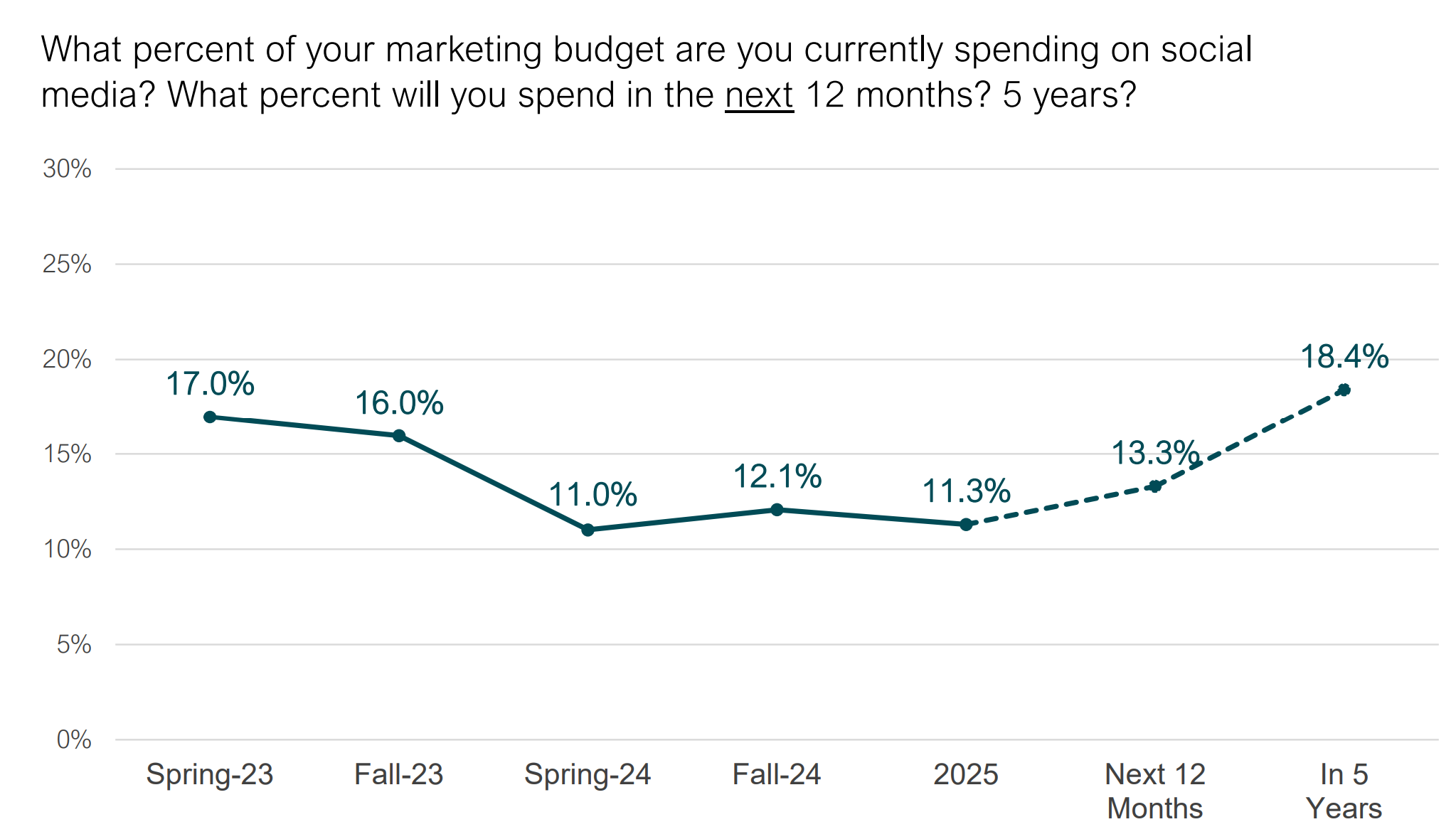
Many businesses allocate a budget percentage of 10-15% of total marketing spend to social media, though this varies based on industry and growth stage.
Hidden Factors to Watch When Setting Your Social Media Marketing Budget
Most budgets cover content, ads, and management. Then smaller costs pile up until you’re 30% over budget without approving anything major.
- Content quality becomes expensive once you’re past the startup phase. Stock photos and Canva work initially. Then your competitors start using professional photographers and your feed looks dated. A brand photoshoot runs $1,500. Video production for Reels costs $500 to $2,000, depending on complexity. Motion graphics for Stories add $800 monthly. The shift from acceptable to competitive content can double production budgets.
- Adding platforms multiplies work in ways spreadsheets don’t capture. Two platforms need one person managing them. Jump to five, and you need a team because each platform wants content in its native format. TikTok videos don’t work on LinkedIn. Instagram carousels need reworking for Stories. Every new channel means separate production schedules, community management, and performance tracking.
- Influencer collaborations include costs beyond the sponsorship fee. Contracts need negotiation. Content goes through approval rounds. Usage rights require legal review.
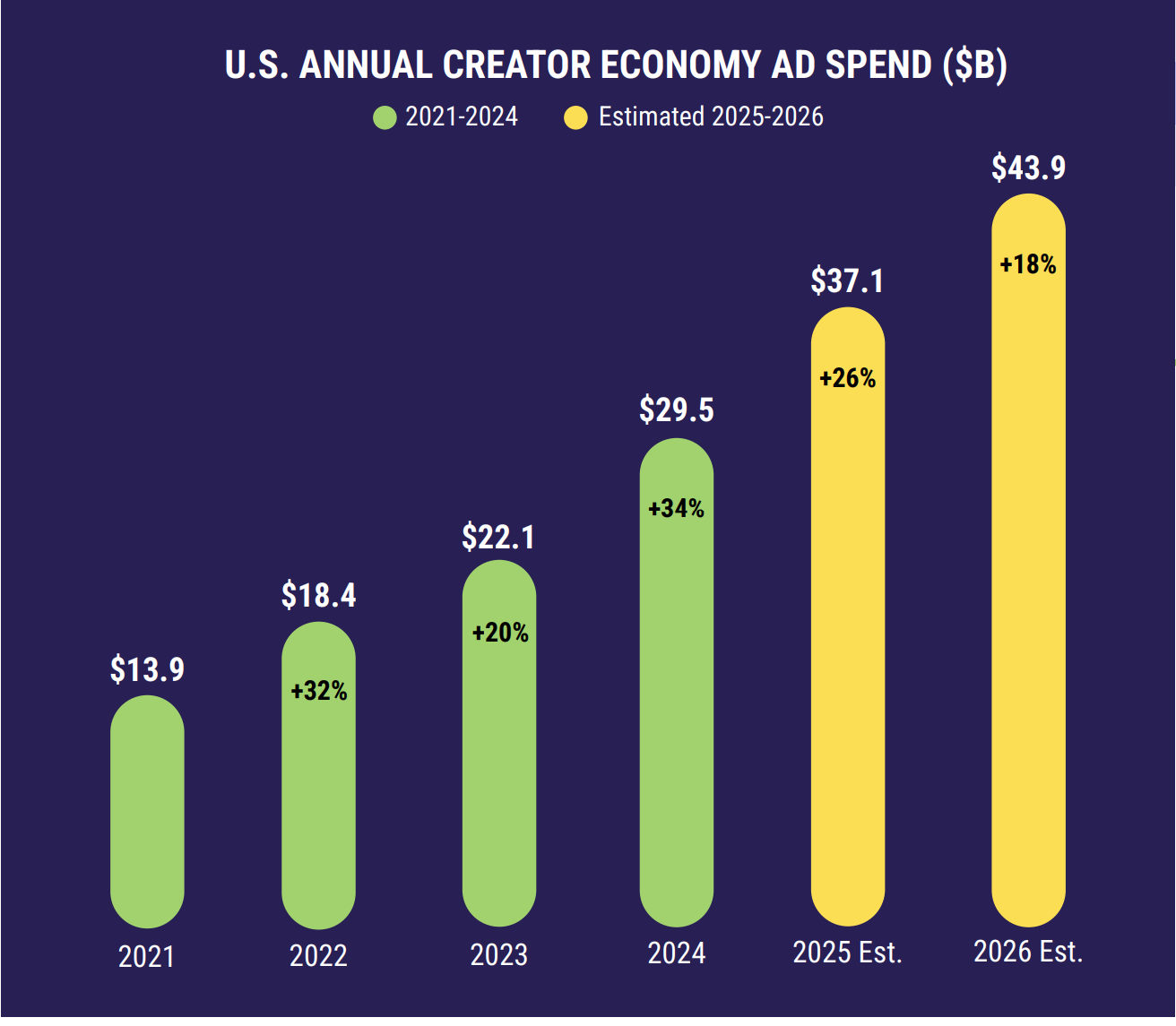
U.S. creator economy ad spend was to hit $37 billion in 2025, up 26% from the prior year, and someone needs to manage these partnerships as a dedicated role.
- Community management and crisis response demand human attention. Automated tools can’t catch brewing problems or respond to upset customers appropriately. Whether you hire someone internally or pay an agency to provide coverage, real-time monitoring costs real money.
- Tool subscriptions creep higher than expected. A scheduling platform costs $99 monthly. Add social media analytics and reporting software at $200, design tools at $55, social listening at $300, and link tracking at $50. You’ve hit $700 in monthly software costs before creating anything.
A Clear Breakdown of Social Media Marketing Pricing Options
Five agency pricing models dominate SMM, offering different social media marketing pricing packages built for varying business needs and risk tolerances.
| Pricing Model | Typical Cost Range | Best For | Main Risk |
| Hourly Rates | $50–$200/hour | Short-term projects, consulting, troubleshooting | Hours pile up fast on ongoing work |
| Monthly Retainers | $2,000–$15,000/month | Consistent management, long-term relationships | Paying for capacity whether you use it or not |
| Project-Based | $3,000–$25,000/project | Campaigns with clear start/end dates, product launches | Scope creep drives costs up mid-project |
| Performance-Based | 10–30% of ad spend or per-lead fees | Brands with proven funnels, measurable conversions | Algorithm changes wreck metrics you’re paying for |
| Subscription Packages | $500–$5,000/month | Small businesses wanting predictable costs | Standardized deliverables may not match your needs |
Each model shifts where risk sits. Hourly puts all risk on you — if work takes longer, you pay more. Performance-based puts risk on the agency — if results tank, they earn less. Retainers split the difference, guaranteeing payment for guaranteed work.
Hourly Rates
Hourly pricing charges for time spent on specific tasks: audits, strategy sessions, crisis management, or troubleshooting platform issues. Rates range from $50/hour for junior freelancers to $200+/hour for senior strategists or specialized consultants.
This model makes sense for short-term needs where scope stays unclear. You need someone to audit your current setup and recommend fixes — that might take 4 hours or 12, depending on what they find. Paying hourly means you’re not locked into a retainer for one-time work.
The problem surfaces with ongoing management. What starts as “a few hours weekly” becomes 15 hours monthly, then 25, then suddenly you’re paying $4,000 for work a $2,500 retainer would’ve covered. Hourly works great for consulting and strategy development, where you need expertise without commitment. It falls apart for execution-heavy work like daily posting, community management, or running ads where hours accumulate faster than expected.
Monthly Retainers
Monthly retainers bundle ongoing work into a fixed fee, typically $2,000 to $15,000 depending on scope. You get consistent content production, daily community management, performance reporting, and paid campaign oversight without negotiating costs every week.
This model dominates social media marketing because the work never stops. Platforms need fresh content regularly, comments need responses within hours, campaigns require constant optimization. Retainers give agencies predictable revenue to staff your account properly and provide stable monthly costs for budgeting.
Retainers work best for businesses treating social media as a long-term channel, not a short-term experiment. If you’re building brand presence over quarters and years rather than testing for a month, the stability justifies the commitment.
Project-Based Pricing
Project-based pricing covers a specific campaign from start to finish: $3,000 to $25,000, depending on what’s included. A product launch might bundle strategy, content creation, influencer partnerships, and two weeks of paid ads. Holiday campaigns typically include creative production, multi-platform ad management, and post-campaign analysis.
Use this model when you have a clear start and end date. You’re testing a new market without ongoing commitments. Your seasonal promotion runs through Black Friday then stops. You need your entire content library overhauled in one concentrated push.
Projects work when you can define deliverables precisely and resist adding “just one more thing” halfway through. Otherwise you’re paying premium rates for what should’ve been a retainer.
Performance-Based Pricing
Performance-based pricing connects payment to outcomes. Agencies charge 10-30% of ad spend, a fixed cost per lead ($20-$100 depending on industry), or a percentage of attributed revenue. They earn more when campaigns perform and less when results disappoint.
Shared accountability makes this appealing. This value-based pricing approach ties compensation directly to business outcomes rather than time spent or deliverables produced. Your partner’s income rises and falls with your conversion rates, which theoretically keeps everyone focused on what matters. No more paying for pretty posts that generate zero business impact.
If your conversion path works consistently and market variables stay relatively predictable, performance pricing can work. If your business model keeps evolving or your industry moves fast, you’ll argue more about what constitutes “fair” results than improving them.
Subscription-Based Model
Subscription packages bundle social media marketing into fixed tiers at $500 to $5,000 monthly. Pick your level and you get standardized deliverables: maybe 12 posts, 8 Stories, basic ad management up to $1,000 spend, and a monthly performance report. Everything’s predetermined.
Small businesses choose subscriptions because they’re straightforward. No scope negotiations. No surprise fees. Many providers use templates and partial automation to keep social media marketing rates lower than custom agency work, offering standardized social media content creation at predictable monthly costs,, which makes professional social media marketing services reachable for companies without $10,000 budgets.
Problems surface when the package doesn’t fit. You need 15 posts but your tier includes 10. Running an extra campaign requires upgrading to the next tier or paying add-on fees that cost more per post than a custom arrangement would’ve. Subscriptions work when your needs stay consistent and fall neatly into predefined boxes.
Social Media Platform Pricing: Comparing Costs Across Top Channels
Global social media CPM averaged around US$6.06 in late 2023 and kept climbing through 2025. That number tells you almost nothing useful because it blends LinkedIn executives with TikTok teenagers into one meaningless average.
The real story lives in where marketers concentrate their spending.
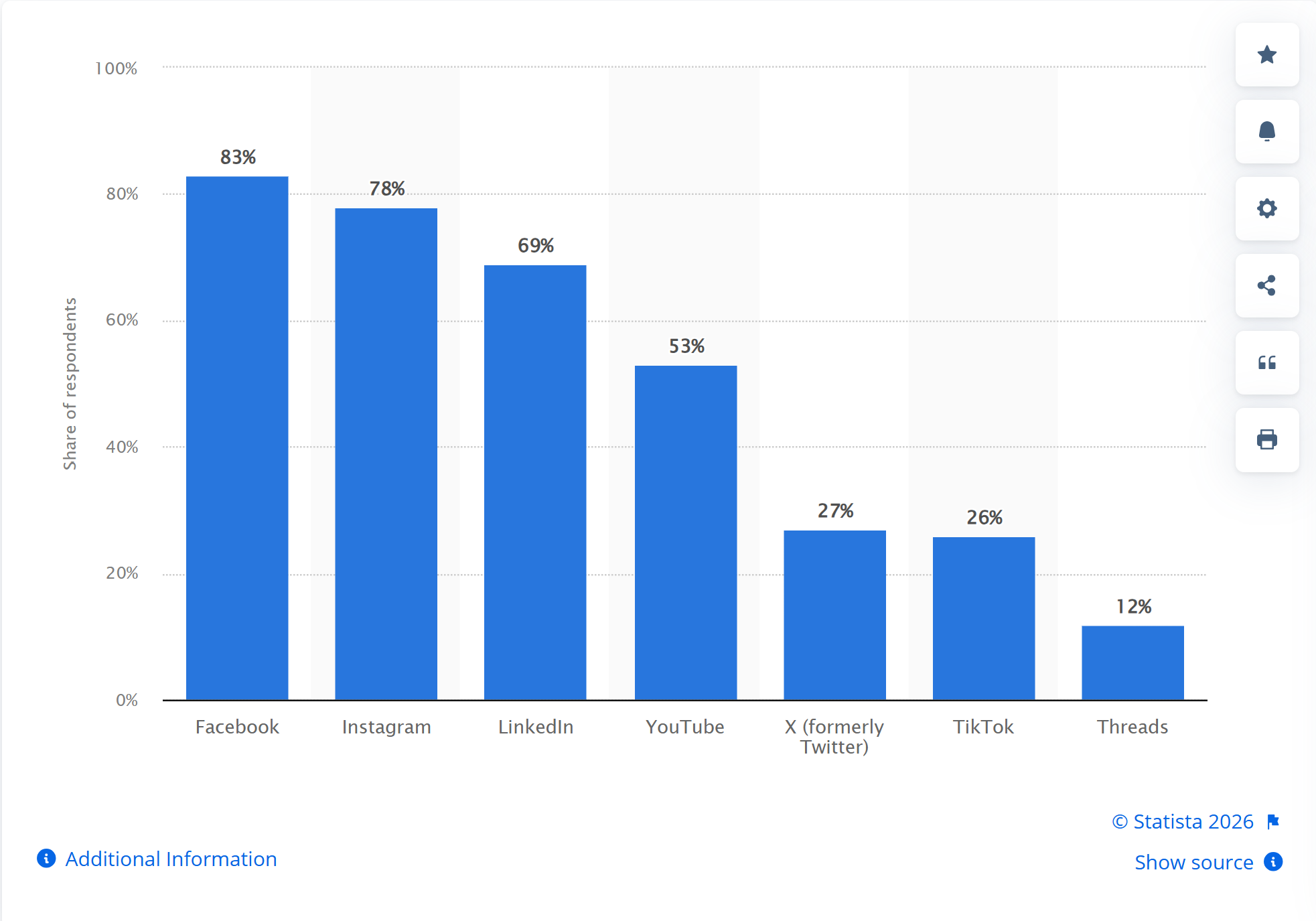
Eighty-three percent use Facebook, 78% percent use Instagram, and 69% use LinkedIn. When that many advertisers crowd the same platforms, auction dynamics change.
You’re not just vying with your direct competitors anymore — you’re bidding against every e-commerce brand, local business, and B2B company fighting for the same eyeballs. Q4 turns especially brutal when retailers flood feeds with holiday promotions.
LinkedIn charges the most per click because you’re reaching CFOs, VPs, and decision-makers who approve budgets. Facebook and Instagram cost less per impression because you’re casting a wider net across consumer demographics. TikTok’s low CPMs look tempting until you realize the platform buries anything that doesn’t use native vertical video with trending sounds, which means your Instagram content dies there, and you’re paying for separate production.
| Platform | Marketer Adoption | Best For | Cost Consideration |
| 83% | Broad consumer reach, e-commerce, local businesses | High competition drives costs up in peak seasons | |
| 78% | Visual brands, lifestyle products, influencer partnerships | Strong engagement on Reels offsets higher production needs | |
| 69% | B2B, professional services, enterprise sales | Premium CPCs justified by decision-maker access | |
| TikTok | Growing fast | Gen Z/Millennial targeting, viral potential | Lower CPMs but video production costs compound |
| YouTube | 53% | Long-form content, tutorials, brand storytelling | Ad costs vary by placement and video length |
Content format performance matters more than raw CPM. Emplifi tracked over 200,000 brand accounts and found Instagram Reels and TikTok short video consistently pull stronger engagement than static posts. Paying half the cost per impression doesn’t help when your static images get ignored.
The shift to video advertising reshapes platform economics. Social video now represents $27.2 billion of the US $72.4 billion digital video market according to IAB’s 2025 research. That’s not a side channel anymore — it’s a primary battleground. Thirty-six percent of marketers told IAB they’re ready to move budgets between social and connected TV depending on what performs, which keeps platform pricing in constant motion as advertisers chase results.
B2B software companies closing $50K deals absorb LinkedIn’s premium rates because one conversion justifies the spend. Consumer brands selling thirty-dollar products need Facebook’s volume because margins don’t support expensive clicks. Understanding digital marketing cost patterns helps you spend where your specific customers convert instead of following competitors onto platforms that don’t match your economics.

Industry Comparison: How SMM Pricing Varies by Sector
Social media costs change depending on what industry you’re in. A fashion retailer and a healthcare provider both need social presence, but they’re paying for different things.
Retail, fashion, and food brands churn through content at high speed. Product photography from last month already looks dated. Video needs constant refresh. Audiences expect new angles, new styles, new everything. The production never stops because visual products live or die on perceived newness.
| Industry | Content Frequency | Main Cost Drivers | Engagement Pattern |
| Fashion & Retail | High volume, daily posting | Professional photography, influencer partnerships, constant visual refresh | Upper end of benchmark range |
| Food & Beverage | Very high volume | Food styling, video production, user-generated content programs | Upper end of benchmark range |
| B2B SaaS | Lower volume, strategic | LinkedIn advertising, case study production, thought leadership content | Lower end of benchmark range |
| Healthcare | Moderate volume | Compliance review, patient education content, HIPAA considerations | Mid-range engagement |
| Financial Services | Lower volume, highly vetted | Legal approval, regulatory compliance, educational messaging | Lower end of benchmark range |
| Real Estate | Moderate-high volume | Property photography, virtual tours, local market targeting | Mid-to-upper range |
These production and compliance differences show up in performance metrics too. Ecommerce and retail brands dominate interactions in Emplifi’s tracking of 200,000+ accounts, especially with short video — which explains why they keep spending on fresh visual content.
Engagement rates span 1.4% to 2.8% across industries per Hootsuite’s 2025 data, with visual brands at the high end justifying their production budgets and B2B at the low end. Social commerce reached $114.7 billion in retail sales last year, giving fashion and beauty brands direct ROI from social spend that B2B companies never see.
Sector knowledge often trumps budget size, which is why many businesses outsource social media marketing to teams already familiar with industry regulations and content requirements.
Business Size Comparison: Small vs. Medium vs. Enterprise
Business size changes social media costs more than you’d expect. Two companies posting the same amount can have budgets that differ by $40,000 monthly.
Small businesses stick to one or two platforms and handle most content internally, bringing in freelancers when needed. Medium companies spread across three or four platforms and either build small teams or work with agencies on retainers. At this stage they start tracking CAC and conversion rates hard because the numbers finally justify the effort. Enterprises run social across brands, markets, and regions with dedicated internal teams plus agency support for specialized work.
| Business Size | Platform Coverage | Team Structure | Primary Pricing Model |
| Small (1-50 employees) | 1-2 platforms | Freelancers or DIY with occasional help | Hourly rates or project-based pricing |
| Medium (51-500 employees) | 3-4 platforms | Small in-house team or agency retainer | Monthly retainers or subscription-based model |
| Enterprise (500+ employees) | 4-6+ platforms | Dedicated in-house team + agency partnerships | Monthly retainers with performance-based pricing elements |
Budget allocation reflects these differences.
Social media takes 11.3% of marketing budgets on average, but B2C product companies spend 19.2%, according to The CMO Survey’s 2025 data. Eighty percent of marketing leaders are pulling money from other channels to fund social, and 87% plan to increase paid spend per Sprout Social’s latest report.
Smaller companies have tactical advantages; larger ones don’t. Emplifi found collaborative posts generated 3.4× higher engagement for extra-small brands in Q4 2024, yet only 4.1% of brands used them. Early adoption of new formats matters more when you’re competing on creativity instead of budget size.
Small businesses optimize for efficient customer acquisition cost. Enterprises optimize for brand consistency across dozens of markets while keeping every post compliant.
Which Works Best for You: In-House, Agency, or Freelancer and What’s Most Cost-Effective
Team structure changes costs and capabilities faster than almost any other social media decision.
| Setup | Monthly Cost | Best For | What You Gain | What You Lose |
| In-House | $8,000-$25,000+ | Daily brand control, fast responses | Everyone knows your voice intimately | Limited specialists, fixed overhead |
| Agency | $3,000-$20,000+ | Diverse expertise without hiring | Access to specialists, scalable help | Slower to learn your business |
| Freelancer | $1,500-$8,000 | Specific projects or skill gaps | Flexible costs, niche skills | Availability gaps, quality varies |
| Hybrid | $5,000-$30,000+ | Balancing control with specialization | Combines strengths of both | Coordination gets messy |
In-house teams live with your brand daily. They know the product roadmap, catch tone problems before posts go live, and understand why last quarter’s campaign flopped based on things no external partner sees. You’re paying them whether you post five times this month or fifty. Salaries, benefits, and software subscriptions don’t flex with workload.
Agencies bring people you’d never hire full-time — motion graphics specialists, TikTok experts, paid media analysts who’ve spent millions on Meta. They scale capacity up for launches and back down after. The learning curve hurts though. New agency partners need months to understand what makes your product actually different from the three similar competitors they already work with.
Companies are building in-house teams for everyday social work and bringing in agencies when they need specialized skills or campaign firepower. Measurement quality beats team structure every time. Nielsen’s research shows marketers who track social media marketing investment across their full media mix outperform those running on gut instinct with disconnected metrics.
Final Thoughts
Social media costs vary wildly by industry and company size. B2B companies optimize for compliance and precise targeting. Retail brands burn budgets on constant visual production. Your typical social media marketing budget needs to match those realities, not generic averages. What you spend matters less than what you get back. Track CAC, conversion rates, and actual revenue instead of engagement metrics. The average social media marketing cost means nothing if your ROAS justifies the investment.