- B2B and SaaS SEO success depends on aligning technical performance, content quality, and clear product positioning.
- Competitor analysis helps identify high-intent opportunities, content gaps, and realistic benchmarks for organic growth.
- Effective SaaS content focuses on real use cases, product education, and problem-solution clarity rather than generic thought leadership.
- Link building for B2B brands works best through digital PR, partnerships, integrations, and authoritative industry mentions.
- Optimizing for AI and LLM-driven search requires consistent messaging, structured data, and a well-defined product entity.
- Keyword clustering and intent mapping support scalable site architecture and higher-converting landing pages.
B2B SEO involves optimizing a company’s website to attract other businesses through organic search. It emphasizes targeting specific, high-intent keywords, establishing authority, and delivering educational content that supports long, complex sales cycles involving multiple stakeholders. Unlike B2C SEO, B2B SEO focuses on generating quality leads, enhancing brand reputation, and nurturing prospects.
About 61% of B2B customers start their purchase journey with a web search on search engines. A successful B2B marketing strategy places your business website in front of people looking to buy your products. SEO and GEO methods (AI‑driven optimization) are an important part of it.
In this guide, we will explore the specifics of B2B SEO, outline the key optimization strategies, and share expert tips to help your business succeed in organic search.
What is B2B SEO?
B2B SEO (Business-to-Business Search Engine Optimization) is the process of optimizing a company’s website to attract other businesses, professionals, and decision-makers through organic search, rather than individual consumers. It aims to drive high-value, targeted traffic, improve visibility for industry-specific search terms, and generate leads.
Difference Between B2B and B2C SEO
The main difference between B2B and B2C SEO lies in the target audience and intent. B2B SEO focuses on driving high-value leads through informative, trust-building content for long decision-making cycles, whereas B2C SEO targets individual consumers with emotional, high-volume content designed for fast, direct, and immediate purchases. Let’s examine this in more detail:
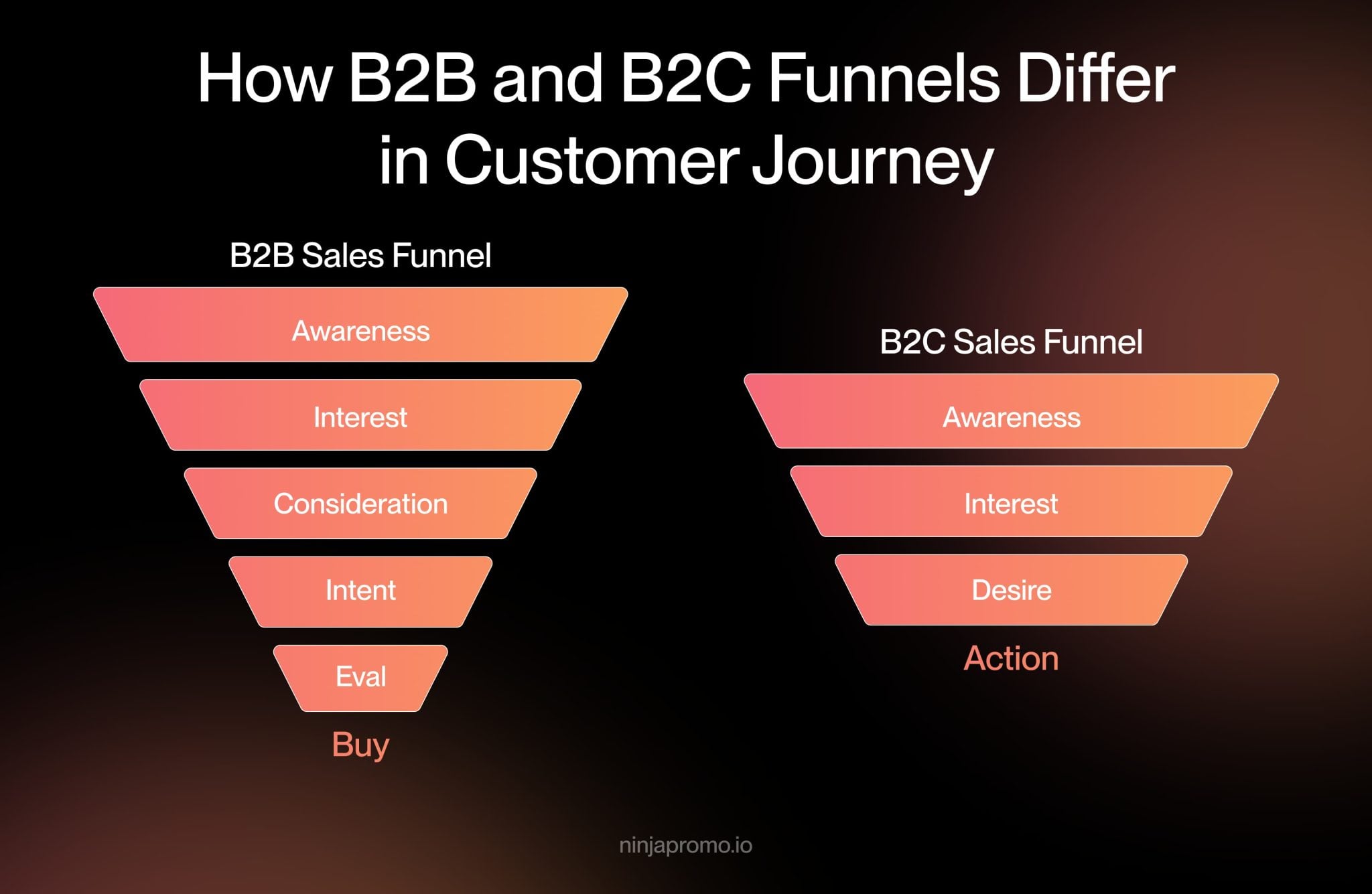
1. More Complex and Longer Sales Funnels
B2B sales funnels are often more complex than B2C (business-to-consumer) customer funnels because B2B sales typically involve a longer buying process and multiple decision-makers.
In contrast, B2C purchase funnels are shorter and involve a single decision-maker (the consumer).
2. Targets Low-Volume Keywords
Business-to-business SEO often involves optimizing for longer, more complex key phrases and phrases, whereas B2C SEO may focus on more short, direct keywords.
In B2B SEO, keyword strategies typically prioritize niche, intent-driven phrases that reflect specific business problems and decision-making contexts, such as “enterprise resource planning software for manufacturers.” In contrast, B2C SEO often focuses on broader, higher-volume product and category terms like “laptops” or “fitness equipment,” while also using long-tail queries to capture purchase-ready consumers.
3. Low Conversion Rates
Conversion rates are lower in business-to-business SEO than in B2C SEO because business-to-business transactions often involve a larger budget, which may require more research and consideration before making a purchase.
Besides, B2B products and services are often more complex and require more technical knowledge, which may slow the decision-making process.
In contrast, B2C sales create a sense of urgency and appeal to a customer’s desire for a product or service, making it easier to convert a customer.
4. Content for Decision Makers
B2B content marketing typically emphasizes educational, problem‑solving formats such as webinars, white papers, and research reports tailored to buying committees, while B2C content marketing more often leans on emotionally engaging formats like short‑form videos, social media content, and visually rich stories designed for rapid consumer engagement.

5. Marketing Communications
In B2B, marketing communications support longer and more complex buying cycles. Brands rely on in-depth, educational content such as articles, guides, webinars, and email sequences. This content helps multiple stakeholders evaluate solutions and builds long-term trust.
In B2C, purchase decisions often happen faster. Brands prioritize concise and visually engaging touchpoints like social media posts, short videos, push notifications, and display ads, while still using longer-form content for higher-involvement products.

B2B SEO: How to Build a Successful Strategy
The development of a comprehensive business-to-business SEO strategy helps you achieve your business goals and increase visibility in the organic and AI search engines. It should be based on consistent progress. Don’t fall for internet advice about guaranteed SEO results in just a few weeks—proper optimization takes much more time.
Map SEO Keywords to User Intent
Effective B2B SEO starts with understanding how decision‑makers search at each stage of the buying journey. Instead of chasing volume, focus on high‑intent, problem‑specific phrases that signal real business needs.
To research these keywords, analyze customer calls and sales emails, review competitors’ content and SERPs, and mine tools for long‑tail and question‑based queries that match awareness, consideration, and decision stages.
The main reasons to do this research are to attract qualified leads instead of generic traffic, align content with real buying pain points, and prioritize SEO efforts around terms that can actually drive pipeline.
You also need to identify keyword intent and determine which keywords should be used on each type of page:

Structure Your Website Around Keyword Clusters
Keyword clustering is a practical way to turn a messy list of keywords into a clear, topic‑based site architecture that reflects how your audience actually searches. By grouping similar search terms into clusters and mapping each cluster to a specific page or section, you make it easier for both users and search engines to understand, navigate, and index your content logically.

The table below shows simple, repeatable steps to move from raw queries to a clean website structure using keyword clusters:
| What to do | How/why it helps (short) |
| List all target search queries | Gives a complete topic overview and avoids duplicates |
| Group similar queries into clusters | Aligns close intents (synonyms, subtopics, variations) |
| Keep clusters to 3–5 keywords | Keeps each page focused on one clear topic |
| Assign one page per cluster | Prevents cannibalization and clarifies page purpose |
| Map clusters to themes and page types | Connects queries to real page roles in the sitemap |
| Create/optimize content by cluster | Increases relevance and semantic coverage per page |
| Review and merge/split clusters | Refines structure as keyword data and content grow |
Picture a B2B SaaS company building a hub for “enterprise data security.”
You start with a central pillar page at /enterprise-data-security/ that covers core concepts, key challenges, and use cases for decision‑makers.
Beneath it, you create focused subpages such as:
- /enterprise-data-security/cloud-security-solutions/
- /enterprise-data-security/compliance-and-governance/
- /enterprise-data-security/integration-with-existing-systems/
Each subpage links back to the main pillar and cross‑links to related subpages, creating a tight internal network around one strategic topic. This strengthens your topical authority for complex B2B queries, helps buyers navigate by problem type, and signals to search engines that your site is a leading resource on enterprise data security as a whole.
Conduct a Full Technical SEO Audit
Performing technical SEO audits help you identify website issues that restrict your site’s organic visibility.
Here are the steps to conduct a technical site audit:
- Identify the crawl errors: Use tools such as Google Search Console to identify and fix any crawl errors, such as broken links, that may prevent search engines from properly indexing your site.
- Optimize page load speed, and core web vitals score: Optimize images, reduce excessive coding, and use a content delivery network (CDN) to improve page load speed. Also, check the core web vitals score using Google Search Console and take steps to fix it.
- Use structured data: Use schema markup to help web crawlers understand the content and organization of your site.
- Check for mobile-friendliness: Ensure your site is mobile-friendly and properly optimized for mobile devices.
- Use a sitemap: Create and submit a sitemap to help web crawlers discover and crawl your website’s pages.
- Use 301 redirects: Use 301 redirects to redirect traffic from old or removed pages to relevant new pages, to prevent 404 errors, and to pass link equity.
- Check for duplicate content: Use tools such as Siteliner to identify and resolve duplicate content issues on your site.
- Check for broken links: Use tools such as Ahrefs or SEMrush to identify and fix any broken links on your site.
- Check for security: Ensure that your site has a valid SSL certificate and is properly secured to protect your website from hacking and other security threats.
- Check for page titles and meta descriptions: Verify that all pages on your website have unique, relevant, and compelling meta titles and meta descriptions.
- Check for hreflang tags: If your website targets multiple languages or regions, you should use hreflang tags to signal to web crawlers which language or regional version of a page they should show to users.
Build a Structured Data Framework to Help Search Engines Interpret Your Content
Structured data helps search engines and AI understand who you are, what you sell, and which pages matter most for specific B2B queries. It won’t magically boost rankings, but it can improve rich results, CTR, and trust signals for decision‑makers.
📈Most useful schema types for B2B
- Organization (home, About) – company name, logo, website, contacts, social profiles, industry.
- Service / Product / SoftwareApplication (solutions, pricing) – what your solution does, who it’s for (B2B), industries, plans, trial info.
- Article / BlogPosting / TechArticle (guides, reports) – authors, publish date, topic to highlight thought leadership content.
- FAQPage (FAQs on product/pricing/integration) – common questions about security, SLAs, pricing models, onboarding.
- HowTo (implementation docs) – step‑by‑step integration or setup guides for your product.
- BreadcrumbList (all deeper pages) – clear path like Solutions → Industry → Use case for better snippets and navigation.
✅Simple Examples
- A SaaS pricing page uses SoftwareApplication + Offer for each plan (e.g., Growth, Enterprise) with price, billing period, and user limits.
- A “B2B Payments 2026 Report” blog post uses Article schema with author, datePublished, and about=B2B payments, compliance, FX.
- An “API onboarding FAQ” section uses FAQPage schema to surface key answers (security, uptime, data storage) directly in search results.
In B2B, links should come from relevant, trusted organizations in your industry (vendors, associations, media, partners) and then be passed through internal links to your key solution and lead‑gen pages.
Build a Link and Internal Linking Strategy That Supports B2B Growth
Effective link building strategies play a critical role in B2B SEO, as they strengthen domain authority, AI visibility, and relevance to search engines. Internal links within the website are just as important, as they help search engines better understand site structure, distribute link equity across pages, and improve the visibility of key sections. Let’s take a closer look:
B2B Link Building (External)
Get links from:
- Industry publications and niche media that cover your market (e.g., manufacturing, logistics, IT services).
- Partners, distributors, and integration/technology allies that list you on “Partners” or “Solutions” pages.
- Professional associations, events, and directories where your buyers look for vendors.
- Guest articles, expert interviews, and quotes where your specialists comment on industry topics.
- Original studies, benchmarks, and case studies that others reference as data or best practices.
✅Example: A B2B equipment supplier is linked from an industry association’s vendor directory, from a distributor’s “Our Partners” page, and from a trade journal article citing their maintenance study.
Internal Linking (Within Your B2B Site)
Use internal links to:
- Point from high‑traffic pages (home, blog, resources) to core pages: Solutions, Industries, Use Cases, Services, Contact/Request a Quote.
- Build topic hubs: a page like “Predictive Maintenance for Industrial Equipment” links to subpages for “For Manufacturers”, “For Energy Companies”, “For Transport Fleets”, and they link back.
- Add contextual links inside articles and case studies toward relevant service/solution pages (e.g., “reducing downtime in production” → “Maintenance Services” + “Automotive plant case study”).
Create Expert B2B Content Across Multiple Channels
74% of marketers agree that content marketing helped them generate more demand and leads.
For B2B SEO, your blog is just one part of a broader expert content ecosystem that should cover search, social, email, and events. The goal is to answer real buyer questions in depth, then distribute that content where decision‑makers actually spend time.
Below is a compact table showing what content to create and where to use it for B2B success:
| Content type | Where to publish / how it helps B2B SEO |
| In‑depth blog posts | Website blog/content hub – capture SEO demand, answer pain points, feed internal links to solutions and case studies. |
| Case studies | Website (Resources/Customers), sales decks – rank for use‑case queries, prove ROI with concrete numbers. |
| Whitepapers/research | Landing pages with forms – target complex, high‑intent topics, earn backlinks, fuel lead gen. |
| Webinars & on‑demand video | Landing pages, YouTube, LinkedIn events – show expertise, create transcriptions and clips that support SEO pages. |
| How‑to guides & docs | Help center, resource hub – win long‑tail “how to” queries, guide users from issues to solutions. |
| Infographics & visuals | Blog, whitepapers, LinkedIn posts – make complex data scannable, increase shares and time on page. |
| Email newsletters | Distribute top content to subscribers and re‑engage visitors who first found you via search. |
| LinkedIn thought leadership | Personal and company pages – amplify SEO content, reach decision‑makers, generate branded search. |
| Community posts/Q&A | Niche forums, Slack/Reddit/Quora – answer specific questions and drive qualified traffic back to key content. |
Optimize Your B2B SEO for AI‑Driven Search
As generative AI answers become the first thing B2B buyers see, your site has to look like a clear, trustworthy “source of truth” that AI can easily quote and summarize. You’re effectively writing for humans and AI at the same time: decision‑makers with complex needs, and models that build instant overviews from your content.
First, AI-driven search changes how success is measured. Rankings alone matter less. What counts is stronger brand search, more qualified organic leads, and conversions from informational pages that AI systems often summarize. When buyers arrive already familiar with your terms and value proposition, it’s a sign your content is being picked up by AI.
Second, AI snapshots increase the need for consistent messaging. When the same positioning and key ideas appear across blogs, reports, webinars, and interviews, AI models recognize your brand as a reliable source. This makes it more likely that AI overviews reflect your language, highlight your strengths, and keep your brand visible throughout the B2B buying journey.
See how AI for content optimization can strengthen structure, improve readability, and keep B2B messaging consistent across search-focused content.
✅Practical Actions:
- Start key pages with a 2–3 sentence direct answer to the main question or topic.
- Use natural, question‑based headings (e.g., “What is…?”, “How does… work for enterprises?”).
- Build deep topic hubs (pillar + supporting pages) around specific B2B problems and use cases.
- Add structured data (Organization, Product/Service, Article, FAQPage, HowTo, BreadcrumbList) via JSON‑LD.
- Make pages easy to “scan” with clear H2/H3s, bullets, and concise paragraphs.
- Show real expertise: named authors, case studies, original data, and specific examples.
- Refresh high‑value pages regularly so facts, regulations, and product details stay current.
Strengthen B2B Trust and SEO with Proven E‑E‑A‑T Principles
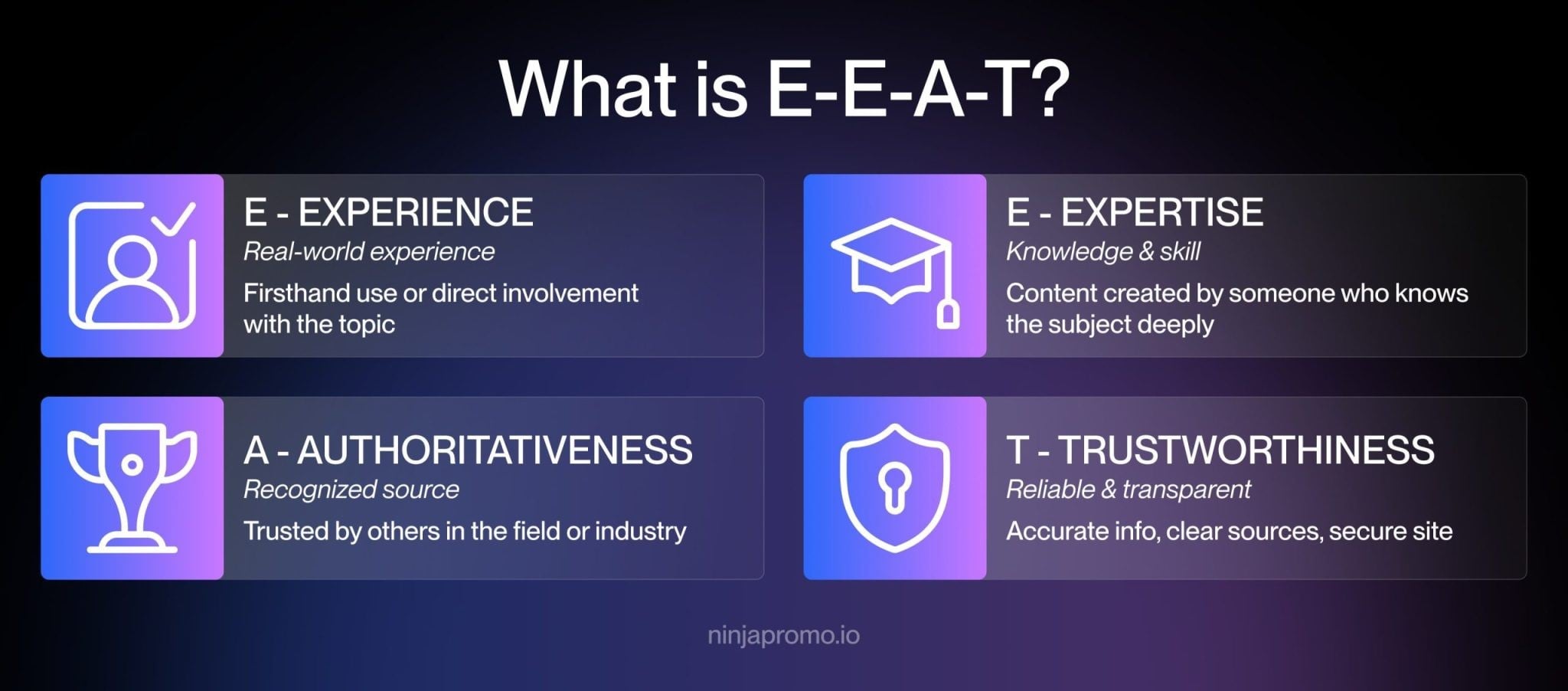
B2B decisions are driven by logic and verification: buyers rely on credible facts, data, and signals of reliability. Search engines, particularly Google, prioritize E‑E‑A‑T (Experience, Expertise, Authoritativeness, Trust) signals when evaluating B2B content. The clearer the origin of data and demonstrated hands‑on experience, the higher the quality of leads.
✅Essential Elements for a B2B Website:
- Detailed author profiles with job titles and verified professional experience.
- Credible sources and references (industry reports, regulators, and recognized publications).
- Regularly updated sections with market insights, research, and case studies.
- “About” page featuring company ownership, licenses, awards, and partnerships.
- Verified client testimonials and brand‑backed success stories.
- Clear contact information, including physical address and department‑specific emails.
- Security signals — HTTPS, privacy policy, and cookie consent banner.
- Media mentions, publications, and expert panel participation by company specialists.
- Structured data (schema.org) for rich and accurate search snippets.
- Continuous content updates reflecting market or regulatory changes.
Conclusion
SEO for B2B is demanding: buying cycles are longer, stakeholders are many, and websites are usually more complex and technical. When you apply the right organic tactics consistently, you can turn this complexity into an advantage by increasing your visibility in both traditional search results and AI. When implemented effectively, the strategies outlined in this guide recognize your company as a trusted expert, generating more opportunities and higher ROI from search engines.