- Choosing between specialized and full-service agencies depends on whether a business needs focused expertise or broader marketing support.
- A strong digital marketing agency should combine strategy, execution, and optimization across both organic and paid channels.
- Agencies are especially valuable for businesses that want access to multiple specialists and a more coordinated approach to growth.
- The right partner should be evaluated through clear questions about goals, experience, pricing, reporting, and strategy.
- Warning signs such as vague pricing, generic case studies, and overpromising often suggest an agency may not be the right fit.
Choosing a digital marketing agency gives your business access to deep expertise across multiple channels, helping you save time and budget while driving stronger ROI through data-led, strategic execution. At the same time, agencies can vary in scope: some are highly specialized, focusing on specific areas like SEO, PPC, or content, while others operate as full-service partners covering the entire marketing ecosystem.
This flexibility allows businesses to choose a model that fits their goals, whether it’s solving a specific challenge or building a comprehensive, long-term growth strategy.
Over 6 billion people worldwide now use the internet, highlighting how deeply digital channels are integrated into everyday life. A well-rounded strategy requires working with true professionals in their field. Let’s break down the key points to consider when choosing one.
Different Types of Digital Marketing Agencies at a Glance
Digital marketing agencies can differ quite a lot in how they work and what they focus on. Some concentrate on one specific area, while others take a broader approach and handle multiple parts of a brand’s marketing strategy at once.
Explore an example of how agencies can be categorized based on the services they provide:
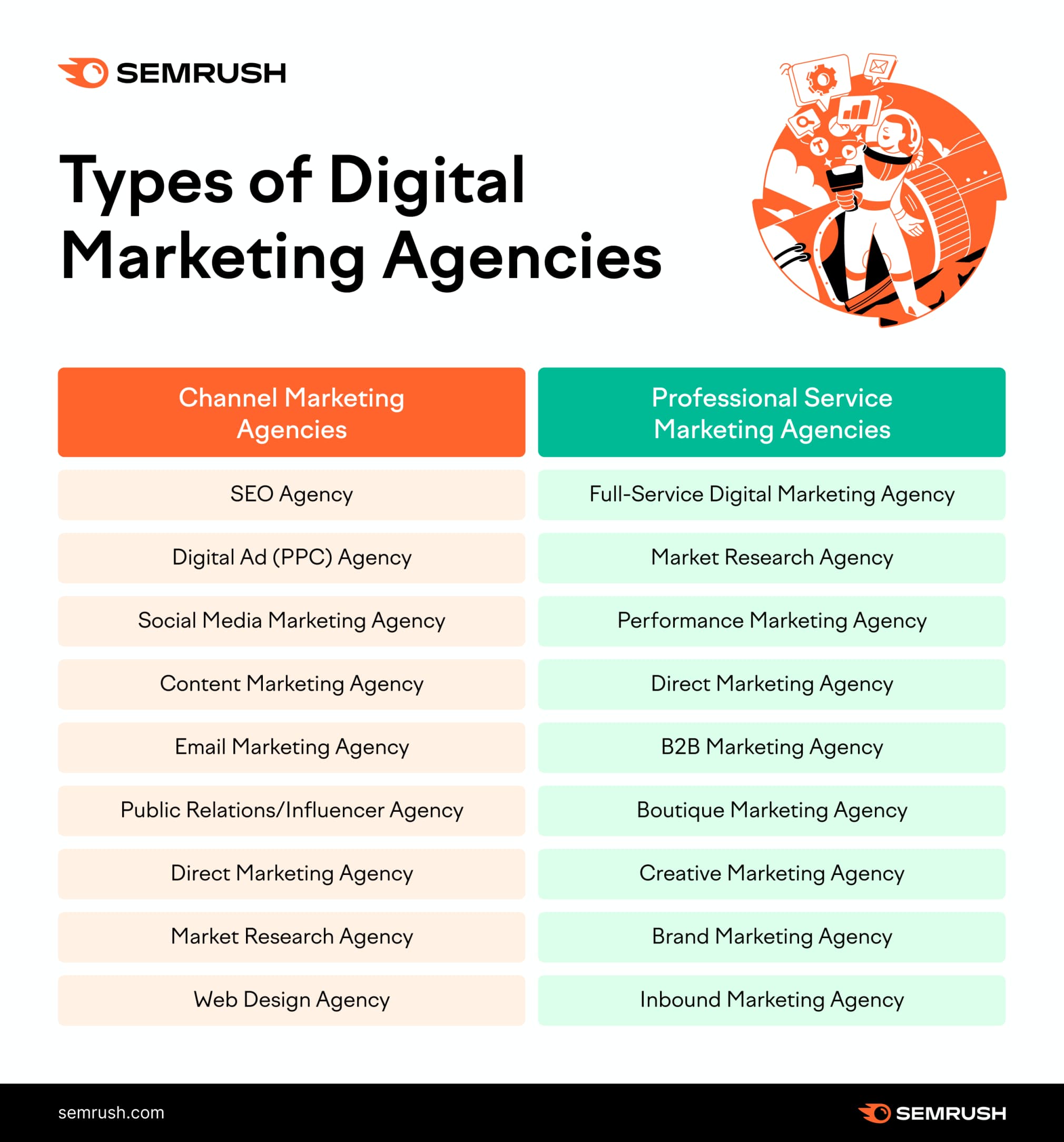
In practice, the real distinction goes beyond the services offered and lies in how an agency supports your business goals. Choosing the right fit means aligning with a partner that solves the specific challenges you face.
They can also be structured around different pricing models. Some work on a subscription basis with a fixed monthly fee, which is often better for ongoing support and long-term collaboration. Others charge for specific services or deliverables, making them a stronger fit for one-time projects or clearly defined tasks.
Learn more about digital marketing cost in our detailed guide.
What Services Should an Effective Digital Marketing Agency Provide?
An effective digital marketing agency should offer a balanced mix of strategy, execution, and optimization across both organic and paid channels. The table below outlines the core services that help brands build visibility:
| Service | Why it matters |
| Search Engine Optimization (SEO) | Increases a website’s chances of appearing in relevant searches and brings steady organic traffic. |
| Pay-Per-Click (PPC) Advertising | Delivers immediate visibility and helps attract targeted visitors through paid campaigns. |
| Social Media Marketing | Builds audience awareness and keeps the brand present in everyday online conversations. |
| Content Marketing | Supports trust and authority by providing useful, relevant information to potential customers. |
| Email Marketing | Keeps communication direct and helps move leads and customers toward action. |
| Digital Marketing Training | Gives internal teams the knowledge they need to work more effectively with digital tools and channels. |
| Branding | Shapes how people recognize and remember the business across every touchpoint. |
| Website Design & Development | Creates a stronger user experience and makes the site easier to use and convert. |
| Conversion Rate Optimization (CRO) | Improves the percentage of visitors who complete a desired action. |
| Marketing Automation | Streamlines repetitive tasks and makes customer communication more timely and personalized. |
| Video Marketing | Presents information in a more engaging format and increases audience attention. |
| Public Relations (PR) | Helps build reputation and secure broader exposure through media and public communication. |
| Influencer Marketing | Connects brands with relevant communities through trusted creators. |
| Lead Generation | Helps businesses capture interest and build a pipeline of potential customers. |
| Community Management | Encourages stronger relationships with followers and keeps engagement active. |
| Mobile App Marketing | Supports app discovery, downloads, and long-term user retention. |
Combining several of these services is especially valuable for achieving comprehensive business growth.
You might be interested: Top Digital Marketing Tools to Use in Your Work
Why Businesses Choose Agencies Over Freelancers and In-House
Businesses often compare agencies, freelancers, and in-house teams before deciding how to manage their marketing. Each option has its own strengths:
Agencies
✅ Pros:
- Offer a full team with different skill sets.
- Provide access to strategy, design, content, paid media, and analytics in one place.
- Scale up or down more easily depending on business needs.
- Bring broader experience from working with different industries and campaigns.
- Usually deliver more consistent results than a single specialist.
❌ Cons:
- Can be more expensive than freelancers.
- May feel less personal than a dedicated in-house employee.
Freelancers
✅ Pros:
- Often more affordable for small tasks or short-term projects.
- Good for very specific work, such as copywriting, design, or paid ads.
- Flexible and easy to hire quickly.
❌ Cons:
- Usually limited to one area of expertise.
- Harder to coordinate when multiple marketing tasks are needed.
- Availability can be inconsistent.
- Results may depend heavily on one person’s capacity and experience.
In-House Teams
✅ Pros:
- Fully focused on one brand.
- Easier to communicate with every day.
- Stronger internal knowledge of the company, product, and audience.
❌ Cons:
- More expensive to build and maintain.
- Requires hiring multiple specialists to cover different functions.
- Can lack the outside perspective and cross-industry experience that agencies bring.
- Slower to scale when marketing needs grow.
While freelancers and in-house teams can work in certain cases, agencies are often the strongest choice for businesses seeking a flexible, results-driven approach. By bringing strategy and execution together in one place, they offer a more efficient way to drive growth.
Related Content: Choosing the Best SEO Agency: Key Insights for a Winning Partnership
What Questions to Ask When Choosing a Digital Marketing Agency
Choosing the right digital marketing agency goes far beyond comparing prices or scanning portfolios. It’s about identifying a partner that truly understands your goals, aligns with your way of working, and can translate ideas into measurable business growth. The most effective way to evaluate this is asking the right questions that reveal how they actually think:
Business Goals and Needs
🎯 What are you trying to achieve with digital marketing?
This question helps the agency understand whether the priority is sales, awareness, lead generation, product promotion, or long-term growth.
🧭 Which goals matter most right now?
Some businesses have several goals at once, but this question helps separate the main objective from secondary ones.
📣 Do you need a specialist agency or a full-service partner?
This clarifies whether you need deep expertise in one area or broader support across multiple channels.
🛠️ Which channels are most important for your business?
This helps the agency focus on the platforms and tactics that matter most for your audience and stage of growth.
Experience and Reputation
🏆 Have you worked with businesses like ours before?
This shows whether the agency already understands your industry, audience, or type of challenge.
📁 Can you share relevant case studies?
Case studies reveal how the agency solves problems in real situations, not just how they present themselves.
Team and Expertise
🔍 What specialists are included in your team?
It is useful to know whether the agency has experts in SEO, PPC, content, design, analytics, and other key areas.
📌 How much experience does the team have?
This helps you judge whether the people behind the agency are seasoned professionals or just support staff.
🔄 How do your team members collaborate internally?
This can reveal how smoothly the agency coordinates strategy and execution across different disciplines.
Cost of Services
💰 How is your pricing structured?
This helps you understand whether you are paying a monthly fee, project fee, hourly rate, or performance-based cost.
📋 What exactly is included in the price?
This avoids confusion later and makes it easier to compare proposals fairly.
⚖️ Are there any extra costs we should know about?
This helps prevent surprises related to tools, ad management, revisions, or additional services.
Strategy and Action Plan
🧠 How do you build a strategy for a new client?
This reveals how the agency thinks and whether it takes a custom approach or uses a fixed formula.
📈 Which KPIs will you track?
This helps you understand how the agency defines success and whether its metrics match your business goals.
🚀 What channels and tactics would you recommend for us?
This gives you a clearer view of how the agency plans to reach your audience.
Reporting and Analytics
📊 How often will we receive reports?
This helps you know how regularly you will see progress and whether reporting will be consistent.
🧾 What will the reports include?
A good agency should give you more than numbers; it should explain performance in a way that is useful.
🔎 How do you analyze results and make improvements?
This question shows whether the company is focused on optimization rather than just reporting activity.
📉 What happens if performance is below expectations?
This helps you understand how the agency responds when results need to be improved.

Red Flags to Watch Out for When Choosing a Digital Marketing Partner
Not every agency that sounds polished is actually a strong partner. Some will promise fast results, big growth, and “proven” success, but once the project starts, the reality can look very different. A major red flag is when an agency talks a lot about what it can do, but says very little about how it will do it. For example, if they promise to “grow your brand fast” without explaining the strategy, channels, timeline, or KPIs, that usually means they are selling confidence, not clarity.
Another warning sign is poor transparency. If an agency avoids answering direct questions about pricing, reporting, or who will actually manage your account, that can lead to problems later. Imagine signing a contract expecting senior specialists, only to discover that most of the work is being passed to junior staff with little supervision. The same goes for vague reporting: if they keep sending you attractive charts without explaining what changed, what worked, and what failed, then you are not getting real insight.
It is also risky when an agency tries to sound like the right fit for everyone. Strong partners usually have a clear point of view and a defined approach, while weaker ones often claim they can do everything for every business. If their case studies are thin, overly generic, or impossible to verify, that should make you pause.
Conclusion
Choosing the right digital marketing agency is rarely simple, especially with so many providers offering such a wide mix of services. The best decision usually comes down to a few key factors: how well the agency understands your goals, whether its services match your needs, how its pricing fits your budget, and whether it has the experience and results to back up its claims. With a professional partner, you are not just outsourcing marketing, you are building support for long-term growth.