Paid search marketing, also referred to as search engine marketing (SEM), is a marketing strategy that lets you target a customer base with actionable intent. When done well, it’s one of the go-to methods that millions of businesses use for converting and growing their traffic.
In this article, you will learn how to build up your paid search campaigns from the ground up and optimize them so that you get the most bang for your ad bucks. We will cover keywords, campaign structure, bidding, ad creation, tracking, optimization steps, and more in this complete manual of paid search marketing.
Understanding Paid Search Marketing
Paid search advertising allows you to be visible in front of users the moment they search for a product or service you offer. It is direct, measurable, and user intent-driven, making it one of the most reliable channels for obtaining fast and consistent results.
What is Paid Search Marketing?
Many businesses rely on paid media to scale their marketing. Paid media is an umbrella term for any marketing content that you pay for to promote on an external platform. These platforms include social media, TV, and radio, as well as search platforms like Google and Microsoft.
Because of the high-intent traffic it generates to your site, paid search is often the most cost-effective part of any paid media strategy. These ads typically appear at the top or bottom of the results page, and you only pay when someone clicks on your ad. The best places to run such campaigns are the Google Ads and Microsoft Ads platforms.

You will often see these paid search ads in various formats, such as:
- Text ads
- Shopping ads
- Call-only ads
The format you choose to use will often depend on the intent of the user, such as learning more, comparing options, or buying.
Differences Between Paid Search Marketing and Organic Search
Paid search engine marketing appears instantly on search engine results once your campaign goes live. Organic search takes time because it depends on content, authority, and SEO improvements to your site. Paid search gives you speed. Organic search gives you long-term stability.
Both can play an important role in your marketing, but they support your strategy in different ways. Paid search engine marketing helps you capture users right now. Whereas, organic search helps you build consistent visibility over time.
| Feature | Paid Search Marketing | Organic Search Marketing |
| Visibility | Your ad appears instantly once the campaign is live. | Rankings take time and rely on ongoing SEO improvements. |
| Cost | You pay for each click. | Clicks are free, but SEO requires long-term content and technical investment on your site. |
| Control | You choose keywords, targeting, and placement. | Algorithms decide where your content ranks. |
| Speed | Delivers traffic and leads immediately. | Slower to build but strong for long-term growth. |
| Positioning | Ads appear at the top or bottom of the results. | Rankings appear based on relevance, authority, and optimization. |
| Testing | Easy to test messages, landing pages, and bids. | Testing is slower because changes take time to reflect results. |
| Scalability | You can scale quickly by increasing the budget. | Campaign scaling depends on content output, backlinks, and domain strength. |
Why Businesses Invest in Paid Search Advertising
Businesses choose to invest in paid search marketing because it gives fast and measurable results. There are many benefits of pay-per-click (PPC), such as, you can reach potential customers the same day you launch your campaign and track every click, conversion, and cost.
SEM allows:
- Precise keyword targeting
- Detailed audience controls
- Full visibility into your return on investment
You can test:
- Ad copy
- Landing pages
- PPC budget
- CTAs
If your company is looking for predictable lead flow and better control over its funnel, paid search is one of the most dependable channels you can invest in.
Recent industry data from WordStream shows that conversion rates on paid search ads increased for 65% of the industries they surveyed in 2025. Some categories, including Sports and Recreation and Education and Instruction, recorded increases of more than 40%. This shows that search ads are still an effective way to drive leads, even as some marketers worry about their rising costs and greater competition.
AI overviews, ChatGPT, Perplexity, and other AI chatbots are taking the internet by storm, causing some gurus to suggest PPC is dead. One of NinjaPromo’s paid search experts argues otherwise:
“Yes paid search still works, and in some industries, it actually works better than before. AI answers have taken away a chunk of purely informational searches. That’s true. But paid search was never really about ‘what is’ or ‘how does it work.’ It’s about intent to act.
When someone is ready to buy, book, sign up, or request a quote, they still go where the offer and the action are clear. What we’re seeing now is not the death of paid search, but a cleanup. Less low-intent traffic, more commercial intent. And that usually means higher-quality leads.”
Dennis F., PPC Team Lead at NinjaPromo
Paid Search Platforms to Run Your Ads
There are several platforms where you can run paid search advertising. No one platform is better than another, but one might work better for your business, depending on your target audience and ad budget. Understanding how these ad platforms work can help you with your budget management and allow you to choose one that will work most effectively for your goals and target audience.
| Aspect | Microsoft Ads | Google Ads |
| Network | Bing Search Network
Yahoo AOL DuckDuckGo Ecosia |
Google Search Network
Google Display Network Google Discover YouTube |
| Reach | 23.363 billion global monthly searches | 417 billion global monthly searches |
| Demographics | Ages 35 to 65
Higher income Desktop heavy usage |
Younger and mixed demographics
Mobile heavy usage Broader consumer reach |
Google Ads
Google Ads is the largest and most widely used SEM platform, generating an ad revenue of $264.59 billion in 2024. It has the largest audience of the platforms we mention here, and people begin their search for a wide range of products and services on Google.
Google also provides you with access to display ads, which help you reach users across millions of websites and apps for additional visibility beyond the search results page. So, by advertising on its search engine, you gain immediate access to a large and diverse audience.
You can get very precise with your Google ad strategy because of the extensive targeting options it offers. You can target searches, locations, devices, and demographics. Furthermore, you can also run multiple types of Google ads that support different objectives, such as sales, leads, or brand visibility.
Google Ads offers:
- In-depth reporting tools
- A wide range of keyword options
- Detailed controls over your ad groups, bids, and extensions
If you want a broad reach and a lot of flexibility, Google Ads is the best place to start.
Microsoft (Bing) Ads
Microsoft Ads will connect you with users across Bing, Yahoo, and AOL search networks and partner networks. Though it has a smaller audience size, the competition is lower. The net result can often be cheaper clicks and, with the correct targeting, a good ROI.
Bing has older and higher-income users; if this is your target audience, it makes Bing a great option for your ad campaigns. Even if that’s not your specific audience, other people also use these search engines. So, when you’re looking for extra reach, or if you’re entering a very competitive segment, you can use Microsoft Ads as part of your paid search plan.
Alternative Paid Search Engines
You can also run ads on some platforms outside major networks. Alternatives include DuckDuckGo, Amazon Ads, as well as niche search engines that may also provide good opportunities depending on your product and target audience. These digital advertising platforms work quite well when your aim is to increase audience size, get fresh traffic sources, or reduce reliance upon a single channel.
Explore practical alternatives to Google Ads to diversify paid search, test new traffic sources, and reduce dependence on a single ad platform.
Paid Search Advertising Management: Core Components
Effective paid search management begins with an organized structure and a refined, continually optimizing plan. Campaigns that truly deliver get the results need to have:
- Thoughtful keyword choices
- Organized ad groups
- Consistent PPC optimization
- Thoughtful ad scheduling
When you build that properly, it makes your account easier to maintain and much more efficient.
Keyword Research for Paid Search Campaigns
Keyword research shapes everything you do in paid search. You want to find the terms that match what your customers search for and avoid the ones that waste budget. For your product or service, start with seed keywords that describe it. Then expand the list with tools such as Google Keyword Planner, Semrush, and Ahrefs.
Focus on keywords with clear intent. High intent terms often include words like “buy,” “pricing,” “service,” or specific product names. Use a combination of short-tail keywords for a greater reach and long-tail keywords for more precision.
Look at the following for each keyword:
- Search volume
- Competition
- Estimated cost-per-click
The goal is to build a balanced list. You don’t want one with only high cost, high intent keywords, because it will eat your budget, and your traffic might be too generic. But on the other hand, you don’t want only precise long-tail keywords because they will probably not generate sufficient traffic to your site to see notable results.
Our experts at NinjaPromo also note that with voice and AI searches, you should consider questions and not just phrases.
Our expert explain:
“Keywords are no longer about exact phrasing. They’re about user intent. People speak and type more naturally now, often in full questions, and the algorithms are much better at understanding what they mean. The brands that win aren’t the ones trying to catch every variation. They’re the ones that understand why the user is searching and design their ads and landing pages around that intent.”
Dennis F., PPC Team Lead at NinjaPromo
Match Types (Exact, Phrase, Broad)
Match types control how closely a search query must match your keyword to trigger your ad. This gives you flexibility in how widely you want to reach users.
- Exact match only shows your ads when the search term is very similar or the same as your keyword. Use this match type when you want full control.
- Phrase match shows your ads when the search includes your keyword in the order you specify. This match type offers a balance between control and reach.
- Broad match gives you the widest reach and uses Google’s systems to match your ads with related searches. Use it when you have strong conversion data and want to scale.

A good setup often includes all three match types. You can start with exact and phrase matches, then add broad matches once you have enough data to guide smart bidding.
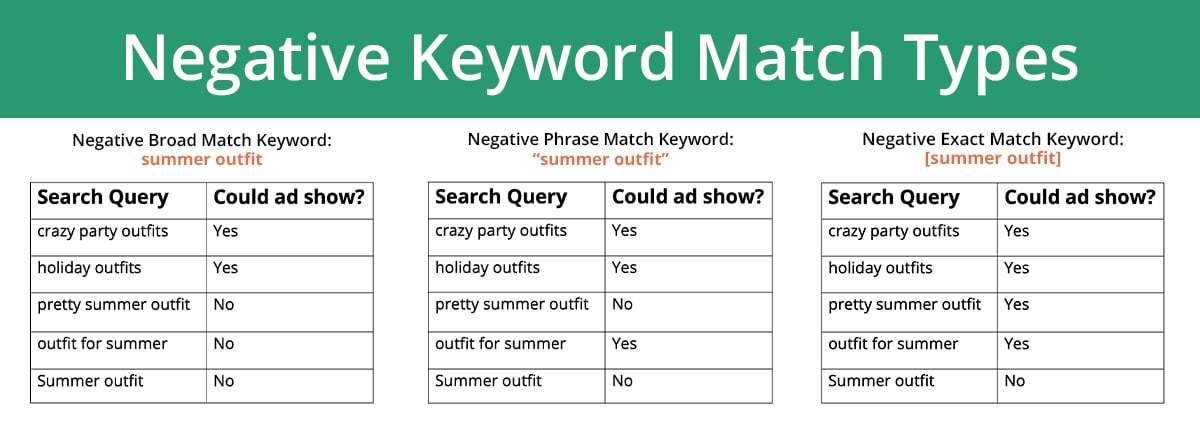
Negative Keyword Strategy
Negative keywords stop you from wasting your PPC budget on clicks that lead nowhere. They stop your ads from being shown when the search query is unrelated to what you sell. This improves your click-through rate and keeps your cost-per-click down.

Research from Proxima shows that many companies are ineffectively spending between 40% and 60% of their digital budgets. A large share of this comes from poor viewability or placement. Using negative keywords can help ensure your ads aren’t shown at irrelevant times and that your entire ad budget is well spent.
For example, if you sell a premium service, you would probably want to add “free” as a negative keyword. This tells the platform not to show your ad when the search includes that word.
Build your negative keyword list by reviewing your search terms report. Look for:
- Irrelevant themes
- Unrelated industries
- Competitor brand names,
- General information searches
Add these terms to your negative keyword list and update it regularly. A solid negative keyword strategy keeps your targeting and your ad spend well-focused.
Structuring Paid Search Ad Campaigns (Campaigns → Ad Groups → Ads)
A clear structure makes your account easier to manage. It also improves relevance and performance.
- Campaigns sit at the top of the hierarchy. They hold your budgets and high-level targeting.
- Ad groups live inside campaigns and contain your keyword themes. Each ad group should focus on one intent or product category.
- Ads live inside each ad group and should connect directly to the keywords in that group.
For example, if you offer three main services, create three campaigns. Then create separate ad groups for specific subservices or themes. This structure helps you control your budget, improve ad relevance, and give you cleaner data from your campaigns that can be used for ongoing optimization.
Budget Allocation and Bidding Strategies
Your budget should reflect the priority of your campaigns. As part of your budget optimization, you will want to allocate more budget to campaigns that generate conversions and hold back spend on campaigns that you are testing out. Review your cost-per-click, cost-per-thousand, impression share, and conversion rate to decide where your ad spend is most effective.
You can choose from several bid strategies within Google Ads.
- Manual bidding gives you full control.
- Automated bidding strategies, such as Target Cost-per-Acquisition, Target Return on Ad Spend, and Maximize Conversions, use machine learning to adjust your bids.
Start with a strategy that aligns with your goals. If you want leads, choose a strategy focused on conversions or cost-per-acquisition. If you are aiming for revenue, use return on ad spend.
Wondering whether you should use a manual CPC or automated bidding strategy? Our expert weighs in:
“In most cases, automated bidding wins. Manual CPC still has its place – usually in very small accounts, niche markets, or early testing phases. But once there’s enough data, smart bidding almost always outperforms manual control. The key mindset shift is this: you don’t manage bids anymore, you manage outcomes.”
Dennis F., PPC Team Lead at NinjaPromo
The average Google Ads cost-per-lead has climbed steadily over the last four years. According to WordStream, the average cost-per-lead increased from $41.40 USD in 2021 to $70.11 in 2025. Rising costs mean you need to keep a closer eye than ever on your ad performance. You should regularly review your keyword selection, campaign structure, and bidding. Good management is the best way to get the best return on your investment.

Writing High-Converting Paid Search Ads
Well-written ad copy helps you stand out and capture the right clicks. Focus on clarity and relevance.
- Use your main keyword in the headline so users know your ad matches their search.
- Highlight your value proposition and what makes you different.
- Use clear calls to action such as “Get a quote,” “Request pricing,” or “Book a demo.”
Write multiple versions of each ad. Test different variations that highlight different benefits, features, pain points, or social proof to see which performs the best. Keep your message simple and use the landing page as the next step for more details.

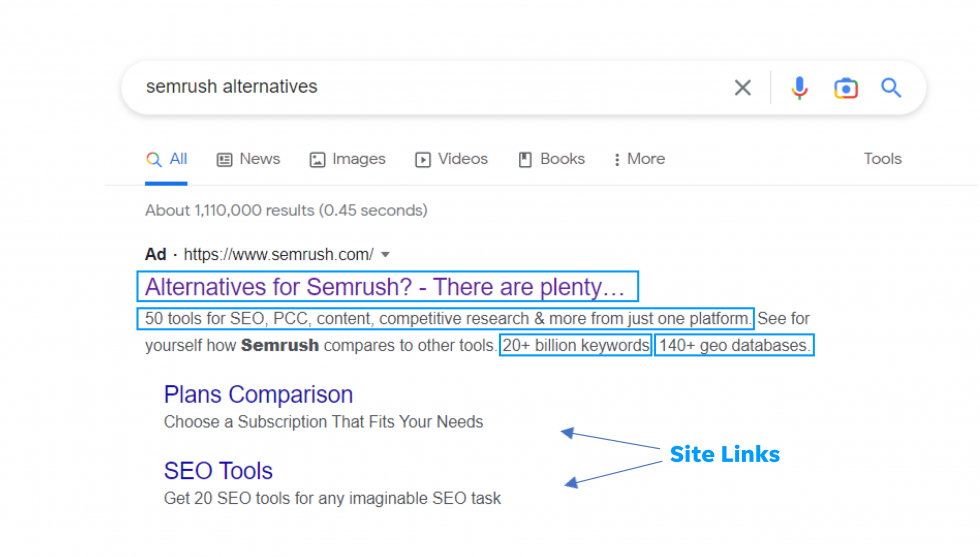
Ad Extensions and Enhancements
Ad extensions give users more information about your business or product, and make your ads more competitive. You can add:
- Sitelinks
- Callouts
- Structured snippets
- Phone numbers
- Location extensions
These extensions help users understand your offer before they click on your ad. They also increase your ad’s visibility and often improve your click-through rate.
Use as many extensions as are relevant to your business. The more complete your ad looks, the more likely users are to engage.

How to Set Up a Paid Search Campaign
A strong paid search campaign starts with a simple and realistic plan. When you define your goals, build a clean structure, and track the right metrics from day one, you give yourself the best chance at steady performance and long-term growth.

Step 1 — Define Your Campaign Goals
Your goals guide every decision you make in paid search. Start by setting a clear and measurable objective. If you want traffic, you can optimize for clicks. If you want leads, focus on form submissions or calls. If you want revenue, optimize for conversions or return on ad spend.
Examples of common goals include:
- Increase qualified traffic
- Generate new leads or demo requests
- Drive online sales
- Improve visibility for a new product
- Capture high-intent users during a promotion
Set one primary goal for each campaign. This helps your bidding strategy and your targeting stay aligned.
Step 2 — Audience and Geographical Targeting
Targeting allows you to reach the right users at the right time. Start with geographic targeting. Focus on regions where you can realistically sell, deliver, or support your service. Narrow your targeting if your budget is small or if you operate in a competitive market.
Next, define your audience. Use demographic filters such as age, income, or household status. You can also target users by interests, online behaviors, or previous interactions with your website. Later on, when you have more data from your campaigns, you can also build remarketing audiences from past visitors or leads to bring warm users back into the funnel.
Use segmentation to group your audience by intent, behavior, or demographic traits so you can deliver more relevant ads to each group. The goal is simple. You want your ads to appear only in front of your target customers.
Step 3 — Building the Keyword List
Your keywords determine where your ads show up. Start by looking for terms that describe your product, service, or category. Include both broad terms (i.e., women’s shoes) and specific long tail keywords (i.e., black Nike women’s running shoes). High-volume keywords will give you reach, whereas long-tail keywords will give you greater precision and lower competition.
Organize your keyword list by intent. Separate the research, comparison, and purchase keywords into different lists. This helps you structure your ad groups and adjust bids based on how close a user is to taking an action. Review estimated cost-per-click and remove any keywords that are too expensive or not relevant.
When building your list, make sure you’re purposeful. Don’t just pile on keywords because they’re relevant.
“Focus beats coverage. It’s far more effective to deeply understand which searches actually drive revenue than to try to cover every possible keyword variation. Search terms reports matter more than the keyword list itself – that’s where real user behavior shows up.“
Dennis F., PPC Team Lead at NinjaPromo
Step 4 — Crafting Ad Copy and Extensions
Your ad copy needs to match the keyword and the user’s intent. Use the main keyword in your headline so users know your ad is relevant. State your unique value clearly. Highlight what makes your offer different. Use simple calls to action such as “Download the guide,” “Book a demo,” or “See pricing.”
Ad extensions will help you stand out.
- Add sitelinks to highlight extra pages.
- Use callouts to list benefits.
- Add a phone number if sales calls are part of your funnel.
Include as many extensions as are relevant for your ad and business. Google will automatically show the best combination.
Good ad copy and extensions increase your click-through rate and improve your Quality Score.
Step 5 — Configure Tracking and Analytics
Tracking gives you visibility of how your campaigns are performing. Install conversion tracking before you launch your ads. Track the most important actions such as form submissions, calls, sign-ups, or purchases. Use Google Analytics to measure behavior on your landing page and identify where users drop off.
Monitor key metrics such as cost-per-click, click-through rate, conversion rate, and cost-per-acquisition. By tracking these revenue-related metrics, you can better understand how much value each dollar of your ad spend brings in. With accurate tracking in place, you can make smarter decisions and allocate your budget where it works best.
Step 6 — Launch and Initial Monitoring
Once your campaign is ready, publish it and monitor performance closely for the first few days. Look for issues such as high costs, low impressions, or low click-through rates. Check your search terms report to identify irrelevant queries and add new negative keywords.
Review your bids, targeting, and ad engagement. If you see early problems, adjust your campaigns quickly. Small fixes in the first week can save a large part of your budget in the future and set your campaign up for long-term success.

Paid Search Optimization Techniques
Optimization maintains performance and profitability. It’s not something you do just one time. It’s something that you repeatedly go back to. Optimize your keywords and landing pages, your bids and budget strategy, and your campaign will perform better and with less waste.
Improving Quality Score
Your Quality Score also greatly affects the performance of your ads. It affects cost-per-click, ad placement and impression share.
Google evaluates three main factors when giving you a Quality Score.
- Anticipated click-through rate
- Ad relevance
- Landing page experience
To increase Quality Score:
- Use keyword-aligned ad copy
- Build tight ad groups around very specific themes
- Use strong calls to action and include extensions to increase engagement
- Make your landing page load speed up
- Make sure your landing page message matches the message of your ad
A good Quality Score helps you reduce costs and improve visibility.
Landing Page Optimization for Paid Search
Your landing page has to get users that have clicked on your ad to convert. Some key points to focus on are to keep the page simple, fast, and relevant. To maintain consistency, repeat the message from your ad so the user knows they’re in the right place.
Point out your offer effectively and demonstrate its value. Include a few basic forms or CTAs that take users to the next step in your buyer journey.
You should also check your mobile experience. Mobile traffic leads to many paid search clicks. Check your bounce rate, time on page, and scrolling depth to see how the users engage on mobile devices. Small adjustments to speed and user experience can have a big impact on conversion and the cost of acquiring customers.
A/B Testing Ads and Creative Elements
What works best is what works best, so it’s always a good idea to include a little bit of A/B testing. Test one element (headline, CTA, etc) at a time, so that you can get clear results.
Test headlines, descriptions, calls to action, benefits, and value propositions. You can also experiment with landing pages or different offers. Keep running each test long enough that you are able to collect useful data. And focus on click-through rate, conversion rate, and cost-per-acquisition as a measure of how well each variation performs.
The winning version should serve as your baseline as you move forward with ongoing testing. Regular A/B testing guides you to getting better and better results from your campaigns over time.

Optimizing Bids and Budgets
Your bids control how competitive you are in each auction. Get to know how best to spend your budget by looking at your cost-per-click, conversion rate, impression share, and search terms for each ad.
Spend more if a campaign works well. If it’s struggling, cut spending or change your keywords and targeting. Try different bidding strategies according to your objectives. If you want more volume, consider Maximize Clicks or Maximize Conversions. If you want efficiency, you could use either Target Cost-per-Acquisition or Target Return on Ad Spend. Go over performance often and rework based on your data.
Reducing Cost-per-Click (CPC) and Increasing ROAS
You can lower your cost-per-click by:
- Improving you ad relevance
- Refining your keyword list
- Using negative keywords.
Focus on search terms with high intent and remove terms that generate low-quality clicks (i.e., people who click but don’t take the action you want them to on your landing page). You can also look to improve your ad copy and landing page to raise your Quality Score.
To increase return on ad spend, spend more on the campaigns that deliver conversions and less on ones that don’t perform as well. Use remarketing to bring back warm leads that you will have a greater chance of converting.
You can also look to improve your funnel so more users convert once they reach your landing page. Funnel optimization helps you lower customer acquisition cost and increase revenue over time.
When you evaluate performance, consider lifetime customer value to understand how much long-term revenue each new customer brings in and how much you can afford to invest to acquire them.
Measuring Success in Paid Search Campaigns
Tracking performance helps you understand whether your campaigns deliver the results you expect. When you measure the right engagement metrics, you can see what works, what needs improvement, and where to invest more of your budget. Strong reporting gives you control and guides every optimization step you take.

Common Mistakes in Paid Search Management
Even well-planned campaigns may lose their momentum if you miss important points. A lot of businesses face the same problems when it comes to paid search management, and most of these problems are easy to address once you’re aware of the issues that will come your way and know to keep an eye out for them. Fixing these errors can help you protect your budget and maintain your performance.
- Using broad keywords without controls: Broad match keywords can waste budget if you don’t use negative keywords or monitor search terms.
- Ignoring the search terms report: You miss irrelevant queries and new opportunities when you skip this report. Review it often to refine your targeting.
- Sending all traffic to your homepage: A homepage is not built for conversions. Use dedicated landing pages that match user intent.
- Leaving bids and budgets unchecked: Costs can rise quickly if you do not monitor your campaigns. Review spending and adjust regularly.
- Running only one ad variation: Without multiple versions, you limit testing and slow down performance improvements.
- Skipping conversion tracking: Without tracking, optimization becomes guesswork. Always track leads, calls, or sales.
- Not updating landing pages: Stale pages can negatively impact your ad performance—review and test improvements to keep conversion rates strong.
- Not reviewing assisted conversion data. This data can help you understand how your paid search campaigns support conversions that may be completed through other channels, such as email, organic search, or remarketing.
- Not monitoring for click fraud. Invalid clicks from bots or competitors can inflate costs and damage performance. Review your traffic sources and use platform-level protection tools to reduce the impact.
The biggest mistake our team identified is expecting ads to fix a broken business:
“If the landing page is weak, the offer isn’t clear, or the product doesn’t solve a real problem, no bidding strategy will save it. Paid search doesn’t hide problems – it amplifies them. The strongest results always happen when marketing, product, and analytics are aligned and working together.”
Dennis F., PPC Team Lead at NinjaPromo
Future Trends in Paid Search Marketing
Paid search continues to evolve, and staying ahead of these changes helps you keep your campaigns performing well.
- AI driven bidding and automation. Platforms continue to rely on machine learning to choose bids, audiences, and placements. Strong data and clean tracking will matter even more.
- More visual search results. Search pages now include images, product feeds, and dynamic formats. Visual assets will play a larger role in driving engagement.
- Greater focus on first-party data. As privacy rules tighten, advertisers will rely more on their own data for targeting and remarketing.
- Better integration with other channels. Paid search marketing works more closely with social ads, CRM tools, and analytics platforms. Cross-channel strategies will become the norm.
- Rising competition in high-intent categories. Costs continue to climb, which means account structure, landing page quality, and optimization will remain essential.
These trends highlight one clear takeaway. Advertisers who invest in clean data, strong creative, and ongoing optimization will stay ahead of the competition.