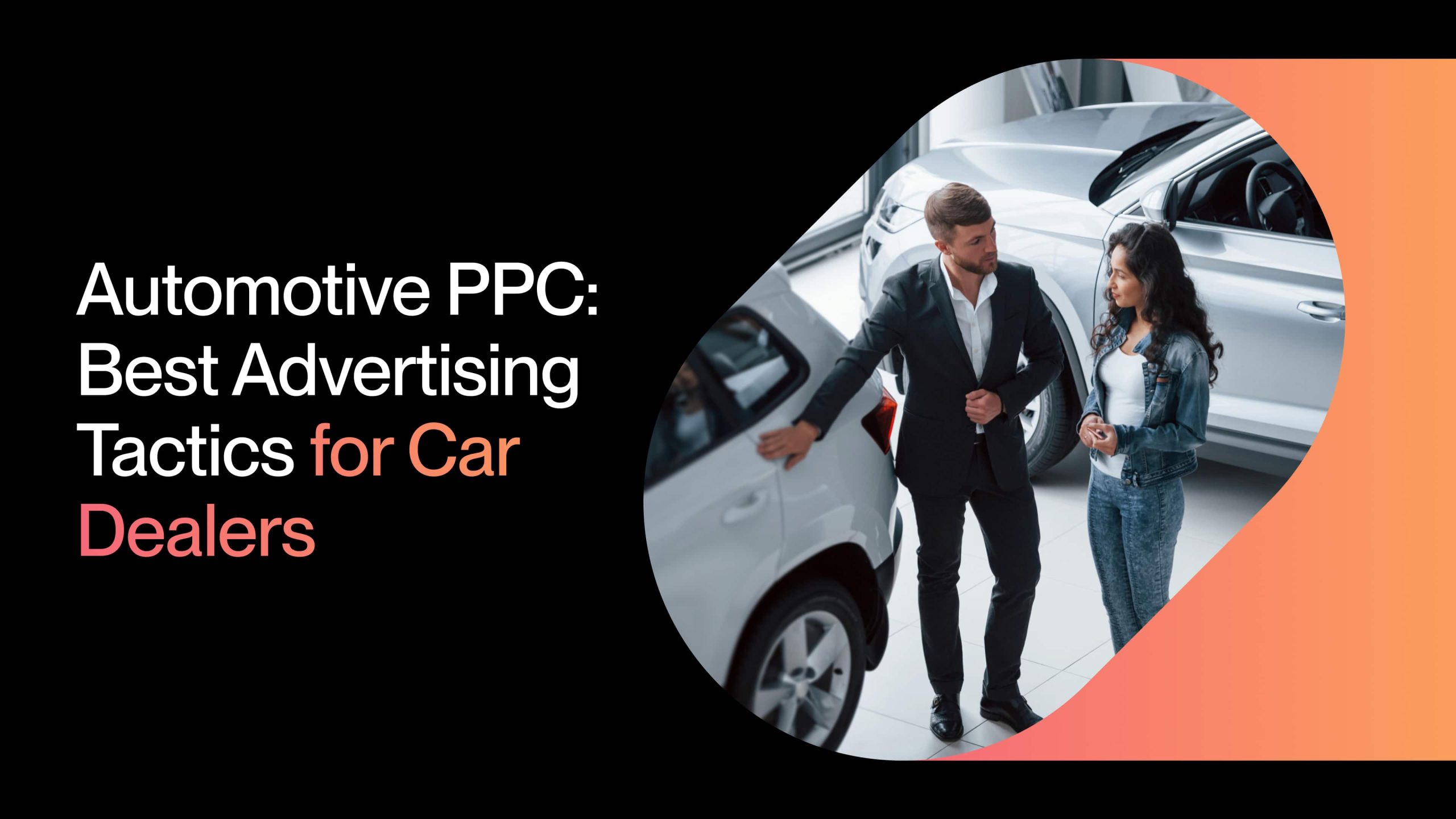
If you have a business in the automotive industry, you’ve probably noticed over the last five years that your online visibility is having a bigger impact than ever on your business. Demand Local found that 95% of car shoppers use digital channels to research options before ever visiting a dealership.
Most buyers have already made up their mind about what kind of car they want before they talk to a dealer. PPC (pay-per-click) advertising helps you to reach these potential customers early, when they are still in their research phase. You can use PPC to place your cars, offers, and brand directly in front of them when their interest is high.
Competition in the industry has only been growing in recent years. This, combined with buyers starting their search for a new car online, means PPC marketing ads have become an important channel for many dealerships.
Local PPC can help dealers reach car shoppers, generate more calls, and bring more foot traffic into their showrooms. One of the big advantages of PPC is that every click and conversion can be tracked, allowing you to see what works and adjust campaigns to improve your ROAS.
In this guide, we’ll cover everything you need to know about automotive PPC advertising, including why it’s so important for your car dealership, how to create a winning strategy, and which advanced tactics deliver the best results.
Why PPC Matters in the Automotive Industry
You’re probably already familiar with automotive PPC. They show up on your social media feed, search engine results, videos when you watch YouTube, and websites across the internet. But just because they’re popular, does that mean that they really work? Let’s review some of the benefits of PPC advertising.
The automotive market is changing, and dealerships need to find ways to keep up. According to Deloitte’s 2025 Global Automotive Consumer Study, brand loyalty is dropping. More and more buyers are considering switching which car manufacturer they buy from. At the same time, higher prices and fluctuating inventories are making things more difficult for dealerships.
PPC helps your dealership show ads to in-market auto buyers wherever they are searching, on Google, social media, and across the web. Whether someone’s looking for “SUVs under $20,000” or “used cars near me,” PPC shows them your listings and offers. This way, you get in front of people who are ready and likely to take action.
WordStream’s 2025 benchmark report suggested PPC ads for automotive brands get more engagement than almost any other industry they tested. On average, click-through rates reach 8.29%, compared to just 5–7% across most other sectors. Car buyers are actively searching for their next vehicle and are ready to spend. This makes PPC one of the best ways to grab their attention at the exact moment they’re looking to buy.

Source: Wordstream
We asked Dennis F., PPC Team Lead at NinjaPromo, why PPC is such an important channel for the automotive industry.
“PPC is critical in automotive because it captures high-intent buyers at the exact moment they are searching for a vehicle or a dealership. Unlike upper-funnel channels, PPC allows us to show tailored ads based on model, pricing, availability, and even local stock – which aligns directly with how users shop for cars. It also offers transparent tracking of calls, VDP views (Vehicle Detail Pages), and lead submissions, enabling data-driven optimization instead of broad media buying.”
PPC helps dealerships connect with the right buyers at the right time. It’s a simple, effective way to build awareness, generate leads, and turn online interest into real showroom visits.
Building a High-Performance Automotive PPC Strategy
Now that you understand how important PPC is to your marketing strategy, you’re almost certainly looking forward to launching your first campaign.

And if you’re in Google, Meta, or another ad platform, here are the steps that will help you plan a campaign that comes into contact with local car shoppers at the correct moment in their buying journey.
Define Clear Goals — Leads, Calls, or Test Drives?
Before you create any ads, consider why you are creating them. What is your goal? What do you want your ads to accomplish? Those sound like simple questions. You’re hoping to sell more cars, right? But there are different ways to do that. Most dealerships focus on three distinct types of success: leads, client calls, and test drives.
Each requires a varied method for achieving this goal the goal you set for your automotive PPC strategy
- Leads: Use lead form extensions or landing pages with short forms to collect contact details.
- Calls: Create call extensions or call-only ads, and list your phone number prominently in each ad.
- Test drives: Write clear CTAs like “Book a test drive today” and send them a link to a clean scheduling calendar.

Dennis tells us more about why this is important:
“For an automotive client, we consolidated all campaigns under a single primary optimization goal: phone calls. Previously, the account was trying to optimize simultaneously for calls, form submissions, and page visits, which diluted the signals and made the algorithm unstable. Once we defined a single, clear conversion goal, the campaigns began to optimize much more effectively:
- The algorithm received stronger, cleaner conversion signals,
- CPC stabilized and decreased by 18%,
- qualified call volume increased by more than 30% within the first month.”
When Google Ads focuses on one prioritized action, the learning phase becomes shorter, optimization becomes stronger, and the system stops wasting budget on low-value micro-conversions. Clear goal definition is one of the most impactful levers for improving PPC performance in automotive.”
Your goal determines how you structure your campaign, what ad formats you use, and which metrics to measure.
✅Pro Tip: Call extensions and location extensions help your audience reach the dealership closest to them without any extra work on their part.
Having goals in place helps you track and improve your ads’ performance using data-driven insights. The harder it is to measure a campaign’s performance if you have more than one goal.
Segment Campaigns by Car Types and Buyer Intent
Segmenting your campaigns is one of the most common and effective ways to improve performance. Rather than lumping all your inventory together, organize it by category. For example, these could be car type, brand, or buyer intent campaigns.
You might create separate campaigns for:
- SUVs and family vehicles: Great for space, comfort, and safety.
- Electric or hybrid cars: Ideal for the eco-conscious who prioritizes sustainability and fuel efficiency.
- Used or certified pre-owned cars: Affordable and reliable
Within each group, you can also target different buyer intentions:
- Research intent: “Best electric SUVs 2025”
- Comparison intent: “Ford Transit vs. VW Transporter”
- Purchase intent: “Buy Toyota Hilux near me”
✅Pro Tip: Keep your ad groups concise and avoid overlap. Don’t mix keywords for new cars, used cars, and services in one group. It can confuse the algorithm and weaken ad relevance.
When you structure your campaigns this way, your ads stay relevant to each shopper’s search. Good PPC account management then leads to better Quality Scores, higher CTR, and more conversions.

Use First-Party Data and CRM Integration
Your customer data is a gold mine and will help you improve your automotive SEM strategy. Use it.
Connect your CRM to your PPC platform. This helps you reach people who already know your brand and find new customers like them (with lookalike audiences).
Use your CRM data to:
- Retarget past leads who didn’t convert
- Exclude current customers from ads
- Build lookalike audiences based on your existing clients
Keep your data clean. Remove duplicates and tag leads by model, location, or stage in their buyer journey. The more organized your data, the more accurate your targeting will be.
✅Pro Tip: Remarketing for car buyers is more effective with custom audiences. For example, if someone looked at a specific model on your site, show them that same car in your next ad.
Map the Customer Journey — Awareness to Conversion
Every buyer moves through a buyer journey before purchasing. Your PPC campaigns should meet them at each stage.
A typical buyer journey has three main stages.

- Awareness: When people start their search. At this stage, you can promote your brand or inventory.
- Example: “Explore the latest SUVs for every lifestyle.”
- Consideration: When people are comparing options. At this stage, you can use search ads for cars that promote special offers or financing.
- Example: “Compare top-rated electric cars and see which fits your budget.”
- Conversion: When people are ready to buy. Here you can push for test-drive signups or a call.
- Example: “Get 0% financing on new models. Book your test drive today.”
Make sure your landing pages are also customized for each stage and match your ad copy. For example, a landing page for awareness should educate, whereas a conversion page can be more sales and push to convert.
Think brand awareness isn’t important, Dennis encourages you to think otherwise. There should always be a happy balance between awareness and performance campaigns.
“Our approach is built on maintaining a strategic balance between awareness and performance campaigns. These two layers always work in synergy, and we adjust the budget split depending on the specific goals of each dealership.”
✅Pro Tip: Keep forms short. Name and phone or email are often enough to qualify a lead.
10 Best Automotive PPC Tactics That Drive Results
Once your campaigns are running and you feel more comfortable with the basics, it’s time to move on to more advanced tactics. The tactics below will help you reach more qualified leads, improve your CTR, and get the most out of your ad spend.
1. Inventory-Based Dynamic Campaigns
Your inventory changes fast. So your ads should too.
The average age of automotive inventory has decreased to 70 days, as of September 2025, down from a peak of 86 days in December 2024. This means you have to constantly update your ads to match your stock. With dynamic ads for vehicles, this becomes easy.
You can use dynamic search ads to pull data directly from your live inventory feed. When a new car is listed, it automatically appears in your ads. When a vehicle sells, it’s removed.
This keeps your ads accurate, so you never end up with frustrated leads who can’t get the car they are looking for. It also prevents wasted ad spend on clicks for cars that are unavailable.
✅Pro Tip: Connect your feed to the Google Merchant Center and set automatic updates to run every 24 hours.
2. VIN-Level Targeting for Precision Ads
Every vehicle on your lot has a unique VIN. You can use those VINs for hyper-targeted advertising.
Upload your VIN list to your ad platform. Then create ads for those exact cars. This lets you show specific details such as the model, features, and price.
VIN-level targeting is perfect for high-value or hard-to-sell vehicles. It also helps with remarketing to buyers who viewed a specific car online.
For example, you might have a car that’s been sitting in the dealership for a while. Let’s say it’s a 2024 BMW X5. You want to push sales for this car, so you can create ads that highlight its specific features.
You could use ad copy such as “2024 BMW X5 M Sport: Low Mileage, $2,000 Off MSRP.” Those specific details make the ad relevant and can attract buyers looking for that exact model.
“Most advertisers underutilize inventory and CRM data for dynamic optimization,” Dennis explains.
He highlights two powerful missed opportunities:
- Syncing real-time inventory (VIN, trims, pricing) into Performance Max / Dynamic Search Ad feeds
- Using CRM data to build high-quality custom audiences (buyers who purchased 24-36 months ago, test-drive no-shows, service-department customers) to improve remarketing precision
Dennis says, “This allows campaigns to react automatically to stock changes and prioritize the models that actually generate margin for the dealership.”
✅Pro Tip: Pair VIN ads with “Book Now” or “Call Today” CTAs to push ready buyers to act fast.
3. Geo-Fencing Competitor Dealerships
You can identify your competitors with PPC competitor analysis. Then, use geo-targeted advertising to find buyers where they’re already shopping (in person). Set up geofencing campaigns around your competitor dealerships.
When potential customers visit those locations, they’ll see your ads on their mobile devices. You can highlight better pricing, financing offers, or exclusive promotions to win them over from competitors.
Geofencing helps you grab the attention of buyers who are already at the stage of going to a dealership. You can use ads to entice them at key decision-making moments and redirect traffic to your dealership.
✅Pro Tip: Use a small radius (1–2 miles) for urban areas and a slightly larger one for suburban or rural markets where populations are less dense.
4. Combine Search Intent with Local Signals
Combine local signals with search intent to reach active buyers where your dealership is based.

Target keywords like “buy Toyota Hilux near me” or “car dealerships open today.” Then layer local data such as proximity, device type, and store hours.
This ensures your ads appear when people nearby are searching with real purchase intent. It increases local visibility and brings qualified leads straight through your dealership’s doors.
✅Pro Tip: Set up location extensions so users can see directions and call options directly from your ad.
5. Smart Use of Dynamic Remarketing
Use dynamic remarketing to bring visitors back to your site.
When someone views a specific car on your website, show them that same car in future ads. Include the photo, price, and availability.
This keeps your dealership top of mind with potential buyers and can increase repeat visits. Buyers for large purchases, such as cars, rarely convert after a single visit, so dynamic remarketing helps push them through their buyer journey and closer to purchase.
✅Pro Tip: Exclude visitors who have already converted to focus your automotive PPC advertising budget on new opportunities.
6. In-Market Audience + Custom Segments
Quickly reach the right buyers by combining Google’s in-market audiences with your own custom segments.
In-market audiences include people actively searching for cars, financing, or auto insurance. Custom segments let you refine this by adding your dealership’s data, such as past leads or website visits.
Pairing these two segments helps you target buyers who are both interested in your inventory and located near your store.
✅Pro Tip: Test different automotive audience targeting combinations and track which ones deliver the lowest cost per conversion.

7. Local Campaigns for Dealership Awareness
Local campaigns help you stay visible in your local area.
Use them to promote your dealership across Google Search, Maps, and YouTube. Share your hours of operation, location, and current offers.
Local campaigns are really good for promoting seasonal sales or events. They drive more foot traffic and can also increase brand awareness in your area.
✅Pro Tip: Include location photos in your ad assets to help build trust and improve CTRs.
8. Time-Based Bid Adjustments
Adjust your bids based on when your audience is most active.
Review your campaign performance by the hour of the day and by day of the week. Then, increase bids when traffic and conversions are at their highest and lower them when engagement drops.
Ad scheduling for car dealerships is a must. Review your campaign performance by hour of the day and day of the week. Then, increase bids when traffic and conversions are at their highest and lower them when engagement drops.
For example, you might raise bids during lunch hours or weekends when people have more time to browse cars.
✅Pro Tip: Schedule your call extensions to show only during business hours so every call reaches your sales team.
9. Phone Call Optimization
A call is a signal that you have the chance to convert a lead. Track and optimize every one.
Use call tracking software to see which keywords and ads drive the most calls. Review call recordings to assess both your sales team and lead value.
Prioritize keywords that drive actual conversions, not just increased call volume. You want your sales team to have a chance to convert those leads, rather than being overworked by a sudden surge in call volume.
✅Pro Tip: Use a dedicated call conversion goal in Google Ads to track and optimize for quality leads, not wrong numbers.
10. AI-Driven Creative Testing
Use AI to help you improve your ad performance.
Use tools like Google’s Responsive Search Ads or third-party platforms that test different headlines, descriptions, and visuals.
These tools are growing in popularity, with 69% of marketing professionals feeling excited about AI technology and its impact on their work.
PPC for car dealerships can get complex with the challenges it faces in competition and inventory. AI will automatically find which combinations of copy, targeting, and other variables drive the most clicks and conversions. You and your team save time by not having to do that kind of analysis manually, while your campaigns continue to improve.
✅Pro Tip: Test one variable at a time (for example, headline, copy, or image) so you know exactly what’s driving results.
Measuring and Optimizing Automotive PPC Performance
PPC ads should never have a “set it and forget it” strategy. You should always track, test, and refine your ads over time. If your campaigns aren’t performing, you will be wasting ad spend that could be used to drive qualified leads. Most ad platforms have built-in tools that help you monitor and improve your results in real time.
Let’s look at some of the best ways to measure your campaigns and implement PPC optimization.
Track and Analyze Performance
Pay-per-click advertising platforms offer real-time reporting tools for your automotive paid search. However, at first glance, they can be overwhelming if you don’t know what to look at. They give you a huge amount of data, but not all of it will be relevant to your specific campaign. The key is to track the metrics that are most relevant to your goals.
Here are some key metrics you can focus on.
- CTR: An indicator of how many people who saw your ad and clicked it. A high CTR generally indicates that your ad copy and targeting are doing a good job. Don’t get too caught up in this metric, though: Just because people are clicking on your ad doesn’t mean they will buy a car.
- CPC: Measures cost per click. This is something you should keep an eye on, because if it isn’t monitored, you may end up paying an excessive amount for the traffic you receive. A higher CPC can mean the whole PPC budget plan just won’t work.
- Form fills and Calls: Lead generation is the main objective of advertising, so form fills and calls will be your primary conversion types. If you’re getting clicks but not leads, you’ll need to come up with alternative landing pages or target audiences.
- Test-Drive Conversions: Shows how many people booked or completed a test drive after seeing your ad. Much like leads and calls, this is a metric that shows you that you are targeting high-quality leads and that your landing pages are effective.
- Cost Per Lead or Action (CPL/CPA): Tracks how much you spend to gain a new lead or completed action. A high CPL or CPA can mean that while your ads are converting, you are not getting a good return on your ad spend.
- Lead Quality: Not all leads are equal. Use your CRM to see how many become actual buyers. You want as many of your leads as possible to convert.
- Lead-to-Sale Conversion Rate: Shows the percentage of leads that result in real car sales. Again, generating leads is great, but you don’t want to spend time and ad spend generating them if most don’t eventually convert.
- Cost Per Qualified Lead (CPQL): Tells you how much you’re paying for leads that meet your sales criteria. This is a bit more specific than CPL. Leads can come to you, but after your sales team’s first interaction, it can become clear that they are not an ideal audience and won’t convert. You will then want to refine your targeting.
- ROAS: Compares your total ad spend to your revenue from those ads. The less you spend to get a sale from your ads, the more profitable your PPC campaigns will be.
- Impression Share: Shows how often your ad appeared compared to how often it could have appeared. If your ads aren’t showing much, it could be because of poor keyword targeting or because you are targeting high-competition keywords and need to increase your budget.
- Device Performance: Tracks which devices (mobile, desktop, or tablet) are driving your best results. You can then allocate more of your ad budget to the devices with the greatest impact.
A/B Test Ads and Landing Pages
A/B testing is one of the easiest ways to improve your automotive PPC performance. It helps you identify what resonates with your audience (and what doesn’t).
To create ads for A/B testing, you start with two identical ads. Then, you change one element of one of the versions. This could be the headline, call to action, an image, etc. You then run both ads with small sections of your audience and compare which performed better.
For example, you could test a CTA of “Book Your Test Drive Today” against “See This Car in Person.” The ad with the higher conversion rate would then become your default ad, and you would publish the campaign for your whole audience.
You can also A/B test your landing pages. Try different headlines, form lengths, or photos. You’ll quickly see which combination generates the most leads.
✅Pro Tip: Use built-in testing tools in Google Ads or Meta. They’ll automatically divide your audience and track performance for each version.
Reduce Wasteful Ad Spend
Even well-built campaigns can waste your budget if you’re not careful. Use tools that keep your spend focused on qualified traffic.
Negative keywords are a good place to start. These tell your ad platform which searches not to show your ads for. For example, if you sell new cars, you can exclude keywords like “used”, “budget,” or “cheap.”
Targeting adjustments can also help. Increase bids in areas near your dealership or during peak times of day. Reduce bids for regions or times with low engagement.
✅Pro Tip: Hire a PPC agency that reviews your search term reports weekly. If a keyword isn’t converting, pause it and reallocate the budget to others that are performing better.
Adjust Bids and Targeting Based on Your Data
Optimizing your ads will always make a difference. Check your data weekly to determine which ads and keywords are performing best. If one campaign is generating more calls or test-drive bookings, increase its budget. If another is getting a high CTR but low conversions, review your landing page or targeting.
Search for friction in the buyer journey. For example, if a person clicks your ad but doesn’t complete the form on your landing page, your design or the form itself might be too long or confusing. Simplify them and test whether that makes a difference.
Pro Tip: Use remarketing to re-engage visitors who clicked your ad but didn’t convert. Offer them a new promotion or remind them about the car they already viewed.
Case Studies: Real Results from Automotive PPC
NinjaPromo partnered with DiMarca Rental Car, a luxury car rental company in the UAE. The goal was to increase brand visibility and attract more high-end clients. The challenge was standing out in a crowded luxury rental market while reaching both international tourists and affluent locals.
Our team built a targeted PPC campaign focused on high-intent searches like “rent a Lamborghini in Dubai” and “luxury car hire UAE.” We combined these with retargeting ads that showcased specific vehicles customers had viewed on the site.
The result: over 80,000 ad clicks, a 145% increase above KPI, and a 25% boost in audience reach. Brand recognition among tourists rose by 8%, while future rental intent among local customers grew by 10%.

Drive More Leads and Sales with NinjaPromo’s Automotive PPC Expertise
PPC for car dealerships is one of the most effective strategies for generating leads. It helps you reach car shoppers when they’re ready to buy, and builds your brand on sites like Google, Facebook, and YouTube.
If you’re looking to get started, a PPC agency like NinjaPromo can be an asset for your business. We review automotive digital marketing strategies and brainstorm ways to optimize your ad campaigns.
Whether it’s overhauling your ad copy, fine-tuning your keyword research, or redesigning landing pages, NinjaPromo is an excellent option for realtors looking to improve the ROI of their paid search campaigns.