Paid social media marketing uses paid placements on social platforms to reach new audiences, amplify your best content, and drive results that organic social alone cannot deliver. It turns social channels into performance‑driven acquisition and branding engines you can control with targeting, creative, and budget.
To make this work long‑term, you need a clear paid social media strategy, not one‑off campaigns. A solid strategy connects your goals with the right audiences, platforms, ad formats, and metrics so every dollar spent on social media advertising moves people through your funnel.
In this guide, you’ll see how paid social media marketing works, how it relates to paid vs organic social media, which platforms and ad types to use, how to create a paid social media strategy step by step, and which metrics to track to optimize performance.
Paid Social vs Organic Social: Key Differences and When to Use Each
Organic social relies on unpaid posts to engage people who already follow or discover your brand. Paid social uses ad budget to reach precisely targeted audiences at scale and drive specific outcomes like leads or sales.
What Is Paid Social Media Advertising?
Paid social media advertising is when you pay to promote content on social platforms to specific audiences and drive measurable actions like clicks, leads, or sales. Unlike organic posts, which depend on algorithms and existing followers, paid ads let you reliably reach the right people at scale using a range of formats from static images to videos and carousels.
Benefits of Paid Social Media Advertising
Organic paid social media advertising works based on the development and acquisition of an organic audience and visibility with time, while paid social media advertising allows brands to raise their voice for quick results. Here is why companies are heavily investing in paid social media ads:
- ✅ Precise targeting: Paid social contains very targeted audiences, letting you reach people based on demographics, interests, and behaviors.
- ⚡ Quick Results: Unlike organic growth, which progresses gradually, paid social advertisements post results immediately.
- 📊 Advanced Social Media Analytics: While both organic and paid campaigns can be measured, paid social media analytics tools offer much finer precision and greater scalability. Paid campaigns can track views, clicks, conversions, and audience behaviors in real-time scenarios and quickly adjust strategies to optimize the impact.
- 📣 It Increases Brand Awareness And Traffic: Paid advertising on social media replenishes brand awareness and increases traffic to other websites or online platforms.
- 🎯 Lead Generation & Conversions: A well-executed paid social strategy should drive quality leads and conversions. Audience segmentation should be designed to drive users through the sales funnel and encourage desired actions, such as purchasing, signing up, or other forms of engagement.
Types of Paid Social Media Ads
Different types of paid social media ads work best at different stages of the funnel. For top‑of‑funnel awareness, you usually want formats that quickly grab attention and tell a simple story. For consideration and conversion, choose formats that let you explain your offer in more depth, showcase products, or collect leads directly inside the platform.
Paid social advertising encompasses a variety of ad formats, each with objective congruence. The section below gives an overview of the most important ad types, their use, and best practices to use them effectively:
1. Image Ads
Image advertisements are static visuals that are done in such a way that they can convey a message or sell a product fast and efficiently. They can be customized according to various marketing objectives, which include:
- Awareness ads:
Objective: Improve brand visibility and expose audiences to your product or service.
Best Practice: Capture attention through striking graphics, succinct messaging, and obvious branding.
Example: A skincare company could run an awareness ad featuring an aesthetically appealing picture of its new product line and a tagline that reads, “Glow Naturally.”
- Engagement Ads
Objective: Engage your audience by driving likes, shares, and comments that will help build a better connection.
Best Practices: Include relatable or aspirational content with a clear call to action that encourages user engagement.
Example: A travel agent may create an image ad with the request to the users, “Share your dream destination!” along with a picturesque picture of a tropical beach.
- Conversion Ads
Objective: Encourage direct actions like purchases, sign-ups, or downloads.
Best Practices: The best practices include high-quality product imagery showing the key benefits, highlighted in a very persuasive call to action, such as “Shop Now” or “Sign Up Today.”
Example: An e-commerce retailer would run an ad for conversion that shows a close-up of their best-seller deal, a banner discount, and a call-to-action button “buy now” on their online ad.
2. Video Ads
Dynamic video ads allow a brand to tell a story or effectively demonstrate product features efficiently. In fact, with dynamic video ads, you have the best opportunity to create emotional engagement or convey complex messages to audiences.
- Suitable for showcasing product demonstrations, customer testimonials, or brand stories.
- YouTube, Instagram, and TikTok tend to have the best performance for video ads since users on these platforms are very engaged with video content.
- Grab attention quickly with the help of videos in short form, from 15–30 seconds. Longer formats are also available and can be used when the story demands deeper storytelling
3. Carousel Ads
Carousel ads let users swipe through a series of images or videos within a single ad unit. They work especially well for showcasing multiple products, features, or steps in a process.
Ecommerce brands often use carousel ads to highlight a collection, different product variants, or “before/after” views. You can also use sequential visuals to walk someone through an action or tell a simple interactive story.
To maximize performance, place the most engaging card first so it hooks attention immediately, and keep each image, headline, and CTA focused on one clear benefit.
4. Slideshow Ads
Slideshow ads are lightweight, video-like formats of static images, text, or audio.
- As such, it will be ideal for enterprises targeting audiences who enjoy slower internet or have limited data.
- These ads require less production effort but can deliver a solid visual impact.
- It works best for promoting seasonal offers or highlighting certain product features concisely.
5. Dynamic Product Ads
Dynamic product ads automatically display products users could be interested in, depending on their browsing history or interests.
- They are personalized and best for eCommerce brands that want to retarget users who might have abandoned carts or browsed specific products.
- Integrate this with your Product Catalogue for real-time information updates about availability or pricing.
- Ideal for driving conversions and re-engaging potential customers through personalized offers.
6. Story Ad
Story ads are full-screen, short-form ads that appear in the story feeds of users on platforms including Instagram, Facebook, and Snapchat.
- Great for flash sales, limited-time offers, or announcements of certain events.
- Design for ‘grab the attention’ in one glance, with clear messages on bold visuals.
- Use features such as swipe-up links to take users to a particular landing page.
7. Messenger Ads
The advertisements running on messaging platforms like Facebook Messenger appear and begin conversing with the users.
- Suitable for personalized interactions, such as customer support, product inquiries, or special offers.
- It can also be integrated with chatbots for automatic responses that could walk the customers through a sales process.
- It works best for businesses that want to establish direct relations with their audience.
8. Branded Content and Influencer Ads
These ads tap into partnerships with influencers or content creators to offer your brand organically.
- Effective in reaching niche audiences through trusted voices.
- Showcase your products in real life through influencers, and consumers will more easily identify with your brand as trustworthy and reliable.
- Best for building credibility and tapping into pre-existing communities of engaged followers.
Top Platforms to Run Paid Social Campaigns
Not every social platform plays the same role in your paid social media strategy. Below is a quick overview of the main platforms, what they are best for, which ad formats they support, and the objectives they’re strongest at driving.
| Platform | Best for | Ideal audiences | Top ad formats | Typical objectives |
| Broad reach and full‑funnel campaigns | Wide B2C, some B2B, ages 25–54 | Image, video, carousel, lead forms, dynamic product | Awareness, traffic, leads, sales | |
| Visual and lifestyle‑driven brands | Millennials, Gen Z, lifestyle/e‑com | Feed, Reels, Stories, carousel, shoppable posts | Awareness, engagement, purchases | |
| B2B lead generation and account‑based ads | Professionals, decision‑makers, B2B SaaS | Sponsored content, video, carousel, lead gen forms | Leads, demo requests, event signups | |
| TikTok | Short‑form video and trend‑driven content | Gen Z, younger Millennials | In‑feed video, TopView, branded hashtags/effects | Awareness, app installs, sales |
| YouTube | Product education and brand storytelling | Broad cross‑age audiences | Skippable/non‑skippable in‑stream, bumper, in‑feed | Brand awareness, consideration |
| X (Twitter) | Real‑time conversations and live moments | News‑driven, tech/finance, crypto | Promoted posts, image/video ads | Real‑time marketing, traffic, engagement |
| Inspiration‑driven discovery and shopping | Mostly female, 25–44, décor/DIY/fashion | Promoted pins, video pins, shopping and carousel ads | Inspiration, e‑commerce sales |
How to Create an Effective Paid Social Media Strategy
An effective paid social media strategy is like a recipe — one with key ingredients pulled together strategically to help your campaigns stay relevant to your target audience and deliver against your business objectives. Here’s a step‑by‑step guide to walk you through it:
1. Clearly Define Objectives
Start by defining what you want to achieve with your paid social media strategy. Some of the common objectives are:
- Brand Awareness:Reach among your target audiences.
- Lead generation:The process of acquiring the interest of potential customers in your products or services.
- Sales and Conversions: Drive sales or other desired actions on your website.
- Engagement: Likes, comments, shares, and every other activity performed on posts.
By setting SMART goals (specific, measurable, achievable, relevant, and time‑bound), you give clear direction to all your campaigns.

2. Know Your Audience
Conduct thorough research to identify your ideal customers. Consider factors such as:
- Demographics: Age, gender, geographical location, income, and other basic characteristics.
- Psychographics: Interests, behaviours, values, and lifestyle.
- Online Behaviour: Most‑used social platforms, content consumption habits, and patterns of engagement.
Gather this information using audience insights from social media platforms, website analytics, and, where possible, your CRM or customer data.
3. Selecting Your Platforms
Choose the social media platforms most relevant to your audience and business goals. For example:
- Facebook and Instagram: Offer great reach along with advanced targeting options.
- LinkedIn: Appropriate for B2B marketing and professional services.
- TikTok: Effective in capturing younger audiences with bite‑sized video content.
4. Develop Compelling Ad Creatives
Develop interesting and relevant ‘ad’ content that resonates with your audience. Consider the following:
- Visuals: Use high-contrast images or videos that command attention.
- Messaging: Develop straightforward and clear copy that will express your value proposition.
- Call-to-Action: Use a strong CTA at the end that directs the user to take the desired action.
5. Establish a Budget and Bid Strategy
Set your advertising budget and select a bidding strategy that aligns with your goals. The common options for bidding include:
- Cost-Per-Click (CPC): Paying for each click on your ad.
- Cost-Per-Impression (CPM): Pay per one thousand impressions.
- Cost Per Conversion (CPA): Paying when a specific action is completed.
Allocate your budget to the platforms and ad formats that yield the best results.
6. Advanced Targeting
Use paid social’s enhanced targeting: Leverage all of the advanced targeting features available in each of the major social media platforms to later conduct a social media audit. Choices include:
- Demographic targeting: Age, gender, and location, among others.
- Interest Targeting: Hobbies, activities, and interests.
- Behavioral Targeting: Past purchasing behaviour, device usage, and more.
- Lookalike Audiences: Reaching users that resemble your current customer base.
This ensures proper targeting so that your ads are shown to the users who will have more engagement with your content.
7. Monitoring and Optimizing Campaigns
Regularly monitor your ad’s performance by focusing on key metrics, including:
- Clickthrough rate: The percentage of users who clicked through your ad.
- Conversion Rate: Number of users who came and took the desired action.
- ROAS: Revenue generated per dollar of ad spend.
With these insights, make data-driven adjustments to your campaigns by changing ad creatives, refining the targeting, or shifting budgets to top-performing ads.
Follow these steps to craft a powerful paid social content strategy that reaches the right audience, effectively meets your marketing objectives in 2024, and ensures a high return on investment.

Best Practices for Paid Social Media Ads
Improve your Quality Score
A high-quality score is important because it will result in a higher ad impression share and lower costs per engagement for the same budget. Focus on tight alignment between your audience, ad copy, creative, and landing page so the experience feels consistent from first impression to conversion. The more relevant and engaging your ads are, the more likely platforms are to reward them with better delivery and lower CPMs and CPCs.
Increase Engagement by Targeting Specific Audiences
Targeting your entire audience with one uniform message could be more efficient and save you money. However, your target audience isn’t a monolithic group. They have different incomes, interests, values, and preferences. To be efficient, you target each segment separately.
Get Extra Reach From High-Performing Paid Ads
Paid campaigns can generate more than just paid clicks — strong ads often drive additional organic impressions, shares, and brand searches. Promote your best-performing content and creatives so they can reach a wider audience and continue to gain momentum beyond the initial paid placement. By reinvesting into proven “winners,” you make your overall paid social media strategy more efficient and scalable.
Score Big Wins With Custom Audiences
That means a variety of new and exciting advertising use cases are opening up to give exposure to you, your brand, or your business using identity-based marketing on social media, whether that be Twitter’s tailored audiences or Facebook’s custom audiences. From there, you can create lookalike audiences based on your highest-value customers or converters to find new users who behave similarly. This identity-based approach helps you prioritize budget on people who are statistically more likely to engage and convert.
Promote Your Content on More Social Platforms
Repurpose the content and post on Medium, Hacker News, Reddit, Digg, and LinkedIn Pulse to drive traffic back to your site. Always remember to post the content that best fits that audience.
Optimize for Engagement to get Insanely Awesome SEO
Improve user experience: organic click-through rate, bounce rate, time on site, and conversion rate. Get brand awareness with social network ads and double your organic search click-through and conversion rate.
Combine Everything With Super Remarketing
Combine remarketing, demographics, and behaviors to serve your paid social media advertising to a hyper-targeted audience interested in your products, who have recently checked out your products, and who can afford to buy your products. Build segments such as “high-intent visitors who viewed product pages,” “cart abandoners with high basket value,” or “repeat customers likely to buy again,” and adjust your messaging and bids accordingly.
Combine Paid Search & Social Ads
Social ads are an inexpensive method to help people get acquainted with one’s brand before they may want to make a purchase. Later, at such a time when the need arises, people take either a branded search for one’s stuff or remember one’s brand and click on one’s paid search ads. When both channels work together, you shorten the path from first impression to conversion and make each touchpoint more effective.

Key Metrics to Measure Success

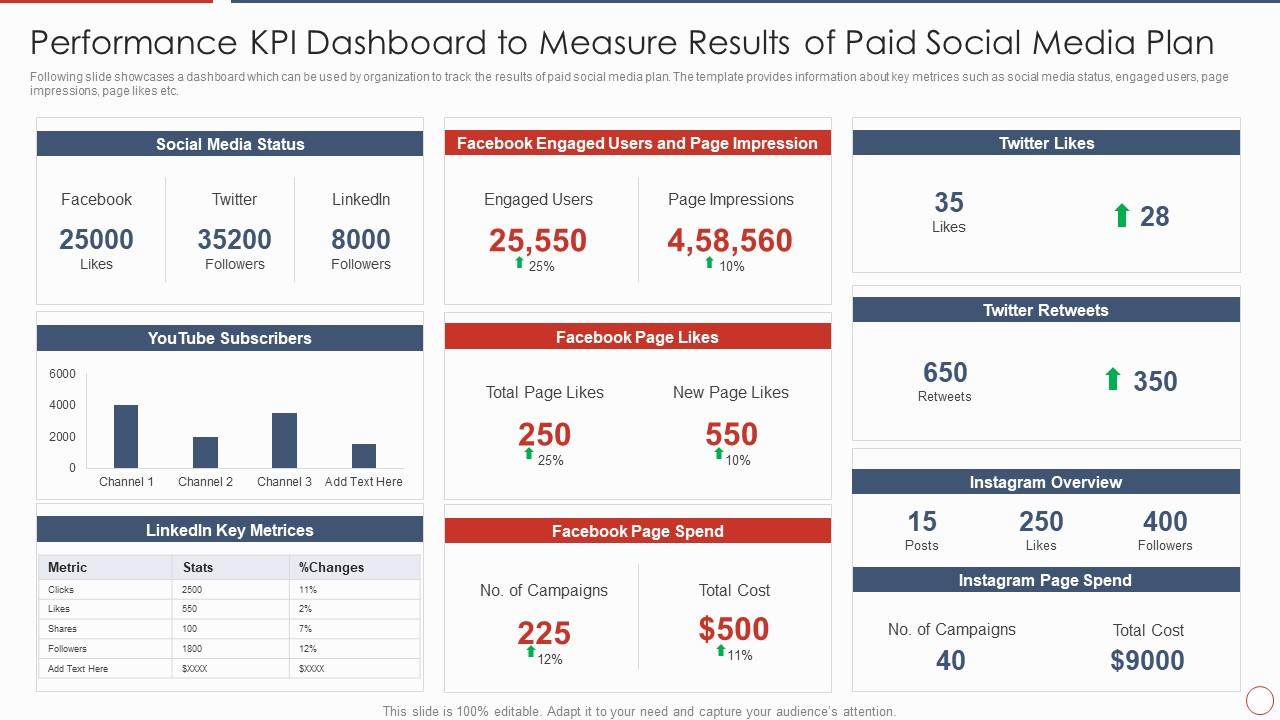
What’s the point of running a paid social media advertising campaign if you can’t measure whether it’s successful? Here are 15 key metrics to better gauge the impact and effectiveness of your campaign. To keep your paid social media strategy focused, group these KPIs by funnel stage: awareness metrics (like reach and impressions) to show how many people you’re getting in front of, engagement and click metrics (such as engagement rate and CTR) to measure interest, and cost‑ and revenue‑based metrics (like CPC, CPA, CPL, and ROAS) to understand how efficiently your campaigns are driving real business outcomes.
| Metric | Description | Insights |
| Impressions and Reach | Impressions show the total views of your ad; reach indicates the unique users who viewed it. | Provides insight into overall ad visibility and reach on the platform. |
| Click-Through Rate (CTR) | The percentage of views resulting in clicks. | High CTR suggests strong interest in the ad and its content. |
| Conversion Rate | Measures how many individuals reached the desired action (e.g., signup, purchase) and completed it. | Indicates ad effectiveness in driving specific goals or actions. |
| Cost per Click (CPC) | The average amount paid for each click. | A low CPC indicates good ad relevance and budget efficiency. |
| Cost per Mille (CPM) | The cost per thousand impressions is focused on brand awareness. | Lower CPM suggests better reach and campaign efficiency. |
| ROAS (Return on Ad Spend) | Compares revenue generated to the amount spent on ads. | High ROAS indicates campaign profitability and return on investment. |
| Engagement Rate | The rate at which users engage through likes, comments, shares, and reactions. | High engagement indicates relevant, engaging content essential for building connections. |
| Video Views and Completion Rate | For video ads, track views and the percentage of videos watched to completion. | High completion rates indicate engaging, valuable video content. |
| Virality Rate | Measures how often content is shared relative to impressions, showing organic spread. | A high virality rate indicates substantial organic reach and content appeal. |
| Audience Growth Rate | Shows the number of new followers gained through the campaign. | Measures ad performance in building a consistent, growing audience. |
| Amplification Rate | The rate at which followers share your content expands reach beyond the immediate audience. | High amplification signals content worth sharing and broader reach. |
| Response Rate vs. Response Time | Response rate is how often you reply to interactions; response time is the speed of response. | The key to customer satisfaction, especially in paid social media campaigns, is driving engagement and feedback. |
| Sentiment Analysis | Uses social listening to analyze tone (positive, negative, neutral) in responses and comments. | Reflects brand perception and campaign tone, indicating customer sentiment. |
| Net Promoter Score (NPS) | Surveys the audience’s likelihood of recommending the brand. | Offers insight into brand loyalty and long-term customer relations. |
| Bounce Rate | Percentage of users who click the ad but leave without further interaction. | A high bounce rate may signal a disconnect between the ad, landing page, or user expectations. |
Examples of Successful Paid Social Media Campaigns
Here’s a strong real‑world paid social campaign that shows how a clear objective, well‑defined audience, and channel mix can work together to drive measurable results.
HTX (Huobi): Driving App Installs With Full‑Funnel Paid Social
For HTX (formerly Huobi), we needed to drive new users to the mobile app and turn them into active, depositing traders in a highly competitive and skeptical crypto market. NinjaPromo developed a full‑funnel paid social media advertising strategy across Facebook, Instagram, and Messenger, combining visually engaging creatives, precise targeting, and strong onboarding incentives.
🎯 Objective
- Increase app installs from new users in priority regions.
- Drive first‑time deposits shortly after install.
👥 Audience
- Crypto‑curious users exploring exchanges for the first time.
- Existing exchange users interested in trending assets such as meme coins.

📱 Platforms and formats
- Facebook, Instagram, and Messenger ads.
- Mix of static, video, and promo creatives tailored to each placement.
- Strategy highlights:
- Used paid social to promote a “for newbies” campaign focused on earning meme coins (like Shiba Inu) as bonuses for completing onboarding tasks, including making a deposit.
- Built targeted audiences based on demographics, interests, and behaviors, then reinforced them with community and content activity on Discord and social channels.
- Continuously optimized creatives, targeting, and budgets to maintain a below‑average acquisition cost while scaling spend.
- Key paid social results: Over 378,000 impressions, a 16.8% install conversion rate, and CPC below 2 USD from paid social ads, contributing to more than 20M USD in new user deposits within 180 days.
Final Thoughts
Paid social media advertising works best when you treat it as a structured, ongoing strategy, not a set of one‑off boosted posts. When your objectives, audiences, creatives, budgets, and metrics all align, paid social becomes a predictable growth channel rather than a gamble. Use the advice, step‑by‑step process, and examples in this guide to design campaigns you can launch, measure, and systematically improve over time—and, if you need a partner to accelerate results, a specialized agency can help you scale faster and avoid the most expensive mistakes.